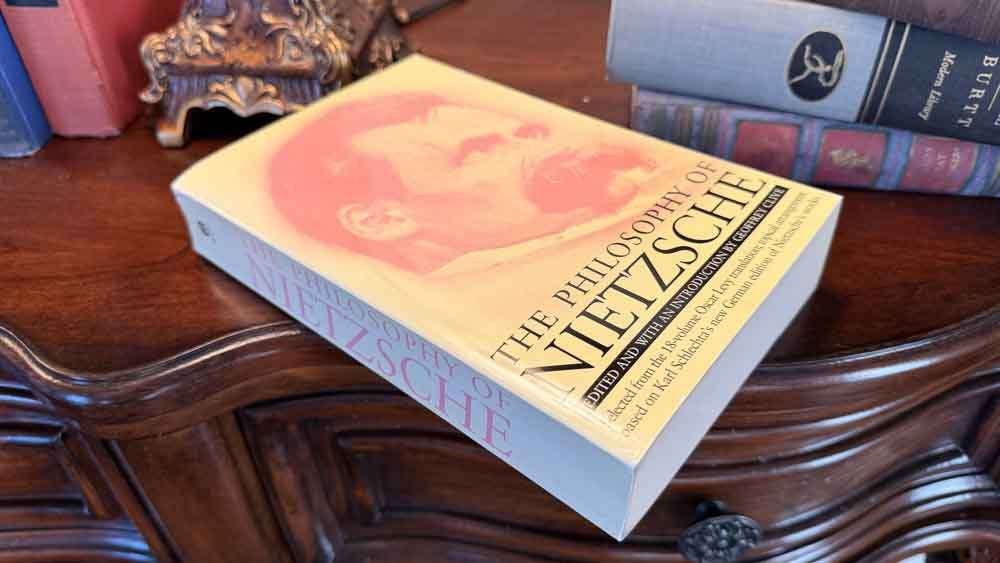
Philosophers are almost always summarized to death before anyone actually reads them. Nietzsche, more than any other thinker in the Western tradition, has suffered this fate with extraordinary cruelty. Most people encounter him as a collection of stripped quotations — God is dead, What doesn’t kill me makes me stronger, the Übermensch — lifted from their context and passed around like fortune cookies, gutted of the rigor, the irony, the fury, and the sorrow that gave them weight. Reading the Oscar Levy edition of the Complete Works is the antidote to all of that. It is not a summary. It is not an anthology. It is the whole machine, assembled and running — and it will not let you look away.
Oscar Levy, a German-born British physician and critic, undertook the monumental editorial project between 1909 and 1913: eighteen volumes, produced in English, gathering Nietzsche’s published works, notebooks, and letters in a form no English-speaking reader had previously encountered in full. It was an act of intellectual devotion that bordered on the obsessive, and its results deserve to be treated with equal seriousness.
Reading Nietzsche Whole Changes the Argument
Anyone who has read only Thus Spoke Zarathustra — and I wrote at length about that particular work here — knows that Nietzsche can intoxicate. But intoxication is not understanding. Reading the Complete Works through the Levy edition forces a more demanding encounter. You move from the prophetic thunder of Zarathustra to the scalpel-precision of Beyond Good and Evil, to the devastating psychological archaeology of On the Genealogy of Morality, to the aphoristic corrosiveness of Human, All Too Human, and something gradually becomes clear that the anthologized Nietzsche never reveals: this man was not offering a system. He was conducting an experiment on the entire history of human thought, in real time, across decades, and he never stopped revising his findings.
The philosopher Kathleen Higgins, in Nietzsche’s Zarathustra (1987), noted that the failure to read Nietzsche sequentially and completely leads readers to assign him positions he specifically dismantled in later texts. The Levy edition makes that kind of intellectual laziness impossible. Volume by volume, the contradictions sharpen and resolve into a more complex coherence — one that rewards patience in the way a long fermentation rewards the baker who refuses to rush the process.
The Genealogy of Morality and Why Comfort Is the Enemy
If Zarathustra is Nietzsche the prophet, On the Genealogy of Morality is Nietzsche the forensic pathologist, and it is in many ways his most dangerous book. Translated in the Levy edition by Horace Samuel, the Genealogy opens a case file on the moral frameworks Western civilization has treated as eternal — Christianity, pity, punishment, guilt — and demonstrates, with methodical precision, that they are not revelations from God or discoveries of reason. They are the accumulated strategies of the weak, the resentful, and the defeated, refined over centuries into weapons aimed at the strong.
His central concept — ressentiment — describes the psychological inversion by which those who cannot act against their oppressors turn their impotence into a moral virtue, reframing weakness as goodness and power as evil. As Nietzsche writes in the Genealogy: “The slave revolt in morality begins when ressentiment itself becomes creative.” It is one of the more uncomfortable arguments in the philosophical tradition, not because it is wrong, but because it forces a reckoning with every moral instinct you have ever trusted without examination.
I did not read the Genealogy comfortably. I read it the way you clean an old leather hide — you find things beneath the surface you were not prepared to see, and the temptation is to put the material down and reach for something smoother. The Levy translation preserves the abrasiveness. Samuel’s English does not soften Nietzsche’s edge into academic plausibility. The argument lands as Nietzsche intended it to: as a blow.
Beyond Good and Evil — The Architecture of Freedom
The Levy edition’s Beyond Good and Evil, translated by Helen Zimmern, may be the volume most relevant to how we now live. Written in 1886, it addresses the condition of a culture that has abandoned its foundational myths but has not yet built new ones — a condition that describes our own moment with uncomfortable precision. Nietzsche called this condition nihilism, and he was not celebratory about it.
What is often missed in casual readings is that Nietzsche did not endorse nihilism — he diagnosed it, the way a good physician diagnoses a disease not to celebrate it but to understand the treatment. The free spirit, the individual who moves beyond the inherited categories of good and evil, is not a libertine who does whatever they want. The free spirit is someone who has taken full responsibility for the values they create, accepted the weight of that creative act, and refused to outsource their meaning-making to tradition, theology, or the crowd.
“The noble soul has reverence for itself,” he writes in Part IX. That sentence has more to say about what a life of genuine quality requires than most self-help books published in the last twenty years combined.
Human, All Too Human — The Nietzsche Most People Miss
The least read and most essential section of the Levy project may be Human, All Too Human, the 1878 work that marked Nietzsche’s public break from Wagner and from Schopenhauer — two father figures whose influence had shaped his early writing. Translated in the Levy edition by Alexander Harvey, it is the most skeptical and scientifically minded of Nietzsche’s books, and the one that most clearly anticipates the psychological and evolutionary thinking that would characterize serious intellectual inquiry for the next century and a half.
Nietzsche here adopted an almost clinical method — short numbered aphorisms, each one a careful probe — to examine love, art, religion, politics, and friendship. It was a break from the lyrical mode of his early work and a declaration that he would follow the argument wherever it led, regardless of what romantic commitments it shattered. Richard Dawkins, whose thinking on memetics and cultural evolution I find deeply compatible with the Nietzschean framework, shares this same refusal to protect cherished assumptions from scrutiny — as I explored in my review of The God Delusion.
What Human, All Too Human reveals is a thinker who trusted no one more than he distrusted himself, who was willing to dismantle his own previous positions the moment he found a stronger argument. That is not inconsistency. That is intellectual integrity at its most demanding.
The Translator’s Role — Oscar Levy’s Particular Vision
It is worth spending time with Levy himself, because his editorial presence shapes this edition in ways that go beyond choosing collaborators and managing production. Levy believed that Nietzsche was the most important thinker of the modern era and that the English-speaking world’s resistance to him was largely a product of poor access. His introductions to each volume are themselves works of advocacy — sometimes polemical, always engaged — and they color the reading experience in ways both useful and worth interrogating.
Levy was also, it must be said, working at a moment before the full scholarly excavation of Nietzsche’s texts had been accomplished. The definitive critical edition — the Colli-Montinari edition compiled between 1967 and 1977 — had not yet exposed the extent of Elisabeth Förster-Nietzsche’s editorial distortions, which I addressed in considerable detail in the Zarathustra review. Levy’s edition is therefore a historically important document with known limitations; it should be read alongside, not instead of, the Walter Kaufmann translations where precision is essential.
That said, as an act of ambition and love for a philosopher who had been systematically misread by his own family, the Levy project stands as something remarkable — a monument to the belief that difficult ideas deserve the widest possible audience.
The Dostoyevsky Parallel — Two Writers Who Refused Easy Answers
Reading Nietzsche complete, as the Levy edition demands, has always reminded me of reading Dostoyevsky complete. Both men were psychologists before psychology had clinical tools. Both were willing to follow the darkest human impulses to their logical conclusions rather than sentimentalizing them into comfortable morality tales. I reviewed Joseph Frank’s landmark biography of Dostoyevsky previously, and the parallels between Frank’s account of Dostoyevsky’s spiritual and intellectual formation and what the Levy edition reveals about Nietzsche’s own are striking — two men defined by illness, isolation, and an inability to stop thinking at the precise moment when thinking cost them everything.
Nietzsche’s own physical deterioration, which accelerated through the years he was producing his greatest work, gives the Levy volumes a particular weight when read in sequence. The man writing The Birth of Tragedy in 1872 and the man writing Ecce Homo in 1888 — the year before his collapse — are both present in this edition, and the distance between them is not measured in ideas alone.
What This Edition Is and What It Demands
The Levy Complete Works is available through Project Gutenberg and through archival print editions on Amazon. It is not a book for casual reading or airport consumption. It rewards the reader who brings time, a willingness to sit with discomfort, and a genuine appetite for an argument that does not resolve into something convenient.
Nietzsche once described his ideal reader as someone who had been made hard by life — not brutalized, but tempered. The Levy edition, read in full, is itself a tempering process. You will not emerge from it with a simple philosophy of living. You will emerge from it with a more honest set of questions, and that is precisely what Nietzsche believed philosophy was for.
You Might Also Like:
- Thus Spoke Zarathustra by Friedrich Nietzsche — The Book That Rewired My Understanding of Everything
- The God Delusion by Richard Dawkins — A Review
- Dostoevsky: The Stir of Liberation by Joseph Frank — A Review
Sources
- Nietzsche, Friedrich. The Complete Works of Friedrich Nietzsche (18 vols.), ed. Oscar Levy. T.N. Foulis, 1909–1913. Available via Project Gutenberg
- Nietzsche, Friedrich. Beyond Good and Evil, trans. Walter Kaufmann. Vintage Books, 1966. Amazon
- Nietzsche, Friedrich. On the Genealogy of Morality, trans. Maudemarie Clark and Alan Swensen. Hackett Publishing, 1998. Amazon
- Higgins, Kathleen. Nietzsche’s Zarathustra. Temple University Press, 1987.
- Kaufmann, Walter. Nietzsche: Philosopher, Psychologist, Antichrist. Princeton University Press, 1950. Amazon
- Sorgner, Stefan Lorenz. “Nietzsche, the Overhuman, and Transhumanism.” Journal of Evolution and Technology, Vol. 20, Issue 1, 2009.
- Colli, Giorgio and Montinari, Mazzino, eds. Kritische Gesamtausgabe (KGW). Walter de Gruyter, 1967–1977.