There is a particular silence inside a Craftsman home that you cannot replicate in new construction. It is not emptiness—it is the accumulated hush of hand-planed quartersawn oak, of mortise-and-tenon joints that have held for a century without complaint, of plaster walls dense enough to absorb the ambient noise of an entire family’s century of living. I know this silence. I have spent twenty-five years at The Heritage Diner on Route 25A in Mount Sinai, listening to the particular language that old buildings speak when their materials are honest and their construction is sound. I have spent another decade at my leather workshop at Marcellino NY in Huntington, where I select English bridle hides with the same diagnostic hand that a Craftsman-era builder would have run across a length of old-growth Douglas fir—feeling for the grain, reading the integrity of the material through the fingertips. And now, as my wife Paola and I prepare to launch Maison Pawli, our boutique real estate venture on Long Island’s North Shore in 2026, I find myself returning again and again to the same fundamental question that Gustav Stickley posed in his magazine The Craftsman more than 120 years ago: What does it mean to build something that endures?
On Long Island, the answer is being rewritten in real time. After decades of being overlooked in favor of colonials, ranch-style homes, and the McMansion sprawl that consumed the 1990s and 2000s, Craftsman-style houses are experiencing a renaissance that is as much philosophical as it is financial. These homes—with their wide eaves, exposed rafter tails, tapered porch columns, and interiors suffused with the warmth of natural wood—are commanding premium prices and shorter days on market across Nassau and Suffolk Counties. But to understand why, you have to understand where they came from, why they nearly disappeared, and what their revival tells us about the evolving soul of Long Island.
The Arts and Crafts Rebellion: From William Morris to Route 25A
The story of the Craftsman home begins not on Long Island but in the soot-blackened industrial workshops of Victorian England, where a textile designer named William Morris looked at the cheap, machine-stamped goods flooding British homes and declared them an insult to human dignity. Morris and the philosopher John Ruskin articulated a radical proposition: that the objects surrounding a person—their furniture, their wallpaper, their very dwelling—were not mere commodities but expressions of moral character (Clark, The American Family Home, 1986). A poorly made chair was not simply uncomfortable; it was a symptom of a society that had traded craftsmanship for convenience, beauty for efficiency, the hand for the machine.
This was the genesis of the Arts and Crafts movement, which crossed the Atlantic in the 1890s and found its most passionate American champion in Gustav Stickley, a Wisconsin-born furniture maker of German immigrant stock who had worked his way up from his uncle’s chair factory in Pennsylvania to become one of the most influential tastemakers in American history (Smith, Gustav Stickley: The Craftsman, 1983). In 1901, Stickley launched The Craftsman magazine from Syracuse, New York, and within it published not only furniture designs but complete house plans—modest, honest dwellings that any middle-class family could build, using local materials and straightforward construction techniques. The Boston Society of Arts and Crafts, founded in 1897 as the oldest nonprofit craft organization in America, had already begun codifying these ideals into institutional practice. But it was Stickley who democratized them, who made the Craftsman home not an aspiration of the wealthy but a birthright of the working American.
Stickley’s influence radiated outward from New York like ripples in Long Island Sound. By 1908, he had acquired 650 acres of land in Morris Plains, New Jersey—just across the Hudson—and established Craftsman Farms, a property that married his design philosophy to agricultural self-sufficiency in what we would now call a farm-to-table ethos (Stickley Museum, Parsippany-Troy Hills). In 1913, he opened a twelve-story Craftsman Building on West 39th Street in Manhattan that functioned as showroom, editorial office, and restaurant—a vertical expression of the integrated life he preached. The restaurant itself served produce from Craftsman Farms, predating the locavore movement by nearly a century (National Trust for Historic Preservation, 2021).
Multimedia: The 2021 documentary Gustav Stickley: American Craftsman, directed by Herb Stratford and available on Apple TV and Prime Video, offers a compelling visual chronicle of Stickley’s rise, bankruptcy in 1915, and posthumous resurrection as an American design icon. The film was shot partly on location at Craftsman Farms in New Jersey—a drive of less than ninety minutes from Mount Sinai.
Anatomy of a Craftsman Home: Reading the Architecture Like a Hide
I tell my clients at Marcellino NY that understanding leather begins with understanding the animal—its diet, its climate, the mineral content of its water supply. The same diagnostic principle applies to architecture. A Craftsman home is not merely a collection of aesthetic choices; it is a philosophical argument rendered in wood, stone, and glass.
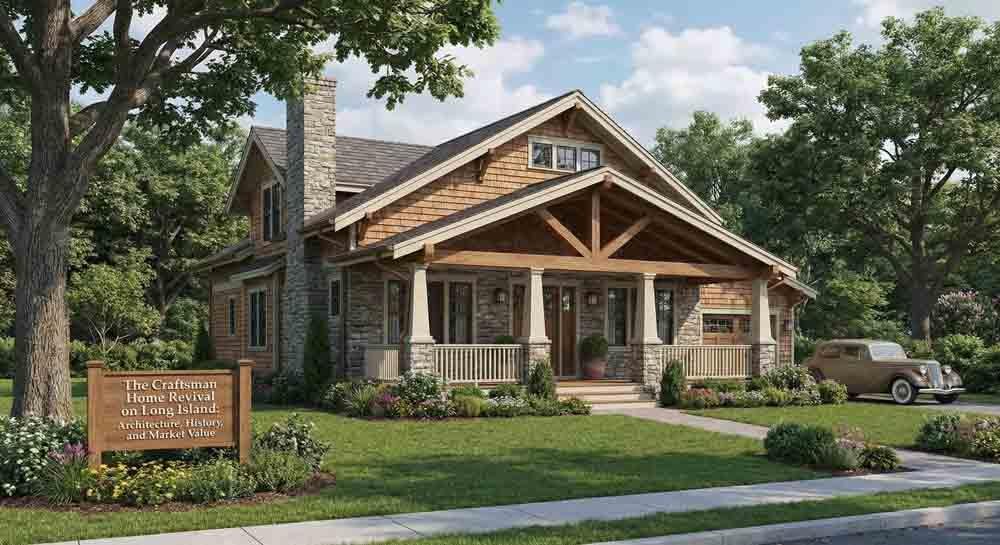
The exterior announces its intentions immediately. The roofline sits low, with a gentle pitch that extends well beyond the wall plane in deep, shadowing eaves—often supported by exposed knee braces or decorative brackets that celebrate rather than conceal the structural logic of the building. The front porch, almost always present, stretches beneath this protective overhang on tapered or battered columns that rest on substantial piers of stone, brick, or clinker block. Where a Victorian home reaches upward in vertical ambition, the Craftsman home reaches outward in horizontal embrace, hugging the earth, acknowledging the landscape rather than competing with it (Antique Homes Magazine, 2018).
The materials are deliberately local and deliberately honest. On Long Island, this historically meant cedar shingle, fieldstone, and the indigenous hardwoods that once covered the North Shore’s rolling moraines. The wood is stained rather than painted—a critical distinction, because staining allows the grain to speak, while paint silences it. In the Craftsman vocabulary, concealment is deception.
Step inside, and the philosophy deepens. Built-in furniture—bookcases flanking the fireplace, window seats with hidden storage, dining room buffets with leaded glass doors—eliminates the need for freestanding pieces that would clutter the open floor plan. The fireplace functions as both literal and symbolic hearth: the center of family life, often clad in locally sourced stone or hand-pressed tile. Woodwork throughout is typically quartersawn oak or chestnut, finished in warm earth tones that deepen with age. Crown moldings are restrained. Coffered ceilings are common. And everywhere, there is the play of natural light through grouped windows—often casement—that dissolve the boundary between interior and landscape.
This is what I mean when I speak of the Marcellino standard applied to architecture. At Marcellino NY, every briefcase begins with the selection of a specific J&E Sedgwick bridle hide, hand-inspected for grain consistency and tensile integrity. A Craftsman home begins with the same reverence for material—the same insistence that quality is not an ornament applied to a surface but a property inherent in the substance itself.
Long Island’s Craftsman Heritage: From the Gold Coast to the Middle-Class Dream
Long Island’s architectural history is often narrated through the grand estates of the Gold Coast—the Guggenheim compound at Sands Point, the Vanderbilt mansion at Centerport, the Phipps estate at Old Westbury—where nearly a thousand country houses were built between the Civil War and World War II for the nation’s wealthiest families (MacKay, Baker, and Traynor, Long Island Country Houses and Their Architects, 1997). But this narrative of Gilded Age spectacle obscures a quieter, more democratic architectural story that was unfolding simultaneously in the island’s villages and hamlets.
As the Long Island Rail Road expanded eastward through Nassau and into Suffolk County in the early twentieth century, it carried not only commuters but an entire lifestyle philosophy. The Arts and Crafts ethos—the belief that a well-built, modest home in a natural setting was morally superior to an ostentatious urban pile—resonated powerfully with the teachers, clerks, tradespeople, and small-business owners who were colonizing the island’s new suburban corridors. Craftsman bungalows and Foursquare homes began appearing in communities from Freeport to Port Jefferson, many built from Stickley-inspired plans published in The Craftsman or ordered from Sears, Roebuck and Company’s famous kit-home catalogs.
Douglas Manor in Queens—technically Long Island’s westernmost reach—preserves one of the finest concentrations of Arts and Crafts residential architecture in the entire New York metropolitan area. Its 600 houses, arrayed along romantically winding streets facing Long Island Sound, include at least two homes built directly from The Craftsman magazine plans, as documented by architect Kevin Wolfe during a 2018 walking tour organized for Jane’s Walk (Wolfe, 2018). The deed restrictions established when Douglas Manor was developed in 1906—three years before New York City adopted its first zoning law—ensured that the community would remain a preserve of freestanding single-family homes with communally shared waterfront, a model of planned community that Stickley himself would have endorsed.
Further east, on the North Shore, the Craftsman influence merged with the existing tradition of shingle-style and colonial architecture to produce a distinctive regional hybrid: homes that wore their Arts and Crafts DNA in the texture of their cedar shakes, the generosity of their porches, and the warmth of their interiors, even as their massing and footprint acknowledged the older patterns of New England building. These are the homes that still line the streets of Setauket, Stony Brook, Smithtown, and yes, Mount Sinai—homes that I drive past every morning on my way to open The Heritage Diner, homes whose front porches have witnessed the same century of neighborhood life that my restaurant has served and sustained.
The Market Case: Why Craftsman Homes Are Outperforming
The numbers in 2025 tell a story that Gustav Stickley, who died in obscurity in Syracuse in 1942, could never have imagined. Long Island’s residential real estate market reached unprecedented heights in the past year, with the regional median sale price for single-family homes hitting $718,500 in March 2025—a 10.5% increase year-over-year (EXIT Realty Premier, April 2025). In Suffolk County specifically, the median closed sale price reached $725,000 by November 2025, with month-over-month appreciation in Suffolk outpacing Nassau at a rate of 3.42% versus 0.36% (EXIT Realty Premier, December 2025). Nassau County’s median sits even higher, at approximately $840,000, representing a persistent 25% premium over Suffolk.
Within this surging market, well-preserved historic homes—and Craftsman-style homes in particular—are demonstrating what real estate economists call “resilient premium appreciation.” According to the PlaceEconomics study of historic districts, properties in designated historic areas average 2.5 times the assessed value per acre compared to the surrounding city, and critically, they fall later and less steeply when markets decline, beginning their value recovery sooner than non-historic properties (The Craftsman Blog, 2025). This finding has been replicated across multiple markets and time periods. Historic homes are, in the language of investment, a hedge—exactly the kind of asset that a volatile, AI-disrupted economy increasingly demands.
The reasons are both structural and emotional. On the structural side, Craftsman homes were built with materials and techniques that simply do not exist in modern production housing. Old-growth timber, hand-mixed plaster, copper flashing, and stone foundations create a building envelope with thermal mass, acoustic dampness, and physical permanence that no spray-foam-and-OSB tract house can replicate. On the emotional side, there is a growing recognition—particularly among millennial and Gen-Z buyers who have spent their formative years in the digital ether—that a home should be more than a commodity. It should be an experience. A story. A place where the grain of the wood tells you something about the tree, and the tree tells you something about the land.
This is the same impulse that drives a client to order a bespoke Marcellino briefcase rather than buying something off a shelf at a department store. It is the same impulse that brings diners to The Heritage Diner instead of a chain restaurant. The market is not simply pricing square footage; it is pricing authenticity. And authenticity, unlike inventory, cannot be manufactured.
Preservation and Restoration: The Unseen Details That Define a Masterpiece
Owning a Craftsman home on Long Island is not a passive act. It is a relationship—a commitment to stewardship that mirrors the commitment I make to every hide that crosses my bench at Marcellino NY. The leather develops its patina through use, through the oils of the owner’s hands, through exposure to weather and time. A Craftsman home develops its character the same way, but only if the owner understands the difference between restoration and renovation.
Restoration means returning a home to its original architectural intent—stripping the paint from the woodwork to reveal the grain beneath, replacing vinyl windows with period-appropriate wood-sash casements, rebuilding the porch columns with stone piers that match the original masonry. Renovation, by contrast, often means imposing contemporary taste onto historic fabric, with results that range from the merely incongruous to the architecturally tragic.
Preservation Long Island, the nonprofit organization (formerly the Society for the Preservation of Long Island Antiquities) that has been advocating for the island’s historic resources since 1948, has documented the ongoing tension between these two approaches. Their Local Landmark Law Locator, an innovative online tool, reveals that approximately one-third of the 109 local governments in Nassau and Suffolk Counties have adopted some form of historic preservation law—including all 13 towns and 31 incorporated villages (Preservation Long Island, 2021). But listing on the National or State Register of Historic Places does not protect a property from demolition by its owner; only local landmark designation can do that.
For homeowners committed to authentic restoration, the economic case is compelling. Industry data for 2025 suggests basic cosmetic restoration of a Craftsman home runs $50–$100 per square foot, while comprehensive restoration with period-accurate materials and techniques can range significantly higher (Greene and Greene Sites, 2025). But the return on that investment—in both market value and personal satisfaction—is substantial. Well-maintained original features like built-in cabinetry, original hardware, and period lighting can add significant premiums at resale, because replacement is either impossible or prohibitively expensive.
The philosophical parallel to leather craft is exact. At Marcellino NY, I can repair a Sedgwick bridle hide briefcase that has served its owner for thirty years—recondition the leather, restitch a worn seam, replace a buckle with hand-forged brass—and return it to service for another thirty. I cannot do the same with a bonded-leather bag from a fast-fashion brand, because the material was never sound to begin with. The same principle holds for architecture: you can restore quartersawn oak, but you cannot restore MDF.
Where to Find Craftsman Homes on Long Island
For buyers seeking Craftsman-style homes on Long Island, certain communities offer richer concentrations than others. The North Shore, with its older building stock and established village centers, provides the most fertile ground. Communities including Huntington Village, Northport, Port Jefferson, Setauket, Stony Brook, Cold Spring Harbor, and Oyster Bay all contain examples of Arts and Crafts residential architecture dating from the 1900s through the 1920s—the golden age of the Craftsman movement. The hamlets of Smithtown and the villages along 25A corridor, including our own Mount Sinai, preserve homes that reflect the democratic side of the Craftsman ethos: modest bungalows and Foursquares built for working families who believed, as Stickley did, that beauty and quality were not the exclusive province of the wealthy.
Further west, the historic districts of Garden City, Rockville Centre, and Freeport in Nassau County contain notable examples, while on the South Shore, communities like Bay Shore and Patchogue offer Craftsman homes at price points that remain more accessible than their North Shore counterparts. Suffolk County, with its median sale price still below Nassau’s by approximately $115,000, represents what market analysts are calling a “catch-up appreciation” opportunity—a zone where historic homes can be acquired at relative value before the market fully prices in their scarcity premium (EXIT Realty Premier, December 2025).
Paola and I, through our forthcoming Maison Pawli venture, intend to focus precisely on this intersection of historic character and market opportunity. We believe that the North Shore’s next chapter will be written not by developers building disposable inventory but by stewards who understand that a home, like a Marcellino briefcase or a Heritage Diner meal, is an artifact of care—a thing made to be inhabited, not merely occupied.
Multimedia: The Gamble House Conservancy’s YouTube channel offers free short-form videos exploring the 1908 Greene and Greene masterpiece in Pasadena—widely considered the pinnacle of American Craftsman architecture. Visit youtube.com/@thegamblehouse for virtual explorations of the woodwork, glass, and garden design that define the style at its most refined.
The Hundred-Year Philosophy: Building for the Next Century
Marcus Aurelius wrote in his Meditations that the object of life is not to be on the side of the majority, but to escape finding oneself in the ranks of the insane. I think of this passage often when I observe the contemporary housing market’s appetite for disposable construction—homes built to code rather than to conscience, designed for a thirty-year mortgage rather than a hundred-year lifespan. The Craftsman home stands as a rebuke to this insanity. It is a physical argument for the proposition that the things we build should outlast us, that the care we invest in our surroundings is a form of respect—for the materials, for the land, for the people who will inherit what we leave behind.
This is the philosophy that connects every thread of my working life. At The Heritage Diner, where we have served Mount Sinai and the North Shore for twenty-five years, I season my cast-iron skillets the same way a Craftsman builder would cure a finish on white oak: slowly, with attention, allowing the material to develop its character through accumulated use rather than chemical shortcut. At Marcellino NY, I select and stitch each briefcase by hand because the machine, for all its efficiency, cannot read the hide the way a human hand can—cannot feel the subtle variations in thickness and grain that determine where a stitch should fall. And at Maison Pawli, Paola and I will bring this same ethos to real estate: a belief that the best properties are not the newest, but the most honestly built; not the most fashionable, but the most enduring.
The Craftsman home revival on Long Island is not a trend. It is a correction—a return to values that the island’s communities understood instinctively a century ago and that the market is now, belatedly, rediscovering. In a world increasingly dominated by the ephemeral—by algorithmic content, by disposable goods, by architecture designed for Instagram rather than habitation—the Craftsman home endures because it was built to endure. Its value appreciates because its materials appreciate. Its beauty deepens because its surfaces are real.
Gustav Stickley went bankrupt in 1915 and died forgotten in 1942. But the homes built from his plans are still standing. The furniture he designed now sells at auction for hundreds of thousands of dollars—Barbra Streisand paid $363,000 for a single Stickley sideboard in 1988, and it resold for $540,000 eleven years later (Associated Press; CBS News). The Craftsman Farms estate in New Jersey was saved from demolition through eminent domain and operates today as the Stickley Museum. And on Long Island, in the villages and hamlets that line the North Shore from the Queens border to Orient Point, the homes that carry his influence—with their honest materials, their welcoming porches, their rooms full of handcrafted light—are being recognized, restored, and revered as the masterpieces they always were.
The unseen details define the masterpiece. This is true of a Marcellino briefcase, where the hidden stitching on the interior gusset determines the bag’s structural integrity for decades. It is true of a Heritage Diner plate, where the seasoning of the grill and the provenance of the beef create flavors that no shortcut can simulate. And it is true of a Craftsman home, where the joinery behind the walls, the hardware beneath the paint, and the stone beneath the porch columns tell a story of care that the market is finally learning to read—and to price accordingly.
Peter is the owner of The Heritage Diner, 275 Route 25A, Mount Sinai, NY, and the founder of Marcellino NY (marcellinony.com), a bespoke leather atelier in Huntington. He and his wife, Broker Paola, are launching Maison Pawli (maisonpawli.com), a boutique real estate venture on Long Island’s North Shore, in 2026.
Sources cited: Mary Ann Smith, Gustav Stickley: The Craftsman (1983); Robert B. MacKay, Anthony K. Baker, and Carol A. Traynor, eds., Long Island Country Houses and Their Architects, 1860–1940 (W.W. Norton, 1997); Clifford Edward Clark Jr., The American Family Home, 1800–1960 (University of North Carolina Press, 1986); PlaceEconomics, Saratoga Springs historic district study; EXIT Realty Premier Long Island Market Reports (2025); Preservation Long Island, Local Landmark Law Locator (2021); Kevin Wolfe, Douglas Manor Arts & Crafts Walking Tour (2018); Antique Homes Magazine, Craftsman Style Guide (2018); Greene and Greene Sites, Craftsman Home Buyer’s Guide (2025); National Trust for Historic Preservation (2021); Associated Press; CBS News.