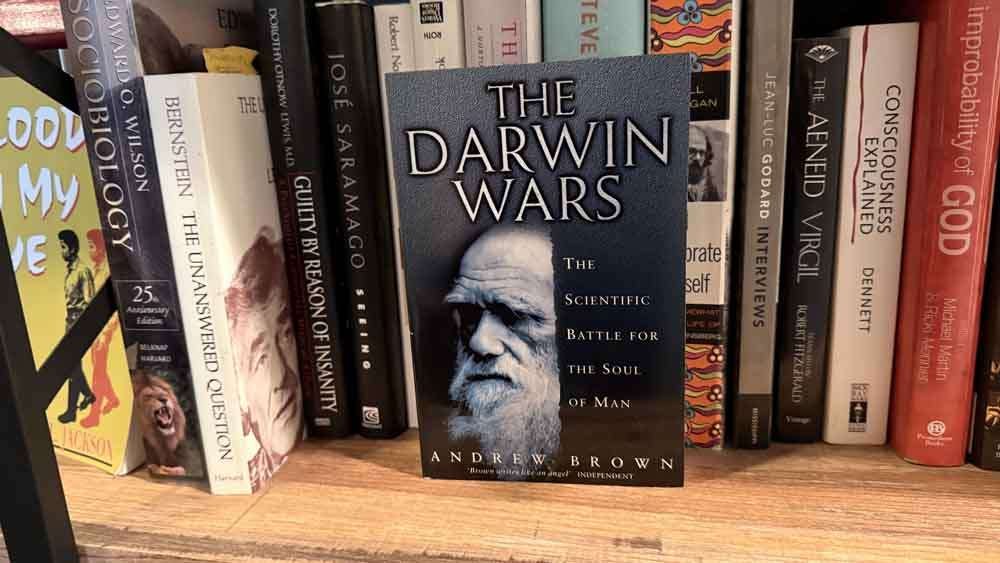
Pick up The Darwin Wars: The Scientific Battle for the Soul of Man by Andrew Brown and you’ll find Darwin’s face on the cover — the famous late portrait, white beard, brow furrowed, looking like a man who has thought himself into exhaustion. It’s an apt image. The book isn’t really about Darwin. It’s about what happens after Darwin: the intellectual inheritance, the competing claimants, and the surprisingly vicious disputes among the very scientists who consider themselves his heirs.
This one has been on my shelf a long time. I keep it because it taught me something about how ideas actually propagate — not cleanly, not charitably, but through competition, distortion, and sometimes outright war.
What the Book Is Actually About
Brown, a science journalist and former editor at The Guardian, focuses on the battles among evolutionary biologists and theorists in the decades following the Modern Synthesis — the mid-20th century reconciliation of Darwinian selection with Mendelian genetics. By the time The Darwin Wars was published in 1999, the field had fractured into competing schools, each claiming to hold the correct interpretation of what evolution means and how it operates.
The central figures are Richard Dawkins, Stephen Jay Gould, E.O. Wilson, and the various scientists who orbit them. These are not polite academic disagreements. They are — in Brown’s telling — tribal conflicts dressed up in the language of science: arguments about the unit of selection, the role of contingency, the validity of adaptationism, the proper scope of evolutionary explanation. Dawkins and Gould, in particular, represent two genuinely different philosophical temperaments that happen to share a commitment to Darwinian evolution.
The Selfish Gene and Its Discontents
To understand The Darwin Wars, you have to understand what Dawkins’s gene-centered view of evolution actually claims. In The Selfish Gene (1976), Dawkins argued that the appropriate unit of selection is the gene, not the individual organism or the group. Organisms are, in his memorable framing, survival machines built by genes to propagate copies of themselves. It’s a powerful, reductive, clarifying argument — and it infuriated a significant portion of the biological community, including Gould and the late Richard Lewontin, who saw in it an ideological agenda dressed up as science.
Brown navigates these disputes without taking sides cheaply. He’s genuinely curious about why the arguments got so heated, and he’s smart enough to understand that the passion isn’t just ego — it reflects real philosophical stakes. What counts as a proper scientific explanation? Is adaptationism — the assumption that every trait has a function — a research program or a just-so story generator? Does evolutionary biology explain human behavior, constrain it, or merely describe the substrate beneath it?
I’ve reviewed The God Delusion by Richard Dawkins on this blog, and the Dawkins who appears in that book is the same combative synthesizer you meet in Brown’s account — certain, eloquent, and supremely confident that the gene’s-eye view is not just correct but illuminating in ways its critics refuse to acknowledge. Brown doesn’t entirely disagree. But he’s also not a Dawkins partisan. He applies the same skeptical curiosity to every camp in the conflict.
The Memetics Chapter
One of the sections that held me longest is Brown’s treatment of memetics — the idea, originating with Dawkins in The Selfish Gene, that cultural units of information (memes) replicate and evolve in ways analogous to genes. Dawkins proposed the concept almost as an aside in the final chapter. By the 1990s, figures like Susan Blackmore had expanded it into a full theoretical framework, and its critics — including Gould — regarded it with barely concealed contempt.
Brown is skeptical of memetics as a rigorous science while taking seriously its intuitive power as a metaphor. The question of whether cultural evolution is genuinely Darwinian — whether ideas compete, vary, and are selected in ways that map cleanly onto biological selection — is one I find genuinely unresolved and genuinely important. It touches everything from how religious belief spreads to why certain political ideas persist long after their utility has expired.
I’ve spent real time with this question. The memetics framework is seductive precisely because it offers a mechanism for cultural change that doesn’t require assuming rationality or intentionality. Ideas spread because they are good at spreading, not necessarily because they are true or useful. That’s a disturbing thought if you follow it far enough — and Brown follows it far enough.
Gould’s Counterpunch
Brown gives Gould his due, which many Dawkins admirers refuse to do. Gould’s theory of punctuated equilibrium — the argument that evolution proceeds not gradually but in bursts of rapid change separated by long periods of stasis — was attacked by Dawkins and others as either trivially obvious or empirically unsupported. Gould and Eldredge maintained it was a genuine revision to the Darwinian picture, not a rounding error.
Brown suggests, carefully, that both sides were partly right and partly interested in being right in a way that went beyond the evidence. The sociology of science is uncomfortable reading for anyone who wants to believe that scientific communities are immune to the tribal dynamics that govern every other human institution. They aren’t. And The Darwin Wars is one of the most honest popular science books I’ve read about that fact.
For deeper context on how Darwin’s tree of life metaphor has itself been challenged by subsequent research, my piece on horizontal gene transfer covers the molecular biology that has complicated the picture still further — in ways that neither Dawkins nor Gould fully anticipated.
Why This Book Stays
The book is out of print in many markets and not as celebrated as it should be. It asks a question most popular science books are too polite to ask: if scientists disagree this fiercely about what Darwinian evolution means and implies, what does that tell us about science itself?
The answer isn’t that science is unreliable. The answer is more interesting: science is a human practice, carried out by people with commitments, blind spots, rivalries, and reputations to protect. The method is designed to correct for this over time. But in real time — in the trenches of the Darwin Wars — the correction process looks a lot less tidy than the textbooks suggest.
I’ve also written about the extended phenotype, one of Dawkins’s later developments of his core thesis, which gives useful context for exactly the kind of gene-centered thinking Brown examines here. Reading Brown alongside Dawkins’s own work gives you a stereo picture that neither provides alone.
The Darwin Wars is the kind of book that makes you a more careful reader of everything else — especially the books written by the combatants themselves. That’s a rare quality, and it’s why it earns its place on the shelf.
You Might Also Like
- The God Delusion by Richard Dawkins — A Review
- The Extended Phenotype: How Your Genes Build Structures Beyond Your Body
- Horizontal Gene Transfer: Why Darwin’s Tree of Life Is Actually a Tangled Web
Sources
- Brown, Andrew. The Darwin Wars: The Scientific Battle for the Soul of Man. Simon & Schuster, 1999. https://www.simonandschuster.com
- Dawkins, Richard. The Selfish Gene (40th Anniversary Edition). Oxford University Press. https://global.oup.com/academic/product/the-selfish-gene-9780198788607
- Gould, Stephen Jay & Eldredge, Niles. “Punctuated equilibria: the tempo and mode of evolution reconsidered.” Paleobiology, 1977. https://www.cambridge.org/core/journals/paleobiology/article/abs/punctuated-equilibria-the-tempo-and-mode-of-evolution-reconsidered/04C79B4F7607A73A5D2E38000A9EBC93
- Blackmore, Susan. The Meme Machine. Oxford University Press, 1999. https://global.oup.com/academic/product/the-meme-machine-9780192862129
- Lewontin, Richard C. The Triple Helix: Gene, Organism, and Environment. Harvard University Press, 2000. https://www.hup.harvard.edu/catalog.php?isbn=9780674006775