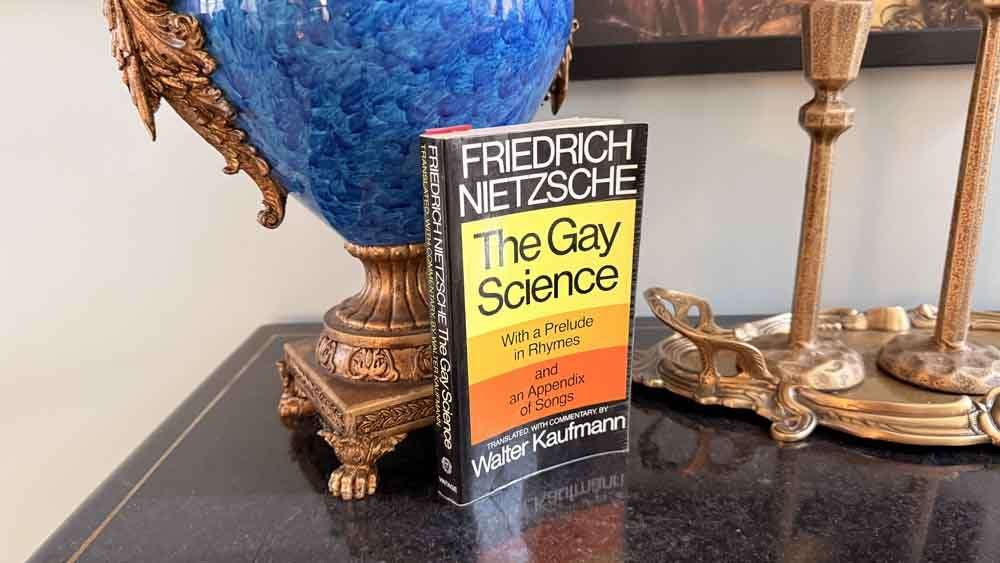
Friedrich Nietzsche published Die fröhliche Wissenschaft — The Gay Science — in 1882, and then expanded it in 1887 with a fifth book that sharpened the blade considerably. It was in this work that he first gave philosophical language to something that had been accumulating in the cultural atmosphere for over a century: the slow, inexorable death of the metaphysical God as the organizing principle of Western civilization. The announcement, delivered through the breathless, lantern-swinging “madman” in Aphorism 125, is one of the most dramatic passages in the history of philosophy — not a celebration, not a triumph, but a scream into the dark. “God is dead,” the madman cries. “God remains dead. And we have killed him.” He looks at the crowd and sees that they do not understand what they have done.
Reading that passage for the first time hit me the way a power chord hits you through a Marshall stack at full volume. It was not shock — I grew up in Brooklyn on Slayer, Manowar, and Metallica, bands that had already been trafficking in these ideas for years through the only language loud enough to carry them. But Nietzsche’s Gay Science gave that cultural undercurrent its philosophical skeleton, and when the two clicked together, something in my understanding of the world reorganized permanently.
The Madman’s Lantern: What Nietzsche Actually Meant
The great misreading of “God is dead” — and it is persistent, almost willfully stubborn — is to take it as a triumphant atheist punchline. It is the opposite. Nietzsche was not celebrating. He was issuing a warning so grave that he cast it as a kind of cosmological emergency.
The madman in Aphorism 125 runs through the marketplace in the morning with a lantern, crying that he is searching for God. The crowd laughs. “Did he get lost? Did he emigrate?” And the madman turns on them: we have killed him, he says. We wiped away the horizon. We unchained the earth from its sun. There is no up or down anymore. And then, with a kind of despairing clarity: “This deed is still more distant from them than the most distant stars — and yet they have done it themselves.”
The philosopher Walter Kaufmann, whose 1974 translation and commentary remains the standard English edition, emphasized that Nietzsche was describing a cultural and historical crisis, not advocating for one. The “death of God” meant the collapse of the entire framework — moral, metaphysical, epistemological — that had organized European civilization. Without that framework, Nietzsche saw not liberation but the abyss of nihilism. The project of The Gay Science, and of everything he wrote afterward, was to locate what could replace it. (Kaufmann, Nietzsche: Philosopher, Psychologist, Antichrist, Princeton University Press, 1974.)
The Science That Is Gay: Joy, Provençal Poetry, and the Art of Living
The title itself is a clue that most readers walk past. Die fröhliche Wissenschaft borrows from the medieval Provençal tradition of gai saber — the “gay science” or “joyful wisdom” of the troubadours, the art of poetry and song and the mastery of living. Nietzsche was deliberate: he wanted a philosophy that did not merely survive the death of God but danced in its aftermath. The book’s motto — a verse he wrote himself — speaks of living above morality while using it as a dance floor.
This is the tension that gives the book its electric quality. It is at once a diagnosis of civilizational crisis and an instruction manual for a new kind of human vitality. Aphorism 276, “Amor Fati,” introduces what would become one of his most enduring ideas: love of fate, not resigned tolerance of it but active, embracing affirmation of everything that is and has been and will be. “I want to learn more and more to see as beautiful what is necessary in things,” he writes. Not acceptance — amor. Love.
The philosopher Alexander Nehamas, in Nietzsche: Life as Literature (Harvard University Press, 1985), argues convincingly that the entire arc of Nietzsche’s project is aesthetic: the self as artwork, life as a creative act conducted with the seriousness and craft of an artist. The gay science is not reckless nihilism; it is the discipline of those who have stared into the void and chosen to build anyway.
Eternal Recurrence: The Heaviest Thought
Before Nietzsche gave us the Übermensch in Thus Spoke Zarathustra (which I wrote about here), he planted the seed of that book’s central myth in The Gay Science. Aphorism 341, “The Greatest Weight,” poses what he calls his most abyssal thought: what if this life — every moment of it, every joy, every pain, every dull afternoon and electric evening — recurred eternally, an infinite loop without variation?
Most people flinch at this. Nietzsche intended the flinch. The eternal recurrence is not a cosmological claim; it is a psychological test. If you would despair at the thought of living your life again and again without end, then you are living wrong. If you would, in the words of the aphorism, “crave nothing more fervently” than that eternal return — then you have achieved something. The heaviest thought is also the most clarifying.
Brian Leiter, in Nietzsche on Morality (Routledge, 2002), identifies the eternal recurrence as Nietzsche’s practical substitute for divine judgment: instead of asking “what would God think of this action?”, ask “could I will this moment to recur forever?” It is a test of authenticity rather than obedience.
Slayer Knew. Manowar Knew. Metallica Knew.
Here is what I want to say plainly, and without apology: heavy metal got to Nietzsche before most philosophy departments did, and it got there honestly.
Slayer’s God Hates Us All (2001) is a record that operates in the same brutal epistemological territory as the madman’s speech. Tom Araya is not singing about Satanism in any literal sense — the album is a diagnosis of a world that has stripped its own moral framework and replaced it with nothing. The God of the title is not the God of Aquinas; it is the cultural God, the organizing myth, the one Nietzsche’s madman was eulogizing. The rage in that record is precisely the rage of people who have been told the horizon has vanished and have not been given anything to navigate by.
Manowar’s entire aesthetic — the Will to Power filtered through Viking imagery, the unapologetic warrior-poet stance, the refusal of commercial compromise — is Nietzschean aesthetics with a Marshall stack. The concept of the Übermensch is not fascist (Nietzsche himself despised German nationalism and anti-Semitism with a ferocity that gets systematically ignored by those who want to misuse him); it is about the individual who creates values rather than inheriting them. Manowar’s “die with your boots on” maximalism is that idea in musical form.
And then there is Metallica’s “The God That Failed” from The Black Album (1991), written by James Hetfield about his mother’s death from cancer — she refused chemotherapy on religious grounds, trusting faith healing. It is, without Metallica framing it this way, one of the most Nietzschean songs in the rock canon. The God of that song does not die as a philosophical abstraction; he dies on a hospital bed, in the specific, irreversible way that a child’s world collapses when belief fails the test of reality. Nietzsche would have understood it completely.
This is not coincidence. Heavy metal, from its Black Sabbath origins through thrash and into the modern era, has always been the genre where Western civilization processes its doubts about the metaphysical structures it inherited. It is loud because the questions are loud. It is dark because the questions are dark. And Nietzsche is its philosopher laureate, whether or not anyone in the pit has read a word he wrote.
The Gay Science and the Crisis of Meaning We’re Still Living Through
It is 2026, and the question Nietzsche posed in 1882 has not been resolved — it has accelerated. The philosophical vacuum he identified when the Christian metaphysical framework began its collapse has only grown wider. The gods that rushed in to fill it — nationalism, ideology, consumerism, technological utopianism — have each failed their own tests. We are a civilization still holding a lantern in the marketplace, still searching for something to organize ourselves around.
Richard Dawkins, in The God Delusion (Houghton Mifflin, 2006) — a book I reviewed here — approaches the death of theistic religion from a scientific and evolutionary standpoint, arguing that God was a human cognitive construct that we can and should outgrow. It is a powerful and important argument. But Nietzsche would press further: the question is not whether the construct is true, but what happens to human meaning-making when it is removed. Dawkins is confident in reason and science as replacements. Nietzsche was not so sure reason alone was sufficient for the full weight of human life — and the century after his death gave him considerable evidence.
What The Gay Science asks of its reader is not agreement with any particular metaphysical position. It asks for seriousness about the problem. It asks whether you are one of the people in the marketplace who laughed at the madman, comfortably post-religious without having grappled with what you lost, or whether you are willing to pick up the lantern yourself. The “gay science,” the joyful wisdom, is not ignorance of the abyss — it is the discipline of those who have looked at it clearly and chosen, with full knowledge, to dance.
Why The Gay Science Belongs in Every Serious Reader’s Library
The Gay Science is not Nietzsche’s most systematic work — that distinction belongs to Beyond Good and Evil or On the Genealogy of Morality. It is something rarer: a work that thinks in the open, that changes register from aphorism to lyric poem to sustained argument with the freedom of a writer who trusts his reader to keep up. It is a book that rewards rereading not because it becomes clearer but because you become clearer, and the book keeps meeting you at your new level.
For anyone who came to these ideas the way I did — through the underground, through music that refused to sanitize the questions — The Gay Science is a homecoming. The madman’s lantern was burning in every distorted guitar tone and every screamed lyric you ever absorbed. Nietzsche just gave you the address.
The Gay Science by Friedrich Nietzsche is available from Vintage Books (Kaufmann translation) and from Cambridge University Press (Nauckhoff translation), widely considered the finest scholarly English edition.
Sources
- Nietzsche, Friedrich. The Gay Science. Trans. Walter Kaufmann. Vintage Books, 1974. https://www.amazon.com/Gay-Science-Friedrich-Nietzsche/dp/0394719859
- Kaufmann, Walter. Nietzsche: Philosopher, Psychologist, Antichrist. Princeton University Press, 1974. https://press.princeton.edu/books/paperback/9780691019833/nietzsche
- Nehamas, Alexander. Nietzsche: Life as Literature. Harvard University Press, 1985. https://www.hup.harvard.edu/catalog.php?isbn=9780674624269
- Leiter, Brian. Nietzsche on Morality. Routledge, 2002. https://www.routledge.com/Nietzsche-on-Morality/Leiter/p/book/9780415856911
- Metallica. “The God That Failed.” Metallica (The Black Album). Elektra Records, 1991. https://www.metallica.com/songs/the-god-that-failed
- Slayer. God Hates Us All. American Recordings, 2001. https://www.slaytanic.com/discography
- Dawkins, Richard. The God Delusion. Houghton Mifflin, 2006. https://www.richarddawkins.net/books/
- Nietzsche, Friedrich. The Gay Science. Trans. Josefine Nauckhoff. Cambridge University Press, 2001. https://www.cambridge.org/core/books/nietzsche-the-gay-science