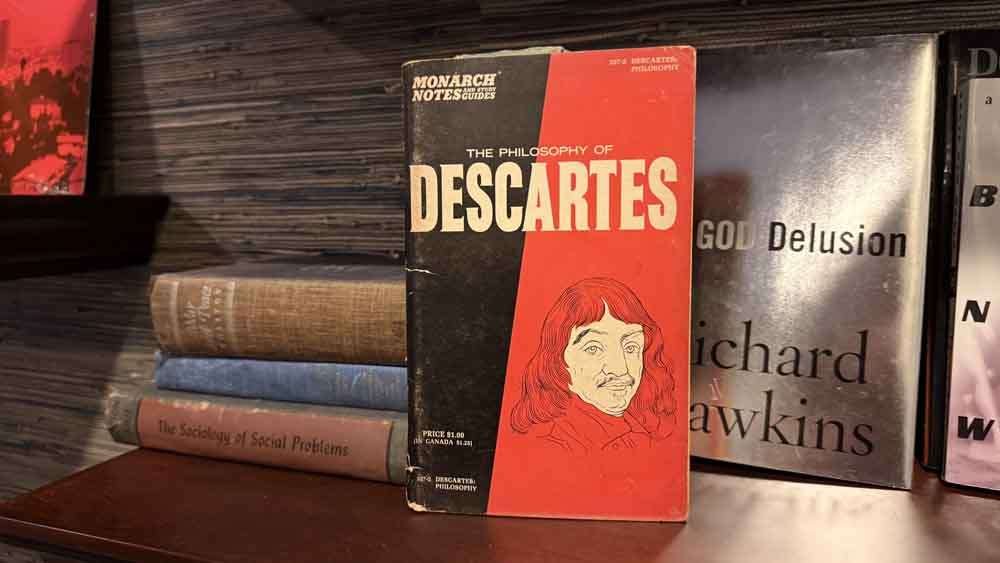
René Descartes did not set out to haunt us. He set out to find certainty — to strip away every assumption, every received truth, every comfortable inherited belief until he hit bedrock. What he found instead was a crack in the foundation of Western thought so deep that we are still arguing about it four hundred years later. That crack is the mind-body problem, and if you have ever wondered why artificial intelligence raises questions that feel almost theological — what is consciousness, can a machine truly think, what makes experience experience — you can trace the fault line directly back to a French mathematician writing by candlelight in a heated room in the winter of 1641.
The Meditations on First Philosophy is a short book. You can read it in an afternoon. But it is the kind of short book that expands inside you, the way a small door opens into a room much larger than the house that contains it. Descartes begins by asking a question that sounds simple: what can I know for certain? His method is radical doubt. He will reject anything that can be doubted — sensory experience, the external world, even mathematics — until he finds something that cannot be questioned. The famous answer arrives with the force of a logical hammer blow: cogito, ergo sum. I think, therefore I am. The act of doubting itself proves the doubter exists. You cannot doubt that you are doubting.
From this single fixed point, Descartes reconstructs the world. But in doing so, he makes a move that seemed inevitable at the time and has caused trouble ever since. He concludes that the mind and the body are two fundamentally different kinds of substance. The body is res extensa — extended matter, measurable, mechanical, subject to the laws of physics. The mind is res cogitans — thinking substance, unextended, immaterial, belonging to a different ontological category altogether. This is Cartesian dualism: the idea that you are a ghost driving a machine, a soul operating a body the way a pilot operates a ship.
Why Descartes Believed It
It is easy, from the vantage point of neuroscience and evolutionary biology, to dismiss the dualist position as a relic. It is harder, and more intellectually honest, to understand why an extraordinarily rigorous thinker arrived there. Descartes had strong reasons. The subjective quality of consciousness — the redness of red, the pain of pain, what philosophers call qualia — genuinely resists reduction to the mechanistic terms available to 17th-century physics. He could describe the eye as an optical instrument. He could not describe, in purely mechanical terms, what it is like to see. That gap felt unbridgeable because, in 1641, it was.
He also had theological pressures. His age was not one in which you could casually propose that human beings were nothing but physical machines without consequences. The immaterial soul served the Church; keeping the mind out of the realm of matter was not merely philosophical convenience, it was survival. Still, even accounting for that, Descartes appears to have genuinely believed it. The subjective weight of his own inner experience — the felt certainty of thinking — seemed categorically different from anything happening in the physical world outside his window.
The problem he could never solve was the interaction problem. If mind and body are fundamentally different substances, how do they communicate? How does the immaterial decision to lift your arm produce the physical arm-lifting? Descartes’ answer — that they interact through the pineal gland — satisfied almost no one, and he knew it wasn’t really an answer so much as a placeholder. Gilbert Ryle, three centuries later, called the Cartesian mind “the ghost in the machine,” and the phrase stuck because it captures exactly what is unsatisfying about the position: it conjures something with no physical presence that somehow runs the physical show.
What Descartes Got Right
Before the critique, the credit. Descartes’ method — systematic doubt as a philosophical tool — is one of the genuinely important intellectual inventions in Western history. It set the template for a kind of rigorous inquiry that separates philosophy from theology, opinion from argument. His mathematical contributions, particularly analytic geometry, are not incidental background; they reflect the same mind that wanted to ground knowledge in self-evident truths from which everything else could be logically derived. He was essentially trying to do for philosophy what Euclid had done for geometry.
The cogito itself remains philosophically durable in a way that the dualism does not. The observation that the act of thinking entails the existence of a thinker — that consciousness is self-presenting in a way the external world is not — is still a serious starting point in philosophy of mind. Even thinkers who reject everything Descartes built on top of it tend to acknowledge that he identified something real: the asymmetry between first-person experience and third-person physical description. You can describe a brain in complete neurological detail and still feel that something about what it is like to be that brain has not been captured.
The Dennett Correction
This is where Daniel Dennett enters, and for my money he delivers the most compelling sustained argument against Cartesian dualism that philosophy of mind has produced. Consciousness Explained — and the more accessible Sweet Dreams and Darwin’s Dangerous Idea alongside it — dismantles what Dennett calls the Cartesian Theater: the intuitive but mistaken picture of consciousness as a kind of inner cinema, a central location where the mind watches the brain’s outputs and the ghost takes the wheel.
Dennett’s argument is that there is no such theater and no such ghost. What we call consciousness is not a separate substance or a mysterious extra ingredient added to neural processing — it is the neural processing, or more precisely, it is what certain kinds of information processing look like from the inside. The felt quality of experience, the sense of an inner self watching the show, is itself a product of the same biological machinery that digests food and regulates heartbeat. The brain is a massively parallel, constantly revising biological computer, and what we call the self is more like a narrative the brain tells about itself than a genuine unified entity steering the whole operation.
This is a deeply counterintuitive claim, and Dennett does not pretend otherwise. He calls his approach “heterophenomenology” — taking seriously what people report about their inner lives without treating those reports as infallible access to a separate realm of mental substance. He is not denying that you have experiences. He is denying that those experiences are made of something other than physical processes. The redness of red is real; it is just a pattern of activity in a visual cortex shaped by hundreds of millions of years of evolution, not evidence of an immaterial soul.
What Dennett shares with Dawkins — whose work on genes and memes I wrote about in The Selfish Gene review and The Extended Phenotype — is the willingness to follow Darwinian logic wherever it leads, even when it unsettles the picture we have of ourselves. If natural selection produced the eye without a designer, it also produced the brain without a soul. The mind is not a ghost; it is an evolved organ, extraordinarily complex, whose subjective face we experience as consciousness.
Descartes and the Machine Question
The reason this debate is no longer purely academic is artificial intelligence. Every serious question about whether a large language model could be conscious, whether an AI agent could genuinely understand rather than simulate understanding, whether something like experience could exist in non-biological hardware — all of these questions are downstream of the Cartesian split. If you are a dualist, consciousness is a special substance that machines categorically cannot have, by definition. If you are a Dennettian physicalist, the question becomes empirical rather than metaphysical: is the right kind of information processing happening? Could it, in principle, happen in silicon?
I wrote about emergent properties in AI at some length in a piece on understanding emergence, and the question Descartes forces is essentially: is consciousness an emergent property of sufficiently complex information processing, or is it something else entirely, something that no arrangement of matter could produce without the special ingredient of immaterial mind? Dennett says emergence. Descartes, had he known what a neural network was, would likely have said the ghost remains irreducible.
This is not a settled question. The philosopher David Chalmers — in neither Descartes’ nor Dennett’s camp — has argued that even a complete physical description of the brain leaves the “hard problem” of consciousness unexplained: why does any of this processing feel like anything at all? Dennett’s response, roughly, is that the hard problem is a well-constructed illusion, a product of the same cognitive machinery that generates all our other intuitions. Whether you find that response satisfying probably depends on how seriously you take your own inner life as evidence.
Reading Descartes Today
Meditations on First Philosophy repays careful reading not because Descartes was right about the mind-body split — I think Dennett makes a more persuasive case that he was not — but because Descartes was asking the right questions with extraordinary clarity and intellectual courage. He was willing to doubt everything, including the ground he was standing on, in order to find what could survive the doubt. That method outlasts the conclusions it generated.
Reading him alongside Nietzsche — particularly the critique of the thinking subject in Beyond Good and Evil, which I explored in the Thus Spoke Zarathustra review — makes the arc of modern philosophy’s discomfort with the Cartesian self visible. From Descartes’ unified thinking substance, through Nietzsche’s skepticism about the very concept of a unified “I,” to Dennett’s multiple-drafts model of consciousness as a distributed, revisionary process with no central author: it is a long road from cogito, ergo sum to the question of whether the cogito refers to anything stable at all.
What you will not find in Descartes, because he could not have imagined it, is an account of where the mind came from. He inherited it from God, essentially. Darwin and Dawkins filled that gap in a way that permanently changes how you read the Meditations. The mind is not a given; it is a result. It evolved. And that single fact does more to undermine Cartesian dualism than any purely philosophical argument, because it situates the thinking thing inside the natural world rather than outside it, making the ghost unnecessary and the machine more interesting than Descartes ever imagined.
You Might Also Like:
- The Selfish Gene by Richard Dawkins — The Book That Unlocked Darwin for Me
- Thus Spoke Zarathustra by Friedrich Nietzsche — The Book That Rewired My Understanding of Everything
- No Exit by Jean-Paul Sartre — The Play That Diagnosed Modern Life Before Modern Life Knew It Was Sick
Sources:
- Descartes, René. Meditations on First Philosophy (1641). Cambridge University Press edition, trans. John Cottingham. https://www.cambridge.org/core/books/descartes-meditations-on-first-philosophy
- Dennett, Daniel C. Consciousness Explained. Little, Brown and Company, 1991. https://www.hachettebookgroup.com/titles/daniel-c-dennett/consciousness-explained/9780316180665/
- Dennett, Daniel C. Darwin’s Dangerous Idea. Simon & Schuster, 1995. https://www.simonandschuster.com/books/Darwins-Dangerous-Idea/Daniel-C-Dennett/9780684824710
- Ryle, Gilbert. The Concept of Mind. University of Chicago Press, 1949. https://press.uchicago.edu/ucp/books/book/chicago/C/bo28187924.html
- Chalmers, David. The Conscious Mind. Oxford University Press, 1996. https://global.oup.com/academic/product/the-conscious-mind-9780195117899
- Stanford Encyclopedia of Philosophy — Descartes’ Mind-Body Distinction. https://plato.stanford.edu/entries/descartes-mind-body/
- Stanford Encyclopedia of Philosophy — Dennett’s Philosophy of Mind. https://plato.stanford.edu/entries/dennett/