
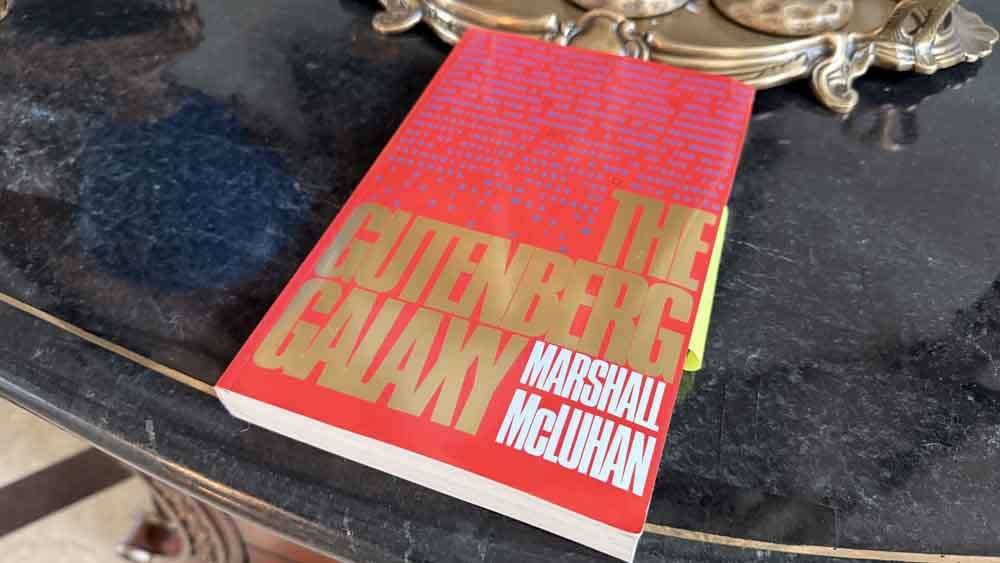
Marshall McLuhan published The Gutenberg Galaxy in 1962, and the world mostly wasn’t ready for it. It arrived not as a linear argument — which would have been a kind of irony, given its subject — but as a mosaic of observations, quotations, historical fragments, and provocations assembled the way a medieval illuminated manuscript assembles imagery: not to be read in a single sweep, but to be inhabited. Six decades later, with the internet having done to print what print did to the oral tradition, the book reads less like media theory and less like prophecy than it does like a quiet record of a transformation that never actually stopped.
What the Book Is Actually About
The core claim of The Gutenberg Galaxy is straightforward enough to state in a sentence: the invention of movable type by Johannes Gutenberg in the mid-fifteenth century did not merely change how information was stored and distributed — it fundamentally reorganized human consciousness. Before the printing press, Western culture was primarily oral and manuscript-based. Knowledge was communal, multisensory, and participatory. The spoken word demanded listener and speaker simultaneously. The manuscript was rare, handmade, expensive, and encountered almost exclusively in monastic or courtly settings.
Print changed all of that at a speed that, for the era, was violent. It gave the Western world uniformity, repeatability, and what McLuhan calls “visual space” — a mode of experiencing reality that is linear, sequential, detached, and individualistic. The reader alone with a book is the template for a new kind of person: the private self, the Protestant conscience, the empirical scientist, the nationalist citizen. These are not natural categories. They are, in McLuhan’s reading, byproducts of a technology.
McLuhan borrows the phrase “typographic man” to describe the human being shaped by five centuries of print culture — a figure who organizes knowledge in straight lines, distrusts ambiguity, values repeatability and standardization, and perceives himself as a separate, contained individual facing the world from the outside. The book is, among other things, an autopsy of that figure performed at the precise moment he was beginning to die.
The Method Is the Message
McLuhan writes The Gutenberg Galaxy in a form that deliberately violates the expectations of print culture. There is no clean thesis-support-conclusion structure. Chapters break into numbered subsections, each with its own title, functioning more like panels in a mosaic than paragraphs in an essay. Quotations from Shakespeare, Francis Bacon, Pope, Rabelais, Harold Innis, and dozens of others are woven in not as supporting evidence in the conventional sense but as resonant material, the way a poet uses allusion.
This was not an accident and it was not laziness. McLuhan understood that the medium of a book about media could not be neutral. To argue in strict linear logic that linear logic is a historical artifact would be to disprove the argument by demonstrating it. The structural messiness of The Gutenberg Galaxy is part of its content — a performance of the acoustic, non-linear mode of intelligence that print had suppressed and that electronic media were beginning, in McLuhan’s view, to revive.
His contemporary Walter Ong — a Jesuit scholar and close reader of McLuhan — would later extend this insight in Orality and Literacy (1982), arguing that “writing restructures consciousness” in ways as fundamental as McLuhan describes. What McLuhan intuited at the level of cultural history, Ong mapped with greater precision at the level of cognition and language. Together, the two books constitute something like a unified theory of how communication technologies shape what it means to think.
The Galaxy Before the Press
One of the book’s most underappreciated sections concerns the medieval manuscript culture that print displaced. For McLuhan, that pre-Gutenberg world was not primitive — it was differently organized. Medieval scholars were trained in what he calls the “acoustic” dimensions of knowledge: the trivium of grammar, rhetoric, and dialectic was understood as an oral and aural practice as much as a written one. Memory was cultivated as a living architecture, not a filing system. Knowledge was social and embodied in ways that print would gradually erode.
The Church, the guild, the oral tradition of legal precedent — these were all information systems organized around participation and presence. Print didn’t improve on them so much as route around them entirely, creating new institutions (the nation-state, the university as we know it, the publishing industry, the professional class) while the older institutions either adapted or hollowed out.
McLuhan draws heavily here on the work of Elizabethan scholar Frances Yates, particularly her research on the “art of memory” — the classical and medieval practice of associating knowledge with elaborate imagined spatial structures. That tradition, which had organized intellectual life for over a millennium, essentially collapsed under the pressure of print. Why build a mental palace when you can buy a reference book?
Print, Nationalism, and the Fragmented Self
Among the most enduring arguments in The Gutenberg Galaxy is the connection McLuhan draws between print culture and nationalism. Before the press, Europe’s educated class communicated in Latin across political borders; the manuscript culture was, in a sense, inherently international. Print changed the equation by making vernacular languages economically viable at scale. When a printer in Mainz could produce thousands of copies of a German-language text, the German-reading public became, for the first time, a coherent market — and then a coherent nation.
This is not a conspiratorial argument. McLuhan is not claiming that nationalism was engineered by printers. He is making a subtler and more troubling point: that the material conditions of communication precede and produce the political and cultural categories we later treat as natural. The nation did not create the vernacular press; the vernacular press created the conditions under which the nation became imaginable. Benedict Anderson, writing in Imagined Communities (1983), would later develop this argument with extraordinary sophistication, but its seed is unmistakably present in McLuhan’s 1962 text.
The same logic applies to individualism. The solitary reader, alone with a text, internalizing it without the mediating presence of a community, a teacher, or a ritual context, is a historically novel figure. The Protestant Reformation — with its insistence that the individual could and must read Scripture without ecclesiastical intermediary — was, in McLuhan’s framework, as much a consequence of print as it was a theological position. The technology enabled the theology by making personal reading not just possible but expected.
The Galaxy’s Edge: Electronic Media and the Return of the Acoustic
McLuhan ends The Gutenberg Galaxy at the threshold of the electronic age, and this is where the book becomes genuinely prophetic in ways that can still produce a slight vertigo. He argues that electronic media — radio, television, and whatever would follow — were beginning to reverse the effects of print by reintroducing the conditions of acoustic, participatory, non-linear communication. The private reader was giving way to something like a new tribal participant: wired into a global nervous system, receiving and emitting simultaneously, no longer capable of the detached, sequential processing that print had trained.
He called this emerging condition the “Global Village” — a phrase so thoroughly absorbed into the cultural vocabulary that most people who use it have no idea it originated here, in this strange, difficult, luminous book from 1962. What McLuhan meant by it was not utopian. The global village is not a community of rational, enlightened individuals sharing information peacefully. It is a retribal world — emotionally intense, immediate, collectively felt, and potentially volatile. Villages, after all, are not known for tolerance of dissent.
Read alongside the fractures of the social media era, this passage carries a chill that no amount of familiarity with McLuhan’s reputation quite prepares you for. He did not know about Twitter or TikTok or algorithmic recommendation systems. He knew about the structural logic of electronic media, and he followed it where it led.
Why It’s Worth the Difficulty
The Gutenberg Galaxy is not an easy book. McLuhan moves fast, assumes much, and often substitutes aphorism for argument in ways that frustrate readers trained to expect evidence organized in chains. His detractors — and there were many distinguished ones — argued that he was brilliant but undisciplined, that his insights were real but his method was impressionistic to the point of irresponsibility.
The criticism is fair as far as it goes. But it also proves the book’s central point: those critics were applying the standards of print culture to a thinker who was deliberately working outside them. If the measure of an intellectual argument is linear rigor, verifiable citation, and progressive argumentation, then McLuhan fails — and he fails in precisely the way he intended. The book rewards not the sequential academic reader but the patient, associative one willing to sit with its fragments and let them accumulate meaning laterally.
What you get, if you give it that patience, is something rare in intellectual writing: a framework that genuinely changes how you see. After The Gutenberg Galaxy, it becomes difficult to look at a book — or a screen, or a podcast, or a social media feed — without asking what kind of consciousness this medium is quietly building in its users. That question, which McLuhan planted in 1962, has only grown more urgent in the decades since.
For anyone who has already encountered McLuhan’s more famous Understanding Media (published just one year later, in 1964), The Gutenberg Galaxy is the essential companion — slower, denser, more historical, and ultimately more foundational. It is where McLuhan builds the ground beneath his aphorisms. It is where “the medium is the message” earns its claim to be taken seriously rather than merely repeated.
My review of The God Delusion by Richard Dawkins touches on a related theme — the way a text’s cultural authority can outlast the world that produced it. McLuhan would have had something to say about that, too.