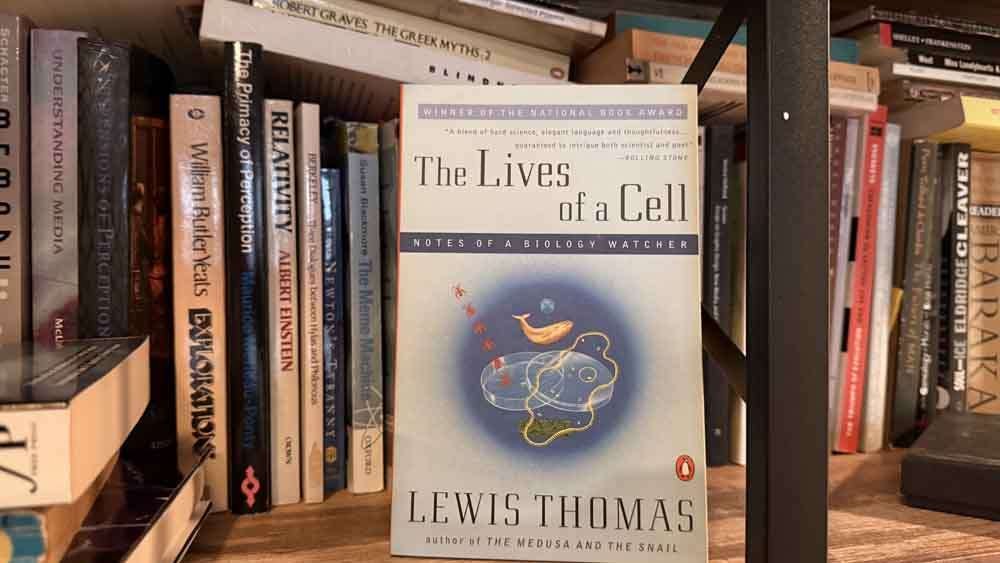
Lewis Thomas | Viking Press, 1974 | 153 pages
Every boundary you trust is a fiction held together by chemistry. That is the quiet revelation at the center of Lewis Thomas’s The Lives of a Cell: Notes of a Biology Watcher, a book that began as a column in the New England Journal of Medicine and ended up as one of the most quietly radical pieces of science writing the twentieth century produced. Thomas won the National Book Award for it in 1974. He deserved it, though the prize category — Sciences — undersells what the book actually is: a philosophical argument dressed in the language of biology, making the case that the membrane — the boundary, the edge, the line between self and other — is not where life is protected. It is where life happens.
What the Book Actually Is
The Lives of a Cell is a collection of twenty-nine short essays. None of them is particularly long. The prose is clean, uncluttered, occasionally funny in the way that only deeply confident thinkers can manage — the kind of funny that doesn’t announce itself. Thomas was a physician and medical researcher, dean of two major medical schools, and eventually president of Memorial Sloan Kettering. He was also a reader, a listener, and a man who thought about music in biological terms and biology in musical ones. The essays range across topics like the sounds insects make, the behavior of ants, the nature of death, the strangeness of mitochondria, the problem of language, the earth viewed as a single living cell. They are connected not by subject but by sensibility: a radical openness to the idea that the categories we use to separate things — self from world, organism from environment, signal from noise — are far more permeable than we pretend.
The Membrane as the Central Argument
Biologists have known for a long time that the cell membrane is not simply a wall. It is a dynamic structure, constantly selecting what passes in and what passes out, maintaining difference while allowing exchange. Thomas takes this fact and runs it to its philosophical end. He is not interested in the membrane as a barrier. He is interested in it as a negotiation — a place where identity is maintained not through exclusion but through controlled relationship.
This matters beyond biology. The membrane model of selfhood is, when you stop to think about it, a direct challenge to the Western instinct for walls. We tend to imagine that what makes us us — whether as individuals, communities, or species — is what we keep out. Thomas argues the opposite. The mitochondria inside every cell you possess were once free-living bacteria, absorbed rather than expelled, now so thoroughly incorporated that they carry their own separate DNA and could not survive outside the cell any more than the cell could survive without them. The line between self and invader, Thomas shows, was crossed so long ago we’ve forgotten the crossing. What we call “ourselves” is already, at the microscopic level, a collaboration.
It is the kind of idea that, once you’ve read it, you cannot stop seeing. It shows up in ecology, in language acquisition, in the way cities work, in the question of what a culture actually is. As Thomas puts it, talking about the earth as an organism, the planet does not merely support life — it is, in some meaningful sense, run by life. The atmosphere’s precise chemical composition is not a precondition for biology; it is a product of it. The boundary between living system and inert environment, examined closely, dissolves.
For readers already familiar with the thinking around evolutionary biology — particularly the ideas Richard Dawkins would elaborate in The Selfish Gene just two years after Thomas’s book appeared — The Lives of a Cell reads as a companion text, probing the same territory from the inside out. Where Dawkins looked at organisms as vehicles for genes, Thomas looked at organisms as membranes for something even larger. Both men were asking the same underlying question: where does the individual actually end?
On Noise, Music, and the Signal Problem
One of the book’s strangest and most beautiful essays concerns the sounds that living things make. Thomas catalogs the sonic output of insects, whales, bats, and birds with the attention of a naturalist and the ear of someone who clearly spent time with music. His argument is that what we call noise in biology is often signal we haven’t learned to read yet — that the boundary between communication and mere sound is, again, a question of the observer’s position relative to the membrane.
This is not a trivial point. It connects to some of the deepest questions in information theory, in linguistics, in the philosophy of mind. Gregory Bateson, whose work on cybernetics and ecology overlapped with Thomas’s in interesting ways, was working through similar ideas at the same time: that information is not a thing carried from one place to another but a difference that makes a difference, a distinction carved out at a boundary. Thomas arrives at the same place by watching insects. The essays on sound and language in The Lives of a Cell are worth reading alongside any serious treatment of how communication works, biological or human.
Those interested in how horizontal information transfer reshapes biological identity will find a natural companion in my piece on horizontal gene transfer — which takes the membrane argument Thomas implies and extends it into the messiest territory modern genetics has found.
Thomas and the Problem of Human Exceptionalism
One of the quiet provocations running through the whole book is Thomas’s skepticism toward the idea of human uniqueness. Not that he denies it — he is not that kind of contrarian — but he insists on framing human capacities (language, technology, collective organization) as continuous with rather than separate from the rest of biological life. We are not a species that stepped outside nature to observe it. We are nature having a particular kind of experience of itself.
This is the kind of claim that sounds obvious until you follow it seriously. If the boundary between human civilization and the natural world is as permeable as the cell membrane — if we are, like the mitochondria, in a relationship of mutual constitution with the systems we inhabit — then the question of how to live is not one of management or stewardship so much as one of membrane dynamics: what do you let in, what do you hold at the boundary, what exchange sustains the whole system? Thomas never puts it in those terms. He was too elegant a writer for that kind of schematic. But the question is present on every page.
For readers who followed the similarly paradigm-troubling arguments in Dawkins’s The Extended Phenotype, Thomas provides a kind of emotional counterweight: where Dawkins is relentlessly logical, Thomas is lyrical, almost tender. Both books are necessary.
Why It Reads Differently Now
The Lives of a Cell was published in 1974. The molecular biology it draws on has been enormously extended since then, and some of Thomas’s specific claims have been revised by later science. None of that diminishes the book. What Thomas was doing was not primarily reporting — it was reframing, constructing a way of looking at living systems that made room for complexity, collaboration, and the productive dissolution of hard boundaries. Half a century later, that reframing looks more prescient than dated. Microbiome research, symbiogenesis, network ecology — the contemporary sciences of life are all, in various ways, Thomas’s sciences.
The prose, too, holds up in a way that most science writing of that era does not. It is not breathless, not self-congratulatory, not burdened by the performative optimism that ruins so many books about biology. Thomas writes like a man who has been genuinely surprised by what he found and wants to share the surprise without inflating it. There is something almost Stoic in his equanimity — an acceptance that the world is stranger and more intricate than any framework can fully hold, and that this is a reason for attention rather than despair.
You Might Also Like
If The Lives of a Cell interests you, a few other pieces from this blog are worth your time. My review of Thus Spoke Zarathustra by Friedrich Nietzsche covers a thinker who was, in his own way, equally preoccupied with what it means to be a bounded self in an unbounded world. And the piece on the Boltzmann Brain Paradox approaches the problem of identity from physics rather than biology — with comparably unsettling results.
Sources
- Thomas, Lewis. The Lives of a Cell: Notes of a Biology Watcher. Viking Press, 1974. Amazon
- Margulis, Lynn. Symbiotic Planet: A New Look at Evolution. Basic Books, 1998. Amazon — foundational on endosymbiosis and the origins of the eukaryotic cell
- Dawkins, Richard. The Selfish Gene. Oxford University Press, 1976. Amazon
- Bateson, Gregory. Steps to an Ecology of Mind. University of Chicago Press, 1972. Amazon
- National Book Foundation. “1974 National Book Award Winners and Finalists.” nationalbook.org
- Thomas, Lewis. The Medusa and the Snail: More Notes of a Biology Watcher. Viking Press, 1979. Amazon — the direct follow-up, equally essential
- Zimmer, Carl. “The Cell: A Biography.” National Geographic, 2007. nationalgeographic.com — useful contemporary context for Thomas’s ideas