From the North Shore to the North Fork, a Meat-Only Movement Is Reshaping How Long Islanders Think About Food, Health, and the American Plate
The Heritage Diner | heritagediner.com/blog
February 2026
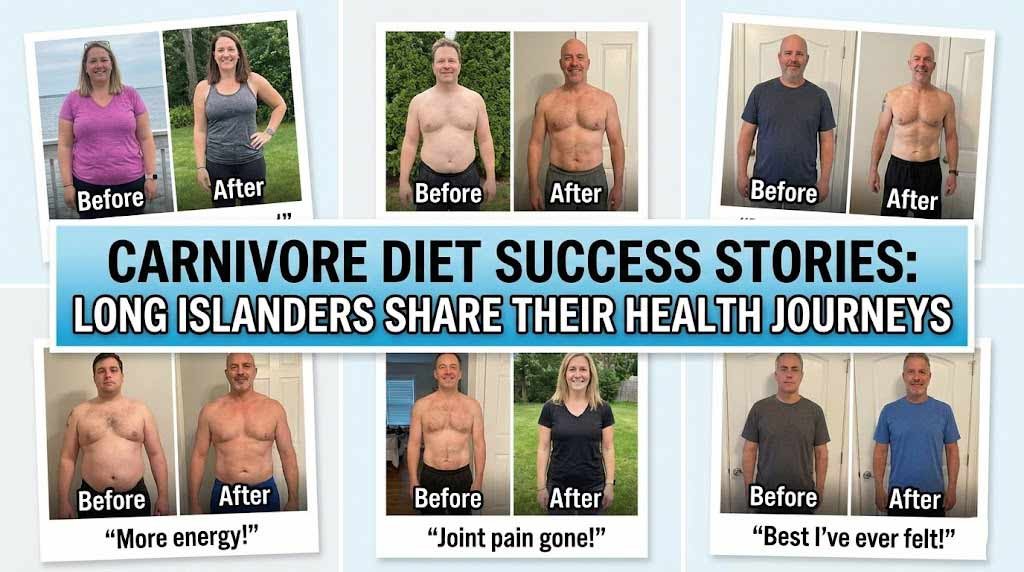
There is a moment, every weekday morning at roughly 6:15 a.m., when the first griddle at The Heritage Diner in Mount Sinai begins to hiss. Butter hits cast iron. Eggs crack against the rim of a steel bowl. Bacon—thick-cut, from a North Fork supplier—curls and renders in its own fat. For twenty-five years, this ritual has unfolded along Route 25A like a kind of secular liturgy: the same sizzle, the same aroma drifting out to the parking lot, the same handshake between cook and community. But something has shifted in the last eighteen months. The requests have changed. More customers are asking for double portions of steak and eggs with no toast. They want burger patties, hold the bun. They want the bacon, the sausage, the rib-eye—and nothing else. They are following what the wellness world has come to call the carnivore diet, and Long Island, of all places, has become one of its unlikely strongholds.
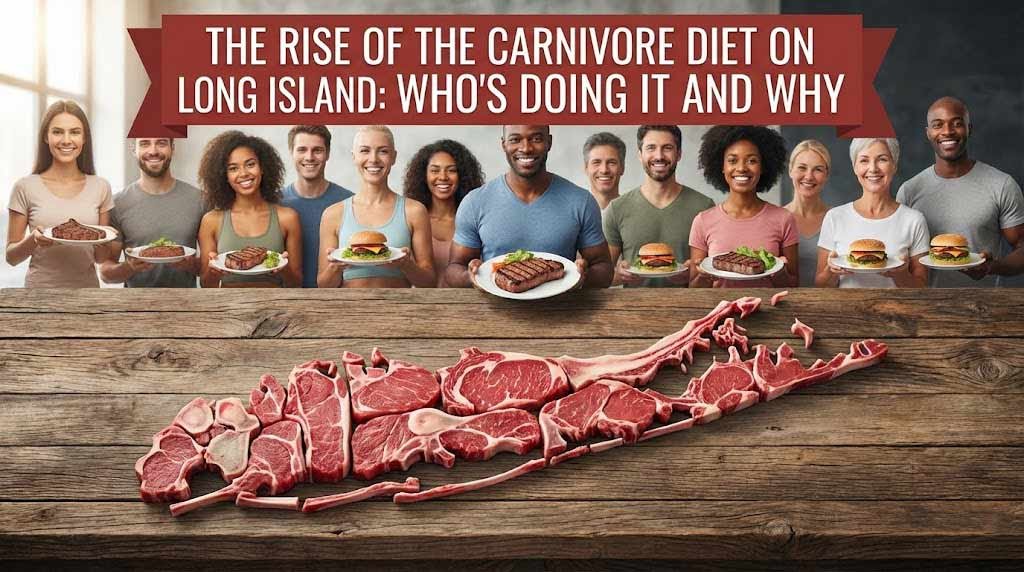
The carnivore diet—an elimination protocol that restricts consumption exclusively to animal products such as meat, fish, eggs, and certain dairy while jettisoning all fruits, vegetables, grains, and legumes—has moved from Reddit subculture to mainstream dinner conversation with startling velocity. A 2025 scoping review published in a peer-reviewed nutrition journal noted that the Instagram hashtag #carnivore had amassed approximately 2.6 million posts by late 2025 (PMC Scoping Review, 2025). Fox News named it among the most talked-about diet trends of the year (Fox News, 2025). And a landmark Harvard-affiliated survey of over two thousand self-identified carnivore dieters, led by Dr. Belinda Lennerz and Dr. David Ludwig at Boston Children’s Hospital, found that ninety-five percent of respondents reported improvements in overall health, with a median BMI drop from 27.2 to 24.3 (Lennerz et al., Current Developments in Nutrition, 2021). The science remains early and contested. The cultural phenomenon does not.
The Anatomy of an Elimination: What the Carnivore Diet Actually Is
Strip away the social media theatrics and the carnivore diet is, at its core, a radical subtraction. Practitioners eat beef, pork, poultry, fish, eggs, and animal fats. The strictest variant—sometimes called the “Lion Diet,” popularized by Mikhaila Peterson—permits only red meat, salt, and water. The more permissive versions allow butter, hard cheeses, and heavy cream. What every version shares is the total exclusion of plant matter: no kale, no quinoa, no fruit, no bread. The Cleveland Clinic has characterized it as pushing beyond even ketogenic protocols in its elimination of carbohydrates (Cleveland Clinic, 2025).
For a diner operator who has spent a quarter century balancing a menu that stretches from Belgian waffles to moussaka, this is not an abstraction. It is a line-item reality. When a customer at Heritage orders a triple-egg omelette filled with cheddar and ground sausage and explicitly refuses the home fries and the rye toast—when he pays the same price and leaves the same tip but consumes roughly forty percent fewer ingredients—that is a data point. When it happens seven times in a single breakfast shift, it is a trend. And when it happens across an entire season, it changes how you source, how you prep, and how you think about the meaning of a plate.
Who Is Doing This on Long Island—and Why Now?
The demographics defy easy categorization. The Lennerz study found that respondents skewed male (sixty-seven percent), with a median age of forty-four, and were overwhelmingly motivated by health rather than aesthetics—ninety-three percent cited health as their primary reason for adopting the diet (Lennerz et al., 2021). On Long Island, the profile maps onto a recognizable archetype: the forty-something professional, often in a high-stress field—law, finance, medicine, construction management—who has cycled through Weight Watchers, keto, intermittent fasting, and the Mediterranean diet, and arrived at carnivore as a last-resort elimination protocol.
But it is not only men in corner offices. The North Shore is producing a quieter cohort of women in their thirties and forties who have turned to all-meat eating to manage autoimmune conditions, chronic inflammation, and the kind of stubborn post-partum weight that conventional dietary guidance has failed to budge. New York’s Carnivore Diet Society, a Meetup group based in Manhattan with outposts of interest across the metro area, reflects this expanding base. The movement’s growth has been accelerated by what the trend-analytics firm Glimpse identified as a ninety-four percent spike in search interest by early 2025 (Glimpse, 2025), driven largely by short-form video platforms where personal transformation stories spread with the speed of a grease fire.
There is a socioeconomic dimension here that deserves honest acknowledgment. Neurologist and science writer Steven Novella described the carnivore diet as one for “select elites” given the cost of high-quality animal protein (Novella, 2023). A pound of grass-fed ribeye from Acabonac Farms on Long Island’s eastern end or from a North Fork operation like 8 Hands Farm in Southold does not come cheap. This is not a poor man’s protocol. It is, in many ways, a luxury elimination—which is precisely why it resonates in the affluent zip codes of the North Shore and the Hamptons, and why a community like Mount Sinai, sitting at the crossroads of working-class grit and suburban aspiration, makes such a compelling lens through which to examine it.
The North Fork Connection: Grass-Fed, Pasture-Raised, and Closer Than You Think
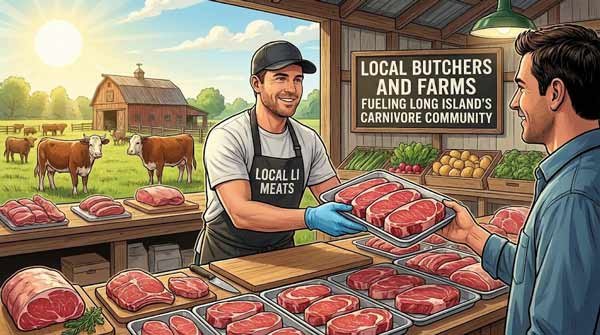
Long Island was farmland before it was suburbia. That fact tends to surprise people who associate the island exclusively with strip malls and the Long Island Expressway. But the North Fork—from Riverhead to Orient Point—remains an agricultural corridor, and its small-scale cattle operations have become inadvertent beneficiaries of the carnivore movement. Acabonac Farms, raising one-hundred-percent grass-fed beef on some of the last preserved agricultural acreage on the island, now ships directly to doorsteps across the metro area (Wrong Direction Farm, 2022). Zilnicki Farms, a fourth-generation North Fork family operation, offers everything from eighth-cow boxes to half-cow shares with a free freezer (Zilnicki Farms, 2025). Olde Road Farm in Southold has built its brand on the phrase “majority grass-fed” and a commitment to what it calls sustainable, locally raised beef.
I understand this supply chain intimately because I live inside it. Twenty-five years of operating a diner means twenty-five years of relationships with purveyors, distributors, and the occasional farmer who shows up at the back door with a cooler. The quality of animal protein available on Long Island—particularly on the North Fork and through direct-to-consumer farms that ship next-day via insulated packaging—has never been higher. It is the same principle I apply to a Marcellino NY briefcase: the material matters before the craft begins. You cannot hand-stitch a masterpiece from inferior leather, and you cannot build a legitimate carnivore plate from factory-farmed commodity beef. The patina of time applies to both leather and livestock. The animal that grazed on grass for its entire life produces a fundamentally different product than one finished on grain in a feedlot—and the carnivore community, to its credit, understands this distinction.
The Science: Promising Signals, Legitimate Cautions, and the Honest Middle Ground
The Lennerz survey is the largest descriptive dataset on carnivore dieters to date, and its findings are simultaneously encouraging and incomplete. Participants reported reduced BMI, improvements in conditions ranging from diabetes to gastrointestinal disorders (forty-eight to ninety-eight percent improvement rates depending on condition), and remarkably low rates of adverse symptoms—under six percent for any category (Lennerz et al., 2021). However, the same study revealed markedly elevated LDL cholesterol at a median of 172 mg/dL, a figure that gives cardiologists pause even when HDL and triglyceride levels were optimal.
A subsequent critique in the same journal raised valid concerns about selection bias and the limitations of self-reported data gathered through online surveys distributed within pro-carnivore social media communities (Kirwan et al., Current Developments in Nutrition, 2022). The authors noted the risk of what they termed “information gerrymandering,” wherein enthusiastic communities may amplify positive outcomes. The original researchers acknowledged these limitations while defending the value of descriptive data in an area where randomized controlled trials remain absent.
The Cleveland Clinic’s position, articulated by registered dietitian Kate Patton, is that the diet’s restrictive nature raises concerns about nutrient deficiencies—particularly in vitamin C, fiber, calcium, and magnesium—and about long-term cardiovascular and colorectal cancer risk associated with high red-meat consumption (Cleveland Clinic, 2025). This is not fringe skepticism; it is the consensus view of institutional nutrition science. And yet, as I have learned from twenty-five years of feeding a town, institutional consensus and individual experience do not always occupy the same plate. The customer who tells me his rheumatoid arthritis symptoms vanished three weeks into an all-meat protocol is not lying. He is also not a clinical trial.
The Diner as Laboratory: Heritage, Adaptation, and the Business of Feeding a Changing Appetite
A diner is, by design, a democratic institution. It serves everyone. The vegetarian sits beside the bodybuilder who sits beside the retiree who just wants a cup of coffee and a slice of pie. That range is the diner’s genius and its operational complexity. When a meaningful percentage of your morning clientele begins ordering in a way that requires zero starch, zero bread, and zero fruit, you adjust—not because you have adopted a dietary ideology, but because the soul of a diner is responsiveness. The Heritage Diner has survived for over two decades not by imposing a vision of what people should eat but by listening to what they actually want and delivering it with integrity.
This is the same principle that governs every Marcellino NY commission. A client comes to me with a need—a briefcase that must hold a fifteen-inch laptop, a leather folio that must age gracefully across ten years of courtroom appearances—and I build to that specification. I do not tell the client what leather they should prefer. I present the options, I explain the trade-offs between English bridle and Italian vegetable-tanned, and I let their hands and their judgment decide. The carnivore diner customer is, in this sense, no different from the bespoke leather client: they have done their research, they have made a choice, and they deserve to have that choice met with craftsmanship rather than condescension.
For the North Shore real estate market—a market that Paola and I watch with the attention of people preparing to launch a boutique storefront in 2026—the carnivore trend is one more indicator of a broader cultural shift toward intentional living. The same buyer who sources grass-fed beef from a North Fork farm is likely the same buyer who wants a home with a Sub-Zero freezer large enough to hold a quarter cow, who values proximity to farm stands and artisanal butcher shops, and who will pay a premium for a community that offers authenticity over convenience. Mount Sinai, with its blend of agricultural heritage and suburban accessibility, is positioned precisely at this intersection.
The Philosophical Steak: Stoicism, Simplicity, and the Appeal of Radical Reduction
There is something philosophically resonant about the carnivore diet that transcends its nutritional claims, and it is worth naming. In a world of overwhelming choice—an average American supermarket stocks roughly thirty thousand SKUs—the decision to eat only meat is an act of radical simplification. It is, in its own way, a Stoic gesture: a voluntary constraint that paradoxically produces a sense of freedom. Marcus Aurelius would have recognized the impulse, if not the specific menu.
Heidegger wrote about the way modern technology turns everything into “standing reserve”—raw material awaiting exploitation. The industrial food system is perhaps the most literal embodiment of this concept: crops and animals reduced to inputs in a supply chain optimized for volume rather than vitality. The carnivore traditionalist’s insistence on grass-fed, regeneratively raised, pasture-finished beef is, whether its practitioners articulate it this way or not, a Heideggerian rejection of that framework. It is a demand that the animal be treated not as standing reserve but as a being whose life and death carry weight, whose flesh is not a commodity but a substance worthy of attention.
I think about this every time I condition a piece of English bridle leather in the Marcellino workshop. The hide came from an animal. The tanning process took months. The stitching will take hours. None of these facts are incidental. They are the work. And the person who carries that briefcase for twenty years will understand, in the wear patterns and the deepening patina, that quality is not a feature—it is a relationship with time.
What the Carnivore Movement Tells Us About the Future of Long Island Food Culture
The carnivore diet will not replace the American diner menu. It will not eliminate the desire for pancakes on a Sunday morning or a piece of baklava after a long Thursday. What it has done, and what it will continue to do, is expand the definition of what constitutes a “serious” meal on Long Island. For decades, seriousness in this part of the world meant a white tablecloth and a prix fixe at a steakhouse in Great Neck or Huntington. The carnivore movement, for all its controversies, has democratized the steak. It has made the double burger patty at a Mount Sinai diner as philosophically loaded as a dry-aged porterhouse at Peter Luger’s in Great Neck—because both are now embedded in a framework of intentional consumption, sourcing awareness, and personal health accountability.
The National Restaurant Association’s ongoing tracking of dietary preferences confirms that protein-forward ordering is one of the defining trends of mid-decade American dining (National Restaurant Association, 2025). The question for operators like me is not whether to accommodate this shift but how to do so with the same integrity we bring to every other plate that crosses our pass. That means sourcing better meat. It means understanding the difference between a customer’s dietary choice and a dietary fad. It means recognizing that the person ordering a plain ribeye at seven in the morning has thought about that decision more carefully than most people think about their entire weekly grocery list.
Twenty-five years behind a diner counter teaches you that food is never just food. It is identity. It is memory. It is a declaration of values pressed onto a ceramic plate and set before another human being. The carnivore diet, whatever your opinion of its long-term viability, has reminded Long Island of something it once knew instinctively: that the quality of the animal, the integrity of the source, and the respect of the person doing the eating are not separate concerns. They are the same concern, viewed from different angles—like a hand-stitched briefcase turning slowly under workshop light, revealing a different shade of leather with each rotation.
At Heritage, we will continue to serve the full spectrum—because that is what a diner does. But we will also continue to watch, with the attention of people who have built three legacies on the unseen details, as the carnivore conversation evolves. The griddle is hot. The meat is sourced. The community is hungry. The only question left is what kind of morning we are making together.
Sources & Citations
Lennerz, B.S., Mey, J.T., Henn, O.H., & Ludwig, D.S. (2021). “Behavioral Characteristics and Self-Reported Health Status among 2029 Adults Consuming a ‘Carnivore Diet.’” Current Developments in Nutrition, 5(12), nzab133. Oxford University Press / Harvard Medical School.
Kirwan, R., Mallett, G.S., Ellis, L., & Flanagan, A. (2022). “Limitations of Self-reported Health Status and Metabolic Markers among Adults Consuming a ‘Carnivore Diet.’” Current Developments in Nutrition, 6(5), nzac037.
PMC Scoping Review (2025). “Carnivore Diet: A Scoping Review of the Current Evidence, Potential Benefits and Risks.” National Library of Medicine / PubMed Central.
Cleveland Clinic (2025). “Carnivore Diet: What Is It and Is It Healthy?” Cleveland Clinic Health Essentials.
Fox News Digital (2025). “Top Diet Trends of 2025.” Fox News / Food & Drink.
Glimpse Trend Analytics (2025). “Carnivore Diet — Trending 94%.” MeetGlimpse.com.
Novella, S. (2023). Commentary on carnivore diet as “select elites” phenomenon. Referenced via Wikipedia / Carnivore Diet entry.
Wrong Direction Farm (2022). “Who Are the Best Grass Fed Beef Farms with Home Delivery to New York, New Jersey, and Connecticut?” WrongDirectionFarm.com.
National Restaurant Association (2025). Annual industry trend tracking on protein-forward dining.
Recommended Viewing
Dr. Shawn Baker on the Joe Rogan Experience (JRE #1050): https://www.youtube.com/watch?v=Yj_Bc9hdHa0 — The interview that brought the carnivore diet into mainstream podcast culture.
Mikhaila Peterson — 5-Year Carnivore (Lion Diet) Anniversary Q&A: https://www.youtube.com/watch?v=UOQCKEoflPc — A long-form discussion on the Lion Diet variant and autoimmune recovery.The Heritage Diner • 275 Route 25A, Mount Sinai, NY 11766 • heritagediner.com