Frozen solid from bow to stern, the East River barely moved on the afternoon of January 13, 1840. Sub-zero temperatures had gripped New York for weeks, ice stretching out into the Long Island Sound in jagged sheets that made the prospect of a night crossing both uncomfortable and genuinely treacherous. And yet the Lexington — 205 feet of teak paneling, coal-fired ambition, and Cornelius Vanderbilt’s engineering pride — pushed out from her Manhattan pier at precisely 4:00 p.m., bound for Stonington, Connecticut, carrying 143 passengers and crew and 150 bales of cotton stacked high on the upper deck.
She never arrived.
By 3:00 a.m. the following morning, the Lexington had sunk beneath the Long Island Sound in 140 feet of dark water. Of the 143 souls on board, only four survived — three crew members and a single passenger who clung to cotton bales for hours in water cold enough to kill a man in minutes. What followed the disaster would reshape the legal and regulatory architecture of American commercial travel, alter the course of visual media history, and leave a permanent scar on the consciousness of a young nation that had placed enormous faith in the power of steam.
The story of the Lexington is not simply a maritime tragedy. It is a story about what happens when profit outpaces prudence — and what a society finally does about it.
A Ship Built for Speed, Sold for Profit
When Cornelius Vanderbilt commissioned the Lexington in September 1834, he was building more than a steamboat. He was building a statement. Constructed at the Bishop and Simonson Shipyards in New York, the paddlewheel steamer was finished in seasoned white oak and yellow pine, outfitted with teak railings and stairways, an elegant dining saloon, and an engine — built at the West Point Foundry — that was among the most efficient then in service (National Underwater and Marine Agency). In June 1835, the Lexington made the 180-mile run from New York to Providence in 12 hours and 14 minutes, establishing herself as the fastest vessel on the Sound.
She was the pride of the northeastern coastal corridor, and she carried passengers with it: businessmen, abolitionist ministers, New England professionals, express couriers hauling gold and silver coin in locked specie boxes. Speed and luxury in the same hull — she was, in the parlance of the age, a marvel.
But in 1837, Vanderbilt transferred the Lexington’s route from Providence to the Stonington run — a change designed to connect with the newly completed railroad to Boston — and by late 1838, he had sold the vessel outright to the New Jersey Steamship Navigation and Transportation Company for approximately $60,000 (Wikipedia: Lexington). The new owners immediately converted the ship’s boilers from wood-burning to coal-burning, a modification that would prove catastrophically incomplete. Coal burns significantly hotter than wood. The smokestack casing, built for the lower thermal load of a wood-fired system, was never properly adapted for the new fuel. Worse, the coal-fired boilers were equipped with forced-air blowers designed to push the ship even faster — driving operating temperatures higher still.
The 1838 Steamboat Inspection Service, the first federal body tasked with ensuring vessel safety, failed to catch any of it (New England Historical Society, 2015). Their inspectors either missed or ignored the defective conversion. The Lexington returned to service carrying the same paying passengers it always had, with a ticking thermal hazard running beneath their feet.
The Night of January 13th
The Lexington wasn’t even scheduled for that run. Early January 1840 was among the coldest on record. The East River, historian and journalist Bill Bleyer recounted in his 2024 book The Sinking of the Steamboat Lexington on Long Island Sound, was “frozen almost solid” with ice pushing out into the Sound itself (Riverhead News Review, 2025). The Lexington was selected specifically because she was considered the only vessel capable of completing the journey in those conditions. Her motto — Through by Dawn — was not merely a marketing slogan. It was a promise to the passengers who chose her for speed.
The ship’s usual captain, Jacob Vanderbilt — brother of Cornelius — was home ill. Veteran Captain George Child took command. Among the passengers that night was Charles Follen, a Harvard professor and radical abolitionist minister en route to the dedication of a church he had designed in New England (Wikipedia: Lexington). According to legend, poet Henry Wadsworth Longfellow had been ticketed for the voyage but missed it while discussing the merits of his poem The Wreck of the Hesperus with a publisher — a story that carries its own particular irony.
At approximately 7:00 p.m., as the Lexington passed Eaton’s Neck on Long Island’s North Shore, a fire broke out near the smokestack. The over-heated casing ignited. Within minutes the fire had spread to the 150 bales of cotton stacked on the freight deck — a flammable commodity stored dangerously close to the stack, a decision driven by the commercial pressure to maximize cargo capacity.
What happened next was a cascade of catastrophic failures. The crew could not extinguish the flames. Captain Child turned the ship toward the Long Island shore in hopes of beaching her, but the tiller ropes burned through and broke, rendering the rudder useless (Connecticut History, 2023). The engine stopped. The Lexington drifted northeast on the wind and current, ablaze and uncontrollable, moving away from shore in the dark. The temperature outside had fallen to 19 degrees below zero.
Three lifeboats were aboard — enough to carry only half the full complement even under ideal conditions. The first lifeboat was lowered and immediately sucked into the paddlewheel, killing everyone in it. The remaining two were swamped as they hit the water. By 8:00 p.m., the center of the main deck had collapsed into the hull. Passengers threw cotton bales and luggage containers overboard and jumped after them. Those who found nothing to hold onto died of hypothermia within minutes. The ship still burned when it finally sank at 3:00 a.m. (New York Almanack, 2022).
Four people survived. Three had clung to floating cotton bales through the night. Second Mate David Crowley drifted for 43 hours before washing ashore at Baiting Hollow in Riverhead — arriving on Long Island’s North Shore, half-frozen, his hands and feet described as having turned to “marble,” before staggering nearly a mile in darkness to a cottage with a light burning in the window (Riverhead News Review, 2025). He kept that cotton bale for the rest of his life.
The Investigation: Negligence on Every Level
An inquest jury convened in the aftermath identified the primary cause of the fire immediately: the improper conversion of the ship’s boilers from wood to coal burning, without adequate adaptation of the smokestack casing (Wikipedia: Lexington). The investigation revealed a compound of failures — each one preventable, each one the product of commercial calculation over safety discipline.
The boilers were not just improperly converted. Extra coal was being burned on the night of the fire because of the rough seas — the crew was pressing the engines harder to compensate for weather, driving temperatures beyond any margin the existing casing could tolerate. Cotton was stowed too close to the stack. The crew violated fire safety procedures in the critical minutes after ignition. The captain of the nearby sloop Improvement, which was fewer than five miles away when the Lexington began to burn, chose not to render assistance — his justification being that he did not want to miss the next high tide (New England Historical Society, 2015).
Nothing systemic was done. The 1838 Steamboat Inspection Service lacked enforcement authority, operated with minimal funding, and depended on private litigants — rather than government agencies — to hold negligent operators accountable (gCaptain Forum, 2019). Penalties existed on paper. In practice, the commercial steamboat industry operated largely unchecked.
Between 1831 and 1838, historian John Burke has estimated that 233 boiler explosions occurred on American steamboats. Between 1810 and 1840, nearly 4,000 people died on Mississippi River steamboats alone (We’re History, 2018). Three Congressmen and a sitting Senator died in steamboat explosions during the 1830s. The Lexington was not an aberration — it was a culmination.
The Image That Moved a Nation: Nathaniel Currier and the Birth of Visual News
The Lexington disaster produced one of the most consequential acts of visual journalism in American history. Three days after the ship sank, the New York Sun published a hand-colored lithographic print by a young Manhattan printmaker named Nathaniel Currier, titled Awful Conflagration of the Steam Boat LEXINGTON In Long Island Sound on Monday Eveg, Jany 13th 1840, by Which Melancholy Occurrence Over 100 Persons Perished.
It sold thousands of copies. It became, in the assessment of art historians, the most widely distributed news picture of its generation (Panorama: Journal of the Association of Historians of American Art, 2025).
In an era when daily newspapers had no photographic capability and illustration was typically limited to crude woodcuts carved in haste, a lithograph — drawn by hand, printed on stone — offered vivid detail and dramatic perspective that no other medium could match. Currier’s team, working around the clock from eyewitness accounts, produced an image of a ship engulfed in orange flame, smoke billowing into a black sky, figures visible in the water. It was a pictorial shock to the American public that had no precedent.
The Sun‘s editor, Benjamin Day, understood immediately what the image represented: not just coverage of a disaster, but a new category of journalism. The Lexington print led directly to Currier receiving a weekly illustrated insert in the Sun — the first regular illustrated news feature in American newspaper history (America-Scoop). By 1857, Currier had taken on a partner, James Merritt Ives, and the firm of Currier & Ives would go on to produce more than 7,500 lithographic images that constituted, as cultural historians have argued, the most comprehensive pictorial record of 19th-century American life.
The wreck of one ship, burning in the dark over the Long Island Sound, had accidentally launched an empire.
The Long Road to Reform: The Steamboat Acts of 1838 and 1852
The legislative response to the Lexington disaster — and to the broader pattern of steamboat catastrophe in antebellum America — unfolded slowly and imperfectly over more than a decade.
Congress had passed the Steamboat Act of 1838 in response to earlier disasters, creating the Steamboat Inspection Service and requiring periodic hull and boiler inspections, basic lifesaving equipment, and vessel registration (Encyclopedia.com). But the 1838 law was structurally weak. Enforcement remained in the hands of private litigants rather than government agencies. Hull inspectors were paid a flat fee of $5 per vessel examination — hardly an incentive for thoroughness. The SIS had missed the defective Lexington conversion entirely.
The disasters continued. Between 1841 and 1848, seventy boiler explosions killed 625 people. In the eight months immediately preceding the next major legislative action, seven separate boiler explosions claimed more than 700 lives (Encyclopedia.com). In 1852, a boiler explosion aboard the Hudson River steamer Henry Clay killed the former mayor of New York City and Andrew Jackson Downing, the father of American landscape architecture.
Congress finally acted with substance. The Steamboat Act of August 30, 1852 (10 Stat. 61) represented a fundamental shift in the federal government’s approach to commercial safety regulation — a shift that maritime legal historians have identified as one of the first serious applications of federal regulatory power to private industry in American history (gCaptain Forum, 2019).
The 1852 Act established precise standards for boiler construction, including hydrostatic pressure testing and mandatory safety valves. It created licensing requirements for steamboat pilots and engineers — the first time federal government required credentials for commercial operators. It placed enforcement authority within the U.S. Department of the Treasury, appointing nine presidentially confirmed supervising inspectors across nine national districts (U.S. House of Representatives). It required life jackets and floats adequate for all passengers aboard — a requirement that had been conspicuously absent from the 1838 law.
The 1852 Act was also the direct institutional ancestor of the U.S. Coast Guard’s marine safety program, a lineage that runs forward through the 1871 revisions, the creation of the Bureau of Marine Inspection and Navigation in 1932, and the permanent assumption of marine safety duties by the Coast Guard in 1946 (Coast Guard Marine Safety History, 2009).
What Lies at the Bottom of the Sound
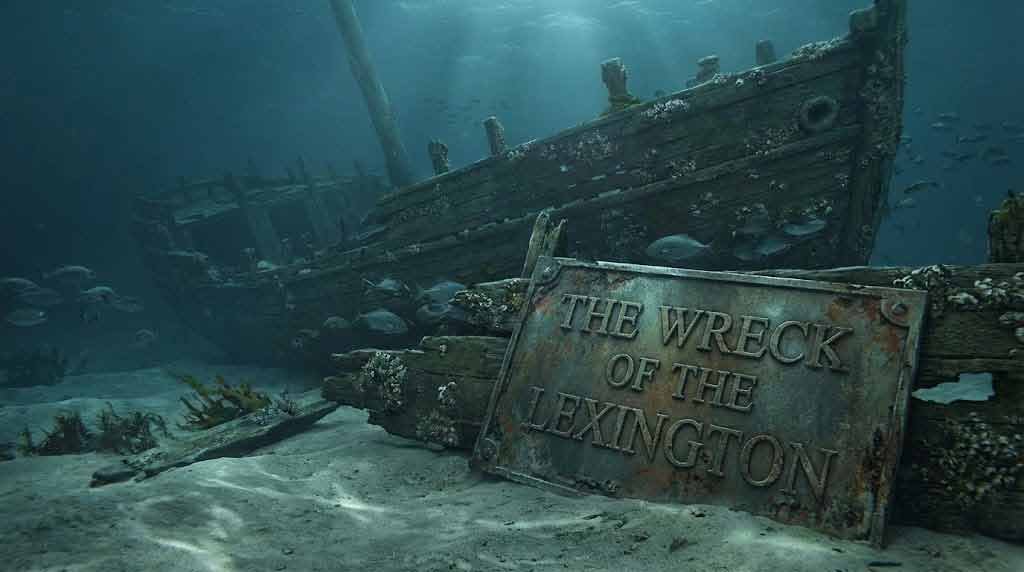
The Lexington’s story did not end with her sinking. In September 1842, salvagers managed to raise her hull using heavy chains. A 30-pound mass of melted silver was recovered from inside — the remnant of specie boxes reportedly carrying $18,000 in gold and silver coin belonging to an express courier named Adolphus Harnden (Wikipedia: Lexington). Then the chains snapped. The Lexington broke into three sections and dropped back to the bottom of the Sound, where she remains today in approximately 80 to 140 feet of water.
An 1850 newspaper report claimed she had been raised again, but no insurance company records confirm a final recovery. Marine historian and researcher Frank Mraz, who spent years pursuing the Lexington’s location for the National Underwater and Marine Agency, eventually located her in her current resting position — broken and scattered across the Sound floor, still carrying, allegedly, gold and silver that has never been recovered (NUMA).
The gold is beside the point. What matters is what the Lexington carried to the surface before she went down for good — not treasure, but testimony. The 1840 disaster forced a reckoning with the human cost of technological progress left unchecked by regulation or accountability. It took more than a decade, and many more deaths, before that reckoning produced durable law. But it produced it.
A Disaster Written Into American Law
Measured against the scale of later maritime catastrophes — the Sultana in 1865, the Titanic in 1912, the Morro Castle in 1934 — the Lexington’s death toll of 139 lives reads as numerically modest. In the context of 1840, it was the worst maritime disaster Long Island Sound had ever seen, and it landed on a country that had no framework for processing mechanized industrial death at scale.
What the Lexington gave America, ultimately, was not grief alone. It gave the country its first serious confrontation with the question that would define the modern regulatory state: when private enterprise causes preventable public harm, who is responsible, and what authority exists to prevent it from happening again?
The answer took years to formalize. It required additional disasters, additional deaths, and the accumulated political will of a Congress that was — as it has often been — reluctant to constrain the commercial interests of the age. But the Steamboat Act of 1852 answered the question in a way that held. The licensing of pilots and engineers, the hydrostatic testing of boilers, the mandatory provision of passenger lifesaving equipment — these were not abstractions. They were the direct legislative response to a burning ship drifting northeast through a frozen Sound in the dark, carrying 143 people and no adequate means of saving them.
The Lexington still rests in the water off Long Island’s North Shore — broken into three pieces, silver possibly still melted in her hull, covered in more than 180 years of silt. She is, in a very real sense, the foundation stone of American maritime safety law. Every life jacket required by federal regulation, every licensed pilot at a commercial helm, every pressure-tested boiler on an American vessel — all of it traces a line back to a January night in 1840, when fire met cotton on Long Island Sound and a nation learned, at catastrophic cost, what happens when the machinery of progress is allowed to run faster than the structures designed to keep it safe.