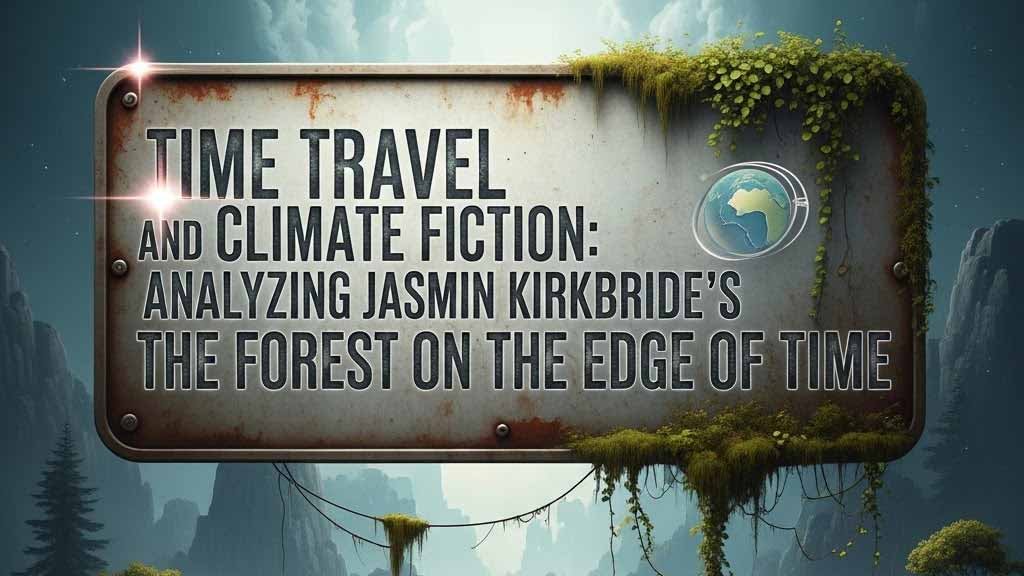
Few debut novels arrive with the structural ambition that Jasmin Kirkbride brings to The Forest on the Edge of Time — a February 2026 release from Tor Books that deserves the attention of anyone who believes science fiction still has something urgent to say.
The Architecture of the Premise
Kirkbride splits her narrative between two women: Echo, navigating the volatile philosophy and politics of Ancient Athens as a healer’s assistant, and Hazel, who exists at the furthest possible extreme — the last human alive, marooned in a laboratory on a polluted island with only small robots and a deeply untrustworthy AI. Both are recruited by the mysterious Project Kairos to alter history and prevent ecological collapse. Both are amnesiac. And when they sleep, their consciousnesses meet in a shared dreamscape that transcends time entirely.
It’s a bold architecture. The use of the dreamscape as connective tissue between radically opposed timelines — ancient civilization and the post-human end — is where Kirkbride earns her standing as a writer to watch.
Why This Book Matters Right Now
Climate fiction has a tendency to traffic in despair — scorched earth, rising seas, the grinding machinery of systemic failure. Kirkbride resists that gravity. Her PhD thesis at UEA explored radical hope in dystopian climate fiction, and that academic commitment bleeds directly into the novel’s emotional core. This isn’t a book that settles for catastrophe as its final word. It asks something harder: what do we owe the future, and what do we owe ourselves in the act of trying to preserve it?
That question, living at the intersection of duty, memory, and ecological responsibility, makes The Forest on the Edge of Time feel less like an escapist exercise and more like a philosophical confrontation. It belongs on the same shelf as Ursula K. Le Guin’s explorations of collective responsibility and Margaret Atwood’s unflinching attention to systems that betray the people inside them.
Craft Under Pressure
The novel’s structural risk is real — amnesia plots and dual timelines can collapse into confusion if the mechanics aren’t sound. Early reader reviews acknowledge some convolution, but the consensus recognizes that Kirkbride largely threads the needle: the time-travel logic holds, the dream communication between characters carries emotional weight, and the prose itself has the kind of earned restraint that suggests a writer who spent years as an editor before she became a novelist. That background shows. Every sentence is load-bearing.
Craftsmanship that disciplines itself — that removes what doesn’t serve the whole — is something I think about regardless of the medium. A Marcellino briefcase and a debut novel share at least one quality: the maker’s willingness to cut what’s comfortable in service of what’s essential.
A Novel for This Particular Moment
What distinguishes The Forest on the Edge of Time is its insistence on hope as an active posture rather than a passive wish. Hazel and Echo aren’t waiting to be saved — they are, despite amnesia and opposing ends of history, attempting to remember their way toward saving others. In a cultural moment saturated with algorithmic noise and ecological anxiety, that’s a posture worth sitting with.
Available now in hardback, audiobook, and e-book wherever books are sold: The Forest on the Edge of Time — Tor Books