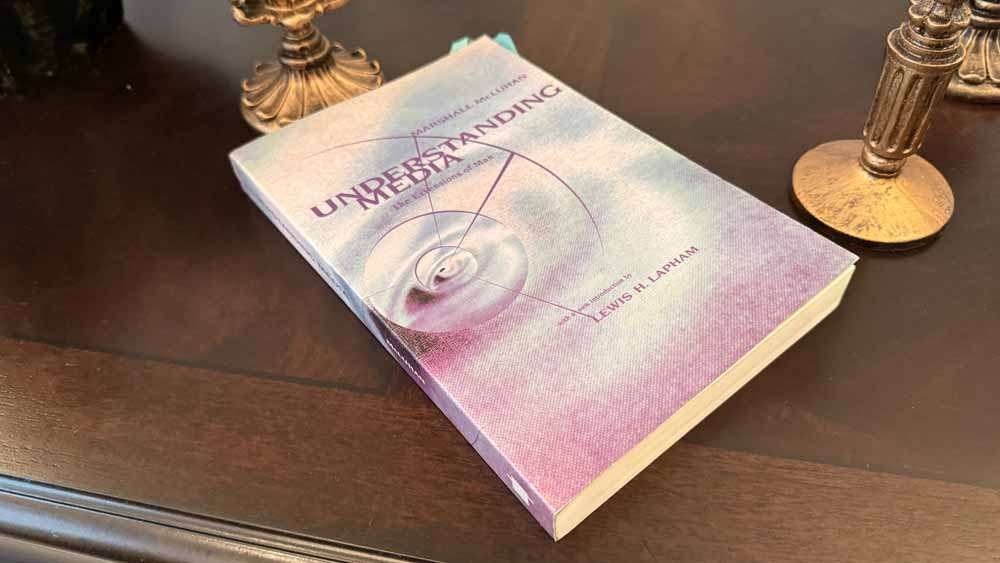
Every decade or so, a book arrives that doesn’t describe the world so much as decode it. Marshall McLuhan’s Understanding Media: The Extensions of Man, first published in 1964, is one of those rare texts. It has been called prophetic, impenetrable, dazzling, and absurd — often by the same person, sometimes in the same sentence. Reading it today, in the middle of an AI revolution that is scrambling every assumption we have about communication, knowledge, and what it even means to think, feels less like revisiting a classic and more like opening a letter someone wrote to you sixty years ago.
The Medium Is the Message — And It Has Nothing to Do With Content
The phrase everyone knows — “the medium is the message” — is also the phrase most people misunderstand. McLuhan wasn’t making a point about journalism ethics or media bias. He was arguing something far more radical: that the form of a medium, independent of whatever it carries, reshapes human perception and social organization at the deepest level. The content of television isn’t the news anchor or the sitcom. The content of television is the way it restructures attention, trains the eye, colonizes the living room, and reorganizes family life around a glowing rectangle. Strip out every program that was ever broadcast and the medium still did its work.
This is disorienting at first because we are trained to think about media in terms of what they say. McLuhan insists we think about what they do — to the nervous system, to culture, to the way humans relate to each other across time and space. He calls media “extensions of man” because each one extends a human faculty outward: the wheel extends the foot, the book extends the eye, the radio extends the ear, the electric circuit extends the central nervous system itself. Each extension also amputates something — the man who gets a wheel often loses the habit of walking. The society that gets the printing press often loses the oral tradition that held its memory together.
Hot and Cool: A Framework That Still Works
McLuhan’s taxonomy of “hot” and “cool” media has confused readers since it appeared, partly because the terms feel counterintuitive. A hot medium, in his framework, is one that extends a single sense in “high definition” — it is packed with data and leaves little room for the audience to participate or fill in gaps. Print is hot. Radio is hot. Photography is hot. A cool medium, by contrast, is “low definition” — it provides sparse information and demands that the audience complete the picture. The telephone is cool. Television, surprisingly to most readers, McLuhan considered cool. The cartoon is cool. The lecture is hot; the seminar is cool.
What makes this framework durable is that it isn’t really about temperature at all — it’s about the ratio of participation to reception. The more a medium demands of its audience, the more cognitively engaged that audience becomes, and the more the medium reshapes the sensory habits of the people who use it. You don’t just consume a cool medium. You become co-author of it.
Hold that thought against the landscape of AI-generated content flooding every platform in 2025. Most of what large language models produce — smooth, confident, syntactically perfect prose — is about as hot as a medium gets. It fills every gap before the reader has a chance to wonder. There is nothing to complete. Nothing resists. The experience of reading AI-written content may be effortless precisely because it has been engineered to require no participation whatsoever. McLuhan would have had a great deal to say about that, and none of it would have been reassuring.
McLuhan as Prophet: What He Actually Got Right
The temptation with McLuhan is to cherry-pick his correct predictions and ignore the rest, the way people do with Nostradamus. That’s not really fair to him. His accuracy wasn’t in seeing specific technologies coming — he didn’t predict the internet by name, didn’t foresee the smartphone in any literal sense. His accuracy was structural. He understood that electronic media, by operating at the speed of light, would create a “global village” — not a utopia of connection, but a retribalizing of human culture, a collapse of the detached, individualist perspectives that print culture had spent five centuries building, and a return to something more visceral, more communal, more prone to the passions of oral culture.
He wrote about this in the early 1960s, before cable television, before satellite, before the internet. He described what he called the “implosion” of information — the way electronic speed collapses distances and forces previously separate communities into immediate, overwhelming contact with each other. He suggested this would produce enormous anxiety, identity crisis, and a nostalgia for the simpler tribal arrangements of pre-literate culture. Look at the state of social media in any given week and tell me that wasn’t prophecy.
The philosopher Neil Postman, a sharp and often dissenting voice in media theory, argued in Amusing Ourselves to Death that McLuhan was correct about television’s restructuring effects but too celebratory — that McLuhan saw media change with too much wonder and too little alarm. That criticism has some merit. McLuhan could be giddy about the global village in ways that feel naive now, as if the retribalizing of culture would produce warm communal fires rather than the algorithmic outrage loops we actually got. But the diagnosis, even if the prognosis was optimistic, was sound.
The AI Age Reads McLuhan Differently
Here is where the book becomes genuinely strange to read in 2026. McLuhan’s central argument is that media are not neutral carriers of content — they are active forces that shape cognition, culture, and human identity. Every new medium retrains the sensorium. Every new medium has a “content” that is, paradoxically, the old medium it displaces: the content of the novel was the old oral tale; the content of the film was the novel; the content of television was the film. By that logic, the content of AI is everything that came before it — every text, every image, every piece of human expression ever digitized. The medium that contains everything is, in McLuhan’s framework, the most dangerous medium of all, because it is the most invisible.
What makes a medium visible — and therefore resistible — is its limitations. Print made you sit still and read sequentially. Radio demanded your ear. Television demanded your eyes and your time slot. Each medium announced itself by what it couldn’t do. An AI that can write, reason, generate images, compose music, translate languages, and hold a conversation has no obvious boundary where you can say: here is where the medium ends and I begin. That boundary, McLuhan argued, is where culture lives. Erase it and you don’t get liberation. You get a new kind of numbness.
He used the word “narcosis” deliberately — from the myth of Narcissus, who didn’t fall in love with himself but with his own image, failing to recognize it as a reflection. Every medium, McLuhan argued, produces a narcotic effect: we use it so constantly and so fluently that we stop perceiving it as a medium at all. We experience our phone not as a device that has reorganized our attention, our memory, our social relationships, and our sense of self — we experience it as just the way things are. That narcosis is exactly what makes the current AI moment so interesting and so difficult to think about clearly.
The reviews of Understanding Media when it was first published ranged from enthusiastic to hostile. The critic Dwight Macdonald famously dismissed McLuhan as a “method actor” whose method was to play the visionary, and there is something to that: the aphoristic style, the deliberate opacity, the refusal to argue in straight lines all serve a rhetorical function. But they also enact the book’s thesis. McLuhan’s prose is deliberately cool in his own sense — it requires completion, participation, argument. He once said he threw ideas out like a fisherman casting nets. You are supposed to pull on the line.
Why the Book Resists Easy Summary
Understanding Media is not a book you summarize. It is a book you argue with. McLuhan makes claims that feel preposterous and then, three paragraphs later, feel inevitable. He slides between media, history, anthropology, and psychology without warning, and the connective tissue between ideas is often intuition rather than evidence. He would have said that was the point — that linear, sequential argument was itself a product of print culture, and that the kind of thinking the electric age demanded was mosaic, not narrative.
Whether you accept that as a genuine epistemological position or as a very sophisticated excuse to avoid rigorous proof depends on your tolerance for intellectual provocation. My own view is that both things are true: McLuhan used the defense of his method to avoid doing work he could have done, and the method itself is genuinely suited to its subject matter. The inconsistency is part of the experience.
For anyone thinking seriously about where AI is taking us — not as a technology story but as a human story, a story about perception and community and what we lose when we automate the last remaining things that required our full presence — this book remains essential. Not because McLuhan had all the answers. Because he asked the question the right way: not what does this new medium say, but what does it do to us?
That question is still open. In 2026, it is more open than it has ever been.
Sources
- McLuhan, Marshall. Understanding Media: The Extensions of Man. MIT Press, 1994 (originally 1964). https://mitpress.mit.edu/9780262631594/understanding-media/
- Postman, Neil. Amusing Ourselves to Death: Public Discourse in the Age of Show Business. Penguin Books, 1985. https://www.penguinrandomhouse.com/books/297276/amusing-ourselves-to-death-by-neil-postman/
- Lapham, Lewis H. Introduction to the MIT Press edition of Understanding Media, 1994. https://mitpress.mit.edu/9780262631594/understanding-media/
- Gordon, W. Terrence. Marshall McLuhan: Escape into Understanding. Basic Books, 1997. https://www.basicbooks.com
- Marchand, Philip. Marshall McLuhan: The Medium and the Messenger. MIT Press, 1998. https://mitpress.mit.edu
You Might Also Like