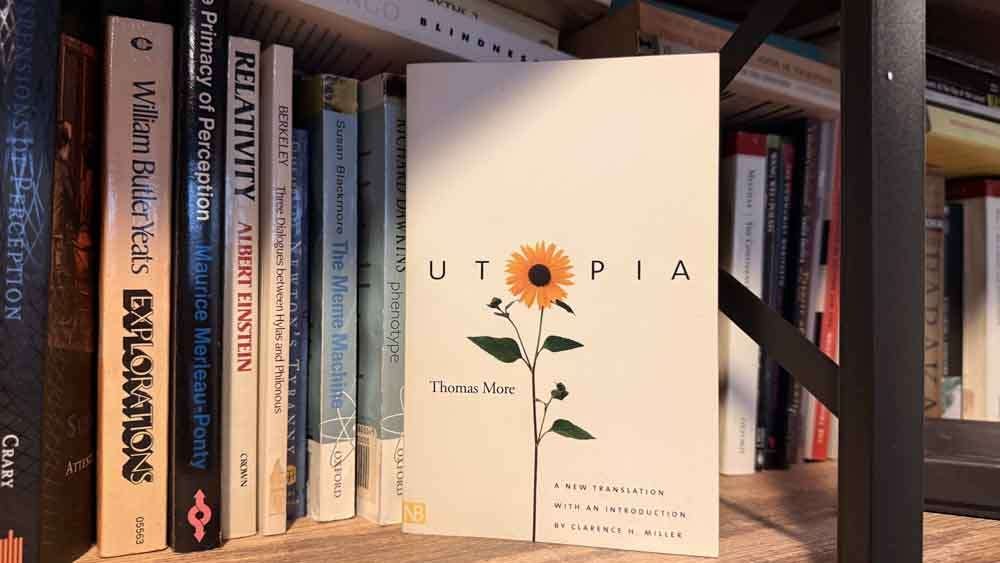
Every book I have ever loved has done something specific to time. Not suspended it, exactly — more like collapsed it, the way a long drive through familiar country suddenly delivers you to the destination without your remembering the miles. Thomas More’s Utopia did that to me. I picked it up, and then I was done, and I sat with it a while before I could move on to anything else. That almost never happens to me with philosophy, and Utopia, whatever else it is, is philosophy wearing the clothes of a traveler’s tale. That it was written in 1516 — five centuries before I was born, by a man who would be executed for his convictions less than twenty years after he published it — made the experience feel almost reckless. How does a book that old still feel like it was written about right now?
What the Book Actually Is
Before anything else, it is worth being honest about what Utopia is, because it resists easy categorization in a way that is itself one of its pleasures. More published the book in Latin in 1516, and it was not translated into English until 1551 — more than three decades after it first circulated among European scholars. It is structured as a dialogue. More himself appears as a character, alongside a fictional Portuguese traveler named Raphael Hythloday, whose name — and this is the kind of detail that makes you love More immediately — translates roughly to “peddler of nonsense” from Greek. Hythloday has visited a remote island called Utopia and describes its society in elaborate, systematic detail. More the character listens, occasionally pushes back, and ultimately remains unconvinced — but fascinated.
The first book is a diagnosis: everything wrong with 16th-century England and Europe, laid out with the precision of a man who was also a lawyer and a statesman. More was dissatisfied with a world rife with intrigue and corruption, where idle monarchs and nobles sought to increase their own wealth and power at the expense of the people. The second book is the prescription — or the dream, depending on how you read it. And reading it is exactly the question the book never stops asking you to confront.
The Six-Hour Workday and Other Impossible Sanities
The ideas in Book Two land with a force that is hard to prepare for even when you know they are coming. In Utopia, everyone works — including in agriculture — but only six hours a day, and the structure is designed to ensure that all people contribute equally and that no one is left idle or exploited. Everyone meets their basic needs because everyone participates in producing them. There are no beggars, no desperate poor, no one grinding through fourteen-hour days so that someone else can rest.
Gold and silver, prized among English possessions, are used in Utopia for chamber pots and slave fetters — a deliberate inversion that makes a point about how completely arbitrary the value we assign to precious things really is. The Utopians think the European obsession with gold is insane. Reading More think through their perspective, I found myself agreeing with them, and then immediately questioning whether I was supposed to agree with them, which is exactly the trap More is laying.
Unlike Plato’s Republic, which is largely an abstract dialogue about justice, Utopia focuses on politics and social organization in stark, practical detail. More is not content with ideals in the abstract. He wants to know: what do people eat, how long do they work, where do they sleep, what happens when someone breaks the rules? The specificity is part of what makes it so disorienting. It does not read like a fantasy. It reads like a blueprint for a place that could exist — and then, just when you have accepted that, it reminds you why it probably cannot.
No Place, Every Place
The word Utopia is itself a clue. More coined it from the Greek ou-topos, meaning “nowhere,” though it sounds identical to the Greek eu-topos, meaning “a good place.” The pun is intentional. The ideal place is no place. More knows this, and he embeds it in the name so that you cannot ignore it. Every time someone uses the word utopian to dismiss an idea as impractical, they are actually repeating More’s own joke back to him.
What strikes me, and what has stayed with me, is that More seems to have written the book in a state of genuine intellectual tension. He is not a propagandist for this system. He is a man who can see, with precision, what is broken about the world he lives in, and who is willing to imagine a radically different arrangement while simultaneously questioning whether human nature would permit it. The character of Morus — More’s stand-in — argues at the end of Book One that without money and private property people will not work hard enough, a position that is then thoroughly contradicted by the evidence of Book Two. More does not resolve the contradiction. He leaves it open, like a door he is not sure he wants to walk through.
That intellectual honesty is what separates Utopia from lesser works in its tradition. More is not selling you anything. He is thinking out loud, in a form elegant enough that it has lasted five hundred years.
Labor, Dignity, and What Work Is Actually For
The section of Utopia that hit me hardest was not the one about property or religion. It was the extended meditation on labor — on what it means to work, and who work is supposed to serve. Hythloday describes a society where every person contributes, every person benefits, and no one’s labor is extracted to make someone else comfortable while they do nothing. The contrast with England — with any society built on extraction and hierarchy — is devastating.
I have spent twenty-five years running a diner. I know what labor looks like up close. I know the people who show up before dawn to prep a kitchen, who spend their feet and their backs doing work that other people barely notice. When More describes a world where that kind of work is shared equitably, where the burden is distributed rather than piled onto whoever has the least leverage to refuse it, it does not read like fantasy to me. It reads like a grievance that is half a millennium old and has still not been addressed.
More was not a communist, not exactly, and it would be too simple to read Utopia as a manifesto. Scholars have long debated whether his work is serious or satirical — whether he is genuinely advocating for communal property and a six-hour workday, or using a fictional device to expose the contradictions in his own society. The answer, as the best scholarship now suggests, is probably that he is doing both at once. Satire is always a form of longing. You do not spend the intellectual energy to describe a better world unless you believe, on some level, that the description matters.
Religion Without Violence
One of the most startling passages in the book concerns religion. The Utopians practice a variety of faiths and have constructed a society in which theological difference is not a source of persecution. This from a man writing in 1516 — three years before Luther nailed his theses to the church door and set a century of religious war in motion across Europe. More imagined peaceful coexistence among many different religious beliefs at a moment when the actual European world was preparing to tear itself apart over them.
The irony is almost too much to sit with. More himself would be executed in 1535 for refusing to bend his own religious convictions to the will of Henry VIII. He died for his faith, and yet he imagined a society where faith was held lightly enough to coexist with difference. Whether that is contradiction or tragedy probably depends on which reading of the book you accept.
Why I Carry This Book on My Skin
Some books you finish and shelve. Some you return to. And a few become part of how you think, the way a particular phrase or image or argument lodges somewhere permanent and shapes the way you see everything that comes after. Utopia is in that third category for me. It is, in fact, on my arm — part of a tattoo that marks the books and ideas that have made an irreversible impression. I do not do that lightly. Permanence has to be earned.
It also found its way into my work at Marcellino NY, where I named one of my English bridle leather briefcases The Thomas More — a piece I still make and still sell. The connection felt natural. More was a craftsman of ideas, someone who worked with precision and patience to produce something that would outlast him. That is the same ambition I bring to every bag I build. The six-month lead time is not an inconvenience. It is the point. What takes time, done right, endures. More understood that about ideas. I think it is equally true about leather.
The Productive Tension at the Heart of It
What separates Utopia from the books that inspire and then fade is that it does not let you settle. It is not a comfort read. It is a productive discomfort — the kind that Nietzsche was chasing when he said philosophy should disturb rather than console. More lays out a vision of a world organized around human dignity, shared labor, and religious tolerance, and then quietly refuses to tell you whether he believes it is possible. He leaves that to you.
I have written before about books that do this — No Exit by Sartre sits in similar territory, a work that diagnoses the human condition without offering a prescription, and Steppenwolf by Hesse does something comparable with the divided self. What these books share is a refusal to be finished with you when you finish them. Utopia coined a word that became a concept that became a lens that millions of people have used to evaluate every society that has existed since 1516. That is not the achievement of a book that offers easy answers. That is the achievement of a book that asks the right questions and then trusts you enough to sit with them.
Sources
- More, Thomas. Utopia (1516). Penguin Classics edition, translated by Paul Turner. https://www.penguinrandomhouse.com/books/286673/utopia-by-thomas-more/
- Fisher, Elijah. “Satirical or Serious: Interpreting the True Intentions of Thomas More’s Utopia.” Tenor of Our Times, Harding University, 2023. https://scholarworks.harding.edu/tenor/vol12/iss1/14/
- “Utopia by Sir Thomas More — Summary and Analysis.” Audible.com, 2024. https://www.audible.com/blog/summary-utopia-by-sir-thomas-more
- Wood, Andrew. “Summary of Thomas More’s Utopia.” San José State University, COMM 149F. https://www.sjsu.edu/faculty/wooda/149F/4-More.html
- “Thomas More: Utopia.” An Open Companion to Early British Literature, Pressbooks, 2019. https://pressbooks.pub/earlybritishlit/chapter/sir-thomas-more-utopia/
- Political Utopias of the Renaissance: An Analysis of Thomas More’s Utopia. Western Michigan University, ScholarWorks. https://scholarworks.wmich.edu/masters_theses/691/