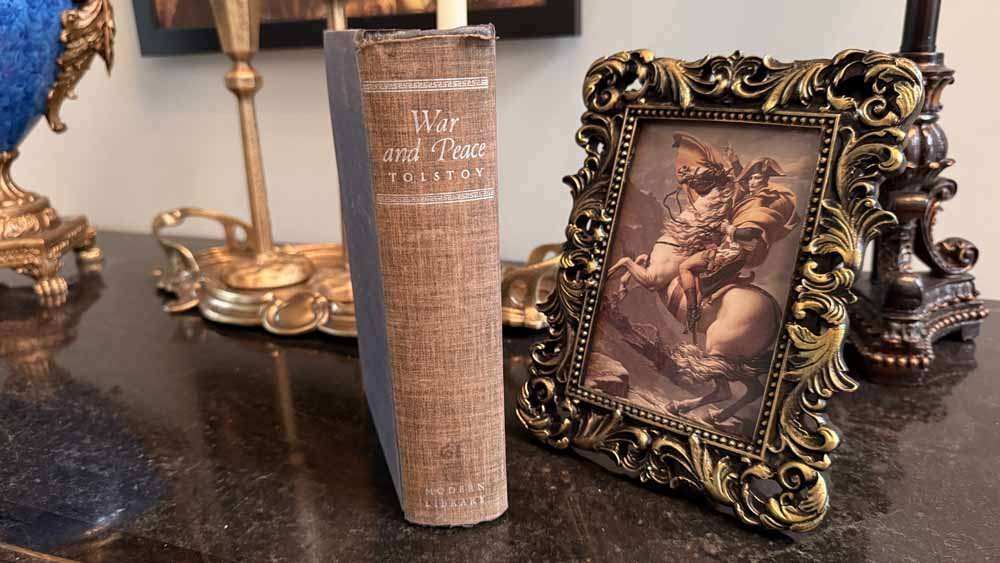
Most novels ask you to give up a few hours. War and Peace asks you to give up something harder to name — a posture, a way of standing in relation to events, a belief that understanding history means knowing who made the decisive moves. Tolstoy is not interested in your time so much as your certainty. Finish the book and you’ll have both less of that and, strangely, more capacity to live without it.
Published in its final form in 1869 after appearing in serialized installments throughout the 1860s, War and Peace spans roughly 1,225 pages depending on the translation, follows more than 500 named characters, and covers the Napoleonic invasion of Russia from 1805 through 1812. It is, by most measures, the largest serious artistic undertaking in the history of prose fiction. But the size is not the challenge. The challenge is that Tolstoy keeps interrupting his own story to argue with you — directly, philosophically, with the patience of a man who has thought about this for decades and has no intention of pretending he hasn’t.
The Novel as Philosophical Argument
Embedded inside War and Peace are long discursive chapters, particularly in the second epilogue, that read nothing like fiction. Tolstoy breaks the fourth wall entirely and lectures the reader on the nature of historical causation, free will, and the illusion of leadership. Napoleon, in Tolstoy’s telling, did not cause the French invasion of Russia. Napoleon was carried by it — a cork on a wave, mistaking the direction of the current for the product of his own swimming.
This is the surrender the book demands before anything else: the surrender of the great-man theory of events. We are trained — by school, by biography, by our own psychological need for narrative compression — to locate history in individuals. Tolstoy finds this not merely wrong but dangerous. He argues that the real engine of historical movement is the aggregate behavior of millions of ordinary people, each making small decisions that no general or emperor could foresee or fully direct. Military historians, he writes, explain battles by the maneuvers of commanders. But battles are won or lost by the morale of the soldier at the edge of the field who does not retreat when he has every reason to.
For readers who come to the book expecting a war epic in the Homeric tradition — heroes steering the fate of armies — the epilogue chapters can feel like a betrayal. They are not. They are the thesis that the preceding thousand pages have been building toward, scene by patient scene.
Pierre, Natasha, Andrei — and What They Cost Each Other
The philosophical argument lands because Tolstoy earns it through character. Pierre Bezukhov is one of the great figures in all of literature: illegitimate, massive in body and in feeling, perpetually confused about how to live, perpetually sincere in the attempt. He moves through the novel like a man trying to find the right door in a hallway of doors, and his failures — his disastrous first marriage, his Freemasonry phase, his idealized revolutionary sympathy, his near-execution by the French — accumulate not as comedy but as honest testimony about what it costs to remain open in a world that keeps punishing openness.
Prince Andrei Bolkonsky is Pierre’s inverse: controlled, brilliant, prone to certainty, and slowly broken by the discovery that certainty is its own kind of prison. His transformation at the Battle of Austerlitz — lying wounded, staring up at the sky, suddenly indifferent to the Napoleon he had worshipped — is one of the most precisely rendered moments of disillusionment in world literature. Tolstoy does not make it redemptive in the conventional sense. Andrei doesn’t emerge wiser and warmer. He emerges quieter, and colder, and it takes the rest of his life to understand what he saw in that sky.
Natasha Rostova is the counterweight to both of them. She is appetite, music, motion, social instinct. Critics across two centuries have debated whether Tolstoy treats her fairly — she makes catastrophic choices, and the book’s final image of her as a domestic manager married to Pierre reads, to some readers, as diminishment. But Tolstoy’s point, arguably, is that the domestic and the unheroic are exactly what history is made of. The epilogue is not Natasha reduced. It is Natasha as evidence.
Kutuzov and the Wisdom of Waiting
The military figures in War and Peace range from the vain to the deluded, but Field Marshal Mikhail Kutuzov, commander of the Russian army, stands apart. He sleeps through councils of war. He retreats when others want to advance. He loses Moscow without panic. And he wins — not through brilliance but through patience, through trusting the forces he cannot control to work in Russia’s favor if he simply doesn’t interfere.
Tolstoy uses Kutuzov as the living argument against Napoleon. Where Napoleon micromanages, Kutuzov endures. Where Napoleon creates plans, Kutuzov waits for the plan to become irrelevant. He is not passive — he understands the moment when action is required — but he has given up the fantasy that understanding an event means controlling it. This makes him, in Tolstoy’s moral universe, the wisest man in the book.
There’s a lesson here that has nothing to do with military strategy. It applies to any domain where the desire to impose order on complexity — to be Napoleon rather than Kutuzov — is the primary source of failure. Tolstoy was writing about 1812, but he was diagnosing something permanent about how human beings relate to events that exceed them.
Translation Matters More Than You Think
Before starting the book, the question of translation deserves serious attention. The most widely read English translation remains the Constance Garnett version, which has the advantage of fluency and the disadvantage of some flattening — Garnett smoothed over passages that Tolstoy left deliberately rough. The Richard Pevear and Larissa Volokhonsky translation, published in 2007, is more faithful to Tolstoy’s syntax and rhythm, including the sections originally written in French (Russian aristocrats of the period spoke French among themselves, a detail that carries social meaning Garnett sometimes obscures). The older Aylmer and Louise Maude translation, supervised by Tolstoy himself, has its own authority. Any of these will serve. What matters is that you choose one and commit.
The French passages, in particular, reward attention. The novel opens in French — a St. Petersburg salon, 1805 — and the shift between French and Russian in the dialogue is not decorative. It marks the divide between the Westernized aristocratic performance and the underlying Russian identity that the war will eventually force characters to reckon with. Some translations handle this with footnotes, some with italics, some by translating everything into English. The Pevear-Volokhonsky edition preserves the French in the text and provides translations at the bottom of the page, which is the closest to Tolstoy’s intent.
The Second Epilogue and Why Most Readers Skip It
The second epilogue — roughly thirty pages of pure philosophical argument at the novel’s end — is the section most commonly abandoned. After the emotional closure of the first epilogue, which follows the characters forward in time and brings the domestic narrative to rest, the second epilogue arrives as an abrupt shift into essay. Tolstoy argues at length against the concept of free will as typically understood, against the great-man theory, against the pretension of historians to explain what they can only describe after the fact.
Many readers treat this section as optional. It is not. The novel without the second epilogue is a great story about the Napoleonic wars with some interesting characters and some digressions about philosophy. The novel with the second epilogue is a unified argument about the nature of historical life — what it means to live inside events you cannot see clearly, cannot control, and cannot understand until long after they have passed. Tolstoy’s second epilogue is not a coda. It is the locked door that the preceding 1,200 pages are the key to.
What the Book Leaves Behind
Finishing War and Peace is its own specific experience. There is the exhaustion, which is real. There is also something harder to describe — a recalibration of scale. Events that seemed significant before reading the book have a tendency to seem smaller afterward, not because Tolstoy makes the world smaller but because he makes it larger. His Russia is full of people trying to matter, trying to act rightly, trying to understand what is happening to them, and largely failing at all three — not through weakness but through the basic condition of being alive inside history rather than outside it, looking back.
The book that most directly precedes this experience in my reading life is Tolstoy’s own Anna Karenina, which covers narrower territory with comparable depth. But War and Peace does something Anna Karenina does not: it refuses to let the drama of individuals stand in for the drama of the world. Pierre’s story matters. It also doesn’t matter, in the exact same breath. Holding both of those truths without resolving the tension between them is the thing the book teaches, if it teaches anything.
The shelf next to this one might include Thus Spoke Zarathustra by Nietzsche — another book that demands you surrender a prior self before it will give you anything in return — or Darwin’s On the Origin of Species, which performs a similar operation on our instinct to locate purpose at the center of natural processes. Tolstoy would have rejected the comparison to Darwin, whose materialism he found spiritually vacant. But the cognitive move the books require of the reader — relinquishing the consolation of agency at the scale we imagine it — is recognizably the same.
Read War and Peace slowly. There is no other way. It was written slowly, lived slowly, and it gives back in proportion to the patience you bring.
Sources
- Tolstoy, Leo. War and Peace. Translated by Richard Pevear and Larissa Volokhonsky. Knopf, 2007. https://www.penguinrandomhouse.com/books/110719/war-and-peace-by-leo-tolstoy/
- Maude, Aylmer. The Life of Tolstoy. Oxford University Press, 1930. Available via Internet Archive: https://archive.org/details/lifeoftolstoy01maud
- Orwin, Donna Tussing. Tolstoy’s Art and Thought, 1847–1880. Princeton University Press, 1993. https://press.princeton.edu/books/paperback/9780691014975/tolstoys-art-and-thought-18471880
- Berlin, Isaiah. “The Hedgehog and the Fox.” In Russian Thinkers. Penguin, 1978. https://www.penguinrandomhouse.com/books/286154/russian-thinkers-by-isaiah-berlin/
- Gustafson, Richard F. Leo Tolstoy: Resident and Stranger. Princeton University Press, 1986. https://press.princeton.edu/books/hardcover/9780691065281/leo-tolstoy-resident-and-stranger