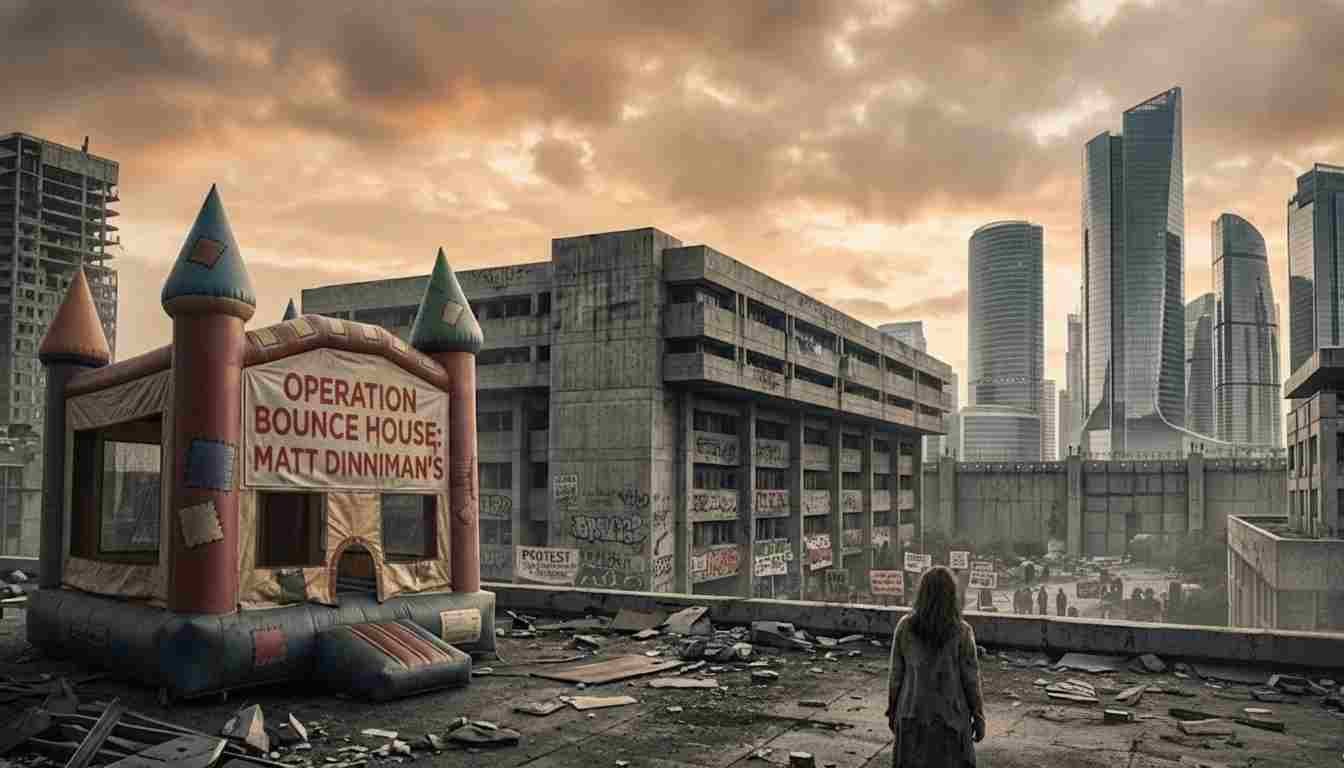
Somewhere between the first page of Matt Dinniman’s Operation Bounce House and the last, you begin to feel an uncomfortable weight settle in — the kind that comes not from horror, but from recognition. This is a science fiction novel about an alien planet under siege. It is also, unmistakably, a novel about right now.
Dinniman — best known for his New York Times bestselling Dungeon Crawler Carl series — arrives in 2026 with something darker, sharper, and considerably more pointed. Operation Bounce House is an instant bestseller for good reason: it is a book that earns its entertainment while quietly doing something more dangerous — making you think.
The Setup: Colonists, Corporations, and a Very Sick Game
Oliver Lewis is a young farmer on New Sonora, a colony planet generations removed from Earth. He tends the family ranch with his sister, plays gigs with his band, and manages an aging fleet of agricultural bots alongside an AI companion named Roger — a floating, sardonic, rule-enforcing robot who just may be the finest comedic invention in recent science fiction.
Life is imperfect but honest. Then Earth comes calling.
The colossal Apex Corporation is hired to commence an “eviction action,” but maximizing profits will always be its number one priority. Rather than spend money deploying AI soldiers, Apex turns the conflict into a game — charging bored Earthers for the privilege of designing their own war machines and remotely piloting them against the settlers of New Sonora. Goodreads The game is called Operation Bounce House. To the players, it’s a premium subscription. To Oliver and his neighbors, it’s annihilation.
The premise alone is staggering in its relevance. In a media landscape where drone warfare, remote-controlled conflict, and the gamification of violence are no longer speculative, Dinniman has constructed a scenario that feels less like science fiction and more like a plausible corporate press release.
Class Warfare at Interstellar Scale
What makes Operation Bounce House resonate so deeply is how cleanly it maps onto the oldest story in human civilization: the powerful deciding the fate of the powerless, and dressing it up as entertainment along the way.
The choice to frame the conflict through gamers rather than a direct corporate or government attack is a deliberate statement. At its core, the book questions the use of violence as entertainment — and wonders whether seeing it in games, movies, and shows from a young age desensitizes us to witnessing it in real life. Winter is Coming
But Dinniman is too sophisticated to simply villainize the gamers and let the institutions off the hook. He shows how Apex manipulates these players — highlighting the ways wealth and power can be leveraged to radicalize people — and uses advanced AI to doctor footage, add and remove details, and uphold a “terrorism” lie that convinces Earth that what’s happening to New Sonora is justified. Winter is Coming This is not a book about bad people. It is a book about systems that manufacture bad outcomes and need willing, often oblivious, participants to do the work.
The class dynamics are drawn without subtlety but with great skill. The settlers of New Sonora are farmers, ranchers, musicians, and mechanics — people who build things with their hands and depend on one another for survival. Their attackers are paying customers, sitting at home, spending a premium for the experience of consequence-free violence. The distance between those two realities is where the novel does its most corrosive work.
AI, Propaganda, and the Architecture of Deception
One of the book’s most unsettling threads is its treatment of artificial intelligence — not as a singular villain, but as infrastructure. Roger, Oliver’s AI companion, is loyal, humane, and indispensable. Apex’s AI systems are weaponized misinformation engines. As one reviewer observed, no matter what rules are in place where AI is involved, it seems to evolve beyond them — and isn’t that what nearly all of science fiction has warned us would occur? Goodreads
The propaganda apparatus Dinniman constructs is chilling precisely because it requires no leap of imagination. Real-time manipulation of imagery, AI-generated narrative overlays, the conversion of genocide into content — these are not speculative technologies. They are dressed in slightly more elaborate clothes in New Sonora, but the bones are familiar. In this sense, Operation Bounce House sits comfortably alongside works like Dave Eggers’ The Circle or George Saunders’ The Semplica Girl Diaries — fiction that uses genre distance to say what realism cannot.
The Heart of the Thing: Community, Art, and Resistance
For all its thematic ambition, Operation Bounce House succeeds first as a story about people. Oliver is an enormously appealing protagonist — flawed, self-aware, occasionally drunk, always trying. The ensemble around him — his sister, his bandmates, his neighbors — is rendered with warmth and specificity. These are not archetypes. They are people with histories, with grievances, with bad jokes at the wrong moments.
The most striking takeaway is that true resistance means embracing the most human parts of ourselves. When things look truly dire, Oliver is left with the truth of words his grandmother once spoke: “The closer we are to the end, the more we need to embrace our happiness.” The book goes to great lengths to humanize its characters, and it emphasizes — powerfully — the importance of art as a form of resistance. The art doesn’t need to be good or profitable to serve that purpose. It just needs to be embraced. Winter is Coming
That insistence — that creativity is not a luxury but a form of survival — is the novel’s most quietly radical argument. In a world increasingly organized around extractable value, around productivity and monetization and ROI, Operation Bounce House insists that the band rehearsal, the half-finished song, the imperfect handmade thing is an act of defiance.
Working alongside craftspeople and small business owners for the better part of three decades, I’ve watched that truth play out in quieter ways. The artisan who refuses to rush a joint. The cook who insists on the slow ferment. The musician who plays the gig for twelve people like it’s twelve thousand. These are not commercial decisions. They are identity decisions — and in Dinniman’s universe, they are the only ones that ultimately matter.
Dinniman’s Craft: Tone, Humor, and the Hard Science of Pacing
One of the genuine pleasures of Operation Bounce House is how skillfully Dinniman manages tone. There are flashes of humor that come through at just the right moments, offering respite against the darkness. It reads like a passion project — something Dinniman genuinely wanted to explore — and that enthusiasm comes through in the heightened emotions and sharper, more pointed humor. BiblioSanctum
The pacing is relentless without feeling rushed. At under 450 pages, the novel covers enormous thematic ground without ever losing the thread of Oliver’s personal story. The action sequences are visceral; the quieter domestic moments are genuinely moving. This is a difficult balance to strike, and Dinniman strikes it with what appears to be practiced ease.
Pierce Brown called it “irreverent yet heartfelt, nostalgic yet wholly original — an anarchic adventure rich with riotous characters and a plot that crackles towards chaos with all the alacrity of a dynamite fuse.” Amazon That is a fair accounting.
Final Assessment: Required Reading for This Particular Moment
Operation Bounce House is a 2026 novel for a 2026 world. It arrives at a moment when the questions it raises — about who controls the narrative, who benefits from remote violence, who gets to decide what counts as terrorism and what counts as entertainment — are not theoretical. Dinniman has written a book that is genuinely fun and genuinely disturbing, often simultaneously, which is the highest compliment you can pay to political science fiction.
It is not a perfect novel. Some secondary characters on the human-corporate side feel underdeveloped, and a few of the action sequences trade tension for spectacle. But these are minor complaints against a book that swings for something meaningful and largely connects.
Pick it up. Read it quickly — the pacing demands it — and then sit with it slowly. It has earned both.
Operation Bounce House by Matt Dinniman — Published February 10, 2026 by Ace/Penguin Random House. Available in hardcover, e-book, and audiobook (narrated by Travis Baldree and Jeff Hays).