
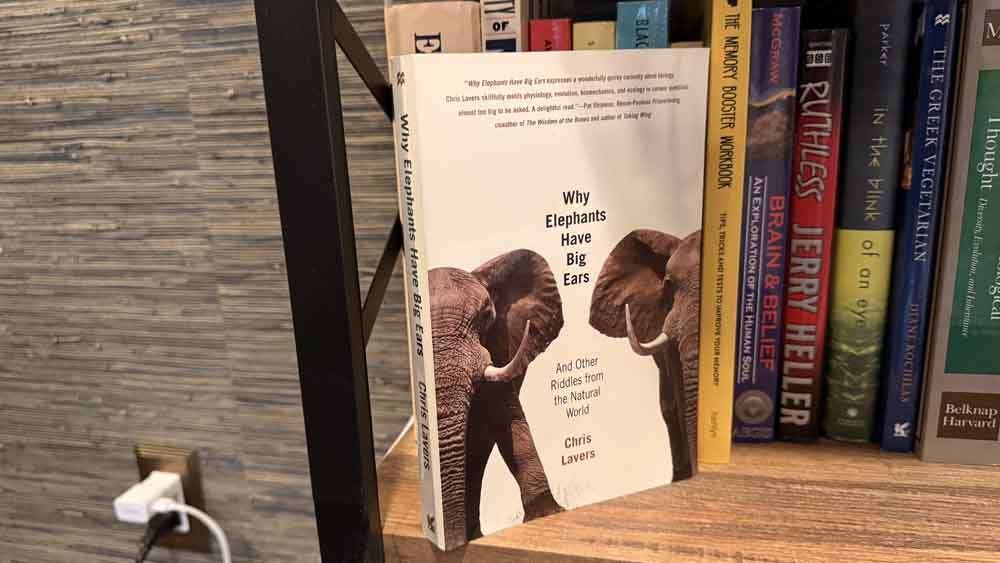
Pick up almost any animal and ask the simple question — why does it look like that? — and you will quickly find yourself in deep water. The elephant seems almost designed to confound: nearly eight tons of animal, covered in almost no fur, swinging a nose the length of a car, fanning ears the size of barn doors. None of it, at first glance, makes intuitive sense. It looks like evolution was drunk the day it drew up the plans. Chris Lavers wrote Why Elephants Have Big Ears to prove that it wasn’t — and in doing so, produced one of the most quietly thrilling books in popular science.
The Central Puzzle: Costly Traits and Brutal Logic
The question at the heart of this book is not just about elephants. It is about the deepest paradox in evolutionary biology: how do traits that appear wasteful, extravagant, or bizarre survive the pitiless arithmetic of natural selection? Selection is ruthless. Every calorie spent maintaining a feature that doesn’t earn its keep is a calorie that can’t go toward survival or reproduction. So why do ears the size of barn doors persist? Why hasn’t a leaner, more economical elephant outcompeted the one carrying all that excess surface area around?
Lavers’s answer is elegant and counterintuitive. Those enormous ears are not a burden — they are a radiator. An elephant’s body, at up to seven or eight metric tons, generates heat at a rate its relatively small skin surface cannot shed fast enough. The animal risks cooking itself alive. The ears, dense with blood vessels and perpetually fanned against the African heat, function as an external cooling system, dumping excess thermal energy into the surrounding air. What looks like extravagance is precision engineering. The ears are not in spite of the elephant’s size — they are because of it.
This single insight unlocks the whole book.
Scaling: The Hidden Grammar of Life
Lavers builds his argument on a concept physicists have understood for centuries but biologists sometimes underappreciate: scaling. The relationship between an object’s volume and its surface area changes as size increases, and it does so in a way that is mathematically ruthless. Double the size of an animal, and its volume grows much faster than its surface area. This means larger animals face fundamentally different engineering problems than smaller ones — problems of heat management, structural support, and metabolic rate that cannot be solved by simply building a bigger version of a smaller creature.
This is why, Lavers explains, King Kong could never have climbed the Empire State Building. A gorilla scaled to that size would collapse under its own weight; bones are not infinitely scalable, and neither is physiology. The same logic explains why elephants have thick, pillar-like legs instead of the slender limbs of a gazelle, why they have almost no hair (fur insulates, which is disastrous when you already run hot), and why their long trunks serve as a drinking straw that doesn’t require the animal to bend its enormous head to the ground. Every feature traces back to the inescapable physics of being that large.
The Cold Blood Question
Some of the book’s most fascinating chapters concern the long-running debate about warm-bloodedness versus cold-bloodedness — and Lavers refuses to let the reader assume, as most of us do, that warm-bloodedness is inherently superior. It is not. It is a trade-off, like everything else in evolution.
Warm-blooded animals — mammals and birds — run their metabolic engines hot. They can operate in the cold, sustain effort over long periods, and maintain high levels of activity regardless of the ambient temperature. But this comes at enormous cost: they must eat constantly to fuel those engines. A crocodile, by contrast, can go months without food. Its cold-blooded metabolism, so often dismissed as primitive or inferior, is in certain environments an almost unbeatable design. Lavers is bracingly clear on this point: the world is crawling with lizards, snakes, frogs, and beetles precisely because the cold-blooded strategy works extraordinarily well at small body sizes. Warm-bloodedness is not victory — it is a different bet, made against a different set of environmental conditions.
This reframing is what makes the book valuable beyond its surface-level curiosity. Lavers is not just cataloguing animal traits. He is dismantling the lazy assumption that evolution progresses toward some ideal endpoint, that mammals are somehow the pinnacle of the whole enterprise. The crocodile, he argues, is not a relic. It is, after two hundred million years of ecological success, perhaps the closest thing nature has produced to a perfect design for its niche.
Birds, Shrews, and the Logic of the Miniature
The book does not stay with large animals. Lavers is equally compelling when he turns to the small: shrews with hearts beating over a thousand times per minute, hummingbirds that must enter a kind of controlled hypothermia each night or starve before morning, gnats that do not get wet in the rain because at their scale, surface tension is a wall. At small body sizes, the physics of life are entirely different — the dominant forces, the dominant threats, the dominant engineering solutions all shift.
Birds, he explains, are predominantly small because smallness is what makes flight affordable. A large warm-blooded flier would need so much fuel to stay aloft that the caloric cost of flight would quickly become prohibitive. Ostriches and emus — large, flightless birds — traded aerial mobility for ground-based efficiency, a different optimization for a different ecological niche. None of this is arbitrary. The pattern, once Lavers establishes the framework, becomes almost predictable: find the environmental pressures, understand the scaling constraints, and the animal’s shape begins to make sense.
The Bigger Argument
By the final chapters, Lavers has assembled something more ambitious than a collection of animal curiosities. He is arguing for a unified theory of why life looks the way it looks — why the planet’s large terrestrial animals are overwhelmingly mammals, why its rivers and swamps are guarded by reptiles, why its forests are filled with small, warm-blooded creatures burning enormous amounts of energy to stay alive. The patterns are not accidents. They flow from a small number of fundamental physical and biological constraints, applied consistently across hundreds of millions of years of evolutionary time.
Lavers concludes with a sobering note on global warming, connecting the book’s framework to the Permian extinction — the greatest die-off in the history of life on Earth — and showing how changes in temperature and climate can cascade through ecosystems in ways that the surface pattern of life masks until it is too late to reverse. It is not alarmist. It is, by this point in the book, simply logical.
What Kind of Book This Is
It is worth being clear about what Why Elephants Have Big Ears is and is not. It is not a field guide, not a catalog of species, not a narrative of expeditions into the wild. It is a book of ideas — a sustained argument about the deep structure underlying the diversity of animal life. Lavers writes at a level that assumes a curious reader but not a specialist one, and he earns his comparisons; the analogies are always instructive rather than merely decorative. Paleontologist Steve Brusatte called it perhaps the best available explanation of evolution and natural selection for a general reader, and that assessment holds up.
The book pairs naturally with others in the same tradition. Readers who have worked through Richard Dawkins’s exploration of how organisms extend their influence beyond their bodies in The Extended Phenotype will find Lavers a complementary voice — where Dawkins focuses on the gene’s-eye view of selection, Lavers focuses on the physics and energy economics that constrain what genes can build. The two books address different layers of the same question, and together they go a long way toward explaining the world outside your window.
The Verdict
Why Elephants Have Big Ears earns its place on the shelf by doing what the best popular science does: it takes questions that seem too simple to be interesting and reveals them to be windows into the deepest patterns of life on Earth. Lavers is methodical without being dry, enthusiastic without being breathless, and consistently willing to complicate the reader’s assumptions rather than confirm them. The elephant’s ears, by the end, feel almost inevitable — and that sense of inevitability, of nature’s logic snapping into focus, is exactly what a science book should produce.
A precise, intelligent, and deeply satisfying read.
You Might Also Like:
- The Extended Phenotype — How Your Genes Build Structures Beyond Your Body
- The Darwin Wars by Andrew Brown — A Review