By late 2025, the landscape consolidated around several dominant orchestration frameworks. Understanding these frameworks has become a core competency for organizations deploying AI at scale.
LangGraph: Graph-Based State Machines
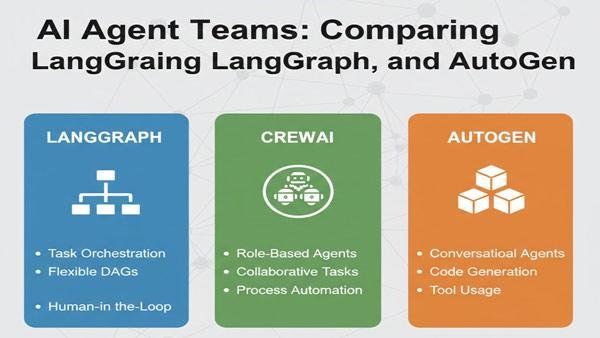
LangGraph takes a graph-first approach. Workflows are directed graphs where nodes represent functions or agent actions, edges define transitions, and state is explicitly tracked. This provides explicit control flow, easier debugging, and handles complex workflows well.
Companies like LinkedIn and Uber run LangGraph in production. It excels in regulated industries requiring audit trails, multi-step reasoning tasks, and sophisticated error recovery.
CrewAI: Role-Based Task Execution
CrewAI models agent teams with defined roles and responsibilities, inspired by human organizational structures. You define agents with specific roles, assign tasks, create crews, and define processes.
CrewAI raised $18M and claims 60% Fortune 500 adoption. It works best for defined workflows, domain-specific teams, and rapid prototyping. The YAML-driven configuration lowers barriers to experimentation.
AutoGen: Conversational Collaboration
Microsoft’s AutoGen frames multi-agent coordination as conversation. Agents are conversational participants exchanging messages asynchronously. Roles emerge from context, and termination conditions end discussions.
AutoGen excels at dynamic tasks, human-in-the-loop workflows, and iterative refinement. For Microsoft ecosystem organizations using Azure and .NET, AutoGen integrates seamlessly.
Practical Decision Framework
Choose LangGraph for complex stateful workflows requiring precise control. Choose CrewAI for role-based teams with defined task sequences. Choose AutoGen for dynamic conversations and human-in-the-loop scenarios.