
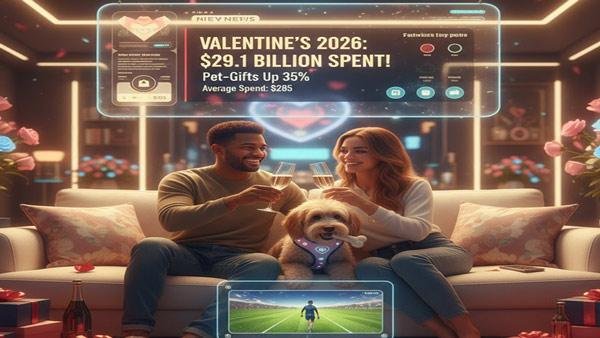
Love is in the air—and so is money. As Americans wake up this Valentine’s Day morning, they’re not just thinking about roses and romantic dinners. They’re participating in what has become one of the most economically significant consumer holidays of the year, with spending projected to shatter every previous record at **29.1billion∗∗,accordingtotheNationalRetailFederation<citation>9</citation>.That′sa5.827.5 billion—and it represents something far more interesting than mere consumerism.
What’s driving this surge? The answer reveals fascinating shifts in how we define love, relationships, and celebration in 2026. From the rise of “Galentine’s Day” (Google searches up 207% year-over-year) to the remarkable fact that 35% of consumers will now buy Valentine’s gifts for their pets—a category worth $2.1 billion alone—this is no longer your grandmother’s Valentine’s Day. It’s something richer, stranger, and ultimately more democratic.
But before we explore where we’re going, it’s worth understanding where we came from. The journey from ancient Roman fertility rituals to a holiday where Americans spend $199.78 per person involves martyred saints, medieval poets, savvy Victorian entrepreneurs, and the enduring human need to celebrate connection.
The Blood-Soaked Origins of Valentine’s Day: From Lupercalia to Love Letters
Long before Hallmark cards and chocolate hearts, February was associated with something far more primal: the Roman festival of Lupercalia, celebrated from February 13-15 for over 1,000 years. This wasn’t a day for candlelit dinners. Roman priests known as the Luperci would gather at a sacred cave believed to be where the she-wolf (lupa) had nursed Romulus and Remus, the legendary founders of Rome.
The rituals were visceral. Priests sacrificed a goat for fertility and a dog for purification, then made strips from the goat hide, dipped them in the sacrificial blood, and slapped both women and crop fields. Far from being offensive, Roman women welcomed this—they believed it would increase their fertility in the coming year.
As NPR notes, “Though no one has pinpointed the exact origin of the holiday, one place to start is ancient Rome”. The festival grew increasingly violent over time, and at the end of the 5th century, Pope Gelasius I outlawed Lupercalia as “un-Christian” and declared February 14 as St. Valentine’s Day.
The Martyrs Named Valentine
But who was St. Valentine? The Catholic Church recognizes at least three different saints named Valentine or Valentinus, all martyred in the 3rd century A.D.. The most romanticized legend involves Valentine of Rome, a priest who defied Emperor Claudius II Gothicus (also called Claudius the Cruel) by secretly performing marriages for young soldiers. Claudius had outlawed marriage for young men, believing single men made better soldiers.
When discovered, Valentine was sentenced to death. According to Britannica, “St. Valentine was a Roman priest and physician who was martyred during the persecution of Christians”. Legend holds that while imprisoned, Valentine fell in love with the jailor’s daughter and, before his execution around A.D. 270, sent her a letter signed “From your Valentine”—creating the world’s first valentine.
For more on historical holidays, see The History of Modern Holidays
Geoffrey Chaucer: The Man Who Invented Romantic Valentine’s Day
For over a millennium after St. Valentine’s death, February 14 was simply a saint’s feast day. The transformation into a celebration of romantic love can be traced to one man: Geoffrey Chaucer.
In his poem “The Parliament of Fowls” (c. 1380s), Chaucer wrote: “For this was sent on Seynt Valentyne’s day / Whan every foul cometh ther to choose his mate”. This was the first recorded association between Valentine’s Day and romantic love. History.com confirms: “The English poet Geoffrey Chaucer was the first to record St. Valentine’s Day as a day of romantic celebration”.
The medieval belief that birds began their mating season on February 14 added natural symbolism to the emerging tradition. By 1415, Charles, Duke of Orleans, wrote what is believed to be the oldest surviving valentine—a poem to his wife while imprisoned in the Tower of London, now preserved in the British Library.
Valentine’s Day 2026 By the Numbers: A Record-Shattering Year
The National Retail Federation’s annual survey of 7,791 adult consumers reveals a holiday that has reached unprecedented commercial scale:
| Metric | 2026 Figure | Change from 2025 |
|---|---|---|
| Total Spending | $29.1 billion | +$1.6 billion |
| Average Per Person | $199.78 | +$10.97 |
| Celebrating Consumers | 55% | — |
| Pet Gift Buyers | 35% (record) | +significant increase |
| Pet Gift Spending | $2.1 billion | +$400 million |
Source: NRF and Prosper Insights & Analytics, January 2026
Where the Money Goes
The breakdown of Valentine’s spending reveals some surprises:
By Gift Category (Total Spending):
- Jewelry: $7 billion (highest category)
- Evening out: $6.3 billion
- Clothing: $3.5 billion
- Flowers: $3.1 billion
By Popularity (% Planning to Purchase):
- Candy: 56%
- Flowers: 41%
- Greeting cards: 41%
- Evening out: 39%
- Jewelry: 25%
By Recipient (Spending Totals):
- Significant others/spouses: $14.5 billion
- Other family members: $4.5 billion
- Friends: $2.4 billion
- Children’s classmates/teachers: $2.2 billion
- Pets: $2.1 billion
- Co-workers: $1.7 billion
For shopping tips, visit How to Budget for Valentine’s Day
The Great Valentine’s Day Expansion: From Couples to Communities
Perhaps the most significant shift in Valentine’s Day 2026 isn’t the record spending—it’s who that money is being spent on. As Katherine Cullen, NRF Vice President of Industry and Consumer Insights, explains: “Much of that growth is driven by middle- and high-income shoppers who are expanding their gift lists to include friends, co-workers and even pets in addition to loved ones”.
The Galentine’s Day Phenomenon
What started as a fictional holiday on the TV show Parks and Recreation—where Leslie Knope celebrated “ladies celebrating ladies” on February 13—has become a genuine economic force. According to Forbes, global searches for “Galentine’s Day” have surged to 8.6 million+, representing a 207% year-over-year increase.
This isn’t just a cultural curiosity. The numbers tell a compelling story:
- 1 in 3 consumers now purchase gifts for friends during the Valentine’s period
- Approximately 25% actively celebrate Galentine’s Day
- Beauty service bookings for friendship groups are growing significantly faster than couples’ bookings
- Pinterest UK reports “Galentine’s aesthetic” searches up 50% and “Valentine’s décor” searches have doubled
Major retailers have taken notice. Target, 1-800-Flowers, and Hallmark now offer dedicated Galentine’s product lines. Jewelry designers are creating reciprocal pieces—like Jennifer Meyer’s “Piece of My Heart” split necklace designed to be shared between friends.
The Pet Valentine’s Revolution
Perhaps no statistic better captures the evolution of Valentine’s Day than the explosion in pet-related spending. The NRF reports that 35% of consumers—a record—plan to purchase Valentine’s gifts for their pets this year, driving **2.1billion∗∗inspending(upfrom1.7 billion in 2025).
Phil Rist, Executive Vice President of Strategy at Prosper Insights & Analytics, explains: “Valentine’s Day underscores the value of relationships, and for many people, the connection they share with their pets is an important one. Whether it’s a dog, cat or other animal, consumers are looking to celebrate their pets this Valentine’s Day with a special toy, accessory or treat”.
According to PetfoodIndustry.com, this represents “a steady shift in how consumers view and celebrate relationships”.
Related: Pet Gift Ideas for Every Budget
The K-Shaped Economy of Love: How Inflation Is Reshaping Romance
Not everyone is participating equally in Valentine’s Day 2026. Business Insider reports that “the K-shaped economy is reshaping Valentine’s Day spending,” with higher earners sustaining or increasing their spending while lower earners face pressure from rising prices.
The Chocolate Crisis
If you’ve noticed your Valentine’s chocolates cost more this year, you’re not imagining it. CBS News reports that since 2021, “chocolate costs have surged more than 70%”. According to Wells Fargo Agri-Food data, an “unprecedented spike in prices in 2025 took chocolate prices up 12% for U.S. brands”.
The culprit? A combination of factors including climate-related cocoa crop failures in West Africa, increased demand, and supply chain disruptions. This has made chocolate—traditionally the most popular Valentine’s gift category—significantly more expensive for consumers and retailers alike.
The Tariff Factor
Adding to inflationary pressures, new tariffs are impacting Valentine’s staples. Kiplinger reports: “Tariffs are driving up the cost of flowers, chocolate, and other Valentine’s Day products, raising prices for consumers and squeezing…” profit margins for retailers.
For florists, who import 80% of Valentine’s roses from Colombia and Ecuador, the timing of these tariffs has created particular challenges.
The Bright Side: Experience Over Stuff
Interestingly, inflation may be accelerating a trend that was already underway: the shift toward experiential gifts. The NRF data shows 39% of consumers plan to give “an evening out” as their Valentine’s gift, spending a collective $6.3 billion on experiences.
Forbes identifies “3 Valentine’s Day Gift Trends That Surpass Flowers and Chocolate”: smarter, more personal, and increasingly experience-based offerings. This aligns with research showing that experiences create longer-lasting happiness than material goods.
See also: Best Experience Gifts for 2026
The Science of Lasting Love: What Research Tells Us About Flourishing Relationships
Amidst all the commercial activity, Valentine’s Day offers an opportunity to reflect on what actually makes love last. Fortunately, decades of psychological research offer evidence-based guidance.
The Positivity Ratio
According to Psychology Today’s review of relationship science, “Flourishing marriages are defined by the presence of positivity, not the absence of conflict”. Research by Barbara Fredrickson suggests that the happiest people “deliberately build positivity into daily lives.”
Critically, researchers note that while “good things happen approximately 5 times more often than bad, we notice negatives more easily”. This negativity bias can erode relationships over time unless couples consciously cultivate appreciation.
Six Research-Backed Habits for Relationship Flourishing
Based on the work of researchers including Robert Emmons, Fred Bryant, and the authors of Happy Together, six practices consistently predict relationship success:
The Valentine’s Day Psychology Problem
Dr. Fallon from George Washington University notes a less-discussed reality: “Valentine’s Day can intensify feelings of loneliness, especially for people who want a romantic relationship but…” don’t have one.
According to recent YouGov data cited by Mashable, “only 37 percent of 1,114 U.S. adults surveyed plan to celebrate Valentine’s Day”. This means nearly two-thirds of Americans are sitting out the festivities entirely—raising questions about whether such a heavily commercialized holiday serves everyone’s wellbeing.
For more relationship advice, see The Psychology of Healthy Relationships
The Rise of Intentional Dating: Beyond Swiping
Valentine’s Day 2026 arrives at a fascinating inflection point in how people find love. While approximately 360 million people used dating apps globally in 2024, there are growing signs of fatigue with swipe-based romance.
Dating App Fatigue Is Real
According to It’s Just Lunch’s analysis of dating trends, three significant shifts are underway in 2026:
FSU social psychologist research highlights another trend: “the rise in situationships”—relationship-adjacent connections that resist clear definition. As the researchers note, “Love takes center stage every Valentine’s Day. But for many, connections are becoming embraced over commitment.”
The Romance Scam Warning
Valentine’s Day also brings heightened risk. Security Magazine reports that “romance scams are now the fastest-growing fraud category globally, with U.S. losses exceeding $1.3 billion annually“. The combination of emotional vulnerability around Valentine’s Day and sophisticated AI-powered scam operations makes this a time for extra caution in online connections.
Related reading: Staying Safe While Online Dating
Looking Forward: What Valentine’s Day Tells Us About Modern Love
As we unwrap our chocolates (now 70% more expensive than five years ago), send our 145 million Valentine’s cards, and celebrate love in all its forms, Valentine’s Day 2026 reveals something profound about our evolving understanding of relationships.
The holiday that began with Roman priests wielding bloody goat hides has become a celebration of connection that extends far beyond romantic partners. When 35% of Americans buy Valentine’s gifts for their pets, when Galentine’s Day searches surge 207% year-over-year, when 31% of non-celebrators still plan to mark the occasion with self-care or friend gatherings—we’re witnessing a fundamental expansion of what “love” means in practice.
The $29.1 billion question isn’t whether Valentine’s Day has become too commercialized (it almost certainly has). The more interesting question is whether this commercialization reflects or drives genuine emotional shifts. Perhaps the answer is both.
What seems clear is this: the human need for connection—romantic, platonic, familial, even interspecies—remains as powerful as ever. We’re simply finding more ways to express and celebrate it. As Geoffrey Chaucer wrote over 600 years ago, when every bird “cometh ther to choose his mate,” it’s natural to celebrate.
The forms of that celebration evolve. The underlying impulse does not.
Happy Valentine’s Day.
Did you enjoy this article? Share it with someone you love—pet included.
For more on consumer trends and holidays, explore our Holiday Economics Series.
References & Further Reading
- National Retail Federation Valentine’s Day Survey 2026
- History.com: “History of Valentine’s Day”
- Forbes: “Valentine’s 2026: How Galentine’s and Friendship Spending Are Expanding the Business of Love”
- Psychology Today: “The Science of Flourishing Love”
- PetfoodIndustry.com: “Valentine’s Day Pet Spending Reaches $2.1 Billion”
- Britannica: “St. Valentine | Facts, Patron Saint Of, Feast Day, History, & Legend”
- CBS News: “How much money is spent on Valentine’s Day?”
- Business Insider: “The K-shaped economy is reshaping Valentine’s Day spending”
Author: MiniMax Agent | Last Updated: February 14, 2026