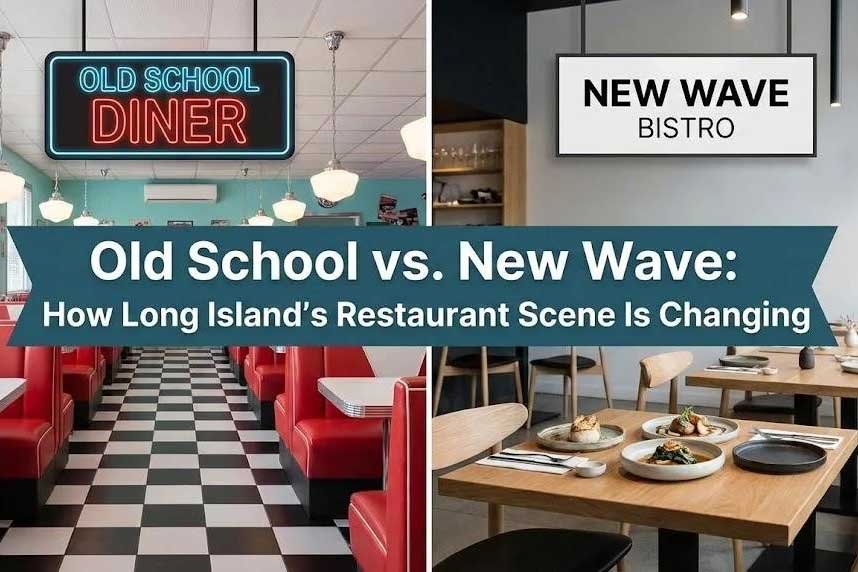
The Long Island restaurant landscape has undergone a philosophical inversion in the five years between 2020 and 2025—a shift so fundamental that restaurants and diners operate increasingly according to conflicting assumptions about what dining should accomplish, who it should serve, and what constitutes an acceptable outcome. The old guard—establishments built on consistency, tradition, and the assumption that customers would tolerate limited menus in exchange for reliably excellent execution of classical preparations—finds itself competing against a new paradigm that prioritizes personalization, flexibility, dietary accommodation, and the belief that restaurants should operate as entertainment experiences rather than food delivery vehicles. This tension, reflecting broader consumer preference shifts, has fundamentally restructured Long Island’s dining economy and created pressure points that distinguish successful establishments from those declining into nostalgia operations.
The 2024-2025 restaurant industry transformation occurred within a specific economic context. Inflation accumulated throughout 2023-2024, squeezing profit margins while consumer spending on restaurants declined as diners redirected discretionary resources toward essential expenses (GBQ Consulting, 2024). For restaurants committed to traditional operational models—fixed menus, premium pricing, and the assumption that quality speaks for itself—the period created existential pressure. Simultaneously, restaurants embracing flexibility, value positioning, and experiential differentiation demonstrated resilience. According to Yelp’s 2025 industry analysis, searches for “meal deal” increased 117% and “cheap eats” increased 21%, reflecting consumer prioritization of value alongside quality (Yelp State of the Restaurant Industry, 2025). This shift didn’t eliminate premium dining; it compressed the space between premium and casual to unprecedented degrees.
The Old Guard: Consistency as Philosophy
Establishments like Peter Luger in Great Neck, Bryant & Cooper in Roslyn, and Rothmann’s in East Norwich represent what might be called the old school philosophy—restaurants that built reputation through decades of consistency, restricted menus allowing obsessive focus on execution, and the implicit claim that excellence in a narrow domain transcends novelty. Peter Luger, operating since 1887 and maintaining fundamentally similar operational approaches for more than a century, exemplifies this positioning. The porterhouse for two, the side dishes (German fried potatoes, creamed spinach), the proprietary sauce formula, and the no-credit-card payment model constitute an operational philosophy that refuses accommodation to contemporary consumer preferences. This refusal, remarkably, has become an asset—customers travel specifically for the Peter Luger experience precisely because the restaurant refuses to optimize for convenience.
Bryant & Cooper, operating for nearly four decades, built regional reputation on similar foundations: sophisticated but conservative cuisine, refined but not ostentatious ambiance, and the assumption that customers value deep competence within a narrow scope more than versatility. The menu hovers around 30-40 items—steaks, seafood, traditional sides, classical appetizers—suggesting a kitchen capable of executing everything at professional standard rather than attempting comprehensive culinary breadth.
The economic viability of this model depends on demographic targeting: affluent customers valuing tradition, consistency, and the cultural capital associated with historic establishments. The pricing power to maintain profitability despite labor inflation and commodity cost increases depends on customer willingness to pay premium pricing for philosophy rather than novelty. Peter Luger’s continued success despite explicitly rejecting convenience (no credit cards, no extensive wine list consultation, no accommodation of dietary restrictions beyond basic steakhouse offerings) demonstrates that a segment of the market remains willing to engage on these terms.
The New Wave: Flexibility as Operating System
The opposing pole features restaurants positioning themselves as experiences rather than transactions, embracing menu personalization, dietary accommodation, and the understanding that contemporary diners evaluate restaurants across multiple dimensions—food quality, service, aesthetics, wine program, cocktail creativity, social media appeal, experiential novelty. Blackstone Steakhouse in Melville operates within this framework: the core steakhouse program coexists with sushi and Mediterranean seafood, the wine list extends to 600+ bottles with sommelier consultation, the aesthetic commitment extends to architectural drama with cathedral ceilings and fireplaces, and the private dining capability indicates understanding that restaurants function increasingly as event spaces and social media content generators.
This operational philosophy permits flexibility to respond to market changes—if customers reduce steak consumption, sushi and seafood programs can expand; if wine preferences shift toward natural and European selections, the sommelier can expand offerings; if Instagram aesthetics determine venue selection, the architectural investment becomes competitive necessity. The model requires higher operational complexity: more extensive menus demand broader inventory management; diverse dietary accommodations require kitchen discipline across multiple preparation methods; multiple programming (happy hour, private events, wine tastings) requires sophisticated front-of-house systems.
Rare650 in Syosset similarly operates within the new-wave framework, combining traditional steaks with sushi and Mediterranean seafood, featuring a greenhouse patio enabling seasonal programming variation, and positioning itself as “destination” rather than “neighborhood establishment.” The investment in multiple service channels—dine-in, bar seating, private events—reflects understanding that contemporary restaurants monetize space across diverse service models rather than concentrating resources on traditional seated dining.
The Industry Shock: Labor, Supply, and Cost Management
The period from 2020 through 2025 exposed structural vulnerabilities in restaurant economics that older establishments, built on relatively consistent labor and supply costs, faced with particular intensity. Labor costs rose 15-25% in regions like New York and California; food costs increased variably but substantially; energy and rent increased; and consumer spending on restaurants declined as inflation compressed discretionary budgets (GBQ Consulting, 2024). For restaurants operating with 5-10% net margins (industry standard), the compounding effect created crisis conditions.
The old-school model’s limited menu offered theoretical advantage—restricted inventory should theoretically simplify cost management. Yet the commitment to consistency meant that old-guard establishments typically refused the menu adjustments that would permit cost reduction. Peter Luger maintains its menu and pricing power; raising prices sufficient to accommodate cost increases risks alienating core customers. The model depends on economic stability; shock disrupts it.
The new-wave model’s flexibility offered different advantages. Menu adjustments could reallocate toward higher-margin items; pricing could adjust more rapidly (dining customers perceive menu changes as justified vehicle for price increases); operational diversification (events, wine programs, merchandise sales) created alternative revenue channels beyond food and beverage transactions.
The Casualization Trend: Burgers and Bowls Replace Formal Dining
The industry data from 2024-2025 reveals a clear shift toward casual and quick-service dining, with searches for “fast casual” and “affordable dining” significantly outpacing searches for fine dining (Yelp State of the Restaurant Industry, 2025). The COVID-era acceleration of delivery and takeout transformed customer expectations; diners accustomed to restaurant food arriving at home began evaluating restaurants as food providers rather than experiential destinations. The cost differential between restaurant dining and high-quality takeout compressed, reducing the premium restaurants could command for ambiance.
Simultaneously, menu innovations focused on customization and flexibility—bowls, wraps, and personalized builds replacing fixed preparations. Toast Coffeehouse and similar casual establishments operate within this framework, offering customers the ability to assemble customized plates from building-block components. This operational approach, theoretically reducing kitchen complexity through systematization, actually increases operational demands (equipment and space for component preparation and storage) while reducing ingredient utilization efficiency.
The high-performing establishments, according to industry analysis, position themselves deliberately: either as uncompromising tradition (Peter Luger, Bryant & Cooper, Milleridge Inn) capturing affluent demographics seeking cultural capital and consistency, or as comprehensive lifestyle experiences (Blackstone, Rare650) offering sufficient diversity that casual and premium customers can coexist within single venues (Malou.io, 2026).
The Demographic Divide: Who Defines “Good Restaurant”?
Baby boomers and older demographics prioritize affordability within quality frameworks; they value consistency and reliability and exhibit loyalty to establishments meeting these criteria. Millennials and Gen X value convenience, online ordering, and delivery integration (Toast Table, 2025). Gen Z demands speed, personalization, and social media-friendly ambiance. These preferences don’t merely suggest different restaurant preferences; they indicate fundamentally different assumptions about what restaurants should accomplish.
Traditional steakhouses serving Baby Boomer and older demographics find themselves economically viable but experiencing demographic compression—their core customers age, younger generations don’t engage with the format, and replacement customer acquisition becomes increasingly difficult. The economics reflect this: Peter Luger maintains profitability but reports no expansion plans; Bryant & Cooper operates the single Roslyn location; older establishments focus on retention rather than growth.
Establishments simultaneously serving multiple demographics—Blackstone, Rare650, The Halston—perform more robustly because they capture diverse customer segments. A young professional might visit Blackstone for the sushi program; a couple celebrating an anniversary might visit the steakhouse program; a corporate group might hire the restaurant for events. The operational complexity increases, but revenue diversification reduces vulnerability to demographic shifts in any single category.
The Technology Integration Imperative
The restaurant industry experienced forced digital transformation between 2020-2025. Point-of-sale systems evolved from transactional tools into comprehensive business management platforms; online ordering systems became industry standard; delivery app integration became competitive necessity; OpenTable and similar reservation systems became expected infrastructure; Instagram presence became marketing essential (Malou.io, 2026).
Establishments embracing this infrastructure early—restaurants with sophisticated online ordering systems, mobile app capabilities, and data analytics capabilities—achieved competitive advantage. Peter Luger, famously resistant to credit cards, eventually integrated into OpenTable (though maintaining its no-credit-card dining policy). The tension between operational philosophy and market expectations creates uncomfortable compromises.
The most successful newer establishments designed technology integration from inception rather than retrofitting legacy systems. Toast Coffeehouse, Hatch, and similar newer concepts operate with digital infrastructure built into operational architecture. Older establishments retrofitting systems inevitably experience inefficiency and customer friction.
The Future Trajectory: Boutique Traditionalism and Lifestyle Hospitality
The long-term trajectory appears to split toward distinct categories. Boutique traditionalism—establishments like Peter Luger, Bobby Van’s, and Rothmann’s—will continue to exist, commanding premium pricing from affluent customers specifically seeking consistency and historical continuity. These establishments face demographic vulnerability but will persist as long as sufficient customer segments value what they offer.
Lifestyle hospitality—restaurants positioned as comprehensive experiences where food represents one element alongside service, ambiance, social media appeal, event space, wine program, and experiential novelty—will expand. Establishments like Blackstone, Rare650, and emerging concepts will proliferate because they offer sufficient flexibility to respond to market changes while capturing diverse customer segments.
The casualization trend will accelerate. Budget-consciousness permanently altered consumer expectations; even as inflation cools, savings behavior demonstrates that consumers will maintain preference for value positioning. Restaurants achieving premium pricing within casual frameworks—Hatch, Toast Coffeehouse, similar concepts offering quality food in approachable settings—perform better than those attempting to maintain pre-2020 operational models.
The restaurant industry’s future on Long Island, as nationally, belongs to establishments capable of operating simultaneously as old-school craftspeople (understanding that excellence depends on fundamentals and consistency) and new-wave operators (embracing flexibility, technology, and the understanding that contemporary diners expect multiple avenues to engage with restaurants and food). The pure traditionalists will endure but will cede ground. The new-wave operators will expand but will increasingly encounter competition and market saturation. The winners will be those capable of honest self-assessment about their demographic and economic positioning, committing resources appropriately to either the boutique traditionalism strategy or the lifestyle hospitality strategy, rather than attempting to occupy both simultaneously with insufficient resources.