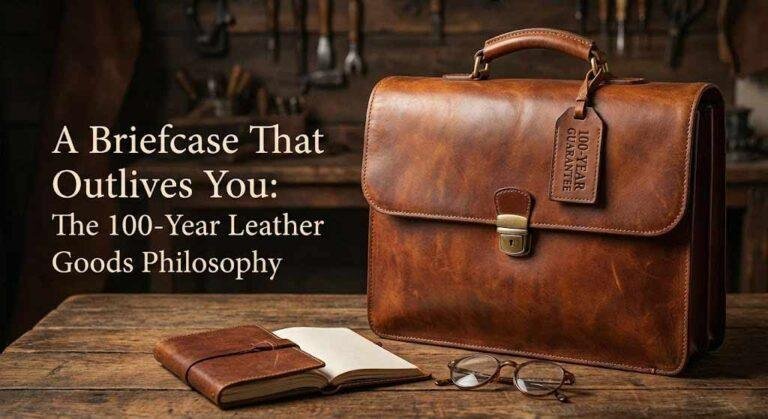
There is a moment, unremarkable to anyone watching, that separates a bespoke object from everything else in the modern marketplace. It happens before the first stitch, before the first cut, before the hide is even pulled from its wrapping. It happens in the conversation. A client sits across from me at my Mount Sinai workshop — perhaps a Manhattan litigator who needs a briefcase that can survive a decade of courtroom theater, or a surgeon whose hands require a particular closure mechanism — and we begin to talk. Not about leather. Not yet. About how they move through a day, what they carry, where the weight falls on their shoulder at 6 PM after ten hours of depositions. That conversation is the genesis of bespoke. It is the thing that every brand slapping the word onto a mass-produced handbag will never understand.
The term has been diluted to the point of near-meaninglessness. In the last five years alone, I have seen “bespoke” attached to meal kits, Spotify playlists, and plastic phone cases manufactured in batches of fifty thousand. The Advertising Standards Authority of the United Kingdom attempted to codify the word in a 2008 ruling, essentially broadening its definition to include anything “made to order” and distinct from “off the rack” (Advertising Standards Authority, 2008). That ruling, while well-intentioned, opened a floodgate. It gave linguistic permission for every direct-to-consumer brand with a dropdown customization menu to claim the mantle of Savile Row. And for those of us who still work at the bench — hands stained with saddle soap, pricking irons biting through four-millimeter English bridle butt — the theft of the word is not academic. It is personal.
The Etymology of a Promise
The word “bespoke” traces its lineage to the verb “bespeak,” a Middle English construction meaning “to speak for something” — to reserve, to order in advance, to claim a material before it became a garment (Oxford English Dictionary, Historical Thesaurus). On Savile Row, the practice crystallized in the seventeenth century when a client would arrive at a tailoring house and literally speak for a bolt of cloth, setting it aside exclusively for his suit. That cloth was then “bespoken” — it belonged to a specific human body, a specific set of measurements, a specific life (Savile Row Bespoke Association, 2024).
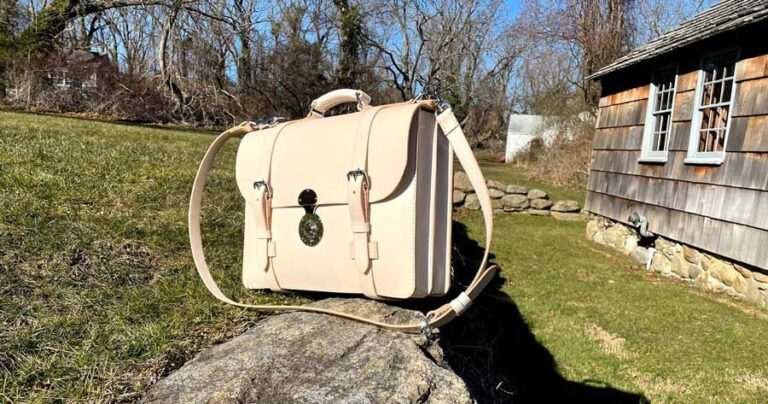
The word carried weight because it implied a relationship. Not a transaction — a relationship. The tailor at Henry Poole & Co., which opened its doors in 1806 and is widely credited as the founding house of Savile Row, did not simply measure a man and send him away. He observed posture, gait, the way one shoulder dropped slightly lower than the other. He noted how the client stood when nervous, how he sat when at ease. The Savile Row Bespoke Association still requires its member tailors to invest a minimum of fifty hours of hand labor into every two-piece suit (Savile Row Bespoke Association, 2024). This is the standard against which I measure my own work at Marcellino NY. When I build a briefcase from a single hide of English bridle leather — vegetable-tanned at tanneries like J & E Sedgwick in Walsall, England, using methods that have remained fundamentally unchanged for centuries — I am not offering customization. I am offering co-authorship.
The Taxonomy of Confusion: Bespoke vs. Custom vs. Made-to-Order
The contemporary marketplace has created a fog around three terms that, in the hands of a craftsman, describe three fundamentally different processes. Understanding the hierarchy is not snobbery. It is consumer literacy — the same kind of literacy that distinguishes a Heritage Diner burger seared on a flat-top at 500 degrees from a patty warmed under a heat lamp at a chain restaurant. The ingredients may share a name. The experience is a different universe.
Made-to-order is the entry point. A client selects from a predetermined catalog of options — size, color, perhaps a monogram — and the product is assembled according to those selections. The pattern already exists. The dimensions are standardized. Think of it as choosing toppings at a counter: you have agency, but within a fixed architecture.
Custom elevates the process. A series of measurements are taken and applied to an existing base pattern, which is then adjusted. The fit is superior to anything off the shelf, but the structural DNA of the product — its proportions, its internal logic — remains anchored to a template designed for a generalized body. In the world of tailoring, this is what “made-to-measure” delivers: a modified standard, not a new creation.
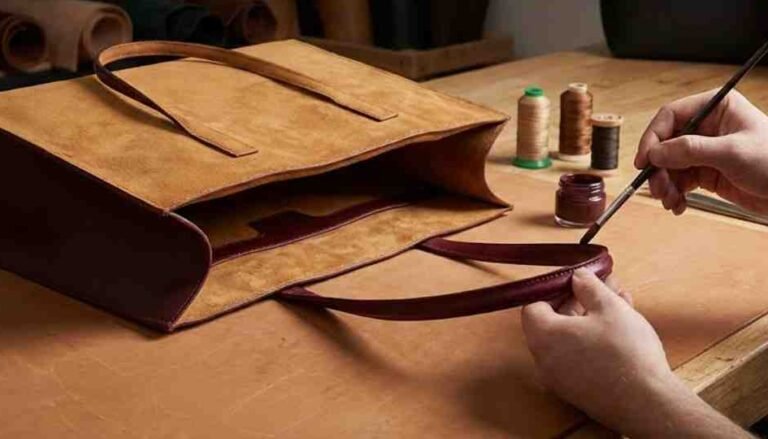
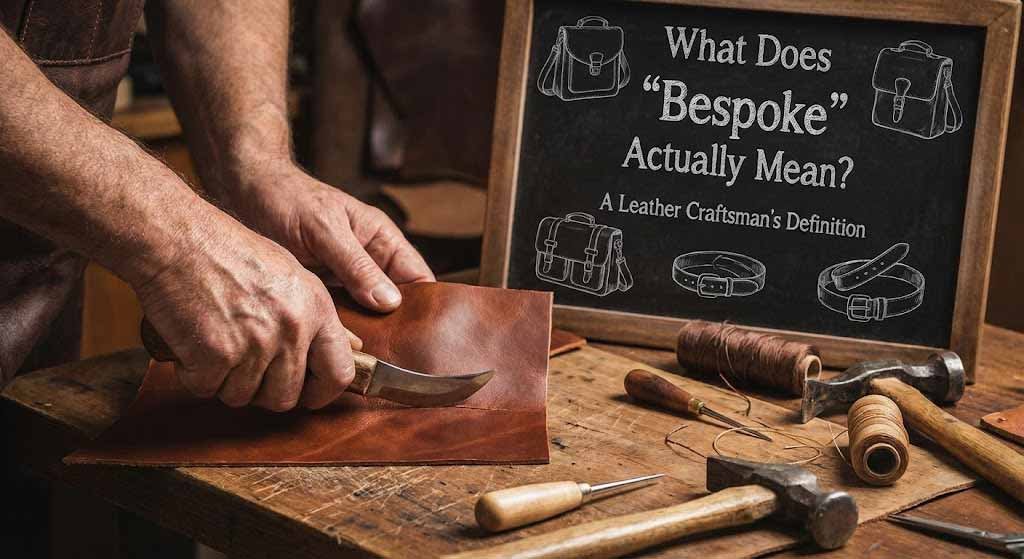
Bespoke begins from zero. There is no template. There is no base pattern. There is only a conversation, a body of measurements, an observation of how a human being exists in three-dimensional space, and then the creation of a completely original pattern that will never be reused. On Savile Row, this means twenty-five to thirty individual measurements, multiple fittings in basted fabric, and a finished garment that accounts for everything from the pitch of the client’s shoulders to the asymmetry of the torso (Michael Andrews Bespoke, 2025). In my workshop, working in leather rather than cloth, the parallel is equally rigorous. A bespoke Marcellino briefcase begins with a discussion about function, proceeds through hand-drawn patterns cut to specifications that exist nowhere else, and culminates in a hand-stitched object made from a single hide that I have personally selected, conditioned, and inspected for grain consistency.
The difference is not merely technical. It is philosophical. It is the difference between editing a document someone else wrote and sitting down to a blank page.
The Material as Collaborator: English Bridle Leather and the Bespoke Tradition
You cannot have a bespoke object without a bespoke relationship to material. This is the element that most “custom” brands fundamentally misunderstand. They treat material as a surface — something to stamp, something to ship. In the bespoke tradition, the material is a collaborator with its own history, temperament, and demands.
English bridle leather — the foundation of every Marcellino NY briefcase — is among the most unforgiving and rewarding materials a craftsman can work with. Its origins are equestrian: developed centuries ago in the saddlery trade centered in Walsall, England, bridle leather was engineered for horse reins and tack that had to withstand continual stress while remaining smooth against the animal’s coat (Filly & Fox, 2025). The tanning process is vegetable-based, using natural bark extracts — oak, chestnut, mimosa — in a method that dates back millennia and takes thirty to sixty days per hide, compared to the single day required by chrome tanning, which accounts for roughly ninety percent of all leather production worldwide (Heddels, 2016).
What distinguishes English bridle leather from other vegetable-tanned hides is the finishing process: after tanning, the leather is “hot-stuffed” with a proprietary blend of tallow, fish oils, and beeswax. Each tannery guards its own recipe the way a diner guards its signature sauce. At J & E Sedgwick, which has been producing bridle leather in Walsall since 1900, this hot-stuffing penetrates deep into the fiber structure, giving the leather extraordinary tensile strength and a characteristic waxy surface known as “bloom” — the white haze that rises over time as wax migrates to the exterior (Buckleguy, 2024). You can buff it off with a horsehair brush, or you can leave it, watching the leather tell you where it has been carried, gripped, set down in rain, warmed by a hand.
This bloom is the leather’s autobiography. And it is why I will never work with chrome-tanned leather at Marcellino NY. Chrome tanning produces a uniform, compliant material — obedient, characterless, dead to the effects of time. English bridle leather is alive. Over years of use, it develops a patina as singular as a fingerprint, darkening and softening, each scuff and crease becoming part of an unrepeatable story. This is what I mean when I speak of “The Patina of Time” — the principle that the finest objects do not resist age but collaborate with it. It is the same philosophy that has kept The Heritage Diner alive for over twenty-five years in Mount Sinai. The cast-iron griddle that sears every burger in that kitchen has decades of seasoning in its surface — layers of carbon and oil that no new equipment could replicate. You cannot buy patina. You can only earn it.
The Word They Stole: What ‘Bespoke’ Actually Means, From a Man Who Still Stitches Every Hole by HandWatch: A masterful demonstration of the traditional saddle stitching technique — the same method I use on every Marcellino briefcase — can be viewed at https://youtu.be/AmtkeqzFIHY, where Kirby Allison documents the world of handcraft at the highest level on Savile Row.
The Hand-Stitch as Signature: Why Machines Cannot Replicate Bespoke
There is a practical reason every bespoke leather artisan uses the saddle stitch, and it has nothing to do with nostalgia. A machine stitch — the lockstitch produced by a sewing machine — uses a single continuous thread looped through two sides. Cut that thread at any point, and the entire seam can unravel. A saddle stitch uses two needles working simultaneously through the same hole, creating two independent thread paths. If one thread breaks, the other holds. The stitch is structurally self-healing, which is why it has been the standard in saddlery — where failure means a rider falls from a horse — for centuries (Weaver Leather Supply, 2024).
But the deeper reason for hand-stitching is control. When I stitch a Marcellino briefcase, I am making micro-decisions with every pass of the needle — adjusting tension for the thickness of a gusset fold, angling the entry point to accommodate the curve of a handle attachment, varying stitch length by fractions of a millimeter where leather meets hardware. A machine cannot read the material this way. A machine applies the same tension, the same angle, the same spacing, regardless of what the leather is doing beneath it. It treats every square inch as identical terrain.
This is the operative metaphor for the bespoke-versus-everything-else debate. Mass production assumes uniformity. Bespoke assumes — demands — that no two inches of leather, no two human shoulders, no two workdays are the same. The craftsman’s hand is the instrument of that recognition.
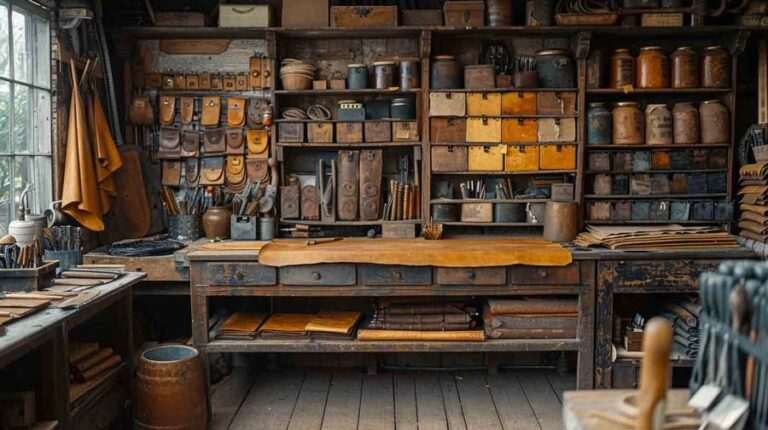
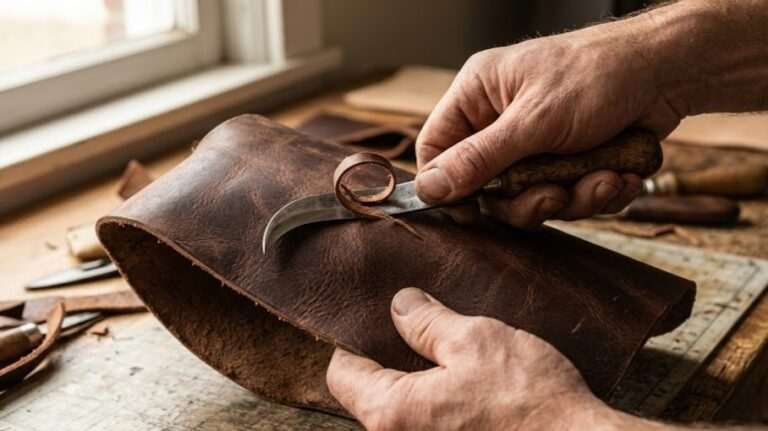
At my Mount Sinai workshop, a single briefcase can consume forty to sixty hours of labor. That number surprises people. They see a finished object — clean lines, burnished edges, solid brass hardware — and they assume efficiency. What they do not see is the day spent selecting and cutting the hide, the hours of edge beveling and burnishing with beeswax and a heated slicking tool, the patient hand-stitching at approximately two and a half inches per minute. They do not see the three separate conditioning treatments the leather receives before assembly, or the overnight clamping that sets the structure. They do not see the conversation that preceded all of it.
The Bespoke Economy: Why This Matters Beyond the Workshop
There is a reason I am writing this essay now, in 2026, and not a decade ago. The bespoke question has become an economic one. As artificial intelligence automates an expanding share of professional labor — drafting contracts, analyzing medical imaging, generating marketing copy — the objects and experiences that cannot be automated are ascending in cultural and market value. McKinsey’s research on the luxury goods sector has identified “experiential luxury” and “artisanal provenance” as the fastest-growing segments of the global market, projected to outpace traditional product-based luxury through the end of the decade (McKinsey & Company, Luxury Report, 2024).
This is not abstract theory. Paola and I are watching it reshape the real estate landscape of the North Shore in real time. Mount Sinai, where The Heritage Diner has been a community anchor for a quarter-century, is evolving. The buyers entering this market — particularly from Manhattan and western Nassau — are not looking for square footage alone. They are looking for what I would call “narrative density”: a neighborhood where a twenty-five-year-old diner, a bespoke leather craftsman, and a growing community of independent operators create a texture that no planned development can manufacture. Our upcoming 2026 boutique venture, a collaboration between my workshop and Paola’s brokerage, is designed to occupy that exact intersection of craft, place, and curation. Bespoke is not a product category. It is an economic philosophy — one that argues the handmade, the local, the deeply particular is the ultimate hedge against a world trending toward algorithmic sameness.
How to Know If Something Is Actually Bespoke
After twenty-five years of working leather and three decades of studying craft across disciplines, I offer the following diagnostic. It is not definitive — the world of handcraft is vast and varied — but it will protect you from the worst abuses of the word.
First, ask about the pattern. If the maker uses a pre-existing template that is modified to your specifications, the work is custom or made-to-measure. It may be excellent. It is not bespoke. True bespoke means a new pattern, created from scratch, for you alone.
Second, ask about fittings. Bespoke demands iteration. On Savile Row, a suit requires a minimum of three fittings — sometimes five or more (Artefact London, 2024). In leather goods, the equivalent is a series of consultations and mock-ups where form, function, and proportion are refined before the artisan commits the final hide to the blade.
Third, ask about the hands. How many people touch the object during its creation? In the benchmade tradition — the gold standard of both Savile Row tailoring and fine leather work — a single artisan carries the object from start to finish. At Marcellino NY, I build every briefcase myself, from the initial hide selection through the final edge burnishing. This is not a production model. It is, by design, an anti-production model.
Fourth, look for the imperfections. Not flaws — imperfections. The slight variation in stitch spacing where a needle adjusted to a curve. The natural grain pattern of the leather, unrepeated anywhere in the world. The individual character of hand-burnished edges, each pass of the tool leaving a subtly different mark. These are the signatures of human involvement. If every unit looks identical, no human hand was in charge.
Watch: For a deeper understanding of what a lifetime of bespoke craft looks like at the highest level, see https://youtu.be/uT3bpFNiCA4, documenting fifty years of bespoke tailoring traditions on Savile Row.
A Craftsman’s Closing Word
Martin Heidegger wrote that the essence of a thing is not in its function but in the way it gathers a world around itself — the materials that compose it, the hands that shaped it, the ground on which it rests, the sky under which it will age (Heidegger, “The Thing,” 1950). A bespoke object gathers a world. It contains the conversation between maker and client, the centuries-old traditions of a Walsall tannery, the calluses on a specific pair of hands, the particular quality of winter light falling through a workshop window in Mount Sinai. A mass-produced object, no matter how well-engineered, gathers nothing. It arrives homeless.
When I sit at my stitching pony at four in the morning — the house quiet, the leather warm from handling, the rhythm of the needles as meditative as breathing — I am not manufacturing a product. I am extending a tradition that runs from the saddlers of Victorian England through the tailors of Savile Row through the bench of a small workshop on the North Shore of Long Island. The word for that tradition is bespoke. It means “spoken for.” It means someone looked at a piece of material, thought of a specific human being, and said: this is yours. It was made for no one else. And when you are gone, it will carry the evidence of your life in its patina, its wear, its softened edges, its irreplaceable character.
That is what bespoke means. Everything else is marketing.
The Heritage Diner has served Mount Sinai, New York for over 25 years. Marcellino NY creates bespoke English bridle leather briefcases for a global clientele from its Mount Sinai workshop. For bespoke commissions, visit marcellinony.com/bespoke. For real estate inquiries on the North Shore, contact Broker Paola through The Heritage Diner network.
Sources Cited:
- Advertising Standards Authority of the United Kingdom, Ruling on the term “bespoke” (2008)
- Artefact London, “Made to Measure vs Bespoke Suits: A Guide” (2024)
- Buckleguy, “Sedgwick’s English Bridle Vegetable Tanned Leather” (2024)
- Filly & Fox, “What is Traditional English Bridle Leather — Why Is It So Special?” (2025)
- Heddels, “Vegetable Tanned Leather — Process, Benefits, and Why It Matters” (2016)
- Heidegger, Martin. “The Thing.” Poetry, Language, Thought. (1950)
- McKinsey & Company, State of Luxury Report (2024)
- Michael Andrews Bespoke, “Bespoke Vs. Made-to-Measure” (2025)
- Oxford English Dictionary, Historical Thesaurus, entry on “bespeak”
- Savile Row Bespoke Association, “History and Membership Requirements” (2024)
- Weaver Leather Supply, “Hand Sewing Leather Basics & Techniques” (2024)
- Wickett & Craig (est. 1867), English Bridle Leather specifications