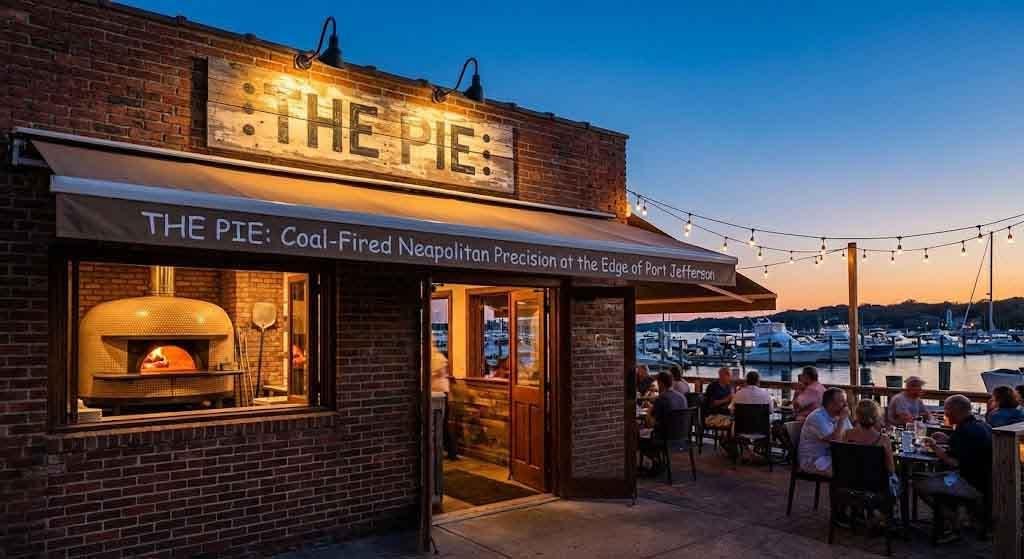
There’s a sound coal makes at 900 degrees Fahrenheit that feels older than the room it’s heating — a low, almost geological hum, as if the anthracite is remembering the Carboniferous age it was born from and briefly singing it back into the air. . It is the sound of deep time compressed into immediate purpose. And at 216 Main Street in Port Jefferson, inside a restaurant that has quietly commanded the respect of Long Island’s North Shore for more than two decades, that sound is the overture to something remarkable: a pizza that honors a lineage stretching from the alleyways of Naples to the coal-dusted brick ovens of lower Manhattan, and now to the edge of a harbor village where shipbuilders once shaped wooden hulls with the same precision their culinary successors now apply to dough.
The Pie is not merely a pizza restaurant. It is a statement of provenance—a coal-fired assertion that in an era of conveyor-belt chains and algorithmic delivery apps, the old methods still produce results that no amount of venture capital can replicate.
A Village Forged by Fire and Water
Port Jefferson has always been a town that understands craftsmanship. Originally known as Drowned Meadow, the village transformed itself into one of Long Island’s most significant shipbuilding hubs during the nineteenth century, constructing massive wooden vessels that helped define America’s maritime commerce (Port Jefferson Historical Society, 2020). The skilled artisans who populated these shipyards understood something that resonates deeply with anyone who has ever watched dough stretch under practiced hands: that materials have memory, that technique is inseparable from tradition, and that the difference between competent and extraordinary lies in the unseen details.
Today, Port Jefferson’s economy has shifted from timber and tar to tourism and hospitality, but the DNA of craft persists. The village’s Main Street descends from the LIRR station toward a harbor that still connects Long Island to Bridgeport, Connecticut via the Bridgeport & Port Jefferson Steamboat Company—a ferry service operating since 1883. More than thirty restaurants now line these walkable streets, but among them, The Pie occupies a singular position: one of the few establishments on Long Island operating an authentic coal-fired oven in the Neapolitan tradition (The Pie of Port Jeff, 2024).
That distinction matters more than most diners realize.
The Coal-Fired Inheritance
To understand what The Pie does requires a brief education in the archaeology of American pizza. In 1905, a Neapolitan immigrant named Gennaro Lombardi adapted his wood-burning brick oven to burn anthracite coal at his grocery store on Spring Street in Manhattan’s Little Italy—an innovation born of pragmatism, not aesthetics (Museum of the City of New York, 2019). Coal was cheaper to transport, occupied less storage space, and burned at ferocious temperatures exceeding 900 degrees, producing a drier baking chamber and a crust that was crisper, more charred, and more structurally distinct than anything a wood-fired oven could achieve.
From Lombardi’s came a diaspora of pizza masters—Antonio “Totonno” Pero, John Sasso, Pasquale “Patsy” Lancieri—each establishing their own coal-fired temples throughout New York. By the 1930s, the gas oven had begun its commercial conquest, and the coal-fired tradition became increasingly rare. In Manhattan, environmental regulations eventually prohibited the installation of new coal ovens; the only way to operate one was to inherit it (Scott’s Pizza Tours, 2023). The coal-fired oven became, in effect, an heirloom—a piece of culinary infrastructure as precious as any antique.
The Pie, established in 2003 in Port Jefferson, carries forward this tradition outside of the city, bringing coal-fired precision to a North Shore village that has historically been underserved by serious pizza craftsmanship. At cooking temperatures ranging from 800 to 900 degrees, the restaurant’s oven transforms dough in minutes—producing a crust that is simultaneously thin, crisp, well-charred, and possessing that elusive interior chewiness that distinguishes coal-fired pizza from every other method of preparation (The Pie of Port Jeff, 2024).
The Menu: Discipline and Generosity
The Pie’s menu reflects a philosophy I understand intimately from twenty-five years behind the counter at The Heritage Diner: do fewer things, but do them with absolute commitment. The coal-fired oven is the centerpiece, but it is not the only instrument.
The Classic Margherita is the benchmark—crispy crust, tomato sauce, fresh mozzarella, basil, pecorino romano, and olive oil. It is the pizza equivalent of a well-made English bridle leather briefcase: no unnecessary embellishments, every element serving a structural and aesthetic function. At Marcellino NY, we often say that the first thing you notice about a great briefcase is that you don’t notice anything—everything simply works. The same principle applies to The Pie’s Margherita.
Beyond the fundamentals, the menu extends into more ambitious territory. The Broccoli Rabe and Sausage pie layers fresh sausage, roasted red peppers, fresh mozzarella, garlic, and parmigiano with or without tomato sauce—a composition that rewards attentive eating. The Clam Pie, featuring littleneck clams prepared with fresh garlic, white wine, fresh mozzarella, and toasted breadcrumbs oreganato, nods to the New Haven apizza tradition that has long been coal-fired pizza’s closest relative (Eat Your World, 2025). The Prosciutto pie—sliced Parma prosciutto with Kalamata olives, artichoke hearts, fresh mozzarella, and tomato sauce—demonstrates the kitchen’s understanding of Italian cured meats and how they interact with extreme heat.
The supporting cast—homemade pastas, salads dressed with balsamic reductions, zucchini fritters that have developed their own following, and the restaurant’s signature Sweetie Pie Sundae for dessert—fills out a menu that serves families and serious food enthusiasts with equal facility. Boylan Bottling Company sodas are a particularly thoughtful touch, signaling that The Pie understands the difference between a beverage program and simply stocking a Coca-Cola cooler.
The Space: Cozy Geometry
Architecture shapes appetite. The Heritage Diner has survived for a quarter century partly because its physical space creates a sense of belonging—what sociologist Ray Oldenburg famously termed “the third place,” that communal gathering ground between home and office (Oldenburg, The Great Good Place, 1989). The Pie understands this principle.
The interior is warm without being kitschy, cozy without being cramped. The dining room maintains what multiple reviewers describe as a moderate noise level—loud enough to feel convivial, quiet enough for actual conversation. The décor favors exposed brick and warm lighting that complements the amber glow emanating from the coal-fired oven. It is the kind of room where a first date feels comfortable and a family gathering feels celebratory.
In warmer months, Port Jefferson Village transforms into one of the North Shore’s premier walking destinations, and The Pie’s Main Street location places it at the epicenter of this seasonal energy. The restaurant sits a short walk from the marina, Theatre Three, and the various galleries and shops that make Port Jefferson a legitimate cultural destination. For visitors arriving via the Bridgeport ferry or stepping off the LIRR at the Port Jefferson terminus, it is a natural first or last stop.
Service and Community
Twenty-two years of continuous operation in a competitive restaurant village tells you everything you need to know about consistency. In this industry, longevity is the only credential that cannot be purchased, fabricated, or marketed into existence. You either earn it daily or you close.
The Pie’s staff is repeatedly cited in reviews for attentiveness and warmth—qualities that reflect ownership priorities. Good service is not a training manual; it is a culture, and culture flows downward from operators who understand that hospitality is not a department but a philosophy. With a 4.6 rating across more than 500 reviews on DoorDash and strong marks on Yelp, TripAdvisor, and Google, The Pie has earned the kind of broad-based approval that indicates consistent execution rather than sporadic brilliance.
The restaurant accommodates reservations, offers both delivery and takeout, and maintains vegetarian and vegan options—practical considerations that demonstrate awareness of how modern diners actually live. Wheelchair accessibility, bike parking, and kid-friendly amenities round out an operation designed for inclusion rather than exclusivity.
Coal, Craft, and the Argument Against Convenience
There is a reason I care about places like The Pie, and it has everything to do with what Paola and I are building with our 2026 boutique real estate venture, Maison Pawli. The argument we make—whether in leather, in hospitality, or in real estate—is that provenance creates value that convenience cannot replicate. A coal-fired oven is not a faster way to make pizza; it is a more intentional way. The temperatures are harder to control, the fuel is more expensive, the learning curve is steeper. Every pie that emerges from that oven represents a deliberate choice to prioritize outcome over efficiency.
In an age when AI-driven dark kitchens and ghost restaurants are flooding delivery apps with optimized mediocrity, a coal-fired pizzeria on Main Street in a historic harbor village is not merely a restaurant—it is a counter-argument. It is the physical manifestation of the same principle that drives every hand-stitched briefcase that leaves the Marcellino NY workshop: that certain things should be difficult to make, because that difficulty is where the quality lives.
The German philosopher Martin Heidegger wrote about the concept of Zuhandenheit—”readiness-to-hand”—the idea that tools reveal their true nature only in use, only when they disappear into the act of making (Heidegger, Being and Time, 1927). The Pie’s coal-fired oven is precisely this kind of tool: invisible to the diner, essential to the experience, and irreplaceable by any modern substitute.
Essential Information
The Pie 216 Main Street, Port Jefferson, NY 11777
Phone: (631) 331-4646
Website: thepieofportjeff.com
Hours: Monday–Thursday: 12:00 PM – 8:30 PM Friday: 12:00 PM – 9:30 PM Saturday: 11:30 AM – 9:30 PM Sunday: 11:30 AM – 8:30 PM
Delivery: Available via DoorDash and Uber Eats
Reservations: Accepted
Price Range: $$
Established: 2003
Features: Coal-fired brick oven, full bar, outdoor seating (seasonal), wheelchair accessible, kid-friendly, vegetarian and vegan options available
Recommended Viewing: For those interested in the craft of Neapolitan dough-making that informs coal-fired pizza, Vito Iacopelli’s masterclass on double-fermented poolish dough is essential viewing: https://www.youtube.com/watch?v=u7Hd6ZzKgBM
Port Jefferson has always been a maker’s town—from the shipwrights of the nineteenth century to the restaurateurs of the twenty-first. The Pie belongs to this lineage, not because it merely occupies space on Main Street, but because it operates with the same understanding that guided every craftsman who ever shaped raw material into something worth preserving: that heat, time, and human attention are the three ingredients that no supply chain can optimize away. In a village where the harbor still connects two states and the LIRR still delivers commuters home from the city, The Pie remains what every great neighborhood restaurant should be—a place where the fire never goes out.