Nine years is not a long time in the restaurant business—unless you spend every one of those years redefining what a neighborhood restaurant can be. Olmsted, the luminous 50-seat dining room that Chef Greg Baxtrom and farmer Ian Rothman opened in the spring of 2016 on a quiet stretch of Vanderbilt Avenue between Park Place and Prospect Place, accomplished exactly that before closing its doors on August 17, 2025. Named for Frederick Law Olmsted, the visionary landscape architect who designed Prospect Park just a few blocks south, this was a restaurant that took its namesake’s philosophy of engineered natural beauty and translated it—quite literally—into edible form. The backyard garden. The clawfoot bathtub aquaponics system. The quail nesting among the kale. Every element of the operation was designed with the kind of intentionality that separates a restaurant with a concept from a restaurant with a conviction.
As someone who has spent a quarter century running The Heritage Diner in Mount Sinai, I recognize the staggering discipline it takes to maintain a singular vision year after year while the city around you reinvents itself every season. Baxtrom did it with the kind of grace that most operators only talk about at industry conferences. He did it while keeping most dishes under $24 in a borough where a cocktail alone can cost that much. And he did it while turning his restaurant into a soup kitchen during COVID, raising $75,000 for displaced workers, and co-founding the New York Hospitality Coalition—because when you truly understand the hospitality business, you understand that feeding people is not a revenue model but a calling (NY1, 2020).
The Pedigree Behind the Produce
Greg Baxtrom’s culinary biography reads like the itinerary of a man assembling a toolkit for something much larger than any single kitchen. He began at Alinea in Chicago—Grant Achatz’s three-Michelin-star temple of molecular gastronomy—before moving to Mugaritz in Spain, one of the most conceptually daring restaurants on earth. He then worked the line at Thomas Keller’s Per Se in Manhattan, followed by a formative stint at Dan Barber’s Blue Hill at Stone Barns in the Hudson Valley, a place that essentially rewrote the American understanding of what farm-to-table means (Wikipedia, 2025). A period in Norway at Lysverket added Nordic sensibility to an already impossibly deep repertoire. And tucked between the Michelin stars and the international stages, Baxtrom served for a time as the private chef for Jerry Seinfeld and his family—a gig that taught him, by his own account, that cooking for people rather than critics was the entire point (Rockefeller Center Magazine, 2022).
His co-founder and co-owner Ian Rothman came from a parallel universe of equally obsessive craft. Rothman had served as horticulturist at Atera, the two-Michelin-star restaurant in TriBeCa, where the two first met and began talking about how food and agriculture should be one continuous conversation rather than two separate industries intersecting at a loading dock (Edible Brooklyn, 2016). Rothman had previously run his own farm in Massachusetts. When he and Baxtrom joined forces, they brought the kind of complementary expertise that produces something neither could have achieved alone—like a great jazz duo, one handling melody, the other rhythm, and neither able to stop jamming.
The Backyard That Changed Brooklyn Dining
The space at 659 Vanderbilt had been a flower shop before it became a restaurant, a detail that feels almost too poetic to be accidental. Baxtrom, Rothman, and Baxtrom’s father Mike—a professional carpenter—built out the entire restaurant themselves, incorporating repurposed wood salvaged from the family barn on their farm outside Chicago. Inside, 50 seats were arranged around an open kitchen with chef’s counter seating, a 12-seat central bar, and a living green wall cascading down white brick walls to maple and walnut butcher block tables. Statuary marble countertops provided the kind of quiet elegance that never announces itself but rewards careful attention (WWD, 2016).
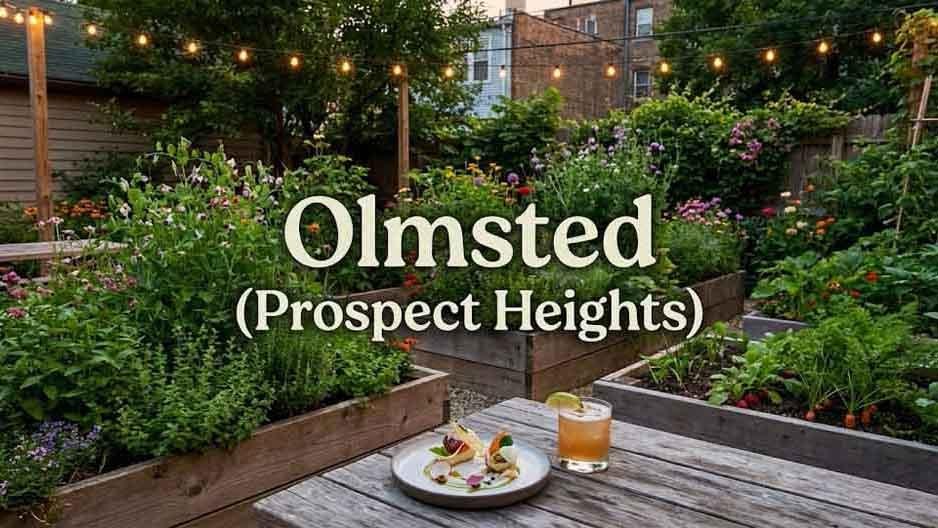
But the true revelation was out back. Rothman designed a micro-farm that grew over 80 varieties of vegetables, herbs, and edible plants across raised garden beds, all of it feeding directly into the seasonal menu and the cocktail program. A repurposed clawfoot bathtub housed crayfish and water-loving plants, deliberately positioned over the restaurant’s heat vent to create a season-extending microclimate. Quail nested in one corner—providing eggs for the kitchen—while in another, food scraps were broken down by black soldier fly larvae that were then fed to the crayfish, completing a closed-loop system that would have made any permaculture theorist weep with admiration (Gardenista, 2016). Fig trees and pawpaw suggested an orchard. Hop vines scrambled up the back wall. In shady areas, Rothman chose plants like orpine, violets, nettles, and ramps that thrived without direct sunlight. At night, with string lights overhead and cushions on the benches, the working farm transformed into one of the most enchanting outdoor dining experiences in the five boroughs.
I spend considerable time thinking about the relationship between provenance and quality—it’s a philosophy that drives both my work at The Heritage Diner and the leather I source from English tanneries like J. & F.J. Baker for Marcellino NY. Olmsted’s backyard embodied a principle I hold sacred: the shorter the distance between origin and outcome, the more integrity the final product possesses. Whether that product is a carrot crepe or a hand-stitched briefcase, the logic is identical.
The Menu: Creativity Without Exhaustion
Baxtrom often described his culinary philosophy with a phrase that should be tattooed on the forearm of every chef who confuses complexity with quality: the goal was to present familiar ingredients in ways diners had never encountered, without making the experience feel like homework. The carrot crepe became the restaurant’s signature—a vibrant orange disc concealing buttery littleneck clams, sunflower seeds, and edible flowers that, once cut open, revealed the kind of sweet-briny interplay that made people rethink the vegetable entirely. It stayed on the menu for nearly the restaurant’s entire run, and for good reason (The Infatuation, 2024).
The rutabaga pasta was another perennial. Chewy noodles fashioned from root vegetables were dressed in a truffle butter sauce subtle enough to avoid the truffle-oil-on-everything cliché that has plagued American dining for two decades. Seasonal rotations brought dishes like delicata squash rings, kale and crab rangoon, fluke crudo, and a falafel that treated the humble chickpea fritter as a showcase for garden vegetables rather than a delivery vehicle for tahini. The duck liver banh mi offered an earthy reimagining of a Vietnamese street staple, while a dessert course featuring s’mores with housemade graham crackers, housemade marshmallows, and a personal tabletop fire pit turned a campfire memory into a Prospect Heights ritual.
The pricing was part of the philosophy, not a compromise. Baxtrom told Brooklyn Magazine in 2022 that he had always wanted his first restaurant to be accessible—that he refused to be just another chef charging $85 for a tasting menu that would generate excitement for two years and then quietly expire (Brooklyn Magazine, 2022). The prix fixe dinner hovered around $89 for four courses, and most individual dishes on the à la carte menu stayed well below $25 for most of Olmsted’s tenure. The Michelin Guide recognized this calibration when it awarded Olmsted a Bib Gourmand—the distinction reserved for restaurants delivering exceptional food at genuine value (Michelin Guide, 2018).
The Awards and the Weight They Carry
Within its first year, Olmsted accumulated the kind of recognition that most restaurants never achieve in a lifetime. Pete Wells of The New York Times awarded it two stars in 2016, writing that the restaurant posed a challenge to the notion that the most expensive stage was the only worthy one for a chef’s talent (The Daily Meal, 2016). Food & Wine named it one of the year’s ten best restaurants. Bon Appétit placed it on its list of 50 best new restaurants in America. Esquire followed with a Best New Restaurant designation. In 2017, the James Beard Foundation nominated Olmsted for Best New Restaurant in New York, and Baxtrom himself earned a semi-finalist nod for Best Chef: New York City in 2018 (Wikipedia, 2025).
These accolades did not make the restaurant impervious to the same economic forces that grind down every independent operator in New York City. But they did confirm what the neighborhood already knew: that Olmsted was not a trend or a moment but a legitimate institution in the making. And institutions, as I’ve learned over 25 years behind a griddle in Mount Sinai, are not built on awards. They are built on the relentless repetition of care—the same hands making the same decisions with the same level of attention, day after day, until the consistency itself becomes the message.
The COVID Chapter and the Hospitality Coalition
When the pandemic shuttered New York’s restaurants in March 2020, Baxtrom faced the same impossible arithmetic confronting every operator in the city: no revenue, a full staff, and a kitchen designed for service, not storage. Rather than pivot to delivery—which he estimated would generate at most 10 to 20 percent of normal revenue while putting his team in harm’s way—he closed for dining entirely and reopened as a food bank (NY1, 2020).
Partnering with the LEE Initiative, Olmsted’s kitchen began preparing more than 250 meals per day for displaced restaurant workers, using ingredients donated by neighboring establishments and harvested from the backyard garden. The restaurant also distributed essentials like diapers and toiletries. A GoFundMe campaign raised approximately $75,000 to support Olmsted’s own employees. But Baxtrom went further still, co-founding the New York Hospitality Coalition with his partner Max Katzenberg—a not-for-profit that held twice-daily calls with 75 industry professionals to process rapidly changing legislation, organize disaster relief advocacy, and funnel critical information to the thousands of small operators who lacked the resources to navigate the crisis alone (Today.com, 2021).
When dining eventually resumed in limited form, Baxtrom transformed the restaurant into what he called “part grocery store, part food bank, and part restaurant”—the Olmsted Trading Post—maintaining operations and payroll through sheer creative stubbornness. His community involvement extended well beyond COVID: over the years, Olmsted raised funds for LGBTQ+ causes, women’s reproductive rights, Ukraine relief, and mental health initiatives. Baxtrom described giving back as a significant part of the restaurant’s identity, not an afterthought or a marketing play (WhatNow, 2025).
The Closing: A New Chapter, Not a Final Page
On August 5, 2025, Baxtrom announced via Instagram that Olmsted would close on August 17 after nearly a decade on Vanderbilt Avenue. The decision, he wrote, emerged from many factors rather than any single crisis. Central among them was his sobriety—Baxtrom had gotten sober nearly five years prior—and the ongoing tension between prioritizing his mental health and the compulsive need to show up whenever the restaurants demanded. Financial pressures compounded the personal ones: the pre-COVID expansion into Maison Yaki and Patti Ann’s had become what he described to Eater as “dead weight” requiring investment beyond his means (Time Out New York, 2025).
The closing followed the earlier shuttering of Patti Ann’s—the Midwestern comfort food spot named for Baxtrom’s mother—and the brief, unsuccessful transformation of Maison Yaki into Petite Patate, a French bistro that lasted only eight months. In his announcement, Baxtrom invited anyone interested in saving the restaurant to reach out, though no buyer materialized. The candor of his public statement—acknowledging financial strain, sobriety, and the limits of his own capacity—offered a rare and vital counterpoint to the industry’s persistent mythology that grit alone can overcome structural impossibility.
Baxtrom’s story continues at Five Acres, his first Manhattan restaurant, located on the Rink Level of 30 Rockefeller Plaza. The space channels the same seasonal, vegetable-forward ethos in a more polished setting, with interiors built partly from wood salvaged from his family’s farm outside Chicago (Rockefeller Center, 2022). His first cookbook, Nothing Matters But Delicious: A Radically Honest Cookbook, written with Joshua David Stein, is scheduled for publication in May 2026 through Penguin Random House. Baxtrom has also announced a forthcoming Black Entrepreneur Series, suggesting that his instinct for community-centered work remains as strong as ever.
What Olmsted Meant—and What It Still Teaches
Frederick Law Olmsted believed that designed landscapes could influence human activity and social values—that a park was not merely a pleasant interruption of the urban grid but an active instrument of civic life. His restaurant namesake embodied that conviction with striking fidelity. Olmsted the restaurant was not merely a place to eat seasonal food in a pretty garden. It was a proof of concept: that a chef trained at the world’s most exclusive kitchens could serve the same quality at neighborhood prices; that a backyard micro-farm could function as both a culinary laboratory and a philosophical statement; that a restaurant could operate as a community institution without sacrificing aesthetic ambition.
Those of us who build businesses anchored in traditional craft—whether that means hand-stitching English bridle leather at my Marcellino NY workshop in Huntington or seasoning a cast-iron griddle at The Heritage Diner—understand the Olmsted lesson instinctively. The unseen details are never unseen by the person who makes them. The integrity of the process is the product. And when a place like Olmsted closes, what disappears is not just a restaurant but a standard—a lived demonstration that quality does not require exclusivity, that ambition and accessibility are not opposing forces, and that the most radical thing a chef can do in a city that worships novelty is to grow carrots in the backyard and make something extraordinary out of them, night after night, for nine years.
Restaurant: Olmsted (Permanently Closed — August 17, 2025) Address: 659 Vanderbilt Avenue, Brooklyn, NY 11238 (Prospect Heights) Chef/Owner: Greg Baxtrom Co-Owner: Ian Rothman Cuisine: Seasonal New American, Farm-to-Table Established: 2016 Awards: Michelin Bib Gourmand; James Beard Finalist, Best New Restaurant 2017; NYT Two Stars (Pete Wells, 2016); Food & Wine Restaurant of the Year; Bon Appétit 50 Best New Restaurants; Esquire Best New Restaurant Website: olmstednyc.com Phone: (718) 552-2610 Instagram: @olmstednyc Greg Baxtrom’s Current Restaurant: Five Acres — 30 Rockefeller Plaza, Rink Level, New York, NY 10112 | fiveacresnyc.com Upcoming Cookbook: Nothing Matters But Delicious: A Radically Honest Cookbook (Penguin Random House, May 2026)