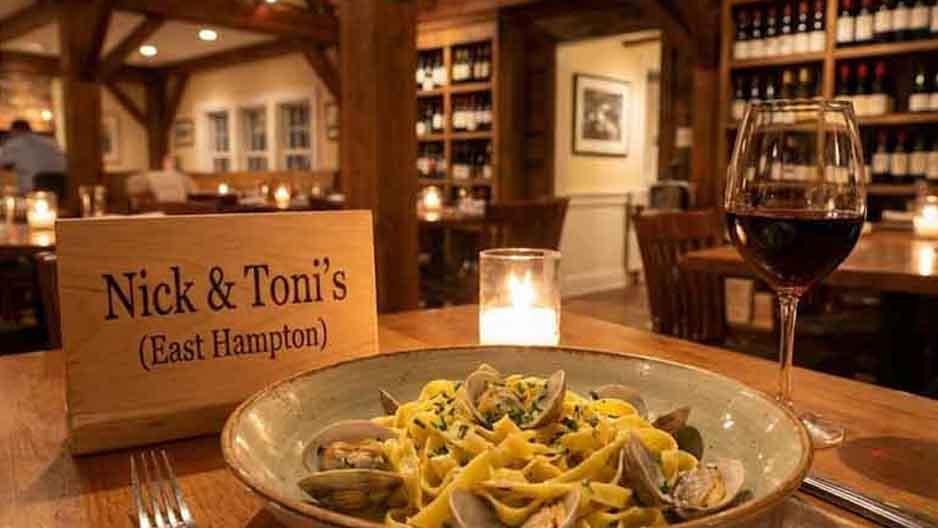
Craig Claiborne walked through the door first. On the evening of August 3, 1988, the retired New York Times food critic — a man who could still extinguish a restaurant’s future with a single published sentence — seated himself at his preferred table in a converted pizza joint on North Main Street. He had been watching the lights from the road, waiting for them to turn on. Nobody had announced the opening. Jeff “Nick” Salaway and Toni Ross, the couple who had gutted the old Ma Bergman’s meatball shop and reimagined it as a Tuscan farmhouse, assumed the fewer guests on opening night, the better. They were wrong. Claiborne returned again and again, bringing companions, offering constructive critiques on everything from the pacing of courses to the temperature of the bread. What started as a quiet experiment in Italian authenticity on the East End would become, across nearly four decades, the single most coveted dining reservation in the Hamptons — a place where Steven Spielberg had a regular table, where Bill Clinton dined under the glow of outsider art, and where the garden Jeff Salaway rototilled with his own hands still feeds plates thirty-seven summers later (The East Hampton Star, 2018; Edible East End, 2018).
As someone who has operated The Heritage Diner for twenty-five years in Mount Sinai, I recognize immediately what Nick & Toni’s represents. It is not simply a restaurant. It is a living archive of decisions made correctly at the foundational level — the kind of establishment where the “unseen details,” as we say in the craft world at Marcellino NY, determine whether something survives a single season or endures across generations. Nick & Toni’s has endured. And the reasons for that endurance tell us something essential about what it means to build a business rooted in place, in people, and in the radical simplicity of doing one thing extraordinarily well.
A Love Story That Started in a Stone Quarry
The origin of Nick & Toni’s reads less like a business plan and more like a passage from a Hemingway novel set in the Italian Apennines. Toni Ross and Jeff Salaway met at a stone quarry in Carrara, Italy — she a film graduate from Wesleyan studying sculpture, he a full-time sculptor with no particular interest in the restaurant business. They fell in love with each other and with the locavore traditions of rural Tuscany, where restaurants served whatever the surrounding land produced that morning and menus shifted with the turning of seasons (The East Hampton Star, 2017; The Daily Front Row, 2018).
Returning to the United States, they carried something more valuable than recipes. They carried a philosophy: food should be direct, fresh, and unadorned. Salaway eventually entered the restaurant world in New York City, managing new-wave establishments including Jonathan Waxman’s legendary Jams. Ross worked alongside him, eventually contributing as a pastry chef. Tired of laboring under someone else’s vision, they pointed their ambitions east. The building Salaway chose at 136 North Main Street was, by all accounts, unpromising. The floors were ruined, the walls were collapsing, and its culinary legacy consisted of pizza and meatballs. Ross later recalled having no idea what her husband saw in the space (Edible East End, 2010). But Salaway possessed what every great restaurateur requires — the ability to see a finished masterpiece inside raw, unworked material. It is the same instinct that drives a leather craftsman to select a particular shoulder of English bridle leather from a tannery in Colyton, Devon, knowing that beneath its rough surface lies a hide capable of developing a sixty-year patina.
Toni’s father, Steve Ross, then chairman of Time Warner, helped trigger what would become the restaurant’s gravitational pull among the East Hampton elite. But the magic was not inherited wealth or Hollywood connections. The magic was simplicity executed at the highest possible level — beet ravioli with poppy-seed sauce, tagliatelle dressed in nothing more than lemon and olive oil, bread served with good oil in an era when most American restaurants still defaulted to butter packets (The Purist, 2019; Social Life Magazine, 2025).
The Farm Before Farm-to-Table Had a Name
Long before “farm-to-table” became a marketing slogan stamped onto every chalkboard menu from Brooklyn to Big Sur, Nick & Toni’s was building genuine relationships with the agricultural and fishing communities of Long Island’s East End. Jeff Salaway rototilled the restaurant’s herb garden himself, a patch of earth behind the kitchen that has since expanded to nearly a full acre of organic production — asparagus, heirloom tomatoes, blackberries, raspberries, and heritage herbs harvested the same afternoon they reach the plate (The East Hampton Star, 2018; Guild Hall, 2023).
The supplier list reads like a directory of East End provenance: Amber Waves Farm, Balsam Farms, Quail Hill Farms, The Milk Pail, Braun Seafood in Cutchogue, Gosman’s in Montauk, and independent fishermen operating through the Dock to Dish program — essentially a community-supported fishery connecting local boats directly to restaurant kitchens. Scott Chaskey, the poet and farmer who directs Quail Hill Farm in Amagansett, was an early influence and helped establish the restaurant’s on-site growing operation (Edible East End, 2018; Southforker, 2023).
This commitment to local sourcing anticipated what the National Restaurant Association now identifies as the industry’s dominant trend, with the majority of today’s diners considering a restaurant’s environmental approach when choosing where to eat. Nick & Toni’s was ahead of this curve by three decades, practicing sustainability not as a brand strategy but as a fundamental conviction about how food should reach a table. At The Heritage Diner, we understand this instinct. Our cast-iron griddles have been seasoned over twenty-five years of continuous use, building layers of flavor that no mass-produced nonstick surface can replicate. Nick & Toni’s organic garden operates on the same principle — time, attention, and an unwillingness to take shortcuts produce results that no supply chain shortcut can approximate.
The Kitchen: Joe Realmuto and the Discipline of Restraint
Executive Chef Joe Realmuto arrived at Nick & Toni’s as a line cook in the early 1990s, fresh from the Culinary Institute of America. He rose through the ranks under Executive Chef Paul Del Favero — during whose tenure the restaurant earned two stars from Ruth Reichl in the New York Times and the Golden Dish Award from GQ — and was named executive chef in 1996 (Guild Hall, 2023; Social Life Magazine, 2025).
Realmuto’s philosophy mirrors the founding vision with an almost monastic discipline. The cooking is Mediterranean and Italian in spirit, anchored by a wood-burning oven that produces whole roasted fish with caramelized fennel and sautéed spinach, rustic pizzas available on select evenings, and seasonal preparations that rotate with what the garden and local waters provide. The current menu features warm rosemary-thyme focaccia with whipped honey ricotta and tomato confit pesto, a radicchio salad crowned with a poached egg and pancetta vinaigrette, house-made pastas, and a curated artisanal cheese selection sourced from producers including La Tur from Piedmont and Grafton Village two-year cheddar (nickandtonis.com, 2026).
Food & Wine once declared Nick & Toni’s the best Italian restaurant on the East End. The New York Times upgraded its rating to three stars — “excellent” — in 2001, and reaffirmed the restaurant’s standing as “very good” in its 2015 review, a remarkable assessment for a restaurant approaching its third decade in an industry where the average establishment survives fewer than five years (Guild Hall, 2023; The East Hampton Star, 2013). The Wine Spectator Award of Excellence, earned in 2007, recognized the restaurant’s expansive and thoughtfully assembled wine program (OpenTable, 2026).
Realmuto has appeared at the James Beard House in 2008 and 2011, and Bobby Flay featured the restaurant on Food Network’s FoodNation. Head Chef John Baron works alongside Realmuto today, maintaining the evolving seasonal vision while Realmuto oversees all culinary operations across the Honest Man Hospitality portfolio (Food Network; Yelp, 2026).
Tragedy, Resilience, and the Making of Honest Man Hospitality
Early in the morning of September 1, 2001, Jeff Salaway was driving home after a late service. Less than two miles from the restaurant, his car struck a tree. He was forty-six years old (27 East, 2011; Dan’s Papers, 2018).
The loss was devastating on every level — personal, professional, existential. Salaway was the restaurant’s spiritual center, its public face, and its most instinctive practitioner of hospitality. Mark Smith, who had joined as an assistant manager in the mid-1990s after a career in the hosiery business and training at Peter Kump’s Cooking School, later described the period as frightening and uncertain. Toni Ross, now a single parent to two young children, could not be present at all. The question hung over everything: could Nick & Toni’s survive without Nick (The East Hampton Star, 2018; The Daily Front Row, 2018)?
The answer came through the collective commitment of people who understood the mission. Smith, Realmuto, Director of Operations Christy Cober, and floor manager Bonnie Munshin — a former dancer who had managed Larry Forgione’s An American Place in Manhattan — held the operation together with an iron grip and a deep fidelity to Salaway’s vision. Smith channeled the tragedy into building Honest Man Hospitality, a restaurant group structured to withstand any future shock. The organization now operates Nick & Toni’s alongside Rowdy Hall (recently relocated to Amagansett after twenty-six years in East Hampton), La Fondita in Amagansett, and Townline BBQ in Sagaponack. Coche Comedor, their regional Mexican restaurant, ran for six years in Amagansett before closing in late 2025 — a reminder that even the strongest hospitality groups must navigate the punishing economics of seasonal dining (The East Hampton Star, 2025; Hamptons.com, 2023).
The Nick & Toni’s Cafe, which operated near Lincoln Center in Manhattan for twenty-three years, also closed. But the flagship endures. And Jeff Salaway’s sculptures still stand, weathered but present, in the garden behind the restaurant where his hands once broke the earth.
The Celebrity Table and the Democratic Spirit
Every restaurant article about Nick & Toni’s eventually arrives at the celebrity roster: Spielberg and Hanks at Table 24, Barbra Streisand prompting the kitchen to fire after closing, Jack Nicholson, Sting, Billy Joel, Paul Simon, Mick Jagger, Chevy Chase, and a regular stream of figures from media, finance, and entertainment (Edible East End, 2018; The NY Independent, 2023; Fox News, 2001).
But the more revealing detail, and the one that separates Nick & Toni’s from the merely glamorous, is the philosophy that governed how those celebrities were treated — or, more precisely, how they were not treated. Salaway’s genius was creating an environment where the famous could arrive and feel like ordinary diners, where nobody fawned and nobody intruded, where the zucchini chips came to every table with the same warmth regardless of net worth. General Manager Bonnie Munshin once compared managing the seating chart during peak summer to air traffic control at JFK, but the governing principle was never to privilege fame over fairness (Edible East End, 2010).
This is the paradox of any great establishment built to last: the more democratic the experience, the more desirable it becomes. At The Heritage Diner, we seat everyone at the same counter. The investment banker from Stony Brook and the electrician from Port Jefferson share the same griddle-seared breakfast. That egalitarian energy is precisely what generates loyalty across decades. Nick & Toni’s understood this from its very first evening, and it has never abandoned the principle.
Community, Philanthropy, and the Roots of Belonging
Beyond the dining rooms, Nick & Toni’s and its leadership have woven themselves into the civic and philanthropic fabric of the East End in ways that extend far beyond any marketing strategy. Jeff Salaway cofounded the Hayground School in Bridgehampton in 1996, an innovative educational institution whose Jeff Salaway Memorial Kitchen now teaches children to source, grow, and prepare their own meals. Toni Ross cofounded the Hamptons International Film Festival in 1993, originally conceived in part to extend the East End’s cultural season beyond Labor Day and now one of the most respected regional film festivals in the country (The East Hampton Star, 2017; The Purist, 2019; Hamptons.com, 2015).
Chef Realmuto spearheaded the Springs School Seedling Project in 2007, building a greenhouse at a local public school to teach children about growing and eating healthy food. He sits on the board of Project MOST, an after-school program serving East Hampton and Springs schools, and volunteers regularly at local soup kitchens. Rather than celebrate their thirtieth anniversary with a gala, the Honest Man Hospitality group donated money to OLA of Eastern Long Island, Springs School’s Blessings in a Backpack chapter, and the Community Council of East Hampton (Guild Hall, 2023; The East Hampton Star, 2018).
The annual Great Chefs Dinner, launched in 2003 to honor Jeff Salaway’s memory, brings together celebrated chefs including Tom Colicchio, Alex Guarnaschelli, Jonathan Waxman, and Josh Capon to raise funds for the Hayground School’s culinary education programs. It has become one of the East End’s most meaningful philanthropic traditions — a gathering where the restaurant industry’s finest pay tribute to a man who believed that hospitality was not a business strategy but a moral obligation (Hamptons Magazine, 2013; 27 East, 2011).
Dining at Nick & Toni’s: What You Need to Know
Nick & Toni’s occupies a Tuscan farmhouse setting with three dining rooms centered around the signature wood-burning oven, plus al fresco outdoor seating during warmer months. The interior features outsider art, bistro chairs, and black walnut tables — refined but deliberately unfussy, a space that communicates seriousness without pretension. The restaurant can accommodate private events in two rooms (up to thirty guests each) or full buyouts for up to eighty (nickandtonis.com, 2026).
The menu changes seasonally and features an extensive cocktail and spirits program alongside the Wine Spectator–recognized wine list. Non-alcoholic options include craft aperitifs from St. Agrestis in Brooklyn and spirit-free cocktails. Wood-oven pizzas are available on select nights, and the restaurant’s signature dessert, the N&T Tartufo, remains a perennial favorite. Takeout is available by calling ahead; DoorDash delivery operates through the Nick & Toni’s Cafe listing. Reservations are made online through the restaurant’s website and are strongly recommended, particularly during summer months when securing a table remains one of the most competitive endeavors on the East End (DoorDash, 2026; Yelp, 2026).
Address: 136 North Main Street (at Cedar Street), East Hampton, NY 11937
Phone: (631) 324-3550
Email: nickandtonisgm@gmail.com
Website: nickandtonis.com
DoorDash: Order on DoorDash
Instagram: @nickandtonis
Hours: Open Wednesday through Monday starting at 5:30 PM. Closed Thursdays. Friday and Saturday until 10:00 PM; other evenings until 9:00 PM. Summer hours extend later. Walk-ins are welcomed.
Reservations: Online through nickandtonis.com (no email reservations)
Dining: Indoor and outdoor seating, full bar, takeout available, wheelchair accessible
Parent Company: Honest Man Hospitality (also operates Rowdy Hall, La Fondita, and Townline BBQ)
Thirty-seven years after Craig Claiborne settled himself at a familiar table in an unfamiliar restaurant, Nick & Toni’s continues to operate under the same governing principles that made it extraordinary from its opening night. The ingredients remain local, the preparations remain restrained, the garden still grows behind the kitchen, and the hospitality still refuses to discriminate between the boldface name and the first-time visitor. Jeff Salaway’s sculptures stand in the garden, weathered by salt air and time, gaining the kind of patina that cannot be manufactured — only earned. It is the same patina that develops on a well-used cast-iron griddle, on a hand-stitched English bridle leather briefcase, on any object or institution that has been cared for with consistency and conviction across decades. Peter from The Heritage Diner, a man who has spent twenty-five years learning that the difference between a restaurant that survives and one that becomes a landmark is always found in the details nobody sees, recognizes Nick & Toni’s for what it is: not merely the most celebrated restaurant in the Hamptons, but one of the most important restaurant stories on Long Island. And like all the best stories, it is still being written.
Peter holds graduate degrees in Philosophy from Long Island University and The New School in New York City. He is the owner of The Heritage Diner in Mount Sinai, the founder of Marcellino NY bespoke leather goods, and is preparing to launch Maison Pawli, a boutique real estate venture on the North Shore, with his wife, Broker Paola, in 2026.