By Peter from The Heritage Diner | heritagediner.com/blog
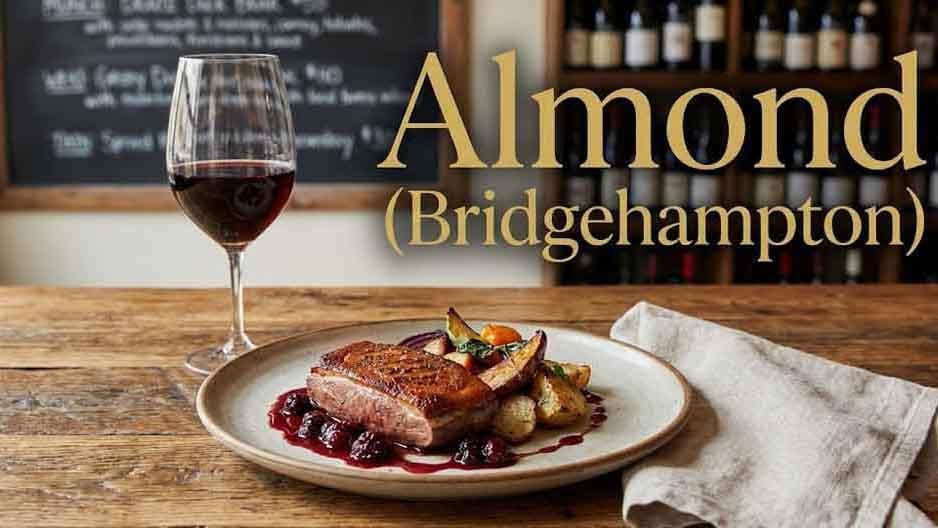
Two Brooklyn kids — one who fell in love with restaurants at thirteen while eating steak frites at a French bistro in SoHo, the other who learned to revere local ingredients while opening Aqua alongside Michael Mina in San Francisco — found each other again in 2001, staring at an empty restaurant space in Bridgehampton. They barely hesitated. By the following spring, Jason Weiner and Eric Lemonides had completed the build-out, opened the doors, and inadvertently created what The New York Times food critic Joanne Starkey would eventually declare: the restaurant that brought French bistro to the Hamptons (New York Times). That restaurant was Almond. Named not for the nut, but for Almond Zigmund — Jason’s then-girlfriend, now his wife — this was a gamble wrapped inside a love story. Two and a half decades later, with locations stretching from Bridgehampton to Manhattan’s Flatiron District to Palm Beach, Florida, Almond stands as proof that when you build a restaurant around relationships rather than reservations, you build something that endures.
I know what endurance looks like in the restaurant business. Twenty-five years at The Heritage Diner in Mount Sinai have taught me that the establishments which survive are never the ones chasing the next trend — they are the ones that become part of the community’s actual infrastructure, as load-bearing as any beam or foundation wall. Almond is that kind of structure for Bridgehampton. And understanding how it got there requires understanding two men who took very different roads to the same empty dining room on Long Island’s South Fork.
Brooklyn Roots, West Coast Fire
Jason Weiner’s culinary education began in the raw heat of Manhattan kitchens — first at Regine, then at China Grill, where he spent four years learning to move with speed and precision on the line (Dan’s Papers, 2021). But the turning point came in 1991, when he joined Chef George Morrone at the opening of Aqua in San Francisco, working directly under Michael Mina. It was there, amid the Bay Area’s farm-to-table revolution, that Weiner discovered the philosophy that would come to define his entire career: that the one-on-one relationship between a chef and the person who grew the food matters more than any technique. As Aqua’s mission centered on all things seafood, Weiner developed an extraordinary command of fish preparation, but it was those early-morning conversations with local farmers and foragers that fundamentally rewired his approach to cooking (Almond Restaurant, 2025).
From Aqua, Weiner moved into the chef de cuisine role at Mina’s three-star Charles Nob Hill in San Francisco, then spent a formative summer on the East End in the kitchen at Nick & Toni’s in East Hampton — his first taste of Hamptons agriculture and the extraordinary produce the South Fork yields each season (Dan’s Papers, 2021). By 1998, he had rejoined the Mina group for the opening of Aqua at the Bellagio Hotel in Las Vegas. After four years in the desert, the pull of the East Coast proved irresistible. Weiner headed back to New York to explore the possibility of something entirely his own.
Eric Lemonides, meanwhile, had been cultivating a different but complementary genius. As a teenager in Brooklyn, he would ride the subway alone into lower Manhattan to visit his father in SoHo. His two unsupervised destinations: his uncle’s restaurant downstairs and La Gamelle, a nearby French bistro where the bartenders let a thirteen-year-old sit at the bar, eat steak frites, sip Pepsi with a splash of red wine, and learn the ancient rhythms of front-of-house hospitality (Almond Restaurant, 2025). By 1991, Lemonides had moved to San Francisco, where he developed what colleagues would later describe as his signature “groovy” approach to service. He became general manager of Piemonte Ovest at twenty-four, then returned to New York to run F.illi Ponte, one of Manhattan’s top Italian restaurants. He opened Pacific East in Amagansett and Chelsea, ran the original Markt in the Meatpacking District, and launched Lunch on Hudson Street in 2000 — which he sold the following year to pursue something more permanent with his childhood friend (The East Hampton Star, 2016).
The Un-Hamptons Restaurant the Hamptons Needed
When Weiner and Lemonides opened Almond in the spring of 2001, the Hamptons dining scene was dominated by a particular kind of excess — overwrought prix fixe menus, celebrity chef vanity projects, and a general attitude that treated dining out as performance rather than sustenance. Almond arrived as the deliberate antithesis. Reasonable prices. Bold bistro fare. No velvet ropes, no attitude, no celebrity posturing. As Lemonides told Dan’s Papers in 2021, the restaurant quickly became the place the Hamptons desperately needed — the “un-Hamptons” restaurant where locals, tourists, celebrities, and fellow restaurateurs could all feel equally at home (Dan’s Papers, 2021).
The timing, as it happened, was both terrible and fortuitous. Almond opened in April 2001. Five months later, the September 11 attacks reshaped every business calculation in the tristate area. Rather than closing or retreating, Weiner and Lemonides made the decision to keep the lights on, keep the kitchen running, and keep the community gathered around the table. As Lemonides later reflected, that period unexpectedly solidified Almond’s identity as a genuine community center — a place where people walked in, recognized their neighbors, and found solace in the elemental act of sharing a good meal (Dan’s Papers, 2021).
The critics noticed. Almond garnered recognition from Wine Spectator and the New York Times, cementing its reputation not just as a local favorite but as a serious culinary destination (Almond Restaurant History). By 2008, the team expanded to Manhattan, opening a second location in the Flatiron District at 12 East 22nd Street — a massive 150-seat space that had been the graveyard of several previous restaurants, including Rocco DiSpirito’s ill-fated Rocco’s (Gothamist, 2009). Weiner and Lemonides not only survived the curse but thrived in it. The OpenTable password for the city location’s reservation system? “Mamasmeatballs” — and as Lemonides told Whalebone Magazine, there was no reason to ever change it (Whalebone Magazine, 2019).
The Philosophy of Minimum Intervention
At the core of Almond’s kitchen sits a philosophy that any craftsman would recognize: the less you do to an exceptional material, the better it becomes. Weiner articulated this plainly to Gothamist in 2009 — his approach centers on taking three or four ingredients he believes in, that are in season, that he can source as directly as possible, then anointing them with oil or vinegar he has equal faith in, and walking away (Gothamist, 2009). This is not simplicity born from laziness. It is the hard-earned restraint that comes from decades of understanding what ingredients can do when a chef refuses to get in their way.
I understand this instinct at the molecular level. At Marcellino NY, my bespoke English bridle leather workshop in Huntington, the same philosophy governs every briefcase I stitch. The finest vegetable-tanned leather from Wickett & Craig or J&FJ Baker does not need embellishment — it needs respect, patience, and the discipline to let the material express itself over time. Weiner’s moules frites at Almond operates on the same principle as a hand-saddle-stitched gusset on a full-grain briefcase: the technique serves the material, never the reverse.
This philosophy manifests in Almond’s obsessive approach to in-house production. The kitchen hangs its own charcuterie, grinds its own sausages, ferments its own kimchi, dry-ages its own steaks, and smokes its own fish and bacon (Yelp; OpenTable, 2025). During harvest season, Weiner sources nearly ninety percent of the plate from within a four-mile radius of the restaurant, maintaining direct relationships with over a dozen local farms including Balsam Farms, Amber Waves Farm, Quail Hill Farm, Marilee Foster’s Farm, and Feisty Acres (Almond Restaurant; The East Hampton Star, 2016). The menu evolves constantly — not on a seasonal schedule, but on the rhythm of what the growers and fishermen are actually harvesting and catching on any given week.
Accolades, Clintons, and a Conga Line
The measure of a restaurant’s gravitational pull can be taken by the range of people it draws through its doors. At Almond, that range is extraordinary. Chef Weiner has been invited to cook at the James Beard House five times — an honor reserved for chefs whose work represents the highest standards of American culinary arts (Dan’s Papers, 2021). He holds the distinction of being the most veteran chef with Outstanding in the Field, the celebrated open-air feast organization, having participated in eighteen of their farm-to-table dinners across the country (Almond Restaurant, 2025). He has been a featured chef at The Chefs Dinner at Hayground School for years, and has partnered with the Bridgehampton School to source produce from their student-maintained greenhouse — an initiative that provides heirloom tomatoes, fava beans, squash, and braising greens directly to the restaurant’s kitchen (Dan’s Papers, 2021).
Then there are the stories that only accumulate over two decades of being the neighborhood’s gathering place. The Clintons have dined at Almond numerous times, celebrated birthdays there, and engaged Weiner to cater fundraising events. The East Hampton Star recounted one particularly memorable evening when the Clintons had to cancel a reservation but said someone would pick up the order. Shortly after, Bill Clinton himself ambled in alone, settled at the bar with a Grey Goose martini, lingered well past the to-go order’s readiness, and before departing, personally visited every single table in the restaurant to shake hands and chat with each guest (The East Hampton Star, 2016). Joy Behar once met John Boehner at the bar; a headlock may or may not have occurred.
New Year’s Eve at Almond has become a tradition unto itself — a locally sourced five-course prix fixe paired with champagne toasts, party favors, and what the restaurant describes as a conga line that “always seems to happen for some reason” (OpenTable, 2025). This is the energy Lemonides and Weiner have cultivated: maximum merriment, conviviality, warmth, and bonhomie, delivered without pretense.
KimchiJews, L&W Market, and the Expanding Universe
Beyond the restaurant itself, Weiner and his team have built an ecosystem of complementary ventures that extend Almond’s philosophy into new territories. L&W Market, adjacent to the restaurant in Bridgehampton, operates as both a prepared foods destination and a retail outpost for Almond’s kitchen — offering takeout items, local produce, superb coffee, fresh pastries, sandwiches, and an evolving selection of dishes straight from the restaurant’s stoves (L&W Market, 2025).
Then there is KimchiJews — the fermented condiment line created by Weiner and Almond chef Jeremy Blutstein, sold through L&W Market and online. The name is as provocative as the product is delicious: a range of srirachas, fermented kimchi, bulgogi marinade, kimchi mayo, and smoked green hot sauces, all made from locally sourced peppers and produce (Sag Harbor Express, 2018). The proprietary red sriracha blends Fresno peppers, garlic, salt, and sugar, fermented between two and eight days. The smoked green version combines jalapeno and poblano peppers, smoked before fermentation. As Blutstein explained to the Sag Harbor Express, the philosophy aligns perfectly with Almond’s core principles: use ingredients from people you know, tell the story of where the food comes from, and make it devastatingly delicious without any pretense (Sag Harbor Express, 2018).
This kind of expansion — organic, rooted in the restaurant’s existing philosophy, and driven by genuine passion rather than brand licensing — represents exactly the model that sustains independent food businesses in an era of corporate consolidation. The National Restaurant Association’s 2024 State of the Industry Report noted that restaurants with diversified revenue streams (prepared foods, branded products, private events) showed measurably stronger resilience during economic contractions (National Restaurant Association, 2024). Almond was practicing this strategy long before the data confirmed it.
A Space Designed for Permanence
In 2011, Almond moved from its original Bridgehampton location to a new home at One Ocean Road in downtown Bridgehampton — a historic space distinguished by 120-year-old tin ceilings, a reclaimed wood and blue steel bar, and classic white subway tile (Almond Restaurant History). The building itself became part of the narrative. Those tin ceilings, pressed and formed in the late nineteenth century, carry the same message that the food does: that there is value in things that have weathered time, that age is not something to be concealed but celebrated. The twenty-five-seat bar anchors the room, and the sidewalk café — open during peak season — extends the dining experience into Bridgehampton’s streetscape.
As someone preparing to launch Maison Pawli in 2026 with my wife Paola, a boutique real estate venture focused on Long Island’s North Shore, I pay particular attention to how restaurants shape the commercial identity of the communities they inhabit. Almond has unquestionably elevated Bridgehampton’s year-round viability. The Hamptons economy has long been defined by its seasonal extremes — flush with money from Memorial Day through Labor Day, then hollowed out through the winter months. Restaurants that close for the season reinforce this pattern. Almond, by remaining open year-round, seven days a week, functions as an economic anchor that stabilizes the village’s commercial life through the quieter months. When the restaurant hosts its Artists and Writers nights during the off-season, or when locals gather at the bar for Saturday karaoke, Almond is performing the essential function that sociologist Ray Oldenburg identified in his landmark work The Great Good Place (1989) — serving as a “third place” that holds a community together between the private sphere of home and the obligations of work.
What You Need to Know
Almond’s current space seats eighty for a sit-down affair and accommodates up to 150 for a standing reception. The private dining room holds thirty guests (OpenTable, 2025). The restaurant is dog-friendly, wheelchair accessible, and offers patio seating, a full bar, gluten-free options, and late-night dining. Delivery, takeout, and curbside pickup are all available.
The menu shifts constantly, but Almond’s foundational dishes have earned legendary status: the moules frites — over sixty tons of mussels served since 2001, by Weiner’s own estimation (Whalebone Magazine, 2019); the steak frites with the option of béarnaise or cheese; the buffalo cauliflower that sparked near-revolt when the team briefly tried to remove it from the NYC menu; escargot in Pernod and garlic croutons; beet-cured gravlax; and “Le Grand” macaroni and cheese with prosciutto and chopped truffles. The Infatuation recommends building dinner plans around Almond’s internationally inspired plats du jour — ramen on Thursdays, a seasonal lamb dish every Saturday (The Infatuation, 2025). The raw bar features local Montauk pearl oysters, scallop and fennel crudo, and the Plateau Royale.
Eric Lemonides curates the wine list with the same unpretentious philosophy that governs everything at Almond — an affordable, thoughtful selection of French bottles complemented by local Long Island wines from wineries like Channing Daughters and Paumanok Vineyards. Specialty cocktails and Long Island craft beers round out the beverage program.
Almond holds a 4.8-star rating from over 1,750 OpenTable diners and is ranked the number-one restaurant in Bridgehampton on TripAdvisor, where it carries a Travelers’ Choice distinction (OpenTable, 2025; TripAdvisor, 2025).
Peter from The Heritage Diner writes about food, craftsmanship, and the culture of Long Island from Mount Sinai, New York. Peter holds graduate degrees in Philosophy from Long Island University and The New School in New York City. The Heritage Diner has served the community at 275 Route 25A since 2000. Marcellino NY handcrafts bespoke English bridle leather briefcases from Huntington, NY — visit marcellinony.com. For apps, projects, and more, visit x9m8.com.
Contact Information:
Almond Restaurant — Bridgehampton One Ocean Road, Bridgehampton, NY 11932 Phone: (631) 537-5665 Website: almondrestaurant.com Reservations: OpenTable — opentable.com/r/almond-bridgehampton Delivery: Grubhub — (877) 585-1085
Hours: Monday: 5:00 PM – 9:00 PM Tuesday: 5:00 PM – 9:30 PM Wednesday: 5:00 PM – 9:30 PM Thursday: 5:00 PM – 10:00 PM Friday: 5:00 PM – 11:00 PM Saturday: 5:00 PM – 11:00 PM Sunday: Closed
Also Visit: L&W Market — Bridgehampton: landwmarket.com KimchiJews: kimchijews.com Almond Palm Beach: almondrestaurant.com