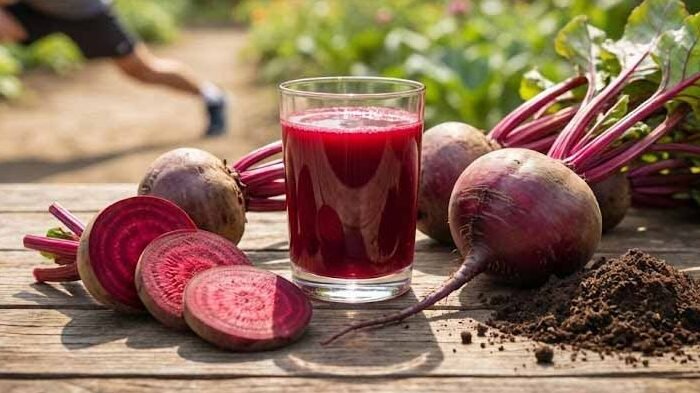
Somewhere between the nitrogen cycle and the dinner plate lies one of the most quietly revolutionary conversations happening in sports nutrition today — and it begins not in a laboratory, but in the ground. Specifically, in the dark, mineral-dense soil of Long Island’s North Fork, where farms like Golden Earthworm Organic and Garden of Eve have been growing certified organic red beets for decades, unwittingly supplying one of nature’s most potent ergogenic compounds to anyone paying attention.
At The Heritage Diner, I’ve spent 25 years watching health trends cycle in and out of the American consciousness like seasonal menus. Most pass like a thunderstorm — loud, brief, and forgotten. But every now and then, something emerges that isn’t a trend at all. It’s a return. A rediscovery of what the body already knew. The science behind dietary nitrate and nitric oxide is exactly that kind of reckoning.
What Nitric Oxide Actually Does — And Why Your Muscles Demand It
Nitric oxide (NO) is a gaseous signaling molecule so fundamental to human physiology that its discovery earned the 1998 Nobel Prize in Medicine. Its role extends across vasodilation, mitochondrial respiration, immune modulation, muscle contraction efficiency, and even neurotransmission. NO plays an essential role in vasodilation and therefore the control of blood pressure and tissue blood flow, but it also operates across processes as diverse as neurotransmission, immune defense, mitochondrial respiration, and skeletal muscle contractile function. GSSI
The challenge is that NO has an extraordinarily brief existence in biological tissue — a half-life measured in milliseconds. The body must produce it continuously. It does so through two complementary pathways: an enzymatic route requiring L-arginine and oxygen, and a dietary route fueled by inorganic nitrate. The second pathway is where the beetroot enters with uncommon authority.
Ingested nitrate is converted to nitrite by anaerobic bacteria in the oral cavity, which can be further reduced to nitric oxide — particularly under conditions of hypoxia or acidosis. PubMed Central In other words, the harder your muscles work and the more oxygen-deprived they become, the more efficiently this conversion accelerates. The body doesn’t operate on a flat schedule; it responds to demand. And that demand-driven production of NO is precisely what makes dietary nitrate so compelling for athletic performance.
I think about it in the same terms I use when explaining why a properly seasoned cast-iron skillet outperforms nonstick over decades — the mechanism is elegant, self-reinforcing, and gets better the more you use it.
The Nitrate-Nitrite-NO Pathway: From Soil to Vessel Wall
The journey from soil to vasodilation is worth following in detail, because understanding the mechanism is what separates intelligent supplementation from supplement folklore.
When you consume a nitrate-rich food — whole beetroot, fresh-pressed juice, or roasted beets at peak organic density — the nitrate (NO₃⁻) is concentrated in saliva. Nitrate is extracted and concentrated in saliva, where it is subsequently reduced to nitrite by anaerobic bacteria in the oral cavity. PubMed Central This is a critical point often overlooked: antibacterial mouthwash used before a training session will eliminate the oral bacteria responsible for the first conversion step, effectively neutralizing the ergogenic benefit. The mouth is not just a passage — it’s an active biochemical processor.
Once nitrite enters the bloodstream and reaches working muscle tissue, the hypoxic microenvironment present during intense exercise drives further reduction to NO. Physiological mechanisms for NO₂⁻ reduction are facilitated by hypoxic conditions — NO is produced in those parts of muscle that are consuming or in need of more oxygen, allowing local blood flow to adapt to oxygen requirements within skeletal muscle. PubMed Central
The vascular effect is profound. NO, as a potent vasodilator, acts on vascular smooth muscle to cause dilation, thereby reducing peripheral resistance and increasing blood flow to skeletal and cardiac muscles. NO can also regulate mitochondrial respiratory efficiency, reducing proton leak across the mitochondrial inner membrane and enhancing oxidative phosphorylation efficiency. MDPI
What we’re describing, stripped of the biochemistry, is this: a root vegetable grown in Long Island’s glacially deposited loam can measurably widen your blood vessels, lower the oxygen cost of physical effort, and increase how long your muscles can sustain high-intensity work. That’s not marketing language. That’s peer-reviewed physiology.
What the Evidence Says — and Where It Gets Complicated
The research landscape on beetroot and athletic performance is extensive, and it rewards nuance. An umbrella review of 20 systematic meta-analyses representing 180 primary studies and 2,672 unique participants revealed that nitrate supplementation improved time-to-exhaustion tasks with more pronounced effects under specific conditions. PubMed Central
The conditions matter. Recreationally active individuals and moderately trained athletes consistently show meaningful improvement in endurance capacity, oxygen utilization efficiency, and time to exhaustion. Beetroot-derived nitrates can improve endurance, oxygen efficiency, muscular power, recovery, and cardiovascular function — particularly in recreationally active or moderately trained individuals. MDPI
Elite athletes present a more complex picture. Their bodies have already adapted toward optimized oxygen delivery and mitochondrial function. Beetroot juice was effective for improving aerobic endurance for non-athletes but not for athletes — a possible explanation for this discrepancy is that elite athletes already have significant population differences in aerobic endurance. MDPI For high-intensity anaerobic efforts, however, the calculus shifts. Elite athletes focused on resistance training and high-intensity exercise are more likely to induce local muscle hypoxia due to inadequate oxygen supply — and in such training scenarios, beetroot juice can activate the NO pathway, leading to vasodilation that improves local blood flow, helps alleviate hypoxia, accelerates the clearance of metabolic waste, and ultimately enhances muscle fatigue resistance. MDPI
The implication is that beetroot’s benefit isn’t one-dimensional. It’s situational, physiologically sophisticated, and dose-dependent — which is to say it rewards the same kind of attention to craft that goes into preparing a 72-hour braised short rib or selecting the right side leather for a Marcellino briefcase panel.
Why Organic Source Material Changes the Equation
Not all beets are created equal. This is where the conversation becomes local and personal.
The nitrate content of beetroot is directly influenced by the soil in which it grows — its mineral density, microbial richness, organic matter content, and the farming practices that either enhance or deplete those qualities. Conventional agricultural beets grown with synthetic nitrogen fertilizers may carry detectable nitrate, but they arrive stripped of the broader phytochemical context — the betalains, polyphenols, and antioxidant compounds — that appear to work synergistically with the nitrate pathway. Beyond nitrate, beetroot juice contains a range of potentially bioactive compounds that may contribute to exercise performance through mechanisms distinct from simple NO production. Frontiers
Organic beets grown in biologically active soil carry more of that context intact. Golden Earthworm Organic Farm, which has been certified organic for over 32 years with CSA pickup locations in Port Jefferson, Stony Brook, and Smithtown, grows red beets seasonally through late autumn — harvested at the peak of their nutrient density. Natural Earth Organic Farms in Calverton and Garden of Eve on the North Fork round out a local network of growers whose product, consumed fresh, delivers a biochemical profile that a processed supplement simply cannot replicate.
At the Heritage Diner, proximity to this supply chain isn’t incidental — it’s philosophical. We source where we can trace. The 100-year principle I’ve built across every venture I’ve touched — from the diner to the Marcellino atelier to the real estate work Paola and I are building into Maison Pawli — is grounded in the same idea: what endures is what’s authentic. A beet grown in mineral-rich North Fork soil by farmers who don’t cut corners is the same argument as English bridle leather sourced from J&E Sedgwick — it’s costlier, slower, less convenient, and entirely superior.
Timing, Dosing, and Practical Application
The ergogenic research has also produced actionable protocols worth knowing. Nitric oxide availability from dietary nitrate peaks approximately 2 to 3 hours after ingestion, as the oral-to-gut conversion runs its course. Athletes looking to leverage this window should consume their beetroot — juice, whole roasted, or blended — roughly 2 to 2.5 hours before training or competition.
Dosing in the research literature gravitates toward 300 to 600 milligrams of inorganic nitrate, which corresponds roughly to 500 milliliters of commercial beetroot juice. A single large Heritage-style roasted beet — approximately 200 to 300 grams — provides a meaningful fraction of that, particularly when sourced from organically grown varieties at full maturity. Chronic loading over 6 to 15 days appears to further amplify the benefit by increasing circulating nitrite stores.
What does not work: mouthwash, antacids, or high-fat meals consumed simultaneously with the beet. Each disrupts a different stage of the conversion pathway. The body’s chemistry is cooperative, not just input-output. You can optimize it or you can obstruct it — the choice is largely dietary discipline.
The Betalain Dimension: Beyond Nitrate
Betalains — the pigments responsible for the deep crimson of red beetroot — have emerged as a secondary point of athletic and clinical interest. These water-soluble compounds carry antioxidant and anti-inflammatory activity that complements the nitrate pathway rather than duplicating it. During high-intensity exercise, oxidative stress and inflammatory signaling climb sharply. Betalains appear to attenuate that rise, potentially accelerating post-exercise recovery and reducing the muscle damage that accumulates across training blocks.
This is the integrative picture that separates whole-food consumption from isolated supplementation. When you eat a real beet — roasted, juiced, or sliced raw into a Heritage grain bowl — you’re consuming the full architecture of the plant. The nitrates signal vasodilation. The betalains buffer the inflammatory aftermath. The fiber feeds the gut microbiome whose oral branch handles the first conversion step. Each element reinforces the others.
Marcus Aurelius wrote in the Meditations that nature wastes nothing. The red beet is, in this sense, a Stoic vegetable. Every compound present is present for a reason, and the attempt to extract only the convenient part and discard the rest is its own form of philosophical error.
Bringing It to the Table — and to the Training Floor
The Heritage Diner has never been a health food restaurant in the performance-nutrition sense. We are a North Shore landmark built on honest food, sourced locally, prepared with care — and evolved continuously over 25 years to reflect what we understand about quality and health. Our slow-fermented sourdough program, our farm relationships, the seasonal beet appearances on the menu — these aren’t wellness trends. They’re an ongoing commitment to serving food that actually does something for the people who eat it.
For athletes training on the North Shore — triathletes out of Port Jefferson, cyclists on the Sound Breeze corridor, recreational runners through the Setauket trails — the case for integrating locally sourced organic beets into a performance nutrition strategy is now scientifically sound and logistically straightforward. The supply chain exists on this island. The evidence is in the literature. The mechanism is elegant and well understood.
What remains is simply the willingness to treat food as the first lever of performance — before the supplement stack, before the wearable, before the protocol. In the same way I approach a Marcellino briefcase: no shortcuts, no substitutions, and absolute fidelity to the quality of the raw material from which everything else follows.
The answer, more often than not, has been growing in the soil a few miles east the whole time.