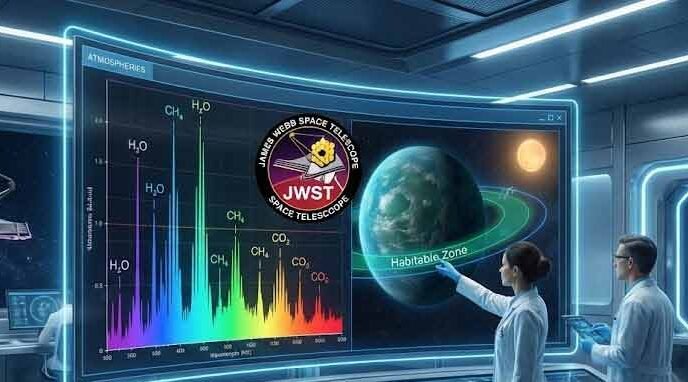
Somewhere in the infrared silence between stars, a telescope the size of a tennis court is doing something that should make every thinking person stop and reconsider the weight of their morning coffee. The James Webb Space Telescope — launched in December 2021 and fully operational since 2022 — is not merely photographing distant suns. It is reading the chemical signatures of their planets’ atmospheres with a precision that borders on the philosophical. It is, in the truest sense, sniffing the breath of other worlds.
What Webb is revealing forces a reckoning not just with astrophysics, but with the ancient human question that no culture, no philosophy, no religion has ever fully silenced: Are we alone?
The Grammar of Light: How Webb Reads an Atmosphere It Cannot Touch
The instrument at the heart of Webb’s exoplanet research is neither a camera nor a simple telescope mirror. It is a spectrograph — a device that fractures incoming starlight into its constituent wavelengths the way a prism scatters white light into a rainbow. When an exoplanet transits across the face of its host star, a fraction of that starlight passes through the planet’s atmosphere before reaching Webb’s instruments. Different molecules — carbon dioxide, methane, water vapor, ammonia, dimethyl sulfide — absorb light at specific, fingerprint-precise wavelengths. What Webb measures is essentially the shadow of chemistry.
This technique, called transit spectroscopy, is not new. Hubble pioneered crude versions of it. But Webb operates in the mid-infrared range with a mirror nearly seven times Hubble’s collecting area, and the difference is not incremental — it is seismic. A single transit observation with Webb provides comparable precision to eight Hubble observations conducted over several years. NASA Science What once required years of telescope time can now be accomplished in an evening.
That efficiency matters enormously. The universe does not wait patiently for slow instruments.
K2-18 b: The World That May Already Be Wet
No exoplanet has generated more serious scientific conversation over the past two years than K2-18 b — a world unlike anything in our solar system. Orbiting the cool dwarf star K2-18 in the habitable zone, 120 light years from Earth, K2-18 b is 8.6 times as massive as our planet and is classified as a sub-Neptune. NASA Science It sits in a category of worlds astronomers now call “Hycean” planets — a term combining hydrogen and ocean — worlds theorized to carry hydrogen-rich atmospheres above vast, planet-spanning liquid water oceans.
Webb’s observations of K2-18 b detected methane, carbon dioxide, and a notable absence of ammonia — a chemical combination that, on Earth’s early ocean-bearing world, would not be out of place. More provocative still was a tentative detection of dimethyl sulfide, or DMS. On Earth, DMS is only produced by living organisms, primarily marine phytoplankton. NASA Science Scientists are careful — appropriately, rigorously careful — to call this preliminary. A single data point in science is a hypothesis, not a conclusion. But it is also not nothing.
What Webb proved at K2-18 b is that sub-Neptune worlds in habitable zones are not merely interesting. They are, by virtue of their size, far more accessible to atmospheric study than rocky Earth-sized planets. The chemistry is readable. The question of what that chemistry means is what keeps astrophysicists at their desks at 2 a.m.
The TRAPPIST-1 System: Seven Worlds and the Weight of Possibility
Forty light years from Long Island’s North Shore, a red dwarf star slightly larger than Jupiter hosts seven rocky, Earth-sized worlds — three of which occupy the classical habitable zone. The TRAPPIST-1 system has been a focal point for exoplanet science since its discovery in 2017, but it is Webb that has brought these worlds from theoretical promise into empirical scrutiny.
The closest planet to the star, TRAPPIST-1 b, was long assumed to be a barren, airless rock baked by stellar radiation. Recent JWST measurements cast doubt on that understanding entirely ScienceDaily, suggesting that the thermal emission data does not conform cleanly to a bare-rock model. The planet may have an atmosphere. It may have reflective clouds. The certainty is gone, replaced by productive scientific uncertainty.
TRAPPIST-1e, the system’s most compelling candidate for habitability, orbits within the Goldilocks zone — where temperatures could theoretically allow liquid water to exist on the surface — but only if the planet has an atmosphere capable of regulating those conditions. ScienceDaily Early Webb observations have hinted at methane, though the complications are real: the host star itself, an ultracool M-dwarf, produces its own spectral noise that can mimic or obscure planetary atmospheric signals. Disentangling a planet’s breath from its star’s is among the most demanding challenges in all of modern astronomy.
The researchers pursuing TRAPPIST-1e are not discouraged by this complexity. They are energized by it. Science at its best is not the confirmation of expected answers — it is the refinement of better questions.
The Signature Problem: When the Star Speaks Over the Planet
One of the most underappreciated challenges Webb faces in this search is what NASA scientists call stellar contamination. Cool M-dwarf stars — the most common type of star in the galaxy and the kind most amenable to exoplanet transit detection — can exhibit signs of water vapor in their own atmospheres, creating a fundamental ambiguity: when Webb detects water, is it reading the planet or the star? NASA Science
This is not a technical failure. It is a natural consequence of operating at the very edge of human instrument capability. Webb was designed before astronomers fully understood the atmospheric complexity of M-dwarf host stars. As University of Arizona astrophysicist Sukrit Ranjan has noted, Webb was not originally designed with small, Earth-sized exoplanets as primary targets — the fact that it can study them at all represents a remarkable windfall. ScienceDaily
Addressing this contamination problem requires more observation time, cross-instrument verification, and the kind of methodical patience that does not make headlines but defines the actual work of science. The forthcoming NASA Pandora mission — a small satellite scheduled to launch in 2026 — is specifically designed to track stellar behavior before, during, and after planetary transits, giving researchers a cleaner separation between what the star says and what the planet whispers.
Biosignatures and the Burden of Extraordinary Proof
The word “biosignature” carries enormous philosophical weight. It refers to any chemical compound, atmospheric ratio, or spectral feature whose presence in combination with other data points strongly suggests biological origin — molecules that life produces and that, in sufficient quantities, cannot be easily explained by purely geological or photochemical processes.
On Earth, the most reliable biosignature combination would be oxygen alongside methane — two reactive gases that would rapidly neutralize each other in the absence of continuous biological replenishment. Their simultaneous presence requires an explanation. Life, on Earth, is that explanation.
Webb has the sensitivity to detect molecules like water vapor, methane, and carbon dioxide — critical components in any biosignature framework — but detecting a given gas is not sufficient on its own. Context, combination, and chemical disequilibrium together constitute the evidentiary standard. NASA Science Carl Sagan’s maxim shadows every Webb press release: extraordinary claims require extraordinary evidence. The telescope is building that evidence, molecule by molecule, transit by transit.
There is a discipline to that approach that I deeply respect. In leather craftsmanship, the difference between a briefcase that looks right and one that is right comes down to layers of invisible work — the temper of the hide, the draw of a hand-stitched waxed linen thread, the break-in behavior of vegetable-tanned bridle leather over eighteen months of daily use. You cannot shortcut your way to that quality. You can only do the work, in the right order, with the right materials. Webb is doing science the same way — slow, layered, irreducible.
What Comes After Webb: The Road to the Habitable Worlds Observatory
Webb is not the final word. It is the opening argument. For Earth-sized planets orbiting Sun-like stars, the atmospheric signals Webb can detect are simply too small — the photometric precision required exceeds what Webb was built to deliver. PubMed Central The true examination of rocky, temperate, Earth-analog worlds requires an instrument purpose-built for that mission.
That instrument — NASA’s Habitable Worlds Observatory, or HWO — is currently in design phase with a projected launch window of the early 2040s. Its central capability will be direct imaging of exoplanet atmospheres using advanced coronagraph technology to suppress starlight, something Webb does only in limited cases. HWO’s design is being informed, in real time, by everything Webb is learning right now about what a habitable planet’s atmosphere looks like, how stellar contamination behaves, and which chemical fingerprints are most diagnostically meaningful.
Webb, in other words, is writing the instrument specifications for its own successor. It is building the vocabulary that the Habitable Worlds Observatory will eventually use to read a sentence we have never read before.
Seven thousand years ago, or perhaps twelve thousand, or perhaps longer than we can trace — human beings stood in the dark outside their settlements and looked up. They named the stars. They built myths around the planets. They wondered, in whatever language they had, whether anything looked back. The question has survived every culture, every catastrophe, every reordering of human civilization.
The James Webb Space Telescope has not yet answered it. But for the first time in the history of this species, we have an instrument capable of approaching an answer through evidence rather than imagination. K2-18 b sits in its habitable zone 120 light years away, wrapped in hydrogen and possibly ocean, its atmosphere carrying the faint chemical whisper of something that might be biology. TRAPPIST-1e orbits its dim red star, 40 light years out, keeping its atmospheric secrets just beyond Webb’s clean resolution.
We are not there yet. But we are closer than we have ever been to knowing — and the knowing, when it comes, will be one of the few events in human history that justly deserves the word epochal.