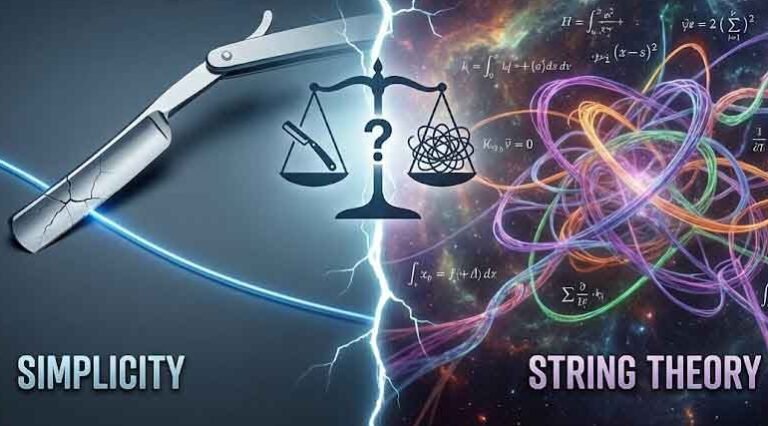

Occam’s Razor in the Age of String Theory: When Simplicity Fails in Theoretical Physics
Abstract Occam’s Razor — the principle that entities should not be multiplied beyond necessity —…

Abstract Occam’s Razor — the principle that entities should not be multiplied beyond necessity —…

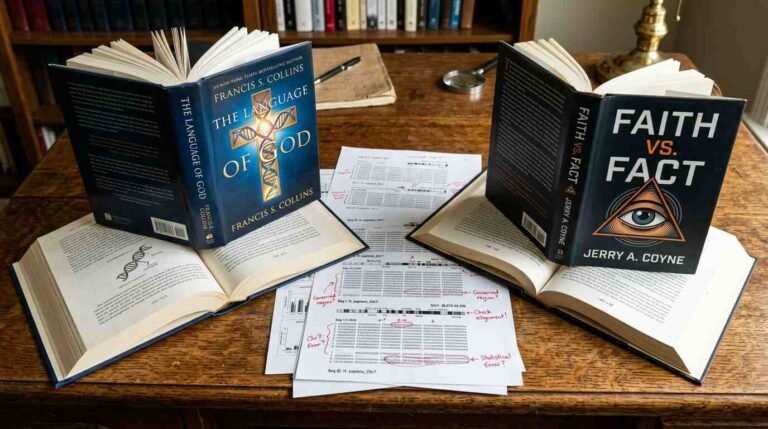
Francis Collins sequenced the human genome and then said it pointed to God. Jerry Coyne spent years publicly dismantling that claim. Here’s what the debate actually showed — and didn’t.

Hegel believed contradiction drives all reality. Kierkegaard mocked him relentlessly. Here’s what happens when you seat them both at a diner counter and hand them a menu.

In 1704, a Berlin dye-maker accidentally invented the first synthetic pigment. It raised a question neither Plato nor Locke could fully answer: does color exist without a perceiver?

Husserl’s theory of time-consciousness says we carry the just-past in every present moment. Whipped cream collapsing back into liquid is not a chemistry problem. It’s a phenomenological crisis.

Ernst Haeckel saw biological beauty as self-sufficient law. Teilhard de Chardin saw evolution as God’s grammar. Their implicit debate, run through drawings and theology, has never been fully adjudicated.