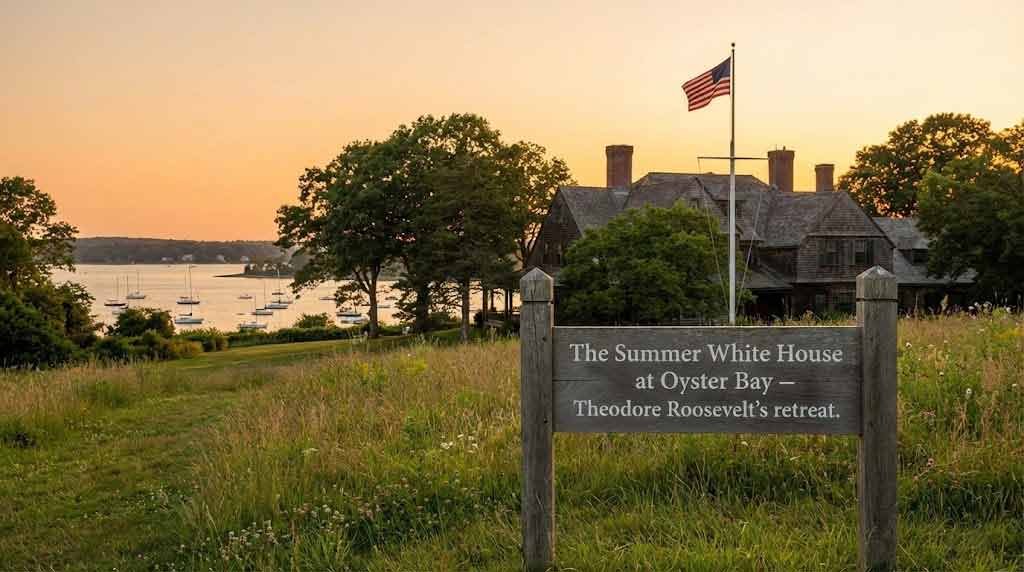
Twenty-five miles east of Manhattan, on a grassy promontory above the cold blue waters of Oyster Bay, a Victorian house once held the fate of two empires. No marble columns. No great ceremonial gates. Just a modest Queen Anne shingle-style home with a wide wraparound porch where, in the summer of 1905, the President of the United States received the foreign ministers of Imperial Russia and Imperial Japan — separately, quietly, and with characteristic force of will — and talked them toward peace. The house was Sagamore Hill. The President was Theodore Roosevelt. The outcome was the Treaty of Portsmouth, which ended the Russo-Japanese War and made Roosevelt the first American to receive the Nobel Peace Prize. That a Long Island hilltop became the stage for one of the twentieth century’s most consequential diplomatic acts is not merely a footnote in North Shore history. It is, in many ways, the defining episode of what this particular stretch of coastline has always represented: a place where serious people go to think and act seriously.
The Architecture of a Presidency
Sagamore Hill was never intended to be grand. Theodore Roosevelt purchased the 155-acre property in Cove Neck, near Oyster Bay, in 1880 for $30,000 — at age 22, with the confidence of a man who believed land was the foundation of a life built on substance rather than appearances. The architectural firm Lamb & Rich designed the home, completing it in 1886: a 22-room Queen Anne structure with the restless, layered aesthetic of the Gilded Age, but also the unmistakable fingerprints of a man who valued function and character over ceremony. (Wikipedia, Sagamore Hill)
Roosevelt named the property Sagamore, after Sagamore Mohannis, an Algonquin chief who had led a tribe across the same land centuries before. That choice of name — not a family name, not a European affectation, but an Indigenous word meaning “chieftain” — spoke volumes about Roosevelt’s self-conception and his relationship to this particular ground. He wasn’t establishing a dynasty. He was claiming kinship with the soil itself.
From 1902 to 1908, during all seven summers of his presidency, Sagamore Hill functioned as what history came to call the Summer White House. Staff operated from the property. Diplomats arrived by rail to Oyster Bay and were driven up Cove Neck Road. The press corps established itself nearby. Cabinet members traveled from Washington. And Roosevelt, characteristically, fit all of it between horseback rides, rowing sessions in the harbor, and afternoons playing with his six children on the wide lawn. Susan Sarna, curator at Sagamore Hill, put it plainly in Cowboys & Indians magazine: “Picture him here in 1905, when Roosevelt would have made a point of playing with his children at the same time he was holding historic meetings with delegates from Japan and Russia.” (Cowboys & Indians, 2016)
This simultaneity — the personal and the geopolitical existing in the same unguarded space — was not an accident of circumstance. It was a deliberate expression of Roosevelt’s philosophy. A man who governed from a desk was one kind of president. A man who governed from a porch, with children running past and no tablecloths on the lunch table, was something different: present, unaffected, and ultimately more dangerous to those who underestimated him.
The War That Demanded an Honest Broker
By the winter of 1904, the Russo-Japanese War had settled into the brutal arithmetic of industrial-age conflict. Russia and Japan were contesting supremacy over Manchuria and Korea — the former a vast empire slow to modernize, the latter an island nation that had industrialized with startling speed. The Japanese Navy had attacked the Russian fleet at Port Arthur in February 1904 without a formal declaration of war, an audacity that shocked European chancelleries but confirmed what shrewd observers already suspected: Japan had arrived as a genuine military power.
Over the following year, the battles of Mukden and Tsushima made the ledger of suffering explicit. At Mukden alone, Russian forces lost 60,000 soldiers; the Japanese, 41,000. (U.S. Department of State, Office of the Historian) Russia’s Baltic Fleet, dispatched on an eighteen-thousand-mile voyage around Africa and India to relieve the Pacific theater, was effectively annihilated at Tsushima. The war had become simultaneously unwinnable for Russia and financially unsustainable for Japan, whose treasury was exhausted despite its unbroken string of victories on the battlefield.
It was Japan that made the first move toward peace. Japanese Foreign Minister Komura Jutarō, recognizing that a negotiated settlement now was preferable to a grinding attrition that could reverse the military calculus, approached the United States. Roosevelt, who had followed the conflict with forensic attention from the earliest days, was the natural choice for intermediary. He had little personal sympathy for Tsarist Russia — word of Siberian penal colonies and anti-Jewish pogroms had reached the American press — but he was also increasingly wary of a Japan whose stunning military capacities had begun to alter the strategic geometry of the Pacific in ways that complicated American interests. (Treaty of Portsmouth, Wikipedia)
What Roosevelt wanted was balance. What he offered was leverage.
Oyster Bay Receives the Empires
The choreography of the summer of 1905 unfolded with Roosevelt’s characteristic preference for personal, direct engagement over the formal protocols of traditional diplomacy. Rather than wait for both delegations to assemble at a neutral site, he invited them separately to Sagamore Hill — first the Japanese delegation, then the Russians — to conduct what might be understood today as pre-negotiation alignment sessions. The goal was to arrive at Portsmouth with the outlines of an agreement already sketched in private.
Japanese diplomat Baron Komura arrived in New York on July 25, and two days later he and Ambassador Takahira visited Roosevelt at Sagamore Hill, the summer White House on Long Island. Roosevelt urged the Japanese to moderate the demand for an indemnity — the cost of war that Japan felt entitled to as a result of its victories.
Russia’s Count Sergei Witte arrived shortly after. The contrast between the two receptions became one of the minor dramas of the summer. The Japanese delegation, according to multiple accounts, was charmed by the informality of Sagamore Hill — its hunting trophies, its atmosphere of a working family home rather than a presidential palace, its menagerie of children and dogs. Witte, on the other hand, was offended that Roosevelt did not provide more high-falutin’ protocol at his Oyster Bay home. Witte said lunch at Sagamore was “almost indigestible” with no wine served and no tablecloth.
This was not oversight. Roosevelt understood that formality creates distance, and distance creates the illusion of leverage where none exists. By receiving Witte without ceremony, he was communicating something precise: that Witte was a visitor to a working household, not a dignitary at a royal court. The power in the room was not Russian.
On August 5, 1905, an introductory meeting was held aboard the presidential yacht, the Mayflower, anchored in Long Island Sound near Roosevelt’s Sagamore Hill summer home. The two delegations met formally for the first time, on American water, within sight of the North Shore bluffs. Whatever ceremony the moment demanded, it was Roosevelt who provided its frame.
The Negotiations and the Art of the Possible
The formal peace conference convened on August 9 at the Portsmouth Naval Shipyard in Kittery, Maine — chosen for its security infrastructure, its cooler summer climate, and its distance from the sweltering politics of Washington. Roosevelt himself remained at Sagamore Hill, but his presence at Portsmouth was felt throughout the twelve sessions. He communicated with both delegations by cable, by private message, and through the social architecture he had established during the Oyster Bay meetings.
The main sticking points were reparations and control of Sakhalin Island. Russia refused to pay a war indemnity, arguing — in defiance of every military reality — that there were no victors in the conflict. Japan’s delegation, led by Komura, initially held firm on both points. Roosevelt, watching from afar, found Russia’s stance irrational. In a message to the Tsar, he warned that a continuation of the war might mean not just the loss of some Asian territory but all of eastern Siberia as well. In the interest of peace, he counseled Russia to “purchase” the northern half of Sakhalin from Japan, which controlled it at that point — framing money as a purchase rather than an indemnity to give both sides political cover.
The diplomacy was exhausting. “I am having my hair turned gray by dealing with the Russian and Japanese peace negotiations,” Roosevelt told his son Kermit. And earlier, when trying to get both parties simply to agree to convene: “Oh Lord! I have been going nearly mad in the effort to get Russia and Japan together.”
The Treaty of Portsmouth was signed on September 5, 1905. Russia recognized Japan as the dominant power in Korea and made significant territorial concessions in China. Japan gained control of the South Manchuria Railway, Russia’s lease on the Liaodong Peninsula, and the southern half of Sakhalin. No indemnity was paid. The war — which had consumed hundreds of thousands of lives — was over.
Roosevelt’s reaction, characteristically, was blunt satisfaction rather than triumphalism. He said simply: “It’s a mighty good thing for Russia and a mighty good thing for Japan. And a mighty good thing for me, too.”
The Nobel and What It Meant for America
Japan emerged victorious over Russia in the Russo-Japanese War, marking the first time an Asian power defeated a European power in modern history — setting the stage for Japan’s future imperial ambitions and exacerbating internal political unrest growing in Russia. The implications of that shift were not lost on Roosevelt. He had mediated the end of a war that had fundamentally reorganized the strategic order of Asia, inserted the United States as an indispensable actor in Pacific affairs, and demonstrated that American diplomacy could operate at the level of great-power statecraft without the vast European foreign services that had, until that moment, dominated such negotiations.
In 1906, the Nobel Prize Committee awarded Roosevelt the Nobel Peace Prize — the first ever given to an American, and the first given to a non-European. He was the first U.S. president to garner this prestigious award. The irony that the honor went to one of the most pugnaciously martial men ever to hold the American presidency was not lost on observers. Roosevelt himself had delivered his famous “Strenuous Life” speech in 1899, arguing that the avoidance of hardship was a form of moral and national decay. Yet it was through sustained, patient, and intellectually sophisticated diplomacy — not force — that he achieved his greatest international triumph.
Edmund Morris, Roosevelt’s most celebrated biographer, assessed the Portsmouth achievement with precision: “By sheer force of moral purpose, by clarity of perception, by mastery of detail and benign manipulation of men, he had become, as Henry Adams admiringly wrote of him, ‘the best herder of Emperors since Napoleon.'”
That the machinery of this achievement — the personal meetings, the informal luncheons, the yacht in the Sound — was centered on a grassy hilltop above Oyster Bay is something the North Shore has perhaps not sufficiently reckoned with. Sagamore Hill was not merely a presidential retreat. It was, for one remarkable summer, the operational hub of an effort that reshaped the political geography of Asia and announced the arrival of the United States as a genuine world power.
The North Room and the Texture of a Life Well Lived
Inside Sagamore Hill, the room that best captures the complexity of Roosevelt’s character is the North Room — added in 1905, the same year as the Portsmouth negotiations. “The North Room cost as much as the entire house had,” curator Susan Sarna told Cowboys & Indians. “It is grandiose.” Measuring 40 by 20 feet, with 20-foot ceilings, it was constructed of mahogany brought in from the Philippines. Roosevelt had the presidential eagle carved by Gutzon Borglum — the sculptor who would later chisel the faces of presidents into Mount Rushmore. The room is filled with hunting trophies, gifts from foreign dignitaries, art, and the thousands of books that were the intellectual raw material of a man who wrote thirty-eight volumes of history, biography, natural science, and political philosophy.
It is the kind of room that demands the word “earned.” Not inherited, not staged, but accumulated through decades of genuine engagement with the physical and intellectual world. Roosevelt had boxed with sparring partners in the New York Governor’s mansion. He had ridden with the Rough Riders in Cuba. He had catalogued birds as a teenager with the rigor of a professional ornithologist. He had ranched in the Dakota Badlands after the catastrophic loss of both his mother and his first wife on the same day in 1884. The North Room was not a display of wealth. It was a record of a life pressed hard against experience.
That ethic — of quality earned through genuine engagement, of a thing being worth exactly what went into making it and no more — is perhaps the most enduring contribution Sagamore Hill makes to the culture of the North Shore. It is a home that asks of its visitor: what have you done, and can the evidence fill a room?
The Long Shadow of Oyster Bay
Sagamore Hill today operates as a National Historic Site under the National Park Service, encompassing 83 acres at 20 Sagamore Hill Road in Oyster Bay. The house is open for guided tours, its interior almost entirely original — the furnishings, the books, the trophies, the piazza where Roosevelt received his nominations for governor, vice president, and president. The Theodore Roosevelt Museum at Old Orchard, on the same grounds, provides the broader biographical and political context. (National Park Service, nps.gov/sahi)
It is a site that rewards slow attention. The grounds slope toward Oyster Bay Harbor, where the Long Island Sound opens east toward the open Atlantic. Standing on the porch in the early morning, with the light coming flat off the water, it is possible — not merely metaphorically but almost sensory — to feel the weight of what was decided here. The delegations of two empires walked these grounds. The cables that crossed the Pacific and the Atlantic during those August weeks of 1905 were composed, in large part, by a man sitting on this hill, insisting on the possible.
There is something in the texture of the North Shore that has always attracted this kind of seriousness — the proximity to New York’s resources without the tyranny of its pace, the access to water that breeds the particular clarity that comes from looking at a horizon. What Roosevelt understood, and what Sagamore Hill embodies, is that consequential work can be done quietly, without marble and ceremony, if the person doing it is prepared.
I think often, in the work I do — whether at the diner counter at The Heritage or at the leather bench late into the evening stitching bridle leather by hand — about what it means to build something that will outlast the moment of its making. Roosevelt understood this instinctively. Sagamore Hill was not a showcase. It was a workshop. The difference matters more than most people acknowledge.
A Place Worth Visiting
Sagamore Hill National Historic Site is located at 20 Sagamore Hill Road, Oyster Bay, NY 11771. Tours of the historic home are ticketed and can sell out, particularly in summer and fall; advance reservations are strongly recommended via the National Park Service website at nps.gov/sahi. The grounds are open free of charge. The Theodore Roosevelt Museum is housed in the Old Orchard building on the same property. The site is open Wednesday through Monday, 9 a.m. to 5 p.m. — closed Tuesdays. The drive from Mount Sinai takes approximately forty minutes along the North Shore.
For those wanting to absorb the full scope of Roosevelt’s life and diplomacy, Edmund Morris’s three-volume biography — The Rise of Theodore Roosevelt, Theodore Rex, and Colonel Roosevelt — remains the definitive account. The Treaty of Portsmouth’s documentary record is held in part by the Massachusetts Historical Society in the George von Lengerke Meyer Papers, portions of which are available online at masshist.org. The Portsmouth Peace Treaty Foundation maintains a detailed account of the negotiations at portsmouthpeacetreaty.org.
The North Shore produced Sagamore Hill. And from Sagamore Hill, America produced its first world-historical act of diplomacy. That is worth the drive.
Sources:
- National Park Service, Sagamore Hill National Historic Site: nps.gov/sahi
- U.S. Department of State, Office of the Historian — Treaty of Portsmouth: history.state.gov
- Treaty of Portsmouth, Wikipedia: en.wikipedia.org
- Theodore Roosevelt Center, Treaty of Portsmouth: theodorerooseveltcenter.org
- Portsmouth Peace Treaty Foundation: portsmouthpeacetreaty.org
- Massachusetts Historical Society, George von Lengerke Meyer Papers: masshist.org
- Cowboys & Indians Magazine, Susan Sarna interview: cowboysindians.com
- Governing.com — “What Did TR Do?” (2023): governing.com
- HistoryNet — “Laws of War: TR’s 1905 Treaty of Portsmouth”: historynet.com
- Britannica — Treaty of Portsmouth: britannica.com
- Edmund Morris, Theodore Rex (Modern Library, 2001)