One sentence in the British Colonial Office archives captures the entire moral catastrophe with the blunt precision of a man who didn’t think he was confessing anything. A senior official, reflecting on the staggering death toll among the African porters who had made Britain’s East Africa campaign possible, wrote that the disaster had not become a public scandal for one simple reason: “…because the people who suffered most were the carriers — and after all, who cares about native carriers?”
He was right, of course. Nobody did. Not in 1918. Not for most of the century that followed.
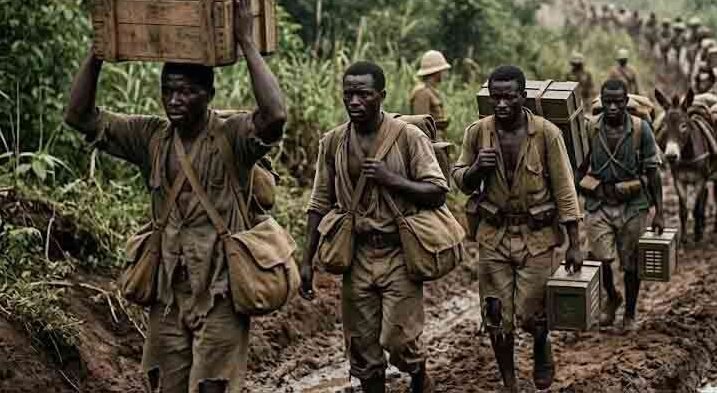
This is the story of the Carrier Corps — a conscripted army of over 400,000 African men who carried guns, ammunition, food, the wounded, and the entire logistical weight of one of the First World War’s most brutal and least documented campaigns across terrain the size of Western Europe. At least 95,000 of them died. Some estimates push the figure toward 100,000. The campaign they sustained outlasted the war in Europe by two full weeks, and when it was finally over, the men who had kept it alive went home to nothing — no pensions, no memorials, no place in the history books that schoolchildren would one day read.
They were erased. Not accidentally. Deliberately.
A War That History Chose to Forget
When most people visualize the First World War, they see trenches. Mud. The Western Front. Passchendaele. The Somme. What the popular imagination does not conjure is a four-year guerrilla campaign fought across German East Africa — modern-day Tanzania, Rwanda, and Burundi — over territory five times the size of Germany, in swamps, mountains, and malarial bush that killed men faster than enemy fire ever could.
The campaign was set in motion by a single German commander of extraordinary tactical brilliance: Lieutenant Colonel Paul von Lettow-Vorbeck. With a force that never exceeded 14,000 men — roughly 3,000 Germans and 11,000 African askari soldiers — Lettow-Vorbeck kept an Allied force ten times his size in permanent pursuit for the entire duration of the war. His explicit objective was to pin down British resources in Africa and prevent their deployment to Europe. He succeeded. The campaign consumed £70 million of British war expenditure and the lives of hundreds of thousands of people, the vast majority of whom were African civilians and porters who had no stake in the imperial quarrel that consumed them.
When Lettow-Vorbeck finally surrendered — on November 25, 1918, fourteen days after the armistice in Europe — he had not been defeated. He had simply run out of war.
The men who chased him did not fare as well.
The Problem of Moving a War Through Africa
To understand why the Carrier Corps existed, you have to understand the terrain. East Africa in 1914 had almost no roads. The few that existed became impassable mud troughs during the rainy season. Railway lines were sparse and strategically irrelevant once Lettow-Vorbeck pulled his forces into the interior. Draught animals — the standard solution to military logistics — were killed within weeks by the tsetse fly, carrier of trypanosomiasis, the sleeping sickness that made large swaths of the bush lethal to horses, mules, and oxen alike.
The British Army, accustomed to deploying Indian Army units and keeping the King’s African Rifles as internal security troops, found itself suddenly unable to feed or supply a large force in the field. The math was staggering: military planners calculated that to deliver one kilogram of rice to troops in the interior, it required fifty kilograms of rice at the coast — almost all of it consumed by the porters required to carry it. The supply chain was, in effect, eating itself.
The solution was the Carrier Corps.
Initially called the Military Labour Bureau, the organization was formalized under the Native Followers’ Recruitment Ordinance of 1915, which established the conscription of African males for porterage. The British recruited — and when recruitment failed, conscripted — men from Kenya, Uganda, Nyasaland, Northern Rhodesia, the Belgian Congo, and even Portuguese East Africa. At its peak, the Corps numbered over 400,000 men. These were not soldiers. They carried loads of up to sixty pounds on their backs, often without boots, across distances that an entire European army would have found grueling with full logistical support. White officers in the field could require as many as six carriers each.
They were paid a wage so low it amounted to economic conscription on top of legal conscription. While a contemporary Mombasa dock worker earned approximately 30 rupees a month, the 1915 Ordinance set carrier wages at 5 rupees per month including food, rising to 6 rupees after three months of service. The historian Geoffrey Hodges, author of Kariakor: The Carrier Corps (Nairobi University Press, 1999) — the definitive account of the Corps — described this compensation structure as placing the workforce barely a legal distinction above forced labor.
The Death Toll and What It Actually Means
The numbers are so large they become abstract. They shouldn’t.
No fewer than 95,000 porters died — around ten percent of the total manpower used. To put that in comparative context that historians have repeatedly emphasized: almost twice as many porters died as the number of Canadian, Australian, and Indian troops who gave their lives during the war combined.
Of the porters who died, 45,000 were Kenyan, amounting to 13 percent of the male population. Entire villages were emptied of working-age men. Districts were depopulated. The agricultural labor required to sustain communities disappeared into the campaign, and the famines that followed the war were partly a direct consequence.
Combat accounted for a fraction of these deaths. The real danger to the Carrier Corps during the war was not that of being killed in combat but succumbing to disease, exhaustion from carrying heavy loads over long distances, and inadequate medical facilities. By the end of October 1917 there were fewer than 13,000 hospital beds available for carriers, most of which were too far from the front lines to make them reachable by those struck down with malaria, dysentery, or pneumonia.
Then came 1918. In October 1918, the Spanish influenza reached East Africa, unleashing an epidemic that any form of medicine — Western or African — was unable to combat. Men who had survived the entire campaign died in the final weeks.
The German side was no better. In the German official history, Der Weltkrieg, Ludwig Boell wrote that of the loss of levies, carriers, and support personnel, no overall count could be made due to the absence of detailed sickness records. The Germans didn’t even bother counting. One historian’s 1989 estimate placed total casualties across all sides in the East Africa campaign at 350,000, with a death rate of one in seven people in affected regions.
Conscription, Resistance, and the Grand Levy
The African populations subjected to conscription did not submit without resistance. They understood, with clarity the colonial administration did not anticipate, what service in the Carrier Corps meant. Word traveled quickly from the bush: the men who left with the British did not come back healthy. Many did not come back at all.
African reluctance to serve was heightened by complaints about conditions, and there were frequent attempts to evade conscription. Chiefs and village elders refused to provide quotas. Entire communities relocated to avoid recruitment parties. In Nyasaland, the Christian minister John Chilembwe organized what became one of the first anti-colonial uprisings of the twentieth century in January 1915, in direct response to forced recruitment. Colonial authorities suppressed both the uprising and the newspaper coverage of his letter opposing conscription.
By 1917, the campaign’s demands had reached a crisis point. The campaigns of 1917 made particularly heavy demands for military labor, and the government attempted to recruit as many able-bodied male Africans as possible under the ‘Grand Levy’ organized by John Ainsworth. The Grand Levy was exactly what its name suggests: a systematic sweep of able-bodied men from across the colonial territories, executed with the urgency of a military operation.
The settler community, already agitated by the depletion of its labor supply, used the crisis as leverage to press for greater colonial control over African labor in the post-war period. The Carrier Corps, in other words, didn’t just kill men. It set the structural conditions for the intensified labor exploitation that would define East Africa through the 1950s.
What Commemoration Looked Like — And What It Didn’t
When the war ended, the question of how to commemorate the dead arose on every front. In Europe, it produced Thiepval. The Menin Gate. The Tomb of the Unknown Warrior. A continent of stone that still draws pilgrims a century later.
For the Carrier Corps, commemoration was nearly nonexistent.
Despite their sacrifices, porters received little compensation or recognition after the war. Veterans were often denied pensions. Commemoration was largely absent from official histories — especially under colonial rule.
The British official history of the Great War was supposed to include two volumes on the African campaign. Only one was written. Its author died before completing the second. No one was assigned to finish it.
There are place names. The Nairobi neighborhood of Kariakor — a Swahili corruption of “Carrier Corps” — is where members of the Corps were housed during the campaign and afterward. Kariakoo in Dar es Salaam preserves the same etymology. These are the monuments: neighborhoods named after a labor force, the geographic equivalent of a receipt. A small memorial stands in Uhuru Park in Nairobi. Public knowledge of what it commemorates remains low.
The serious scholarly reckoning with the Carrier Corps has come almost entirely from outside the mainstream. Geoffrey Hodges spent years reconstructing the Corps’ operational history from administrative records that the British government had no particular interest in publicizing. Edward Paice’s Tip and Run: The Untold Tragedy of the Great War in Africa (Weidenfeld & Nicolson, 2007), which Antony Beevor called “a very well-researched account of that extraordinary and fascinating sideshow,” brought the campaign to a general audience for the first time. David Olusoga’s The World’s War: Forgotten Soldiers of Empire (Head of Zeus, 2014) pushed the broader story of non-white service and sacrifice into public consciousness.
These are important works. But they remain specialized. A century on, the East Africa campaign and the Carrier Corps that made it possible are still not part of the standard narrative taught in British or American schools when November comes around.
The Architecture of Forgetting
The omission of the Carrier Corps from standard World War I history is not an accident of archiving. It is the product of choices — institutional, editorial, and political — made repeatedly across a century.
Colonial administrations did not keep thorough records of African casualties because, as the Colonial Office official’s quote makes clear, those casualties were not considered worth counting with precision. The absence of records then became the justification for omission from histories: we can’t write about what we don’t have data for. The data gap was engineered, and the engineering was then rendered invisible.
The intellectual framework matters here. For most of the twentieth century, the canonical history of the First World War was written by and for people whose losses were primarily European. The scale of the war’s impact on Africa — the conscription of over one million porters across all belligerent forces, the famine, the displacement, the demographic collapse of entire districts — had no constituency in the publishing houses or universities where history was produced and distributed.
This is what historians mean when they use the phrase “deliberately buried.” Not a conspiracy in the thriller sense, but something more systemic and arguably more damning: a shared cultural decision, made across multiple institutions over multiple generations, about whose suffering counted as history and whose counted as background.
The Carrier Corps men were background. The tsetse fly was background. The famine of 1917 that killed another 300,000 civilians in German East Africa was background. The war’s real protagonist, in the version that survived, was Lettow-Vorbeck — the German commander whose brilliant campaign was romantic precisely because it could be told as a European story, a tale of martial genius played out on an exotic stage.
What Remains and What Is Owed
History’s debts don’t expire. They compound.
The current reassessment of the Carrier Corps is part of a broader, necessary recalibration of how the World Wars are taught and understood. Institutions including the Imperial War Museum in London and the National Army Museum have made serious efforts to document the contribution of non-white service personnel. Academic work on the war in Africa, from the Journal of African History to post-colonial scholarship at universities across East and Central Africa, has reconstructed a story that the original record-keepers tried to make unrecoverable.
What this scholarship establishes is something the Colonial Office official accidentally confirmed: the East Africa campaign could not have been fought, let alone sustained for four years, without the Carrier Corps. Lettow-Vorbeck’s genius was real — but so was the human infrastructure that chased him across 750,000 square miles of hostile terrain. Without the men who carried the ammunition, the rations, and the wounded on their backs through equatorial heat and swamp, Britain’s East Africa campaign collapses in 1915.
They won a war they were never invited to join, for an empire that regarded their deaths as an administrative nuisance, and were sent home without ceremony to communities that had been stripped of their labor and their food supply.
That Colonial Office official thought his candor was harmless because no one of consequence would ever read it. A century later, it reads as an indictment — not just of a man, but of the entire machinery of selective memory that decided, for a hundred years, that it was correct.
Further Reading
- Hodges, Geoffrey. Kariakor: The Carrier Corps — The Story of the Military Labour Forces in the Conquest of German East Africa, 1914–1918. Nairobi University Press, 1999. The definitive operational history.
- Paice, Edward. Tip and Run: The Untold Tragedy of the Great War in Africa. Weidenfeld & Nicolson, 2007. Available at Amazon
- Olusoga, David. The World’s War: Forgotten Soldiers of Empire. Head of Zeus, 2014.
- Killingray, David and Matthews, James. “Beast of Burden: British West African Carriers in the First World War.” Canadian Journal of African Studies, Vol. 13.
- Savage, Donald C. and Munro, J. Forbes. “Carrier Corps Recruitment in the British East Africa Protectorate 1914–1918.” The Journal of African History, Vol. 7, No. 2, 1966. Cambridge Core
- 1914-1918 Online International Encyclopedia of the First World War — Carrier Corps entry. encyclopedia.1914-1918-online.net
- Wikipedia: East African Campaign (World War I)
- Wikipedia: Carrier Corps
- Kenya History: Kenya in the First World War — Carrier Corps and the Forgotten Front
- National Army Museum: East Africa Campaign