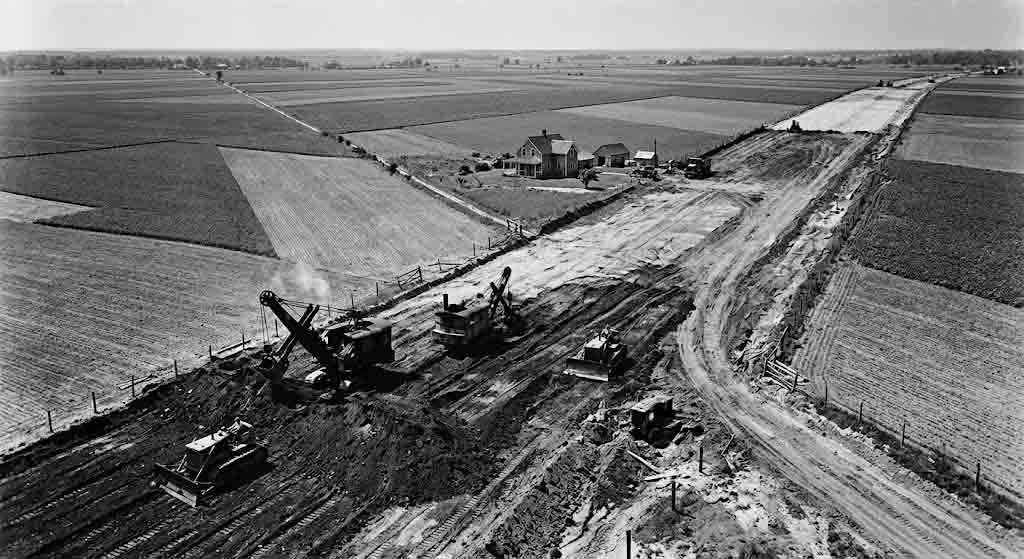
Concrete arteries choked out working-class neighborhoods. Robert Moses shaped Long Island real estate with a bulldozer and a drafting table — and if your farm or your house happened to sit in the path he’d drawn in pencil, the state came knocking. Not to negotiate. To inform you.
Robert A. Caro spent years inside archives and in conversation with the people Moses ran over before he published The Power Broker in 1974. The book is 1,162 pages and it does not run out of material. Moses held twelve simultaneous government positions at his peak — positions he had largely designed for himself, positions that were structured so he could not easily be removed from them. He controlled the Triborough Bridge and Tunnel Authority, the Long Island State Park Commission, the New York City Parks Department, and others. The power he accumulated wasn’t charismatic or electoral. It was structural. He had built the architecture of authority around himself the way a man builds a house around a load-bearing wall.
And with that authority, he paved.
The Northern and Southern State Parkways
The Northern State Parkway and the Southern State Parkway were Moses’ defining Long Island projects — the two great concrete gestures that announced what the island was going to become. Before them, Long Island was farms, small towns, fishing villages, and estate land. After them, Long Island was commuter country. Suburbs waiting to be built. Moses understood the car before most public officials did, and he used that understanding like a crowbar.
The routes he chose were not random. According to Caro’s meticulous documentation in The Power Broker, Moses used his powers of eminent domain aggressively and selectively. Families who had farmed the same land for generations found themselves holding condemnation notices. The process was legal. The compensation was frequently inadequate. The timeline was rarely negotiable. When Moses wanted to move, he moved.
Hundreds of families were displaced to make way for the parkway corridors. The land taken was not waste ground. It was cultivated. It was lived in. Some of it had been in the same hands for decades, acquired by immigrants and their children who understood land ownership the way their parents had understood it — not as investment, but as permanence. You owned land so that nobody could tell you to leave.
Moses told them to leave.
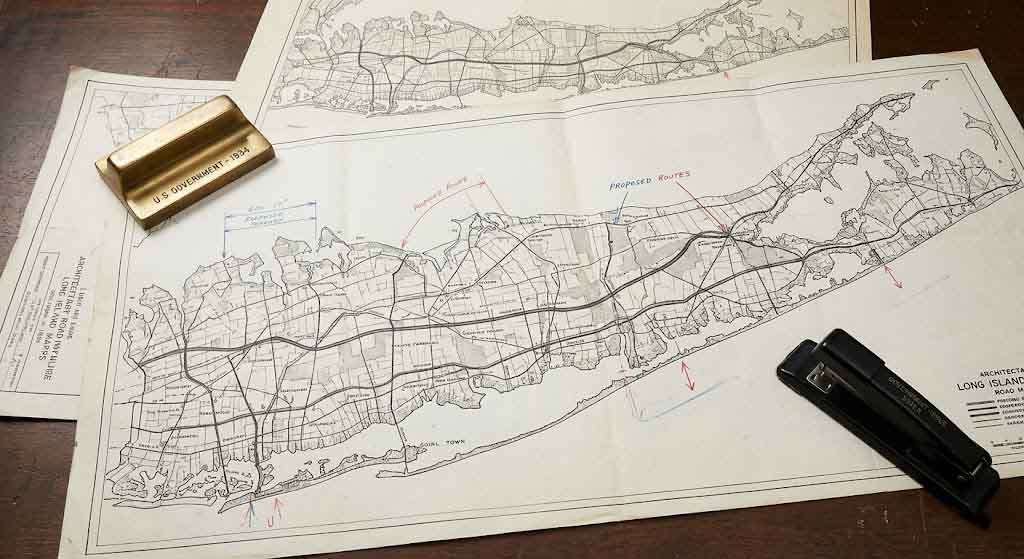
The Architecture of Authority
What made Moses extraordinary — and what made him dangerous — was the combination of genuine vision with genuine contempt. He wanted to build things. He wanted to build them at a scale nobody had attempted. And he genuinely believed that the people standing in his way were obstacles to be managed, not citizens to be heard.
Caro documents instance after instance of Moses manipulating the condemnation process — pressuring assessors, controlling appraisals, moving faster than property owners could organize legally. The eminent domain power that governments use to acquire private property for public use is meant to come with “just compensation.” Moses’ version of just compensation was whatever he could get away with. For families with limited resources and limited access to lawyers, that was often very little.
I grew up around people who understood the relationship between the state and the working man pretty clearly. You didn’t call the city when something went wrong with the pipes unless you wanted to wait six weeks and pay three times the cost. The idea that an agency of the government was coming to give you a fair shake on the value of the land your father cleared — that was not a story those people would have believed. They were right not to believe it.
The parkways got built. Long Island got connected. Millions of people drive those roads every year. The families displaced to build them are largely forgotten.
What Eminent Domain Looks Like on the Ground
The legal doctrine of eminent domain — derived from English common law, codified in the Fifth Amendment’s Takings Clause — requires that private property taken for public use be compensated at fair market value. In theory, this is a reasonable balance: society sometimes needs to build roads, utilities, schools, and parks on land that individuals own.
In practice, the government sets the terms. It hires the appraisers. It controls the timeline. It has lawyers. The individual property owner, particularly one of modest means, is negotiating with one hand tied behind their back. Moses knew this and used it. What Caro’s research shows is not an administrator reluctantly exercising an unpleasant power in service of genuine public need — it’s a man who relished the machinery of displacement.
The New York State Parks Department archives contain records of the condemnation proceedings attached to the parkway construction. The gap between official appraisals and the actual market value of properties taken — particularly farmland and residential properties in Nassau and Suffolk Counties — reflects a pattern that Caro characterizes as systematic undervaluation. The people who received those checks generally had no practical recourse.
This is not ancient history in real estate terms. The properties displaced by Moses’ parkway construction were transacted — condemned, compensated inadequately, absorbed into state infrastructure — within living memory of people still on this island. Long Island’s current property map is partially the product of that displacement. When Pawli at Maison Pawli talks about North Shore real estate today, she’s working a market whose boundaries were drawn, in part, by Robert Moses and his drafting pencil.
The Overpass Question
Caro documents one detail about Moses’ parkway design that became famous among urban planners and historians: the overpasses on the Southern State Parkway were deliberately built too low to allow standard-height buses to pass under them. The practical effect was to prevent public transit — and therefore the populations who depended on public transit, disproportionately poor and Black New Yorkers — from reaching Moses’ beaches and parks.
Moses denied this interpretation. Caro documented it rigorously enough that the denial is largely academic.
The overpass story matters because it shows that Moses wasn’t just building infrastructure. He was engineering social geography. He was deciding, with concrete and clearance heights, who would have access to Long Island and who wouldn’t. The parkways weren’t just transportation networks. They were social boundaries with speed limits.
That’s the kind of power that gets built into the land and stays there. You can’t see it anymore. But it’s in the infrastructure.
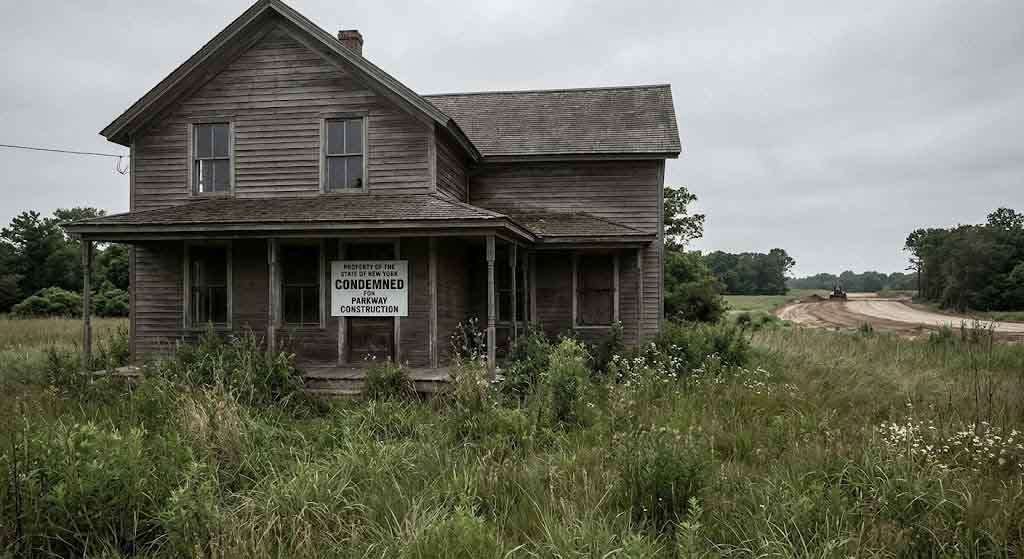
The Power Broker’s Legacy
Moses was removed from most of his positions in the 1960s, largely through the combined opposition of Nelson Rockefeller and a public that had finally grown tired of his methods. He died in 1981. The parkways are still there. The neighborhoods he demolished are not.
What remains is a Long Island shaped by one man’s vision of what it should be — a vision that was brilliant in some respects and brutal in others, and that was executed with a thoroughness that left very little room for the people it ran over.
Caro’s Power Broker remains the most thorough examination of how political power actually functions when it’s allowed to accumulate without genuine accountability. The book is not primarily about roads. It’s about what happens when a man decides he knows better than everyone else and gets access to enough leverage to act on that belief. It’s about the distance between the map and the territory — between the elegant line drawn in an office and the family sitting at a kitchen table trying to understand a condemnation notice.
Every piece of real estate on Long Island has a history that goes back further than its current owner. Some of that history is beautiful. Some of it is the story of the asphalt axe coming down.
You Might Also Like
- Long Island Real Estate Market Update: Q1 2026
- Understanding Property Taxes on Long Island (And How to Appeal Them)
- Best Commuter Towns on Long Island for NYC Professionals
Sources
- Caro, Robert A. The Power Broker: Robert Moses and the Fall of New York. Knopf, 1974. amazon.com
- New York State Office of Parks, Recreation and Historic Preservation — Parkway History. parks.ny.gov
- Ballon, Hilary, and Kenneth T. Jackson, eds. Robert Moses and the Modern City: The Transformation of New York. W. W. Norton, 2007. amazon.com
- Cornell University Library, Division of Rare and Manuscript Collections — Robert Moses Papers finding aid. rmc.library.cornell.edu