In the 1850s, Port Jefferson was launching more wooden ships per capita than almost any harbor in New York State. Today you park your car where the keel blocks used to be.
Spend an afternoon in Port Jeff and you’ll walk past the harbor, maybe grab something to eat along the waterfront, watch the ferry load up for Bridgeport. The place has a nautical feeling to it — the architecture, the hill, the water at the end of every sightline. But “nautical feeling” and “industrial shipbuilding center” are very different things, and the gap between what this harbor was and what it is now is one of the most quietly remarkable erasures in Suffolk County history.
At its peak, Port Jefferson didn’t just have a shipyard. It had several. And among them, the Bayles operation was something that deserves a lot more than a historical marker on a harborfront park.
James Madison Bayles and the Business of Building Ships
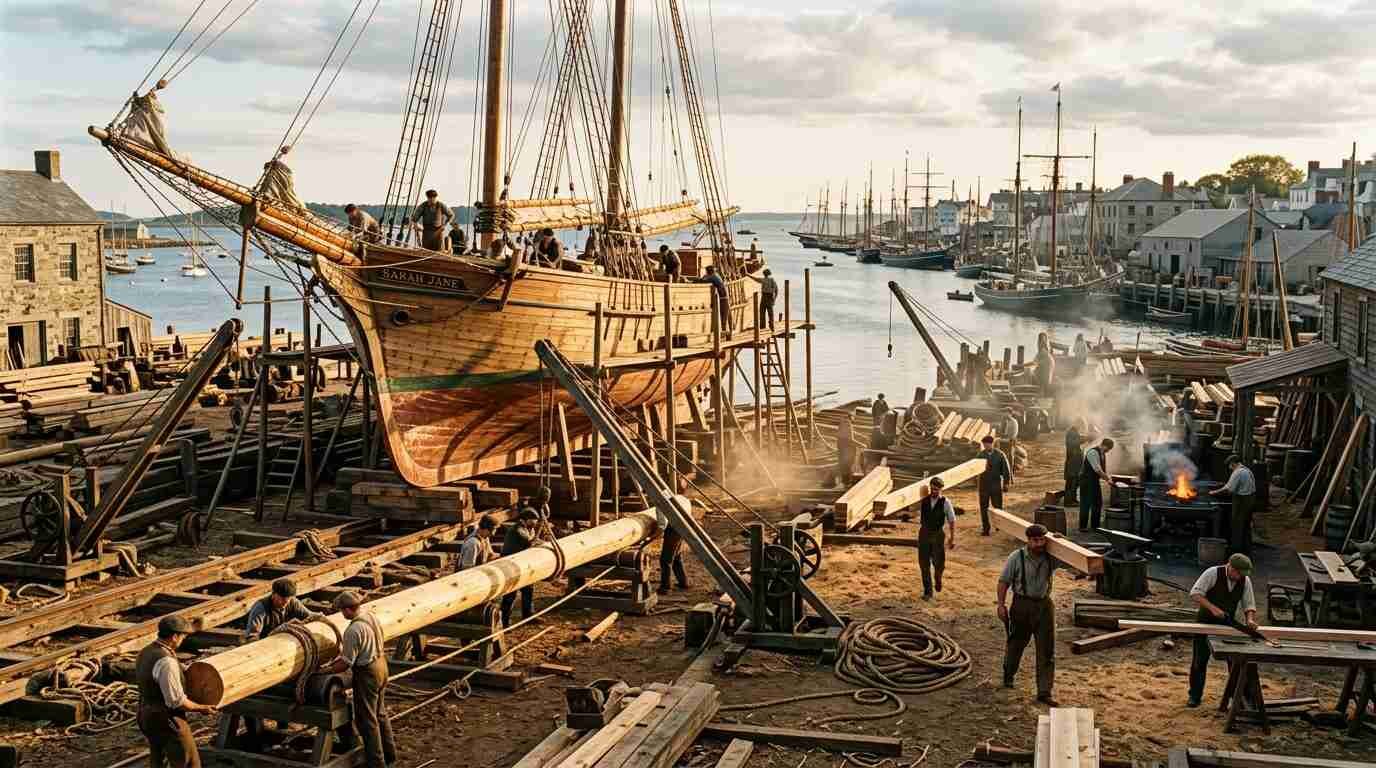
James Madison Bayles established James M. Bayles & Son in Port Jefferson in 1835. His son, James Elbert Bayles, joined the operation in 1863. Over the next eight decades — across three generations of the family — the yard built more than 140 wooden ships. Not restorations. Not replicas. Working vessels: cargo ships, whaling ships, schooners for the coastal trade, luxury yachts for clients who could afford something built right.
The records of James M. Bayles & Son are held at the Mystic Seaport Museum in Connecticut — shipbuilding contracts running from 1856 through 1906, organized chronologically. There’s something striking about a file of wooden shipbuilding contracts spanning half a century: it’s a ledger of a world that operated entirely on wind and timber, and then had to figure out what it was when that world ended.
At its height, Port Jefferson was the leading shipbuilding center in all of Suffolk County, accounting for roughly 40% of the county’s total production. That’s not a rounding error. That’s dominance. The Bayles yard wasn’t the only operation — the Mather shipyard sat just west of the ferry terminal, the Jones shipyard occupied the west side of Jones Street (now Main Street), the Harris shipyard anchored the west side of the harbor, and the Darling yard sat in the northwest corner. All of them together made Port Jefferson a production hub that punched well above the weight of a village with a funny name about flooding.
What They Actually Built
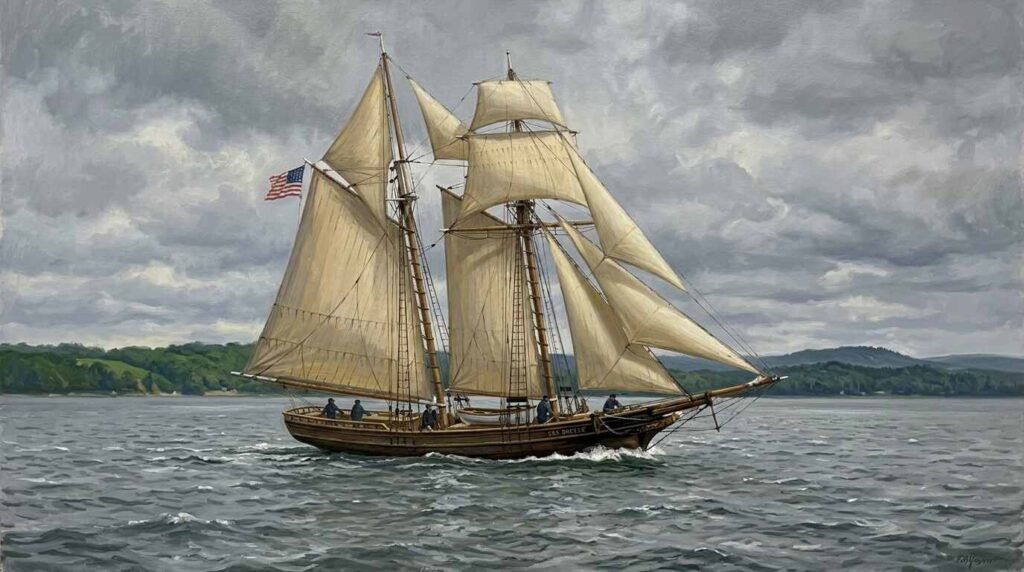
The schooners and vessels that came out of Port Jefferson fed the coastal freight trade — the unglamorous, essential commerce that moved goods between Long Island’s agricultural interior and the manufacturing towns of New England. Before refrigerated rail cars, before interstate highways, before the container shipping revolution, the coastal schooner was the supply chain. You needed someone to build those ships. In this part of the Sound, a significant fraction of them were built right here.
Lloyd’s Register of Shipping — the historical editions accessible through marine archives — lists vessels built at Port Jefferson yards by name and tonnage, a catalog of working ships that crossed Long Island Sound thousands of times before most of them were eventually worn out, run aground, or broken up for timber.
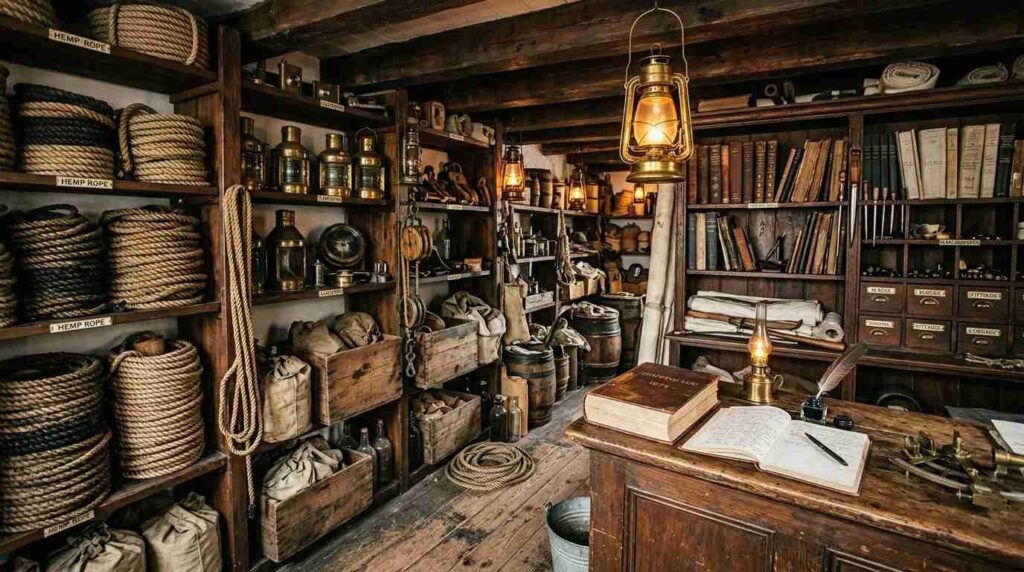
The Long Island Maritime Museum in West Sayville holds construction records and photographs from this era. The detail in those records tells you something about the scale of ambition involved: these weren’t backyard boatbuilding operations. The Bayles yard had a chandlery — documented on a historical marker now in Harborfront Park — that served as the informal community center of early Port Jefferson. The upstairs room of the Bayles Chandlery was where the village conducted its civic life while ships were being built thirty feet away.
The 1897 Fire and What Came After
In 1897, a waterfront fire destroyed the second Bayles Chandlery — an Italianate wooden structure that had stood west of the passway leading into the yard. The third Chandlery, the one that still stands, was built on the same footprint. If you’ve walked Harborfront Park and noticed the old structure near the dock, you’ve looked at the rebuilt version of a building that stood at the center of a working industrial shipyard.
Port Jefferson’s shipbuilding industry survived the Civil War, which is more than most American yards could say. The transition from sail to steam killed shipyards across the northeast — towns that had thrived on wooden hulls and canvas found themselves structurally obsolete almost overnight. Port Jefferson adapted. The transition here wasn’t clean or painless, but the yards kept building.
What eventually ended the era wasn’t a single blow. It was accumulation: a series of fires, title disputes over waterfront property, and — critically — the arrival of the Long Island Rail Road to Port Jefferson in 1873. The railroad didn’t just bring passengers; it reorganized the entire commercial logic of the region. Coastal shipping had been the only efficient way to move goods between Long Island and the mainland. Once rail connected Port Jefferson to New York City and the broader network, the economic rationale for a major shipbuilding industry centered on coastal freight began to soften.
When James E. Bayles finally sold the property in 1917, the new entity — Bayles Shipyard, Inc. — received government contracts from the Emergency Fleet Corporation to build steel freighters and ocean-going tugs for the merchant marine in World War I. That’s how deep the shift had gone: the same waterfront that had launched graceful wooden schooners was now being retooled for steel fabrication with federal wartime money.
The Parking Lot
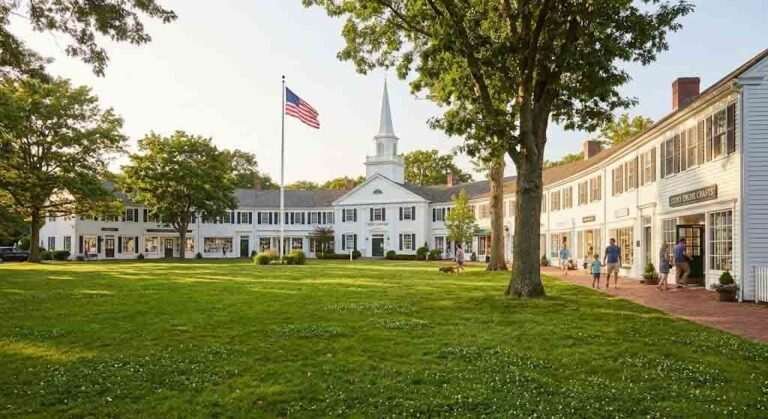
The new firm was not a success. Another company, New York Harbor Dry Dock Co., took over and completed the wartime contracts, continuing afterward as a repair facility. The property passed through more hands. Eventually it became part of a 5.1-acre site owned by Mobil Oil — a petroleum terminal on what had been a shipyard on what had been a working harbor. The Village of Port Jefferson purchased the site in 1997. Harborfront Park was completed in 2004.
You can look up the National Register of Historic Places listing for Bayles Shipyard — it was added in 2000. The register entry encompasses the 1897 Chandlery, the 1917 Machine Shop and Mould Loft, and the 1917 Compressor House. The keel blocks are gone. The launching ways are gone. The ships are gone, scattered in the wakes of a hundred long voyages, broken up, sunk, salvaged, forgotten.
What remains is a park, some surviving structures, a historical marker, and the harbor itself — which still looks, on the right kind of morning, like a harbor that meant something.
Why This Matters If You’re Buying Near the Water
I’ve written about adaptive reuse and how industrial waterfront history shapes property values — the way a building’s former life echoes through its current use and its neighborhood’s sense of identity. Port Jefferson is a case study in that dynamic, compressed into a few blocks.
The waterfront property you’re looking at near the harbor sits at the end of a very specific historical chain: shipyard, petroleum terminal, municipal park, mixed-use village core. Each transition changed the character of the surrounding blocks, the density patterns, the commercial uses, the land values. If you’re evaluating a property near that harbor today, you’re not just looking at square footage and school districts. You’re looking at the downstream consequences of 150 years of industrial transition.
The village’s character — the reason it feels different from Smithtown or Hauppauge, the reason people relocate there on purpose — is inseparable from this layered past. The North Shore Food Trail, the ferry, the walkable village center: none of it would exist without the economic foundation that the shipbuilding era built, and without the slow conversion that followed when that era ended.
If you want to understand what you’re buying, understanding what was here first is not a bad place to start. Pawli at Maison Pawli a Boutique Modern Realty works this market with that kind of depth.
You Might Also Like
- The North Shore Food Trail: A Curated Restaurant Guide from Cold Spring Harbor to Port Jefferson
- The Whaling Barons of Sag Harbor: How a Small Deep-Water Port Rivaled Nantucket and Illuminated the World
- From Printing Press to Penthouses: The Eagle Warehouse
Sources
- Mystic Seaport Museum — Records of James M. Bayles & Son, Coll. 343: research.mysticseaport.org/coll/coll343
- Naval Marine Archive — Bayles Shipyard, Port Jefferson: navalmarinearchive.com
- Bayles Chandlery Historical Marker: hmdb.org/m.asp?m=114738
- Untapped New York — 10 Places to Discover in Port Jefferson: untappedcities.com
- The Shipyard at Port Jeff — History: shipyardportjeff.com/histories
- National Register of Historic Places — Bayles Shipyard listing (added 2000)
- Long Island Maritime Museum, West Sayville, NY: longislandmaritimemuseum.org
- Lloyd’s Register of Shipping (historical editions via marine archives)