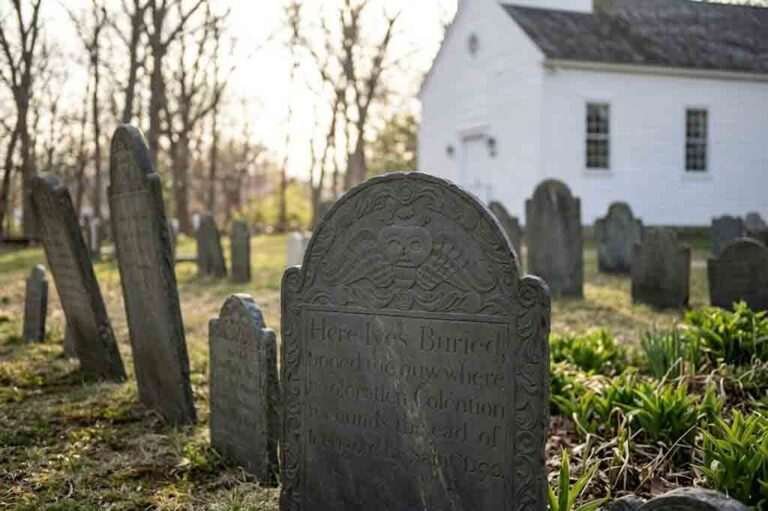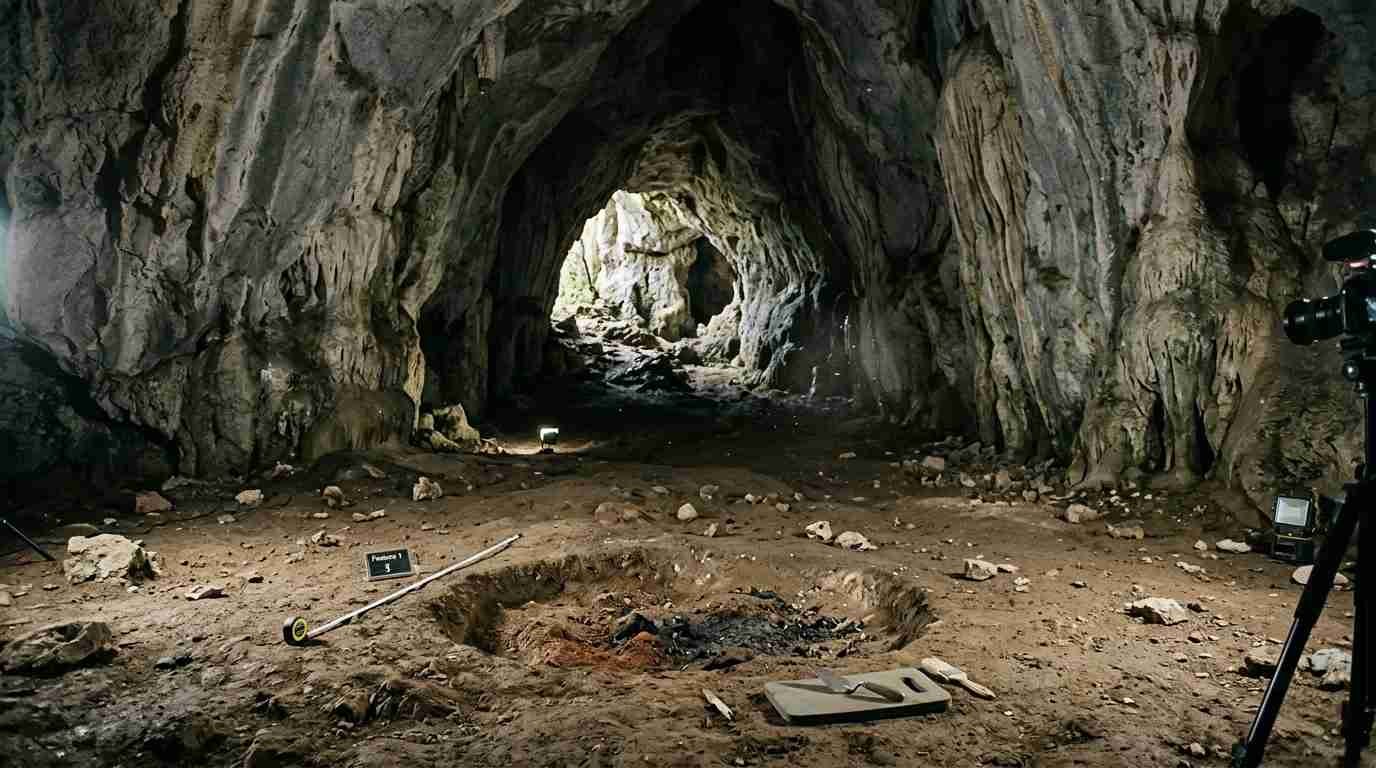
The cave at Shanidar, in the Zagros Mountains of northern Iraq, has produced some of the most debated human fossil evidence in paleoanthropology. Ralph Solecki excavated it between 1951 and 1960, recovering the remains of at least ten Neanderthal individuals. Most were discussed in the technical literature with measured interest. One — Shanidar IV — became the center of a controversy that has never fully resolved, and which a new generation of chemical analysis has now complicated further.
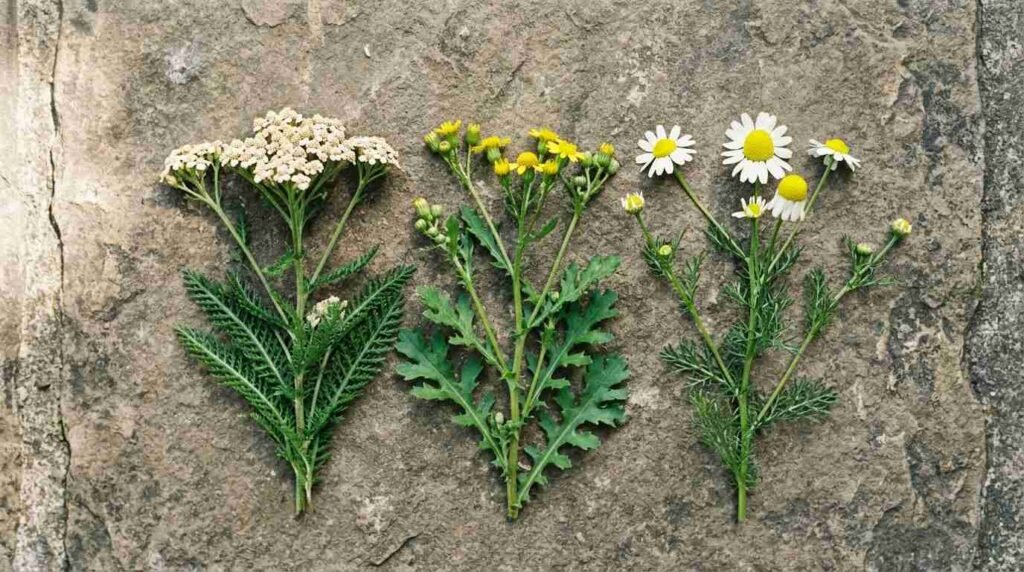
Shanidar IV was buried, Solecki argued, with flowers. The soil samples surrounding the skeleton contained pollen clusters from at least eight plant species, seven of which have documented medicinal properties: yarrow, groundsel, ephedra, grape hyacinth, and others. Solecki’s 1975 paper in Science proposed that Neanderthals had deliberately placed flowering plants with the body — evidence of symbolic thought, mourning, and possibly pharmaceutical knowledge.
The skeptics were immediate and numerous. The pollen clusters, some argued, could have been deposited by burrowing rodents — Meriones persicus, the Persian jird, is known to carry flowering plant material into burrow systems in exactly the region Shanidar occupies. The “flower burial” case was, for decades, treated as uncertain at best.
What followed was not a resolution but a series of new approaches that reframed the question entirely.
What Dental Calculus Reveals
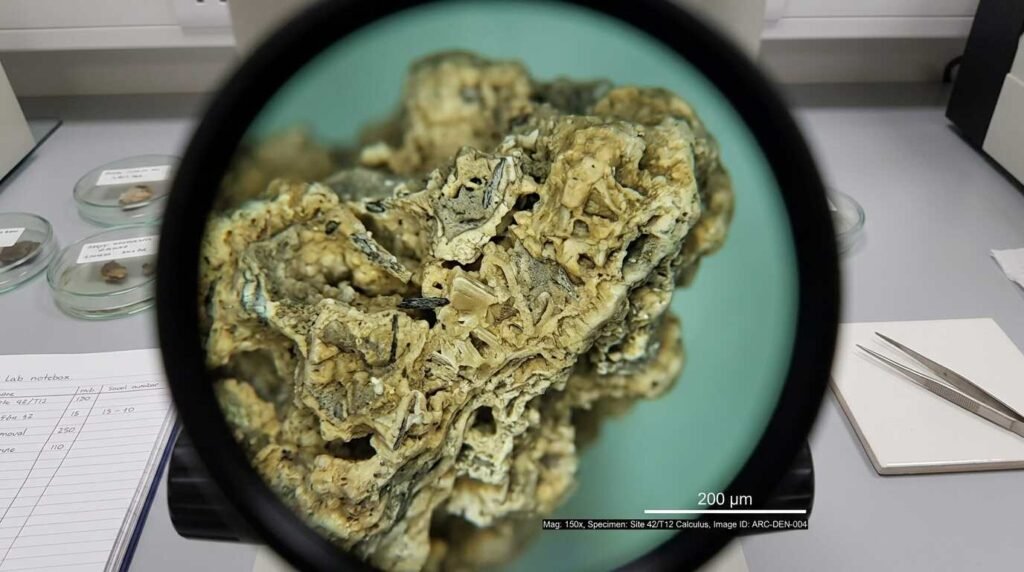
Dental calculus — mineralized plaque, essentially a biological time capsule that accumulates on tooth surfaces during life — has emerged as one of paleontology’s most productive analytical targets. Unlike soft tissue, it preserves organic compounds across hundreds of thousands of years. And unlike bone, it contains material that was in direct contact with what the individual was eating, breathing, and occasionally consuming medicinally.
The 2017 study by Weyrich and colleagues, published in Nature, analyzed dental calculus from five Neanderthals recovered from El Sidrón cave in northern Spain. The results were specific. One individual showed evidence of consuming poplar bark — a natural source of salicylic acid, the precursor to aspirin, with well-documented anti-inflammatory and pain-relieving properties. The same individual’s calculus showed the presence of Penicillium mold — not consumed as food in any obvious sense, but potentially with some antimicrobial effect on an oral environment showing signs of dental abscess.
The Weyrich team was careful in their framing. They noted that the selection of analgesic plant material by an individual with documented dental pathology — identifiable in the skeletal record — was consistent with intentional self-medication but could not be proven conclusively. The calculus showed what was in the individual’s mouth. It could not show intent.
Hardy and colleagues, working from El Sidrón calculus in a separate 2012 study published in Naturwissenschaften, found evidence of yarrow and camomile — plants with essentially no caloric value and strong bitter taste, making accidental or dietary consumption as a food source implausible. Both plants have documented traditional medicinal uses. Yarrow in particular is a well-characterized hemostatic and anti-inflammatory agent used in folk medicine across Eurasia for centuries.
The Cognitive Implications
The debate about Neanderthal pharmacological knowledge is ultimately a debate about cognitive complexity — about what class of mental operations selecting and consuming a specific plant for its physiological effects requires.
At minimum, intentional self-medication requires the ability to associate a symptom (pain, inflammation, infection) with a behavioral intervention (consuming a specific plant) across a time gap sufficient to observe the effect. It requires memory of that association across context changes. It requires communication of the association to others if the knowledge persists across individuals — which is implied if the behavior is found across multiple individuals in a population.
These are not trivial cognitive requirements. They are, in fact, the same basic operations involved in any empirical learning process. The specific knowledge that yarrow reduces inflammation or that poplar bark relieves pain has to be discovered, retained, and transmitted. That the discovery might have happened through conditioning rather than through abstract reasoning does not make it less significant as evidence of behavioral complexity.
The El Sidrón population also showed evidence of care for injured individuals in their skeletal remains. One individual showed a healed amputation. Another showed evidence of a severe developmental disorder that would have required caregiving through childhood and into adulthood. The combination of evidence — care for the injured and ill, consumption of non-nutritive medicinal plants — builds a picture of a population with social structures capable of sustaining dependent members.
The Shanidar Reassessment
Shanidar Cave was re-excavated by a team from the University of Cambridge beginning in 2015. The new excavations recovered a partial Neanderthal skeleton — now designated Shanidar Z — in situ, with modern stratigraphic control unavailable to Solecki. Analysis of the sediment surrounding Shanidar Z is ongoing.
More significant for the flower burial question: the new excavations allowed researchers to assess the Meriones hypothesis directly. Solecki had not had modern rodent burrowing detection methods available. The Cambridge team, working with updated geoarchaeological analysis, noted that while rodent activity was present in some layers, the original flower burial sediment associated with Shanidar IV showed characteristics inconsistent with simple bioturbation as the complete explanation for the pollen distribution.
This does not prove deliberate flower placement. What it does is reduce the confidence with which the rodent-transport dismissal had been applied. The Shanidar IV evidence remains contested. The dental calculus evidence from El Sidrón does not require the same leap — it shows plant compounds in Neanderthal mouths. The interpretation of why they were there is where the scientific debate sits.
Where the Evidence Points
The current state of the evidence supports a cautious but substantive conclusion: Neanderthals consumed plants with documented pharmacological properties in contexts — individuals with identified pathologies, plants with no dietary rationale — consistent with intentional medicinal use. The evidence does not support the claim that Neanderthals had a sophisticated pharmacy or transmitted pharmacological knowledge in a form resembling human traditional medicine. It does not rule that out either.
What the dental calculus studies have established is that the question is no longer purely speculative. It is testable, incrementally, as additional Neanderthal dental calculus samples are analyzed and as the chemical signatures of specific plant compounds become more reliably identifiable in ancient organic matrices.
You Might Also Like: Punctuated Equilibrium vs. Gradualism | The Origin of Humankind by Richard Leakey