
Georg Ernst Stahl introduced phlogiston theory in the early eighteenth century to explain combustion, calcination, and respiration. Phlogiston, in Stahl’s framework, was a subtle substance present in all combustible matter that was released during burning. A candle flame was the visible evidence of phlogiston escaping. Metals left behind a calx — what we now call an oxide — after calcination because the phlogiston had departed. Air was necessary for combustion because it absorbed the released phlogiston; saturated air could absorb no more, which was why a candle in a closed jar eventually extinguished.
The theory was wrong. There is no phlogiston. The experiments conducted under its framework explained correctly by oxygen and oxidation.
What is less commonly noted is that phlogiston theory was also, for roughly a century, extraordinarily productive. The analytical methods, the quantitative approaches, and the experimental rigor that Stahl, Priestley, Scheele, and their contemporaries developed while working inside a false framework produced the chemistry that Lavoisier used to dismantle it. The tools of the wrong theory became the instruments of the right one.
Stahl’s Framework and Its Explanatory Power
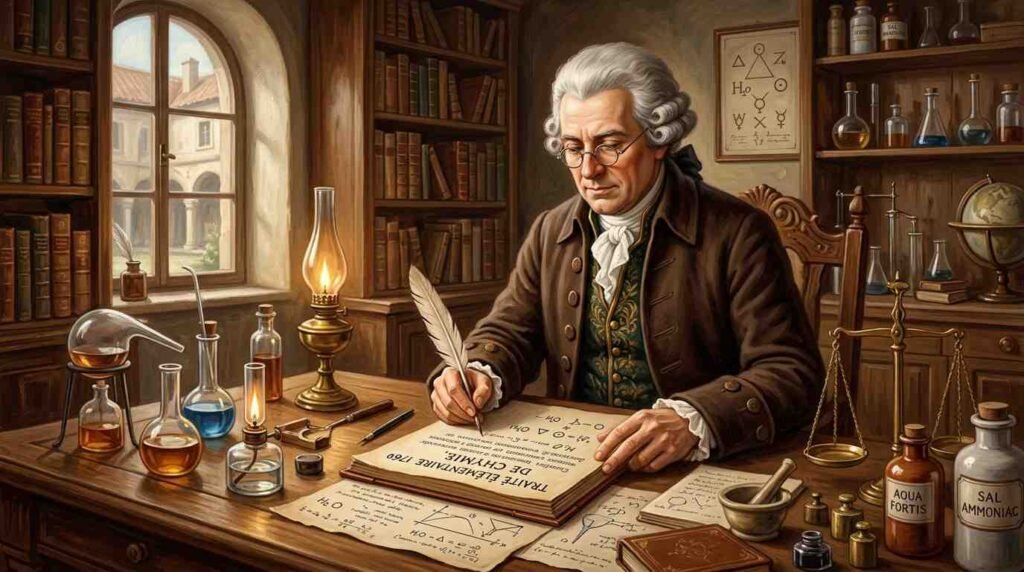
Stahl’s original articulation of phlogiston drew on Johann Joachim Becher’s earlier notion of a combustible “earth” principle. Stahl formalized it, named it, and extended it across a remarkable range of phenomena. Combustion, respiration, fermentation, calcination of metals, and the reduction of metallic calxes to metals — all were unified under the phlogiston account.
The unifying power of the theory was real and significant. Before phlogiston, combustion and metal calcination were explained separately, through different principles. Stahl showed they were structurally similar processes — both involved the loss of the same substance. This was an organizing insight, a genuine advance in conceptual chemistry, even though the substance being tracked did not exist.
What made phlogiston theory scientifically useful — and scientifically dangerous in equal measure — was that it made precise predictions. Combustion should produce a calx plus phlogiston transferred to the air. Reduction of a calx with charcoal should add charcoal’s phlogiston back to the calx, restoring the metal. These predictions were testable. And they were tested, with increasing quantitative precision, throughout the eighteenth century.
Priestley’s Discovery, Priestley’s Blindness
Joseph Priestley stands as the central figure in phlogiston’s paradox. Working in England in the 1770s, he systematically investigated the properties of gases — then called “airs” — with an experimental rigor and productive curiosity that produced an extraordinary series of discoveries. He isolated nitric oxide, nitrous oxide, sulfur dioxide, ammonia, hydrogen chloride, and carbon monoxide, all before oxygen.
In August 1774, Priestley heated mercuric oxide (the calx of mercury) with a burning glass and collected the gas produced. He found that a candle burned brilliantly in this gas. A mouse kept in it survived far longer than in ordinary air. He had isolated oxygen.
He called it “dephlogisticated air.” In the phlogiston framework, this made perfect sense: air from which phlogiston had been removed could absorb more phlogiston from a burning candle — hence the brighter flame. The theory had predicted a specific type of air; Priestley had found it, named it within the theory’s vocabulary, and published it.
When Priestley described his work to Antoine Lavoisier during a Paris visit in October 1774, he handed Lavoisier the experimental result that would, in Lavoisier’s hands, become the cornerstone of a completely different chemistry. Lavoisier ran quantitative combustion experiments with oxygen and established that combustion involved the combination of a substance with oxygen — not the release of phlogiston. He named the gas oxygen. He built a system of chemical nomenclature on the oxygen theory that is still in use.
Priestley spent the rest of his life defending phlogiston. He lived until 1804 — long after the chemical community had largely abandoned the theory he had done as much as anyone to elaborate. He died genuinely believing Lavoisier was wrong.
Hasok Chang’s Revisionist Reading
The philosopher of science Hasok Chang, in his 2012 book Is Water H2O? published by Springer, offers a sophisticated defense of phlogiston theory’s historical standing that goes beyond the conventional “noble failure” framing. Chang argues that phlogiston chemistry was not simply a wrong theory replaced by a right one. It was a coherent research program that made genuine discoveries, solved genuine problems, and maintained explanatory resources that the oxygen theory did not immediately provide.
Chang’s specific argument is that the phlogiston framework handled certain phenomena — particularly the electrolytic decomposition of water and some aspects of acid-base chemistry — with greater ease than the early oxygen framework. He is not arguing that phlogiston was correct. He is arguing that the history of science does not proceed by the clean replacement of false theories with true ones, and that what was lost when phlogiston was abandoned included some useful conceptual tools.
This connects to Thomas Kuhn’s account of scientific revolutions, and also departs from it. Kuhn’s Structure of Scientific Revolutions presented paradigm shifts as relatively clean breaks — anomalies accumulating under the old paradigm, crisis, and replacement. Chang’s examination of the phlogiston-oxygen transition shows a messier process: years of coexistence, partial conversion, practitioners on both sides making genuine discoveries, and no single moment at which the old theory simply failed.
What Priestley’s continued commitment to phlogiston illustrates is not scientific stubbornness in a simple sense. It illustrates how deeply embedded theoretical commitments are in experimental interpretation — how the same data can be organized, named, and explained within two mutually incompatible frameworks, both with internal coherence, for a surprisingly long time.
What the Wrong Theory Got Right
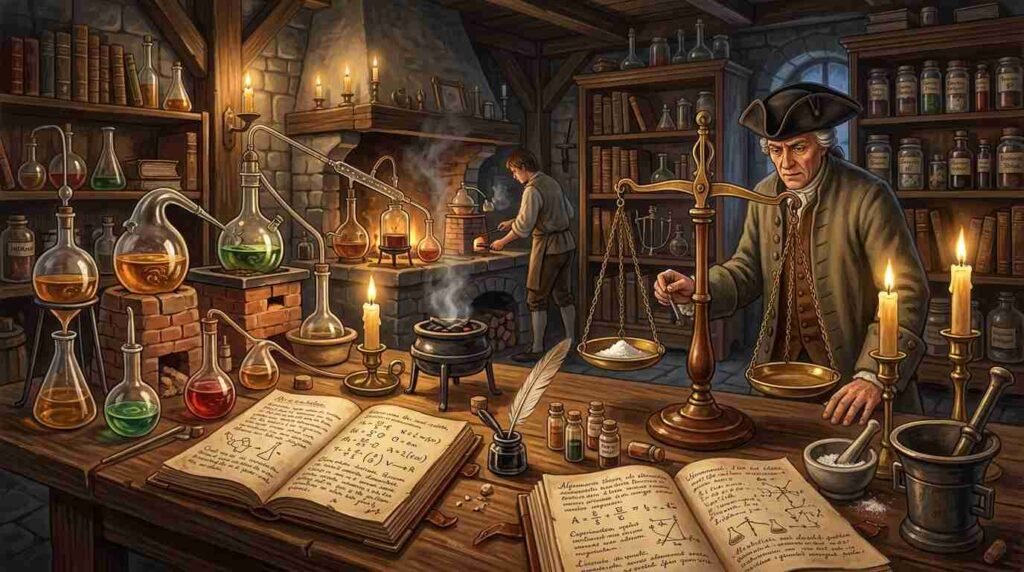
The most underappreciated aspect of phlogiston theory’s history is its methodological contribution. The quantitative methods Stahl’s successors developed — precise weighing of reactants and products, controlled atmospheric conditions, systematic investigation of multiple gas species — were not invented to disprove phlogiston. They were invented to characterize it more precisely. The more precisely phlogiston was characterized, the more the contradictions became visible.
Lavoisier’s decisive experiments depended on balance — the precise quantitative measurement of mass before and after reactions. He established that combustion increased the mass of the product (because oxygen was being added), contrary to phlogiston’s prediction (that mass should decrease as phlogiston escaped). This was Lavoisier’s central weapon. But the weapon was forged in phlogiston laboratories, by researchers trying to quantify the behavior of a substance that did not exist.
The productive error is not an anomaly in the history of science — it is a recurring structure. The caloric theory of heat produced thermodynamics. Nineteenth-century ether physics produced electromagnetism. Wrong frameworks generate right tools with uncomfortable regularity.
You Might Also Like: Occam’s Razor in the Age of String Theory | The Problem of Induction: David Hume, Black Swans