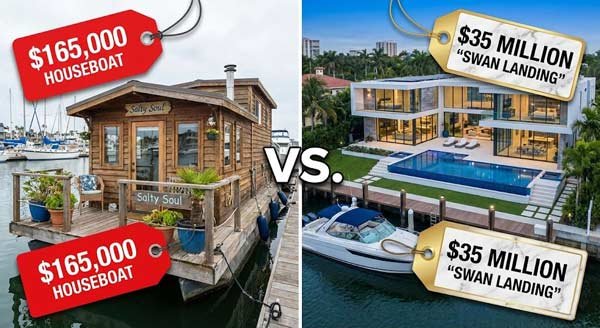
In Nassau County right now, you can simultaneously buy a floating home in Seaford for roughly the price of a studio apartment in Manhattan, or a waterfront palace in Great Neck that costs more than most people will earn in a lifetime. The stark divide between these two active listings—separated by just 20 miles and $34.8 million—tells you everything you need to know about Long Island real estate in 2026: it’s a market where “average” means absolutely nothing.
At 220 Shore Road in Seaford, a 1,100-square-foot houseboat built in 1984 sits at Slip #2, offering unobstructed bay views, a rooftop deck, and a lifestyle most millionaires would envy—for $165,000 cash. Meanwhile, at 227 Dock Lane in Great Neck, “Swan Landing” sprawls across 23,000 square feet on 5.4 pristine acres, featuring indoor and outdoor saltwater pools, a waterfront Har-Tru tennis court, imported East End beach sand, and architectural pedigree worthy of Architectural Digest—for $35,000,000.
These aren’t outliers. They’re the current bookends of Nassau County’s active residential listings, and they reveal a truth about Long Island real estate that most market reports miss: when you say “Long Island home,” you’re saying everything and nothing at the same time. The market isn’t
one market—it’s dozens of micro-markets layered on top of each other, creating a real estate landscape so diverse that a single median price (currently $831,000 in Nassau County) obscures more than it reveals.
This is the story of Long Island’s most extreme listings in early 2026, what they tell us about wealth inequality and housing diversity, and why understanding this spectrum matters whether you’re buying a floating home or building a waterfront estate.
The $165,000 Houseboat: Millionaire Views on a Middle-Class Budget
The listing copy for 220 Shore Road, Slip #2 doesn’t try to hide what it is: “WELCOME ABOARD SLIP #2 WITH YOUR MULTIMILLION DOLLAR VIEW!”
That exclamation point is doing a lot of work, because it’s acknowledging the central paradox of houseboat living—you get views and waterfront access that would cost $5-10 million in a traditional home, but you’re living in 1,100 square feet of 1984 construction that floats.
The Specs: What $165,000 Actually Buys
Property Details:
- Address: 220 Shore Road, Seaford, NY 11783 (Slip #2)
- Price: $165,000-$175,000 (varies by listing date; cash only)
- Square Footage: 1,100 sq ft
- Bedrooms: 2
- Bathrooms: 1 full bath
- Year Built: 1984
- Type: Houseboat/House barge
- Listing Agent: Alexander Iaquinta, LaQuinta Premier Properties
Key Features:
- Unobstructed panoramic bay views
- Rooftop deck with sunset views
- Three floating docks surrounding property
- Spiral staircase to lower deck (can fit 22′ boat)
- Open layout with skylight-topped living room
- Eat-in kitchen with granite counters and electric stove
- Sliding doors to upper deck
- Primary bedroom with serene water views
- Adjacent office area (remote work compatible)
- Two storage sheds
Mechanicals & Systems:
- Whole-house water filtration system (iSpring FP25B multi-layer)
- Brand new Beckett oil burner with forced-air heat
- 60 amp electrical service
- 100-gallon electric hot water heater
Location Benefits:
- Heart of Seaford
- Convenient access to LIRR Ronkonkoma Station
- Near local restaurants, beaches, shopping, parks
- South Shore lifestyle
The Catch: Why It’s Cash Only
The listing is explicit: “Houseboats/House barges are cash only sales.”
This isn’t a preference—it’s a hard requirement that fundamentally changes who can buy this property. Traditional mortgage lenders won’t finance houseboats for several reasons:
1. Collateral Issues: Banks need to be able to foreclose on and resell the property if the borrower defaults. Houseboats occupy a legal gray area—are they boats? Are they real estate? They’re classified as “chattel” (personal property) rather than real property in most cases, making them difficult collateral.
2. Depreciation: Unlike land-based homes that appreciate with land value, houseboats depreciate like vehicles. A 1984 houseboat is 42 years old—ancient in boat years.
3. Slip Rights vs. Ownership: The houseboat owner doesn’t own the water or the slip—they’re renting the right to moor there. This creates uncertainty about permanent location rights.
4. Insurance Complexity: Houseboats require specialized marine insurance, and not all insurers will cover liveaboard situations. Flood insurance is a particular challenge since the home is, by definition, in water.
5. Resale Market: The buyer pool for houseboats is tiny. Banks know that if they need to sell a foreclosed houseboat, they’re looking at months or years to find a buyer.
This cash-only requirement means that despite the low asking price, the houseboat is inaccessible to most first-time buyers or middle-class families who rely on financing. You need $165,000-$175,000 liquid.
The Lifestyle: Who Actually Buys a Houseboat?
Based on market analysis and houseboat owner demographics, buyers typically fall into several categories:
1. Retired Boaters: People who’ve spent their lives on the water and want to downsize from a larger home while staying waterfront. They have home equity to roll over and knowledge of marine living.
2. Second Home Seekers: Buyers looking for a unique weekend getaway. The houseboat becomes a novel vacation property—more interesting than a condo, cheaper than a beach house.
3. Remote Workers Seeking Low Cost of Living: Digital nomads or remote employees who can work from anywhere. The houseboat offers ultra-low housing costs (no property taxes, minimal fees) with waterfront aesthetics perfect for Zoom backgrounds.
4. Creative Types: Artists, writers, photographers attracted to the unconventional lifestyle and nautical aesthetic. The houseboat offers character and story value.
5. Investors: Buyers who see rental potential. The listing suggests it “Whether used as a full-time residence, a weekend getaway or investment property.” Rental listings show houseboats at the same location renting for $1,700/month plus electric—a solid return on $165,000.
The Reality: What Living There Actually Means
The listing copy is aspirational (“laid-back marina vibes,” “serene coastal living”), but houseboat reality includes:
Challenges:
- Limited space (1,100 sq ft for a couple or single person only)
- Marine maintenance (hull inspections, corrosion management, dock repairs)
- Weather vulnerability (storms can be unnerving when your house moves)
- Utility limitations (60 amp service isn’t much; electric heating is expensive)
- No land (nowhere to garden, limited outdoor space beyond decks)
- Marina fees and regulations (slip rental, rules about modifications)
- Resale difficulty (tiny buyer pool when you want to sell)
Benefits:
- Unbeatable cost per view dollar
- Waterfront living without waterfront taxes
- Can dock your own boat at your front door
- Marina community and camaraderie
- Easy “lawn maintenance” (the bay handles it)
- Unique lifestyle and conversation starter
The houseboat represents a specific trade: you accept limitations and unconventionality in exchange for waterfront living at a price point that’s otherwise impossible on Long Island.
The $35 Million Estate: When Money Is No Object
If the Seaford houseboat is about maximizing value per dollar, “Swan Landing” at 227 Dock Lane represents the inverse philosophy: creating perfection regardless of cost.
The Specs: What $35 Million Actually Buys
Property Details:
- Address: 227 Dock Lane, Great Neck, NY 11024
- Price: $35,000,000
- Square Footage: 23,000 sq ft
- Lot Size: 5.4 acres (some sources cite 5.3 acres)
- Bedrooms: 13
- Bathrooms: 14 (10 full, 4 half in some listings; 12 baths in others)
- Year Built: 1995
- Architect: Shope Reno Wharton Associates (award-winning firm)
- Landscape Architect: Peter Cummin (renowned)
- Style: Stone and shingle masterpiece, Colonial influences
- Featured In: Architectural Digest, House & Garden
The Architecture: Custom-Designed Excellence
Swan Landing wasn’t merely built—it was conceived as a complete artistic vision by Shope Reno Wharton Associates, an architecture firm known for high-caliber residential work blending classical elements with modern functionality.
Exterior Features:
- Long tree-lined drive approach
- Sculpted boxwoods
- Tuscan-style columns
- Stone and shingle construction
- Striking facade designed for visual impact
Interior Features:
- Grand barrel ceilings with cove lighting
- Two formal libraries:
- One clad in English oak
- One in mahogany
- Both centered around twin 18th-century fireplaces
- Great stair hall with arched windows and custom inlay flooring
- Formal living room with panoramic Manhasset Bay views
- Curved window walls
- Circular columns
- Refined finishes throughout
- Cathedral ceilings in select areas
- Elevator for multi-floor access
- Whole-house entertainment system
- Central vacuum system
The Amenities: A Resort Within a Residence
Indoor Recreation:
- Indoor saltwater lap pool with French doors to outdoors
- Gaming area
- Temperature-controlled wine cellar
- Changing rooms
- Sauna
- Wet bar
Outdoor Paradise:
- Outdoor saltwater pool with slate patio
- Entertaining pavilion
- Waterfront Har-Tru tennis court (clay court surface preferred by professionals)
- Private dock (deepwater)
- Private beach with imported East End sand (a detail revealing obsessive attention—they didn’t use local sand; they imported better sand)
- Romantic lily pond
- English garden with hydrangea-draped seawalls
- Greenhouse
- Custom pony house (for actual ponies)
- Japanese maples, beech trees throughout
Grounds & Landscaping: Designed by renowned landscape architect Peter Cummin as a “year-round sanctuary,” the grounds represent landscape architecture as high art—not just planting trees, but creating experiential outdoor environments that change with seasons.
Guest Accommodations:
- Separate two-bedroom, two-bath guest cottage
- Complete with independent living facilities
- Allows for privacy for both main residents and guests
The Context: Great Neck’s Gold Coast Legacy
Swan Landing sits in Great Neck, a North Shore community with a storied history of extreme wealth.
Historical Context: Great Neck is part of Long Island’s legendary “Gold Coast”—the collection of North Shore estates built in the 1890s-1930s by America’s wealthiest families (Vanderbilts, Guggenheims, Chryslers, Woolworths). F. Scott Fitzgerald immortalized the area in The Great Gatsby, where the fictional West Egg and East Egg were based on Great Neck and Sands Point.
While many original Gold Coast estates were demolished or converted to institutions in the mid-20th century, Great Neck maintains its reputation as a center of wealth, driven by:
- Proximity to Manhattan (LIRR access, ~30 miles from NYC)
- Top-rated Great Neck school district
- Waterfront location on Manhasset Bay and Long Island Sound
- Established wealthy communities
- Cultural amenities and country clubs
Current Market: The $35 million asking price for Swan Landing places it among Long Island’s most expensive homes. For comparison:
- Median Nassau County home: $831,000
- Great Neck median (typically): $1M-$1.5M depending on neighborhood
- Ultra-luxury Great Neck estates: $5M-$20M typical range
- Swan Landing at $35M: Top 0.1% of market
Who Buys a $35 Million Home?
At this price point, we’re talking about:
Net Worth Required: Financial advisors typically recommend housing costs no more than 25-30% of income. At $35 million, even ignoring financing and assuming you’re buying cash, you’d need:
- Net worth: $100M+ (minimum)
- Annual income: $20M+ (to justify ongoing costs)
- Liquid assets: $50M+ (to avoid asset illiquidity)
Buyer Profiles:
- Finance Executives: Hedge fund managers, private equity partners, investment bankers
- Tech Founders/Executives: Successful startup exits or Fortune 500 tech leadership
- Entertainment/Sports: A-list actors, major music artists, pro athletes with mega-contracts
- International Wealth: Foreign nationals seeking US property (common in Great Neck)
- Generational Wealth: Old money families maintaining/expanding estates
- Corporate Titans: CEOs and board members of major corporations
The Costs Beyond Purchase:
- Property Taxes: Roughly $300,000-$400,000 annually (estimate based on Great Neck rates and assessment)
- Insurance: $50,000-$100,000+ annually for ultra-high-value property
- Maintenance: $200,000+ annually for grounds, pool, tennis court, mechanical systems
- Utilities: $50,000-$100,000 annually for heating/cooling 23,000 sq ft
- Staffing: $200,000+ for groundskeeper, housekeeper, property manager
- Total Carrying Costs: $800,000-$1,000,000+ annually
To justify this, you need annual income in eight figures. This isn’t a house—it’s an operating expense comparable to running a small business.
The Market Context: Understanding Nassau County’s Extremes
These two listings—$165,000 and $35,000,000—aren’t aberrations. They’re the endpoints of a spectrum that defines Nassau County and Long Island real estate.
The Numbers: Nassau County Market (Early 2026)
Overall Market Statistics:
- Median Sold Price: $831,000 (up 0.9% month-over-month, December 2025 data)
- Median Listing Price: $849,000 (up 10.4% year-over-year)
- Sold to List Price Ratio: 100.4% (buyers still paying over asking)
- Median Days on Market: 34 days
- Months of Inventory: 2.08 months (down 20.9% month-over-month)
- Market Status: Strong seller’s market (balanced market = 6 months inventory)
What This Means: Nassau County remains intensely competitive. With only 2.08 months of inventory, “theoretically, if no new listings were to come to market, the entire inventory of Nassau County would be sold out in approximately 75 days” (EXIT Realty Premier analysis).
Homes are selling at or above list price on average, and days-on-market of just 34 days indicates rapid absorption of new listings—particularly for “turnkey” move-in-ready properties.
The Diversity: Why Long Island Defies Simple Analysis
Geographic Diversity: Nassau County spans from the Queens border to Suffolk County, encompassing wildly different communities:
- West: Dense, older suburbs (Elmont, Franklin Square) with smaller lots, older housing stock, median prices $400,000-$600,000
- Central: Mid-market family suburbs (Levittown, Hicksville, Massapequa) with post-WWII development, median prices $500,000-$700,000
- North Shore: Wealthy waterfront estates (Great Neck, Sands Point, Old Brookville) with Gold Coast legacy, median prices $1M-$5M+
- South Shore: Beach communities (Long Beach, Atlantic Beach) with coastal premium, median prices $600,000-$2M+
Property Type Diversity:
- Co-ops and condos: $200,000-$800,000 typical range
- Starter homes/ranches: $400,000-$600,000
- Family colonials: $600,000-$1.2M
- Luxury estates: $2M-$10M
- Ultra-luxury waterfront: $10M-$35M+
- Houseboats: $165,000-$300,000
Income Diversity: Nassau County residents span from working-class to ultra-wealthy:
- Median Household Income: Approximately $120,000-$130,000 (varies by source)
- Income Range: $30,000-$50,000 (lower quintile) to $500,000+ (top quintile)
- Ultra-High-Net-Worth Households: Thousands of households with $10M+ net worth concentrated in North Shore communities
This income diversity drives property diversity. A household earning $120,000 can afford roughly $450,000-$550,000 with 20% down. A household earning $500,000 can afford $2M+. And households with $100M net worth aren’t constrained by mortgage mathematics at all.
The “Two Markets” Phenomenon
Long Island agents increasingly describe a “bifurcated market” or “tale of two markets”:
Market 1: Turnkey Properties (Move-In Ready)
- Selling in days, often with multiple offers
- Commanding premiums over comparable homes needing work
- Bought primarily by buyers who value time over money
- Driving the “100.4% of list price” statistics
Market 2: Fixer-Uppers (Renovation Needed)
- Sitting for months
- Requiring price cuts to attract buyers
- Challenged by high interest rates making renovation loans expensive
- Construction labor shortages adding to renovation costs and timelines
This bifurcation exists at all price points—there are $500,000 fixer-uppers sitting while $550,000 turnkey homes sell instantly, and $3M fixer estates sitting while $4M turnkey estates get multiple offers.
What the Extremes Reveal: Five Lessons for Long Island Buyers and Sellers
Lesson 1: Location Multipliers Are Exponential, Not Linear
The houseboat and Swan Landing are both waterfront. Both have unobstructed views. Both offer private docks.
Yet one costs $165,000 and one costs $35,000,000—a 212x price difference.
Why? Location multipliers compound:
Seaford Houseboat:
- South Shore (less prestigious than North Shore): 0.5x
- Houseboat vs. land-based home: 0.1x
- Slip #2 vs. owned land: 0.1x
- Seaford vs. premier town: 0.7x
- Combined Location Multiplier: 0.0035x compared to premier North Shore land-based waterfront
Swan Landing:
- North Shore Gold Coast: 2.5x
- Great Neck (top-tier community): 1.8x
- Manhasset Bay waterfront with private beach: 3x
- 5.4 acres vs. typical lot: 5x
- Combined Location Multiplier: 67.5x compared to average Nassau property
This isn’t additive (2.5+1.8+3+5 = 12.3x). It’s multiplicative (2.5 × 1.8 × 3 × 5 = 67.5x).
The difference between $165,000 and $35,000,000 isn’t about the houses themselves (though the 23,000 sq ft vs. 1,100 sq ft matters). It’s about location multipliers creating exponential value differences.
Takeaway for Buyers: Location isn’t just important—it’s exponentially important. Moving from a B+ location to an A+ location doesn’t add 20% to the price; it can double or triple it.
Takeaway for Sellers: If you’re in a premium location, price accordingly. If you’re not, understand your competition isn’t just other homes in your town—it’s homes in better towns at similar price points.
Lesson 2: Financing Access Stratifies the Market
The cash-only requirement for the houseboat creates an invisible barrier:
Who Can Buy the $165,000 Houseboat:
- People with $165,000-$175,000 liquid cash
- Estimated percentage of Nassau County households: 15-20%
Who Can Buy the $35,000,000 Estate:
- People with $100M+ net worth
- Estimated percentage of Nassau County households: 0.01%
But here’s the paradox: despite the houseboat being 212x cheaper, it might actually be accessible to fewer total households because of the cash requirement.
Consider:
- Households earning $200,000/year: Can qualify for mortgages up to $800,000-$1M but probably don’t have $165,000 liquid. They’re excluded from the houseboat but could buy a $700,000 home with financing.
- Households with $100M net worth: Have essentially unlimited access to both properties (and would never buy the houseboat, but they could).
This creates perverse outcomes where middle-class professionals can’t access the cheapest waterfront property despite having good incomes, while ultra-wealthy individuals have access to everything.
Takeaway for Buyers: Cash requirements exclude you from properties regardless of income. If you’re targeting cash-only properties (land sales, foreclosures, houseboats), you need liquid capital, not just earning power.
Takeaway for Sellers: Accepting only cash dramatically reduces your buyer pool. Unless the property can’t be financed, offering seller financing or working with buyers to find creative solutions expands your market.
Lesson 3: “Luxury” Is Relative and Arbitrary
The houseboat listing describes:
- “Multimillion dollar view”
- “Beautifully maintained”
- “Thoughtfully designed”
- “One-of-a-kind nautical retreat”
- “Serene coastal living”
- “Laid-back marina vibes”
Swan Landing listing describes:
- “Magnificent waterfront estate”
- “Luxury at its highest level”
- “Unparalleled beauty and privacy”
- “Grand in scale yet warm in feel”
- “Timeless architecture meets modern sophistication”
- “Enduring estate that simply cannot be replicated”
Both use luxury language. Both emphasize uniqueness. Both focus on lifestyle over mechanics.
The difference isn’t in marketing approach—it’s in reality. The houseboat genuinely is unique and offers lifestyle value relative to its price. Swan Landing genuinely is unreplicable and offers lifestyle value relative to its cohort.
“Luxury” in real estate isn’t a price point—it’s the gap between expectations and reality within a price tier.
A $165,000 houseboat with granite counters, new mechanicals, and panoramic views is luxurious relative to $165,000 expectations (which might be a dated condo or a tiny fixer-upper).
A $35,000,000 estate with imported sand, dual libraries, and indoor lap pool is luxurious relative to $35,000,000 expectations (which include these amenities as baseline).
Takeaway for Buyers: “Luxury” marketing is everywhere. What matters is whether the property delivers luxury relative to other options at the same price point, not relative to your dream home.
Takeaway for Sellers: Don’t over-invest in luxury upgrades that are standard in your price tier. Invest in the upgrades that create meaningful differentiation from comparable properties.
Lesson 4: Carrying Costs Distort Affordability
Houseboat Annual Carrying Costs (Estimated):
- Slip rental/marina fees: $12,000-$18,000
- Property tax: $0 (it’s a boat)
- Insurance: $3,000-$5,000 (marine insurance)
- Utilities: $6,000-$10,000 (electric heat is expensive)
- Maintenance: $5,000-$10,000 (marine maintenance, dock repairs)
- Total: $26,000-$43,000/year
Swan Landing Annual Carrying Costs (Estimated):
- Property tax: $350,000-$400,000
- Insurance: $75,000-$100,000
- Utilities: $75,000-$100,000
- Maintenance/groundskeeping: $250,000+
- Staffing: $150,000-$300,000
- Total: $900,000-$1,150,000/year
The houseboat costs $165,000 to buy but $26,000-$43,000/year to own—roughly 16-26% of purchase price annually.
Swan Landing costs $35,000,000 to buy but $900,000-$1,150,000/year to own—roughly 2.6-3.3% of purchase price annually.
In percentage terms, the houseboat is FAR more expensive to own relative to purchase price. In absolute terms, Swan Landing costs 30x more annually.
This reveals a general rule: Lower-priced properties often have higher carrying costs as a percentage of value.
Why? Fixed costs (insurance minimums, basic utilities) hit small properties harder. And tax structures often favor high-value properties (homestead exemptions, tax caps, wealth-driven political influence).
Takeaway for Buyers: Always calculate total cost of ownership, not just purchase price. A “cheap” house with high taxes and expensive heat might cost more annually than a moderately-priced efficient home.
Takeaway for Sellers: If your property has unusually low carrying costs (low taxes, low utilities), emphasize this in marketing. It’s a competitive advantage.
Lesson 5: The Market Is Whatever Buyers Make It
Despite the 212x price gap, both properties have been on the market for extended periods (the houseboat since late 2025; Swan Landing since August 2021 in some listings, August 2025 in others, suggesting it’s been on-and-off market).
Why aren’t they selling?
Houseboat Challenge: Too unconventional for most buyers, too expensive for true boat lovers (who could buy an actual yacht for less), too limited for families (only 2 bedrooms, 1 bath), cash-only requirement excludes 80%+ of potential buyers.
Swan Landing Challenge: Even in the ultra-luxury market, $35M is expensive. Buyer pool is tiny (dozens of qualified households in the region, not thousands). Property is magnificent but niche—needs a buyer who specifically wants Great Neck (not Hamptons, not Greenwich CT), specifically wants 23,000 sq ft (not smaller), specifically wants 5.4 acres (not more land).
This creates an interesting paradox: The most extreme properties take longest to sell, even in strong markets.
Why? Extreme properties have extreme specificity. The houseboat needs someone who wants exactly this lifestyle. Swan Landing needs someone who wants exactly this location, exactly this size, exactly this price tier.
Takeaway for Buyers: Unusual properties stay on market longer, giving you negotiating leverage. If you’re willing to embrace the unusual, you can often get better deals than on generic properties where competition is fierce.
Takeaway for Sellers: Pricing extreme properties is art, not science. Comparables don’t exist. You’re finding the one buyer in the region who wants exactly what you’re selling. Price accordingly (optimistically but not absurdly), and be patient.
The Future: What These Listings Predict for Long Island 2026
These two extreme listings aren’t just anomalies—they’re leading indicators of market trends.
Trend 1: The Hollowing Middle
Nassau County’s market is experiencing what economists call “hollowing”—growth at the extremes, stagnation in the middle.
Evidence:
- Ultra-luxury: Strong demand, limited supply, prices holding or rising
- Starter/entry-level: Strong demand (especially turnkey), supply constrained, prices rising
- Middle market ($700,000-$1.5M): Softer demand, more inventory, prices flat or slight decline
Why?
- High interest rates hurt the middle most: At 6.15%, a $1M mortgage costs $6,100/month in principal and interest. This requires $250,000+ household income, squeezing the middle-class move-up market.
- Ultra-wealthy are rate-insensitive: Paying cash or able to absorb higher financing costs
- Starter buyers are motivated: First-time buyers must get into the market despite rates; they can’t wait
- Middle market has flexibility: Move-up buyers often don’t have to move, so they wait for better rates
The houseboat and Swan Landing represent the extremes that are working. Middle-market homes in the $700,000-$1.5M range are struggling comparatively.
Implication: We may see continued bifurcation in 2026—strong activity at entry and luxury levels, sluggish activity in the middle.
Trend 2: Cash Is King (Again)
The houseboat’s cash-only requirement isn’t unique. We’re seeing increased cash purchases across Long Island:
Exit Realty Premier data: Cash buyers and “equity rollers” (people with substantial equity from previous home sales) are dominating transactions. First-time buyers are struggling.
Why This Matters:
- Cash buyers can move faster, waive contingencies, and offer certainty
- In competitive markets, cash offers beat financed offers even at lower prices
- Sellers increasingly prefer cash over higher-priced financed offers
Implication: Properties that can only be purchased with cash (houseboats, land sales, short sales, foreclosures) may see renewed interest as cash-heavy buyers seek opportunities with less competition.
Trend 3: Location Premiums Are Widening
The 212x price gap between Seaford and Great Neck isn’t just about these properties—it reflects widening location premiums across Long Island.
Behind the Hedges analysis: “If there is any meaningful migration out of Manhattan — driven by policy concerns, taxes, or lifestyle preferences — that demand will likely land on Long Island, further pressuring already limited supply.”
Where will this demand land? Not evenly.
NYC migrants with significant wealth will target:
- North Shore Gold Coast communities (Great Neck, Manhasset, Roslyn)
- Hamptons and North Fork (East End premium)
- Waterfront anywhere
They won’t target:
- Inland mid-market suburbs
- Areas with longer commutes
- Communities without the “brand” they seek
Implication: Location premiums will widen further. Great Neck, Sands Point, Hamptons will see continued price strength. Mid-tier locations may see relative stagnation.
Trend 4: Unconventional Housing Gains Traction
The houseboat represents a broader trend: acceptance of unconventional housing as prices squeeze buyers.
Other Examples:
- Tiny homes
- Converted barns/industrial spaces
- Accessory Dwelling Units (ADUs)
- Multi-generational compounds
- Co-housing arrangements
Why?
- Traditional housing is unaffordable for growing segments
- Remote work makes conventional housing less necessary
- Younger buyers prioritize experience over convention
- Wealth inequality means traditional housing markets serve the wealthy, forcing others to innovate
Implication: Expect more unusual listings—converted commercial spaces, floating homes, modular housing—as buyers seek affordability and sellers recognize niche markets.
The Verdict: What “Long Island Real Estate” Really Means in 2026
When someone says they’re buying “a Long Island home,” that statement contains multitudes:
- It might mean a $165,000 houseboat requiring cash and embracing unconventional living
- It might mean a $35,000,000 estate requiring generational wealth and full-time staff
- It might mean anything in between across hundreds of communities and price points
The median ($831,000 in Nassau County) is virtually meaningless because:
- It masks the extremes
- It ignores property type diversity
- It assumes geographic homogeneity that doesn’t exist
- It treats all buyers as equivalent when their circumstances are wildly different
What matters instead:
- Your specific market segment: Are you competing for entry-level homes? Move-up homes? Luxury estates? Each has different dynamics.
- Your specific location: North Shore vs. South Shore. Premier towns vs. mid-tier. Waterfront vs. inland. Each location has different multipliers.
- Your specific constraints: Cash vs. financed. Turnkey vs. fixer. Conventional vs. willing to embrace unusual.
- Your specific timeline: Must move now vs. can wait for rates to drop. Selling before buying vs. buying first.
The Long Island real estate market isn’t a market—it’s dozens of micro-markets operating simultaneously with different supply-demand dynamics, different buyer pools, different pricing pressures.
The $165,000 houseboat and the $35,000,000 estate prove this conclusively. They’re both waterfront. Both in Nassau County. Both active listings in February 2026.
And they have absolutely nothing in common.
That’s Long Island real estate: everything and nothing, simultaneously, depending entirely on where you stand.
Related Articles:
- Understanding Nassau County’s Micro-Markets: A Neighborhood-by-Neighborhood Guide
- Cash-Only Properties: How to Compete Without Traditional Financing
- The Ultimate Guide to Long Island Waterfront Property Buying
- Great Neck Real Estate: Inside Long Island’s Gold Coast Legacy
- Alternative Housing on Long Island: Houseboats, Tiny Homes, and ADUs
Further Reading & Sources:
- OneKey MLS: Nassau County Market Statistics (January 2026)
- EXIT Realty Premier: “Long Island Housing Market Report November 2025”
- Educators Realty: “Nassau County Market Update January 2026”
- Behind The Hedges: “Long Island Agents Forecast the 2026 Market”
- Norada Real Estate: “Long Island Housing Market Forecast 2025-2026”
- LaQuinta Premier Properties: 220 Shore Road Listing
- Daniel Gale Sotheby’s International Realty: 227 Dock Lane Listing