
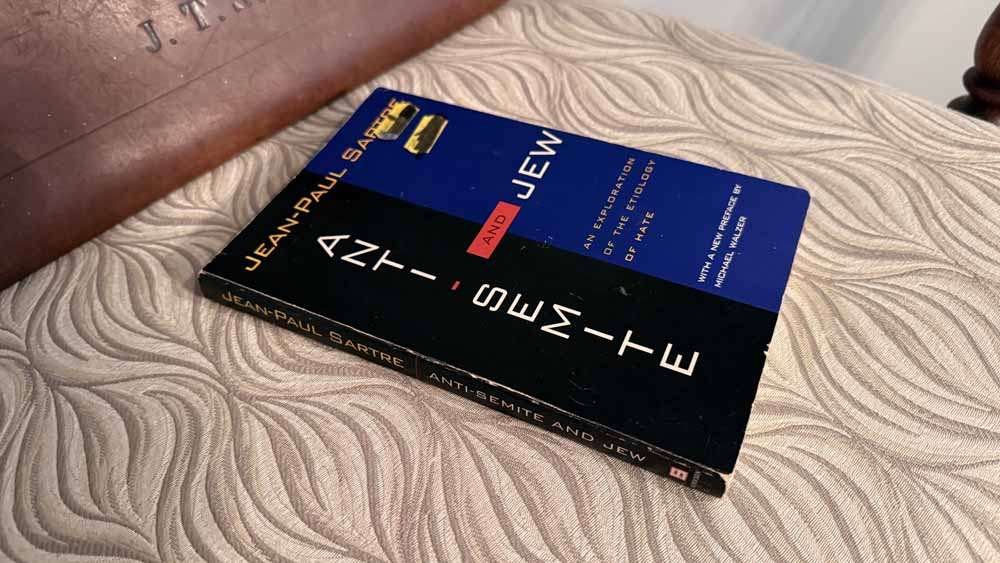
Few books in the Western canon carry the particular discomfort of being simultaneously essential and flawed. Jean-Paul Sartre’s Anti-Semite and Jew, first published in France in 1946 as Réflexions sur la question juive, is exactly that kind of book — a text that cuts through the fog of postwar denial with surgical clarity, then stumbles badly in the very act of trying to help. It is the work of a man who understood hatred with almost frightening precision, yet understood Jewish identity with considerably less.
Reading it now, with antisemitism resurgent across Europe and the United States in ways that would have seemed implausible a generation ago, the experience is unsettling in multiple directions at once. Sartre was right about the psychology of the antisemite. He was substantially wrong about the Jew. And the tension between those two things is not a footnote — it is the entire problem.
The Antisemite as a Philosophical Portrait
Sartre opens with something genuinely radical for 1946: the insistence that antisemitism is not an opinion. It is not a position one arrives at through reason, evidence, or argument. It is a passion — a way of experiencing the world that precedes any rational content and resists rational refutation. The antisemite does not dislike Jews because he has studied them. He has studied them, selectively and dishonestly, because he already dislikes them.
This is not merely a sociological observation. Sartre grounds it in his existentialist framework with considerable force. The antisemite is, in his reading, a person in flight from freedom — from the anxiety of being a radically contingent creature in a world without fixed meaning. Existentialism holds that human beings are “condemned to be free,” to coin Sartre’s own phrase: we have no predetermined essence, no divine blueprint that tells us who we are. That condition is vertiginous. The antisemite solves the vertigo by choosing permanence over freedom, by electing to be a stone rather than a man. He embraces an identity that is ready-made, solid, and eternal — I am French, I am of the soil, I am not them — and in doing so, trades the burden of authentic selfhood for the comfort of tribe.
Sartre calls this bad faith (mauvaise foi), the same concept he explored in Being and Nothingness and that pulses through his play No Exit — the self-deception by which we deny our own freedom and responsibility by pretending we are something fixed and determined. The antisemite is the bad faith actor par excellence. He does not merely lie to others. He lies to himself, systematically and with great psychological investment, because the truth — that he is nothing except what he makes of himself — is too destabilizing to bear.
What makes this portrait still devastating is that Sartre refuses to let the antisemite off the hook as simply ignorant or mentally ill. He is not a pathological exception. He is a moral coward making a deliberate, if not fully conscious, choice. To argue with him using facts and statistics is to misunderstand the game entirely. The antisemite has “chosen to live on the plane of passion,” Sartre writes, and reason is simply not the arena in which the fight is taking place. This is why education and refutation so frequently fail. You cannot dislodge a position that was never held for rational reasons with rational counterarguments. The architecture of the hatred is not logical; it is existential.
Where the Framework Holds — and Where It Buckles
Sartre extends his analysis to two other figures: the democrat and the inauthentic Jew. His portrait of the well-meaning liberal democrat is worth pausing on. The democrat, Sartre argues, defends the Jew not as a Jew but as an abstract universal human being, insisting that “there are no Jews, there are only men.” This sounds like tolerance. It is, Sartre contends, a subtler form of erasure — a refusal to acknowledge the concrete, particular, historical existence of Jewish people in favor of an abstraction that happens to be more comfortable for the non-Jew. The antisemite wants to destroy the Jew. The democrat wants to dissolve him. Neither actually sees him.
This is sharp, and it remains sharp today. The demand that a persecuted group transcend its particularity as the price of acceptance is a move that appears across virtually every form of discrimination. You are welcome here, so long as you stop being so conspicuously you. Sartre identifies it clearly, and his identification holds.
The trouble begins with his account of the “authentic” versus “inauthentic” Jew. Sartre argues that Jewish identity is not a positive, self-generated tradition but rather a product of the antisemite’s gaze — that Jews exist as a community because they have been defined as one by those who hate them. The “authentic Jew,” in his reading, is one who accepts this condition honestly, owns the identity that has been imposed, and lives in the awareness of the danger surrounding him.
The Jewish intellectual response to this was immediate and largely withering, and it was correct. Hannah Arendt, writing in 1948, criticized Sartre for his fundamental ignorance of Jewish history, religion, and culture — pointing out that Jewish identity did not spring into existence as a reaction to European antisemitism but had millennia of independent philosophical, spiritual, and communal substance. Sartre had written a book about Jews without, apparently, learning very much from them. He reduced a living civilization to a sociological effect, a reflex produced by hatred rather than a tradition produced by history.
The philosopher Emmanuel Levinas, himself a major figure in twentieth-century French thought and a survivor of Nazi captivity, went further. For Levinas, Jewish ethics and the face-to-face encounter with the Other were not anxious responses to persecution but the generative center of an entire moral philosophy stretching back through the Talmud to the Torah. To collapse all of that into “the Jewish condition as defined by the antisemite” was not merely incomplete — it was, from a Jewish standpoint, a kind of philosophical imperialism wearing the costume of solidarity.
The Non-Jewish Witness Problem
There is a larger structural issue here that Sartre, to his credit, seems to have partly intuited but never fully resolved. He was writing as an outsider, and the limits of that position are visible on almost every page that deals with Jewish experience directly. His existentialism gave him formidable tools for diagnosing hatred, but those tools were not Jewish tools. They did not emerge from Jewish texts, Jewish suffering, or Jewish ways of understanding the relationship between identity, memory, and community.
The result is a book with two distinct registers of authority. When Sartre writes about the psychology of the persecutor, he is operating from his own philosophical tradition and doing so brilliantly. When he writes about the experience of the persecuted, he is speculating from the outside — and it shows. The prescriptive passages, in which he tells Jews how they ought to understand themselves, carry a paternalism that is visible across seven decades even to a reader sympathetic to his project.
This is not simply a matter of Sartre being wrong in particulars. It is a methodological problem that serious readers should hold on to: the tools you bring to an analysis determine what the analysis can and cannot see. Existentialism is a powerful lens. It is not a universal one. A lens built from the experience of French bourgeois intellectuals in the twentieth century will illuminate certain features of hatred with great precision and leave others in shadow.
Why You Should Still Read It
None of this makes Anti-Semite and Jew a book you should skip. On the contrary, the sections on antisemitic psychology remain among the most penetrating ever written, and their relevance in the present moment is not theoretical but urgent. The portrait of a person who chooses irrationality not despite its irrationality but because of it — who finds in the emotion of hatred a relief from the anxiety of selfhood — explains a great deal about what we are seeing in the world right now. The bad faith actor has not disappeared. He has migrated platforms.
Sartre also deserves credit for writing this at all. The book was published one year after the liberation of the camps, in a France that was deeply invested in not examining its own complicity in the Vichy deportations. The comfortable tendency of postwar Europe was to treat antisemitism as a German problem, an aberration, something foreign. Sartre refused that comfort. He wrote about French antisemitism as a French phenomenon rooted in French psychology, French social anxiety, and French bad faith. That took a particular kind of intellectual courage in 1946, and the argument cuts just as cleanly against comfortable self-exculpation today.
Read it alongside its critics, though. Arendt’s response is indispensable. So is Richard Dawkins’ framework for how ideas propagate and mutate through populations — because one of the things Sartre cannot quite explain is why antisemitism persists across centuries and cultures with such stubborn consistency. Memetics offers a different vocabulary for that question, one that complements the existentialist account without replacing it. The hatred is both a psychological choice and a cultural inheritance; both bad faith and a self-replicating idea that has found, across generations, an extremely effective host.
A Book That Earns Its Discomfort
Anti-Semite and Jew is not a comfortable read, and it should not be. The discomfort it produces is not uniform — you will be unsettled by Sartre’s portrait of hatred, and then unsettled again by his presumption in defining Jewish identity from the outside, and then unsettled a third time by the realization that both forms of discomfort are instructive. The book forces the question of what it means to speak on behalf of those whose experience you have not shared. It raises, by its very failures, the issue of whose testimony counts and whose theorizing substitutes for testimony. That is not a small thing.
What Sartre got right still cuts. The antisemite is not confused. He is not misinformed. He is in flight — from contingency, from freedom, from the terrifying openness of a self that has no predetermined content. He has chosen a hatred that feels like bedrock because the alternative, standing on nothing but one’s own choices, feels like falling. That diagnosis remains precise. That diagnosis remains necessary.
What he got wrong serves as its own kind of lesson — about the limits of any single tradition’s capacity to understand another’s interiority, and about the particular care required when the act of analysis shades into the act of definition. You can be right about the persecutor and still fail the persecuted. The two are not mutually exclusive, and Anti-Semite and Jew lives, uncomfortably and productively, in the space between them.
Sources
- Sartre, Jean-Paul. Anti-Semite and Jew. Translated by George J. Becker. Schocken Books, 1948. https://www.schockenbooks.com
- Arendt, Hannah. “The Jew as Pariah: A Hidden Tradition.” Jewish Social Studies, 1944. https://www.jstor.org/stable/4615994
- Levinas, Emmanuel. Difficult Freedom: Essays on Judaism. Johns Hopkins University Press, 1990. https://www.press.jhu.edu/books/title/2044/difficult-freedom
- Bernasconi, Robert. “Sartre’s Gaze Returned: The Transformation of the Phenomenology of Racism.” Graduate Faculty Philosophy Journal, 1995. https://www.pdcnet.org/gfpj
- Gordon, Lewis R. Bad Faith and Antiblack Racism. Humanity Books, 1995. https://www.humanitybooks.com
- Judaken, Jonathan. Jean-Paul Sartre and the Jewish Question. University of Nebraska Press, 2006. https://www.nebraskapress.unl.edu/university-of-nebraska-press/9780803243200/