
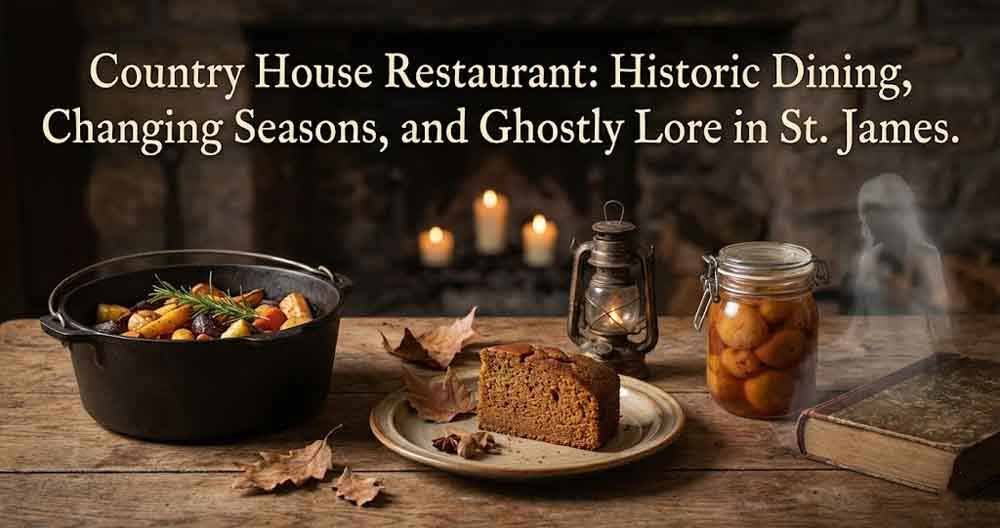
A building at the corner of Route 25A and Main Street in Stony Brook holds a kind of candlelight that flickers differently than anywhere else on Long Island. The structure was standing before George Washington had a country to lead, before the Culper Spy Ring turned quiet farmsteads into nodes of revolutionary intelligence, and before the North Shore became what the Wall Street Journal would one day call one of America’s most desirable corridors of waterfront real estate. Built circa 1710 as a colonial farmhouse, The Country House Restaurant has survived three centuries of war, séance, reinvention, and roasted swordfish. It is, without exaggeration, one of the most historically layered dining experiences in the Northeastern United States—a place where Revolutionary ghosts, Spiritualist painters, Manhattan nightclub impresarios, and modern-day chefs have all left fingerprints on the same wooden beams. Having operated The Heritage Diner for twenty-five years just a few miles east on this very same Route 25A, I can tell you that buildings like this one do not simply survive. They endure because someone, at every generational turn, recognized the rarity of what stood before them and chose to protect it. The Country House is that kind of place—the kind that makes you understand why the North Shore remains one of the most compelling real estate and cultural markets in the nation.
From Farmhouse to Fortress: The Colonial Origins (1710–1783)
The structure that houses today’s Country House Restaurant was originally built as a working farmhouse and was subsequently expanded around 1740 by Obediah Davis, whose family would occupy the property for four generations. In an era when the North Shore of Long Island was a patchwork of salt marshes, timber lots, and agrarian homesteads, the house served multiple civic purposes—as a town meeting place and as a stagecoach stop along the route that connected the rural hamlets of Suffolk County to the commercial world of Manhattan. That route, now known as Route 25A, would later be officially designated by New York State as the Washington Spy Trail, a roughly fifty-mile corridor stretching from Great Neck to Port Jefferson that the members of the Culper Spy Ring used to transmit intelligence to General George Washington during the American Revolution (Stony Brook University Libraries, 2024).
The Culper Ring, assembled in 1778 by Major Benjamin Tallmadge at Washington’s request, remains one of the most sophisticated intelligence operations in American military history. Operating from the Setauket and Stony Brook area, spies such as Abraham Woodhull, Robert Townsend, Caleb Brewster, and Austin Roe used invisible ink, numerical code books, and clothesline signals to relay British troop movements across Long Island Sound. The AMC television series TURN: Washington’s Spies (2014–2017) dramatized these events for a national audience, and Long Island’s Culper Spy Day—an annual collaboration of more than twenty-five local institutions—regularly features the Country House Restaurant as a themed stop along the trail (Discover Long Island, 2024). According to the restaurant’s own accounts, members of the Culper Ring are believed to have held meetings within its walls, making it one of a handful of buildings on the North Shore with a verifiable connection to America’s first organized espionage network.
The Legend of Annette Williamson: Long Island’s Most Famous Ghost
No profile of The Country House would be complete without addressing the presence that many say has never left. According to the legend—widely cited in Kerriann Flanagan Brosky’s Ghosts of Long Island II and featured on News 12 Long Island—a young woman named Annette Williamson was living in the house during the Revolutionary War. When her parents departed for New Jersey to attend to another property, seventeen-year-old Annette was left to care for her younger siblings. British troops arrived and occupied the home. Annette, with no other option, allowed them in. After the war ended, locals accused her of being a British loyalist. The townsfolk cornered her inside the house and, by most accounts, killed her violently. Her body is believed to be buried in the Obediah Davis Cemetery on the hillside directly behind the restaurant (Atlas Obscura, 2024).
Owner Bob Willemstyn, who took over the restaurant in November 2005 after working there for twenty-seven years, has spoken openly about the haunting. Flashing lights, unexplained orbs, footsteps on the upper floors, the sound of a woman singing, and full-bodied apparitions in the dining room have all been reported by staff and guests. Children, in particular, seem to perceive the presence most clearly—some call her by name, while others have been too frightened to enter. Brosky, who investigated the property for her books and a documentary, described it as one of the most actively haunted locations she has encountered on Long Island (Three Village Patch, 2011). The restaurant’s annual psychic nights sell out regularly, and the ghostly lore is woven into seasonal decorations and themed events that have become a hallmark of the establishment’s identity.
Whether one is a believer or a skeptic, the Annette Williamson narrative accomplishes something that few restaurant marketing campaigns could ever manufacture: it connects the act of dining to a lived—and lost—human story that predates the nation itself. In the world of bespoke craftsmanship at Marcellino NY, we often speak of provenance—the traceable history of a material from its origin to its finished form. A piece of J&E Sedgwick English bridle leather carries within its grain the story of the tannery, the artisan, and the decades of patina yet to come. The Country House carries its provenance not in leather but in lore, and that lore is as essential to the dining experience as any entrée on the menu.
Séances, Spiritualism, and the North Shore’s Artistic Soul
In the late nineteenth century, the house became the home of Thomas Hadaway, a well-known English actor who brought with him an intense fascination with the Spiritualist movement. Spiritualism—the belief that the spirits of the dead could be communicated with through mediums, séances, and table-rapping—had swept through American intellectual life in the 1850s, catalyzed by the famous Fox sisters of Hydesville, New York, and embraced by figures ranging from Mary Todd Lincoln to Sir Arthur Conan Doyle (Ward Melville Heritage Organization, 2024). Hadaway regularly conducted séances in the house, and his neighbor, the celebrated Long Island genre painter William Sidney Mount, was a frequent attendee.
Mount, born in Setauket in 1807, was the first native-born American artist to specialize in genre painting. His works—including Dance of the Haymakers (1845), Farmers Nooning (1836), and Dancing on the Barn Floor (1831)—captured the rhythms of rural Long Island life with a warmth and dignity that earned him international acclaim. The Long Island Museum in Stony Brook holds the largest collection of his paintings. But Mount was also a man consumed by questions of mortality and the unseen. His private Spirit Journal, dated 1854–1855, records his experiments with séances and his reported communications with deceased family members (Wikipedia, 2025). That these séances took place inside the very building where diners now enjoy escargot and French onion soup is the kind of layered historical irony that you simply cannot fabricate.
The connection between Mount’s artistry and Hadaway’s Spiritualism within the walls of The Country House speaks to something deeper about the North Shore’s cultural DNA. This corridor has always attracted people who refused to separate the material world from the world of ideas. Ward Melville, the philanthropist who created the Stony Brook Village Center in 1941 as America’s first planned business community, understood this. He invested his own fortune—$500,000 in 1940 dollars, equivalent to over eight million today—into building a colonial-style village designed to be what he called a “living Williamsburg” (Stony Brook Village Center, 2024). The Country House Restaurant sits at the entrance to that vision, a sentinel of the older world that Melville’s project sought to honor.
From the Stork Club to Stony Brook: The Restaurant Reinvention
After two hundred and sixty years as a private residence, the building was converted into a restaurant in 1970 under the name “The 1710 House.” In 1973, it was rechristened “The Hadaway House” in honor of its Spiritualist-era owner. And in 1978, it became The Country House Restaurant, the name it has carried ever since. The man who shaped the restaurant’s identity during its formative decades was Thomas Wendelken, who had a pedigree that connected Long Island directly to Manhattan’s golden age of nightlife. Wendelken came from the world of the Stork Club, the legendary East 53rd Street establishment that, from the 1930s through the 1950s, served as the unofficial headquarters of American celebrity culture (CountryHouseRestaurant.com, 2024).
The Stork Club, owned by the flamboyant Oklahoma-born Sherman Billingsley, was where Walter Winchell held court at Table 50, where Ernest Hemingway cashed a $100,000 check for film rights, and where Grace Kelly’s engagement to Prince Rainier was first announced. Billingsley understood something that every great restaurateur eventually learns: a dining room is not merely a place to eat but a theater of social performance, a stage upon which the rituals of community, status, and belonging play out nightly. Wendelken brought that philosophy east, spending twenty-seven years fine-tuning the Country House into a landmark that treated every detail—from the hand-painted murals to the carved gilded fireplace—as essential to the guest experience. The current proprietors maintain that his presence is still felt, quite literally: the faint scent of his distinctive cigarette brand is sometimes detected at the end of the bar where he once sat.
The Dining Experience: Creative American Cuisine in a Three-Century Setting
The Country House offers casual fine dining in a setting that no architect could replicate from scratch. The restaurant features multiple distinct dining rooms, each with its own character. The Old Field Room—named for the adjacent hamlet and the very room where, according to legend, Annette Williamson met her end—features a working fireplace that has been warming guests since the colonial era. The Fireside Room offers a second working fireplace, while the Garden Room provides an enclosed greenhouse-style patio for those who prefer to dine beneath the stars. The décor changes seasonally, with holiday decorations that have become so renowned they have been featured on social media and in local press. Reviewer after reviewer on Tripadvisor describes walking into a world of flowers, hand-painted details, and an atmosphere that feels less like a restaurant and more like being welcomed into a beautifully appointed private home.
The creative American menu changes monthly, anchored by prime steaks and fresh seafood. Appetizers include burrata with artichoke hearts, roasted tomatoes, and basil; a sautéed lobster pot with house-made coleslaw; and flatbreads topped with sausage and ricotta or Neapolitan preparations. Entrées range from grilled swordfish with chilled avocado mousse and citrus to braised beef short ribs and a chicken cordon bleu that regulars describe as definitive. The brunch menu leans savory—salmon with broccolini, Maryland crab cakes, center-cut pork chops, and entrée salads such as the Fireside with caramelized pecans, blue cheese, and pears. A prix fixe option is available for both lunch and dinner, and live music on Thursday and Friday evenings adds another dimension to the experience. Happy hour runs daily from 3 to 7 p.m. with half-price drinks, and a late-night happy hour from 9 to 11 p.m. Sunday through Thursday ensures the evening stretches as long as the conversation (Yelp, 2026).
Voted “Most Romantic Restaurant on Long Island” by AOL City Guide in 2007 and ranked among the top three restaurants in the Stony Brook area on Tripadvisor with a 4.1 rating across nearly 150 reviews, The Country House has earned its reputation through consistency and an unwillingness to compromise on ambiance. As someone who has spent a quarter century behind the pass at The Heritage Diner, I recognize the discipline this requires. A menu that changes monthly demands a kitchen that can source, execute, and innovate at a pace that would exhaust most operations. A three-hundred-year-old building demands a maintenance ethos that borders on obsession. And a ghost story demands a proprietor willing to honor the narrative without letting it overshadow the food.
Stony Brook Village and the North Shore’s Cultural Renaissance
The Country House does not exist in isolation. It sits at the gateway to the Stony Brook Village Center, surrounded by an ecosystem of cultural institutions that make this stretch of Route 25A one of the most concentrated heritage corridors in the New York metropolitan area. The Long Island Museum—a Smithsonian affiliate since 2006—holds an extraordinary collection of American art, history, and horse-drawn carriages, with the nation’s premier assemblage of William Sidney Mount paintings as its crown jewel. The Three Village Inn, a waterfront establishment whose guest rooms are named after members of the Culper Spy Ring, offers overnight accommodations just minutes from the restaurant. The Jazz Loft, a six-thousand-square-foot venue on Christian Avenue, houses archives from some of the greatest jazz musicians of the twentieth century and features live performances on a stage constructed from the original Roseland Ballroom dance floor. And the Stony Brook Grist Mill, Long Island’s only fully operational working grist mill, has served the community for over three hundred years (Ward Melville Heritage Organization, 2024).
For those of us in the real estate and hospitality worlds, this concentration of cultural assets is not merely charming—it is economically significant. As Paola and I prepare to launch Maison Pawli, our boutique real estate venture on the North Shore in 2026, we study corridors like Stony Brook Village because they demonstrate a principle that data consistently supports: communities anchored by authentic cultural institutions and heritage dining retain property values more durably than those dependent on transient retail or chain development. The National Trust for Historic Preservation has long argued that historic buildings create economic multiplier effects that newer construction cannot replicate. The Country House is a case study in that thesis—a three-century-old structure that generates revenue, attracts tourism, anchors a village center, and preserves a narrative that no amount of new construction could replace.
The Unseen Details: Why a Three-Century Restaurant Matters
At Marcellino NY, we hand-stitch every briefcase using the same saddle-stitch technique that English leather workers perfected two centuries ago. We do this not because it is efficient—it is categorically not—but because the technique produces a result that no machine can replicate: a seam that grows stronger with age, that will outlast the leather it binds, that carries within each puncture the evidence of a human hand guided by intention rather than automation. The Country House Restaurant operates on the same principle. Its fireplaces are not decorative—they work. Its ghost is not a marketing gimmick—it is a story that predates the Constitution. Its menu is not static—it evolves monthly. And its seasonal décor is not an afterthought—it is a practice so meticulous that visitors describe the Christmas experience alone as worth the trip from Manhattan.
The German philosopher Martin Heidegger wrote about the concept of Dasein—the idea that our existence is always situated, always embedded in a particular place and time. The Country House is a building that has been Dasein for over three hundred years: it has been a farmhouse, a meeting place, a stagecoach stop, a spy rendezvous, a home for actors and painters, a séance parlor, a nightclub veteran’s passion project, and a fine dining destination. Each layer does not erase the last but enriches it, the way the patina on a well-worn briefcase does not diminish the leather but reveals its character.
The next time you drive down Route 25A—Washington’s Spy Trail, the road that connects The Heritage Diner in Mount Sinai to The Country House in Stony Brook—slow down at the corner of Main Street. The candlelight will be visible through the windows. The seasonal flowers will frame the entrance. And somewhere inside, between the French onion soup and the sound of live music on a Thursday evening, three centuries of North Shore history will be waiting for you to pull up a chair.
ESSENTIAL INFORMATION
Address: 1175 North Country Road (Route 25A), Stony Brook, NY 11790 Phone: (631) 751-3332 Website: countryhouserestaurant.com Instagram: @thecountryhouse1710 Hours: Wednesday–Sunday, 12:00 PM to closing. Closed Monday and Tuesday. Cuisine: Creative American, Prime Steaks, Fresh Seafood. Monthly rotating menu. Features: Prix fixe lunch and dinner, live music Thursdays & Fridays, daily happy hour 3–7 PM, late-night happy hour 9–11 PM (Sun–Thu), weddings, private parties, seasonal holiday décor, outdoor dining. Accolades: Voted “Most Romantic Restaurant on Long Island” (AOL City Guide, 2007). Tripadvisor 4.1 stars, ranked #3 in Stony Brook. Featured in America’s Most Haunted Restaurants (The Daily Meal). Featured in Ghosts of Long Island II by Kerriann Flanagan Brosky. Nearby Attractions: Long Island Museum, Three Village Inn, Stony Brook Grist Mill, Jazz Loft, Washington Spy Trail, Avalon Nature Preserve.
Related Video: TURN: Washington’s Spies – Official Trailer (AMC): https://www.youtube.com/watch?v=WOTnJnBPEYo