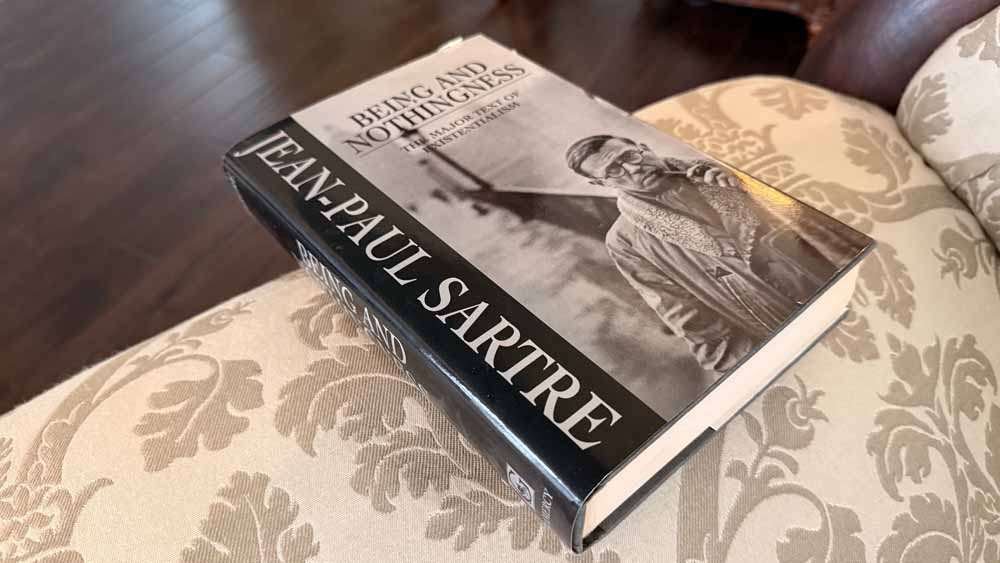
Eight hundred pages to say one thing. You are free, you know you are free, and that terrifies you so completely that you spend your entire life pretending you are not.
That is Being and Nothingness. Jean-Paul Sartre published it in 1943, in occupied Paris, while France was under German control and the entire philosophical project of the Western tradition was being stress-tested against actual history. The book weighs in at roughly 800 pages in most English translations. It is dense, knotty, repetitive in the way that only a man who has genuinely wrestled with something is repetitive — returning to the same idea from a different angle because he needs you to really get it before he moves on. Some of it reads like a man arguing with himself. That is, in fact, exactly what it is.
I have spent time with this book. I have been frustrated by it. I have put it down and picked it up again. And I keep coming back to the same conclusion: the core argument is not complicated. Sartre just needed 800 pages to seal all the exits.
Existence Before Essence — The Phrase That Changed Everything
Sartre’s most famous formulation is that “existence precedes essence.” Most philosophy before him had operated more or less on the reverse assumption — that a thing has a nature, a purpose, a built-in definition, and that its existence is the expression of that definition. God creates man with a soul. Nature produces organisms with roles. Society produces citizens with duties. In every version, there is something you are before you show up.
Sartre says no. You show up first. You are thrown into the world without a predetermined nature, without a built-in purpose, without a fixed self. You exist. Then, through every choice you make, you create what you are. “Man is nothing else but what he makes of himself,” he writes, and he means it in the hardest possible sense. Not inspirationally. As a burden.
This is the philosophical starting gun for everything that follows. If there is no given nature — if you are not a fixed thing with a predetermined role — then you are responsible. Entirely. For everything. For who you are, for what you do, for what your life becomes. And most people, Sartre argues, will do almost anything to avoid confronting that.
Bad Faith — The Chapter That Does the Real Work
The section on bad faith is where the book becomes uncomfortable in a way that a lot of philosophy never manages to be. Sartre is not asking abstract questions. He is describing a way of being in the world that almost everyone recognizes in themselves once they see it named.
Bad faith, in Sartre’s terms, is self-deception — but a very specific kind. It is not simply lying to yourself about a fact. It is a structural refusal to acknowledge your own freedom. It is pretending, to yourself and to the world, that you have no choice when you do. That you are what you are because of what happened to you, because of what you were born into, because of what the situation demands. That you are a role, a type, a thing — rather than a consciousness that keeps choosing what to be.
His most famous example is the waiter. “His movement is quick and forward, a little too precise, a little too rapid.” The waiter is performing the role of waiter so completely — so eagerly — that he has, in effect, agreed to become it. He is not a man who waits tables. He is a waiter, full stop. The job is his identity. The identity is his escape from freedom. He does not have to choose who he is every morning because the role has already chosen for him. And this, Sartre says, is bad faith. Not because there is anything wrong with waiting tables. But because the man has used the occupation to avoid the question of who he actually is underneath it.
The same analysis applies everywhere. The person who stays in a relationship or a job or a life they hate, then explains this as necessity — I have no choice, this is just how it is, this is what people like me do — is in bad faith. Not because they are stupid. Because acknowledging the choice is worse. Acknowledging the choice means owning it. Owning it means you could make a different one. And making a different one means accepting the full weight of what you are doing with your life.
Sartre is merciless here, in the way that only a philosopher writing under occupation can be merciless. The stakes are not theoretical. In 1943, the question of whether you could pretend you had no choice was not an academic one.
The Look — What Other People Do to You
Sartre’s phenomenology gets stranger and richer in the section on the Other. His central claim is that your consciousness is, in itself, a kind of nothingness — a gap, a lack, a thing that is always other than what it was a moment ago. The self is not a fixed object. It is a process. “Consciousness is a being such that in its being, its being is in question.” You are not a thing. You are a questioning of yourself, perpetually.
The problem is that other people treat you as a thing. When someone looks at you — really looks at you, sees you as an object in their world — you feel it. You feel yourself becoming fixed, pinned down, classified. This is the famous Sartrean gaze. Not voyeurism in the vulgar sense, but something philosophically precise: the moment another consciousness makes you into an object in their perceptual field, you become aware of yourself as a thing in the world rather than a free subjectivity. You experience, as Sartre puts it, “shame.” Not guilt — shame. The feeling of being caught in a particular form, of having a definite nature in someone else’s eyes before you have consented to it.
This is why he can write, in No Exit — which I looked at separately here — “Hell is other people.” It is not misanthropy. It is phenomenology. Other people are a constant threat to your freedom because they keep making you into something. Defining you. And the temptation, always, is to accept their definition. To let their look settle the question of who you are. Which is, of course, another form of bad faith.
Facticity and Transcendence — The Two Things You Can Never Escape
One of the more useful distinctions in the book is the one between facticity and transcendence. Your facticity is all the brute facts of your existence — where you were born, what your body is, what your history has been, what situation you currently occupy. You cannot change any of that. It is the raw material you have been handed. Your transcendence is the fact that you always exceed those facts — that you are never simply the sum of your situation, that you always have the capacity to take a stance on what you have been given, to mean it differently, to project yourself toward something other than what the facts seem to dictate.
Bad faith, in this framework, is the refusal of the tension between these two. One version of bad faith pretends you are only facticity — that your history, your biology, your circumstances have determined you completely, that you have no transcendence. This is the person who says I can’t help it, I was raised this way, I am what I am. The other version pretends you are pure transcendence — that you are infinitely free, that the past leaves no mark, that you can simply will yourself into being whatever you choose at any moment. This is the person who refuses all commitments, all identities, all ground. Both are escapes. Both are dishonest. The honest position, which Sartre calls authenticity, is to hold both at once: to acknowledge what you are made of and to acknowledge that you still have to choose what to do with it.
Philosophers who have read Kierkegaard — and I wrote about the Kierkegaard anthology here — will recognize a family resemblance in Sartre’s insistence on the individual’s irreducible responsibility. The lineage runs from Kierkegaard’s leap of faith, through Nietzsche’s will to power as self-overcoming, to Sartre’s radical freedom. Each of them is trying to describe what it means to take your own existence seriously rather than outsourcing it to a system.
The Hardest Part of the Book
The hardest part to sit with is not the metaphysics. It is the ethics, which Sartre does not fully articulate until a brief discussion near the end and then more fully in later work — but which is implied throughout. If you are entirely free, and if that freedom extends to your values (since values, on Sartre’s account, are not discovered but chosen), then there is no moral authority outside of your own choosing. You cannot appeal to God. You cannot appeal to nature. You cannot appeal to social convention. You are, as he says in Existentialism is a Humanism, “condemned to be free.” The condemnation is the absence of any escape from the responsibility of choosing.
The philosopher Iris Murdoch, who was often a sharp critic of Sartre, wrote that his philosophy produced “a picture of human life which is unrealistic and also, I think, unattractive — a picture which overvalues the will.” There is something to that. Sartre’s human being is almost heroically isolated, bearing the weight of all meaning in the universe. The communal, the embedded, the relational dimensions of human existence — the ways we are constituted by others, not just looked at by them — get less attention than they deserve.
That critique stands. But it does not undo the core of what Sartre is doing, which is not so much a complete theory of human life as a specific diagnosis of a specific failure mode: the failure of bad faith. And on that diagnosis, I have not found anyone who has improved on him. Sigmund Freud got close, in a different vocabulary — and Civilization and Its Discontents maps some of the same territory from the direction of the unconscious. But Sartre is doing something Freud is not: he is holding you responsible for the self-deception, not just describing its mechanism.
Why It Still Matters
The criticism most often leveled at Being and Nothingness today is that it is too rationalist — too confident in the transparency of consciousness to itself. Cognitive science, as Francis Crick’s work suggests, has complicated the picture considerably. If you are nothing but neurons firing, the idea of a consciousness that can be in bad faith — that can lie to itself while somehow also knowing it is lying — starts to look philosophically shaky.
Sartre was aware of the objection in principle, even if the neuroscience that would sharpen it had not yet arrived. His answer, roughly, is that bad faith is a pre-reflective structure — that it operates below the level of the explicit, deliberate self-examination we usually call thinking. You do not consciously choose to deceive yourself. The deception is built into the mode of being. That is partly why it is so hard to see and so hard to undo.
Whether or not the neuroscience ultimately supports that account, the phenomenological description rings true to anyone who has paid attention to themselves. We do tell ourselves stories about our situation that conveniently leave out our own agency. We do accept definitions handed to us by others and then forget that we accepted them. We do perform roles with such commitment that we forget we are performing. Sartre named that. Eight hundred pages to name it, but he named it.
Reading Being and Nothingness is not a comfortable experience. It is not meant to be. Sartre is not trying to explain the world to you from a safe distance. He is trying to make it impossible for you to look at yourself the way you usually do. That is a different thing. It is, in the end, more useful.
You Might Also Like
- No Exit by Jean-Paul Sartre — The Play That Diagnosed Modern Life Before Modern Life Knew It Was Sick
- A Kierkegaard Anthology — The Thinker Who Refused to Let Me Go
- Thus Spoke Zarathustra by Friedrich Nietzsche — The Book That Rewired My Understanding of Everything
Sources
- Sartre, Jean-Paul. *Being and Nothingness*. Trans. Hazel E. Barnes. Washington Square Press, 1956. https://www.simonandschuster.com/books/Being-and-Nothingness/Jean-Paul-Sartre/9780671867805
- Sartre, Jean-Paul. *Existentialism is a Humanism*. Trans. Carol Macomber. Yale University Press, 2007. https://yalebooks.yale.edu/book/9780300115468/existentialism-is-a-humanism/
- Murdoch, Iris. *Sartre: Romantic Rationalist*. Yale University Press, 1953. https://yalebooks.yale.edu/book/9780300106152/sartre/
- Flynn, Thomas. “Jean-Paul Sartre.” *Stanford Encyclopedia of Philosophy*. https://plato.stanford.edu/entries/sartre/
- Reynolds, Jack. *Understanding Existentialism*. Acumen, 2006. https://www.routledge.com/Understanding-Existentialism/Reynolds/p/book/9780773530966