
Fifty-three years is a long time to stay off the Moon.
Apollo 17 lifted off the lunar surface on December 14, 1972, and humanity hasn’t touched down since. That hiatus wasn’t a failure of technology — it was a failure of political will, budget continuity, and the absence of a sufficiently terrifying rival. Now, with China methodically advancing its own crewed lunar program and taikonauts potentially reaching the South Pole by 2030, the calculus has shifted. The Artemis program is no longer just about exploration. It is about establishing jurisdiction — not through flags, but through infrastructure.
What we are witnessing is the first act of an off-world geopolitical contest, and the architecture being designed right now will determine who writes the rules of space for the next century.
Artemis II and the Road Back
This April, NASA will launch Artemis II — a crewed circumlunar mission carrying Commander Reid Wiseman, pilot Victor Glover, Christina Koch, and Canadian astronaut Jeremy Hansen on a 10-day arc around the Moon and back. No landing. Not yet. But the purpose is foundational: prove that human beings can survive the deep-space radiation environment beyond low-Earth orbit, test life support, and set the psychological stage for what follows.
Artemis III, the first crewed lunar landing since Apollo 17, is scheduled no earlier than mid-2027, with SpaceX’s Starship serving as the Human Landing System, descending two astronauts to the lunar surface for approximately 6.5 days. Wikipedia Beyond that, Artemis IV and V build out the Lunar Gateway — a space station in a near-rectilinear halo orbit that will serve as the staging post for all future surface operations.
The pace feels deliberate. It is.
The South Pole: Why That Patch of Ice Changes Everything
The entire program pivots around one geographic decision — the lunar South Pole. This isn’t sentimentality or aesthetics. It’s resources.
The highest concentration of water ice is found in the permanently shadowed regions at the poles, which is precisely why the Artemis Base Camp will be located there. Rethinking The Future Water ice means propellant. It means oxygen. It means the difference between a base that resupplies from Earth at catastrophic cost and one that begins generating its own logistics chain. When engineers talk about In-Situ Resource Utilization — ISRU — they are describing the moment a lunar base becomes economically viable rather than merely symbolic.
The lunar regolith itself, studied through Apollo samples and spectral imaging, is rich in silicon, aluminum, and iron Rethinking The Future — raw material for 3D-printed structural components built directly on the surface. The Artemis architecture envisions printing habitats from the ground up using robotic systems, reducing the tonnage that must be launched from Earth. Every kilogram lifted from this planet to the Moon costs roughly $1 million by conventional estimates. The Moon’s own soil, properly processed, is worth a fortune it has never been asked to pay.
The Structural Engineering Problem No One Talks About
The design challenges of a permanent lunar base are not the ones popularized by science fiction. Radiation shielding, yes — but the deeper problem is one that only emerged recently, and it changes the entire structural philosophy.
The Moon is a seismically active, shrinking world. Engineers are now incorporating seismic resilience into their blueprints, with the American Society of Civil Engineers drafting guidelines recommending “base isolation” techniques similar to those used in earthquake-prone Tokyo or San Francisco. UnboxFuture The critical variable isn’t the magnitude of a lunar quake — it’s the duration. Where a magnitude 5.0 earthquake on Earth might shake a building for thirty seconds, a similar event on the Moon can vibrate the ground for an hour or more due to the absence of water to dampen seismic waves UnboxFuture, creating what engineers call “long-duration shaking” — a continuous fatigue load that will compromise rigid structures in ways that short-burst events never would.
This means that the architectural language of a lunar habitat cannot borrow from terrestrial precedent the way early designs assumed. Lander legs, pressurized modules, and tunnel connections must be designed around perpetual resonance, not impact resistance. It is a paradigm shift that arrived late — but it arrived.
The Geopolitics: Accords, Rivals, and the New Space Order
As of mid-2025, 56 nations from every continent have signed the Artemis Accords, forming a coalition that affirms resource extraction in space is consistent with the Outer Space Treaty and aligns with a US-led framework for cooperative, rules-based exploration. New Space Economy This is diplomacy dressed as science policy. The Accords are a mechanism for building a bloc — nations that sign are, by implication, agreeing to operate within an American-defined legal architecture for space.
China and Russia declined to sign. Instead, they declared a joint plan to establish the International Lunar Research Station in the South Pole-Aitken Basin, with the goal of landing taikonauts on the Moon by 2030. Universe Today Two permanent bases. Same polar region. No agreed boundary. No shared jurisdiction.
There is a phrase in real estate — “location, location, location.” On the Moon, the permanently shadowed craters at the South Pole are the only location. There are a finite number of sites with the combination of water ice access, communications line-of-sight, and near-permanent solar exposure. Both programs want the same ground. The Outer Space Treaty prohibits national sovereignty claims, but it says nothing about base camp perimeters, water extraction rights, or communications interference. That ambiguity is not an oversight. It is the contested frontier.
What a Lunar Base Actually Looks Like
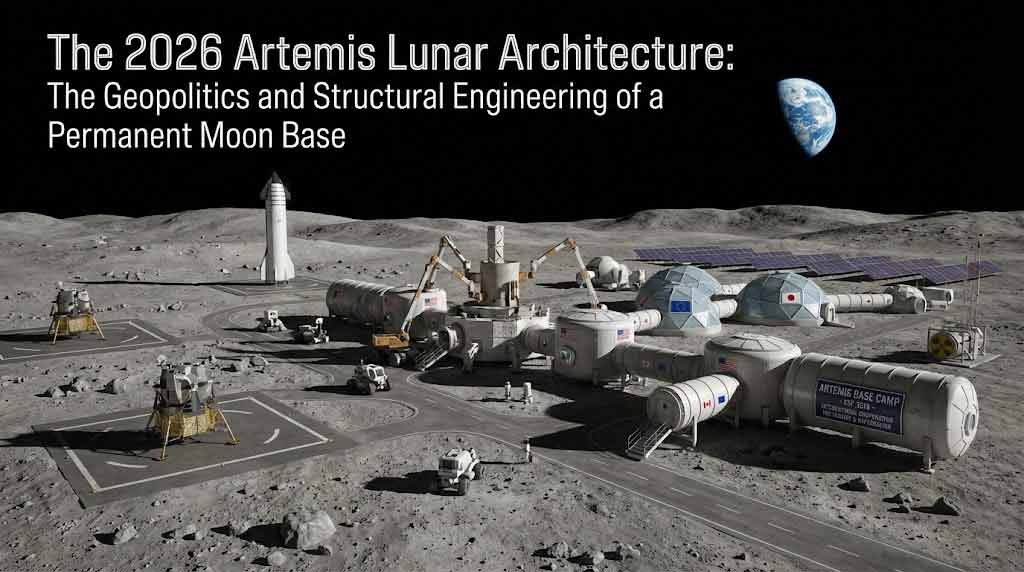
NASA’s Artemis Base Camp concept, planned for the late 2030s, is not a single structure. It includes a modern lunar cabin, a pressurized rover, and a mobile home NASA — a distributed campus rather than a monolith, designed to support extended surface operations across a wide geographic range. The Gateway station in orbit provides the logistics hub; the base camp is the operational surface layer.
Prefabricated modules, deployable on the surface and reinforced with regolith for additional protection, offer immediate shelter while ISRU techniques are refined for long-term construction. Rethinking The Future The progression mirrors what any serious builder understands: you start with what you can deploy, you use what the site gives you, and you build toward permanence incrementally. No one pours a foundation on unstable ground without first reading the geology.
That incremental philosophy — starting with what works, refining toward what lasts — is something I’ve come to believe in deeply, whether I’m stitching a briefcase panel by panel in English bridle leather or watching a neighborhood restaurant survive three recessions while chain competitors vanish. The best structures, earthbound or otherwise, are built by people willing to take the long view.
The Budget Problem and the China Factor
Here is where idealism confronts arithmetic. The Space Launch System costs approximately $4 billion per launch. Starship, SpaceX’s commercial alternative and the designated Human Landing System for Artemis III, has not yet completed full orbital refueling demonstration — a prerequisite for the Trans-Lunar Injection burn required for a Moon landing.
U.S. domestic political and budgetary uncertainty has exposed the discrepancies inherent in a multinational venture, with concerns that further delays may be inevitable. Taylor & Francis Online Meanwhile, China’s program has suffered no such institutional friction. Its robotic lunar missions — Chang’e 3, 4, 5, and 6 — have returned samples, mapped the far side, and validated landing technologies with disciplined sequencing. Long March 10, China’s crewed lunar launch vehicle, is slated for its first launch in 2026 Universe Today, and multiple aerospace analysts now consider it plausible that taikonauts reach the South Pole before Americans return.
If that happens, the geopolitical implications extend well beyond national pride. It establishes precedent — physical, operational precedent — for who controls the most valuable real estate off-Earth. The Artemis Accords become a framework without a fact on the ground.
The Moon as a Proving Ground for Everything That Comes Next
There is a deeper logic to this entire endeavor that the press releases understate. The Moon is not the destination. It is the curriculum.
Everything required to sustain human life on the lunar surface — closed-loop life support, autonomous construction, long-duration radiation protection, in-situ resource conversion — is the same curriculum required for Mars. The Moon is close enough to Earth that a signal round-trip takes 2.6 seconds, not 24 minutes. Mistakes are recoverable. The supply chain, while expensive, exists. On Mars, there is no resupply. Every system must work, every time, from the first day.
The Artemis program positions the Moon as a critical proving ground for technologies and operational experience needed for eventual human exploration of Mars New Space Economy — a stepping stone, not a terminus. NASA’s architecture documents are explicit about this, referring to the entire program as the first phase of a “Moon to Mars” strategy.
What is being built up there is not a flag. It is a school.
The question of who builds it first — and who writes the rules for those who follow — is the most consequential geopolitical competition of the next fifty years. It will be decided not by speeches or treaties, but by structural engineering, budget discipline, and the willingness to put human beings into the most hostile environment our species has ever attempted to inhabit. Permanently.
That, more than anything, is what Artemis is actually about.