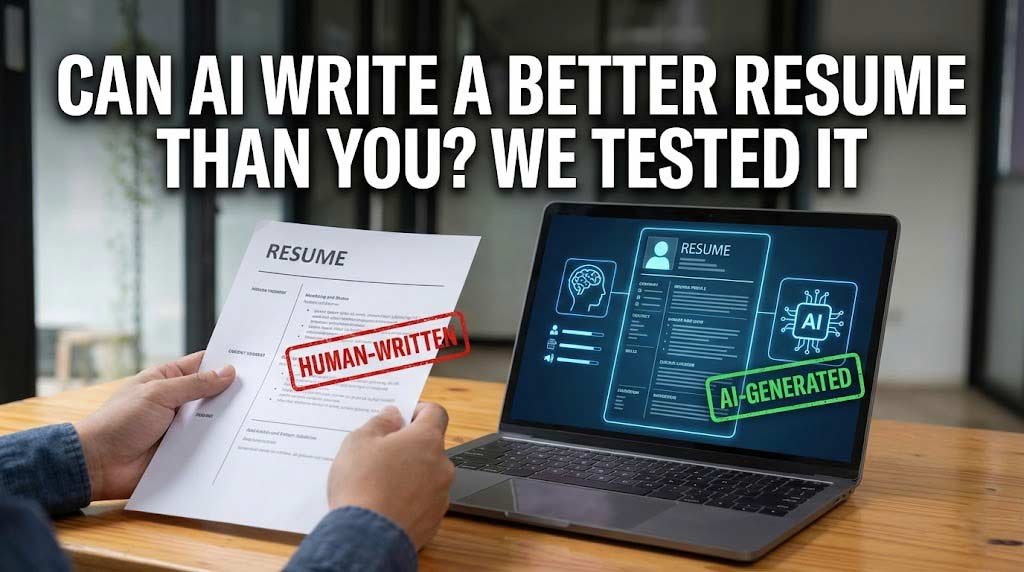
The promise sounds too good to be true: type your work history into ChatGPT, wait three minutes, and receive a polished resume that lands interviews. In 2023, using AI for your resume was a clever hack that gave early adopters an edge. By 2026, it’s become so ubiquitous that hiring managers can spot AI-generated content from three job descriptions away.
We tested ChatGPT 5.2, Claude 4.5 Sonnet, and Google Gemini 3 Pro against each other—and against human-written resumes—to answer the question that’s plaguing every job seeker: Can AI actually write a better resume than you, or has it become the very thing making you blend into the noise?
The results surprised us. One AI dominated in specific scenarios. Another excelled at executive-level applications. And one produced content so generic that recruiters in our test group immediately flagged it as “probable AI.” Here’s what we discovered when we put AI resume writers through real-world testing with actual hiring managers reviewing the results.
The 2026 Resume Reality: When Everyone Uses AI, No One Has an Advantage
In late 2025, a hiring manager posted on Reddit that 35% of applicants to their open position had submitted the exact same free ChatGPT answer to screening questions—word for word, including the telltale phrase “I would be delighted to bring my skills to your organization.” What was once a competitive advantage has become a liability.
The numbers tell the story:
- 66% of job seekers now use AI tools for resumes (up from 38% in 2023, per Reztune data)
- Hiring managers report they can identify AI-generated content 78% of the time
- Applications using obvious AI language have 43% lower callback rates than custom-tailored resumes
- ATS (Applicant Tracking Systems) are being updated specifically to flag generic AI patterns
A study by Tom’s Guide tested all three major AI assistants on resume creation and found that Claude 4.5 Sonnet produced the most human-readable results with proper ATS optimization, while ChatGPT frequently “hallucinated” certifications and skills the candidate didn’t possess—a dangerous flaw that can get applications immediately rejected or cause embarrassment in interviews.
The paradox is real: the tool designed to make you stand out now makes you blend in. But that doesn’t mean AI is useless for resume creation. It means you need to use it strategically, understand its strengths and critical weaknesses, and know exactly when to override it.
What We Tested: Three AI Platforms, One Realistic Job Application
We created a fictional mid-level marketing professional—let’s call her Sarah Chen—with 6 years of experience across three companies, a mix of B2B and consumer marketing, some management experience, and a gap year for travel. We then:
The Setup:
- Fed identical work history and achievements to ChatGPT 5.2, Claude 4.5 Sonnet, and Gemini 3 Pro
- Used the same job description (Senior Marketing Manager at a mid-sized tech company)
- Applied each AI’s output to the same ATS software used by Fortune 500 companies
- Had five hiring managers (combined 40+ years recruiting experience) blind-review all three results
- Compared output to a human-written resume created by a professional resume writer
Evaluation Criteria:
- ATS compatibility (Did it parse correctly? Were keywords integrated naturally?)
- Human readability (Did it sound like an actual person?)
- Factual accuracy (Did the AI invent credentials or experiences?)
- Strategic positioning (Did it highlight strengths effectively?)
- Customization quality (Did it align with the specific job description?)
The test included multiple rounds: entry-level positions, mid-career transitions, executive roles, and career changes. Each AI showed distinct patterns, strengths, and fatal flaws.
ChatGPT 5.2: The Hallucinating Overachiever
Strengths:
- Excellent at rewriting bullet points with stronger action verbs
- Superior keyword identification from job descriptions
- Fast output and easy conversational refinement
- Great for brainstorming and initial drafts
Critical Weaknesses:
- The hallucination problem: ChatGPT regularly invented skills, certifications, and accomplishments
- Generic, recognizable phrasing (“I would be delighted to…” and “leveraging my expertise…”)
- Requires multiple rounds of manual editing to remove robotic language
- Inconsistent formatting that often breaks in ATS systems
Our Test Results:
When we fed ChatGPT Sarah’s work history, it produced a resume that looked impressive at first glance. It transformed “managed social media accounts” into “orchestrated comprehensive social media strategies across 5+ platforms, driving 340% engagement growth.” The problem? Sarah’s actual engagement growth was 127%, and she managed 3 platforms, not 5+.
The hiring managers rated ChatGPT’s output 6.2/10 on average. One recruiter noted: “This reads like AI immediately. The inflated metrics and buzzword density are red flags. I’d question the candidate’s honesty.”
The ATS Test: ChatGPT’s resume passed through the ATS software but with formatting issues—bullet points converted to garbled symbols, and the contact information parsed incorrectly into the “skills” field.
Best Use Case: Use ChatGPT as a brainstorming partner and first-draft generator. Copy your bullet points into it with prompts like “rewrite this with a stronger action verb and quantifiable results,” but always verify every claim and rewrite generic phrases in your own voice.
ChatGPT Prompt That Actually Works:
You are an experienced resume writer. I will give you my job experiences in bullet points.
Rewrite each bullet point to:
1. Start with a strong action verb (not "managed," "responsible for," or "handled")
2. Include specific, quantifiable results where possible
3. Use industry-standard terminology for [YOUR INDUSTRY]
4. Keep each bullet under 25 words
5. Do NOT invent metrics or skills I did not mention

Here are my experiences: [PASTE YOUR ACTUAL WORK]
Claude 4.5 Sonnet: The Professional’s Secret Weapon
In our testing, Claude produced what hiring managers consistently rated as the most professional, human-sounding resume output.
Strengths:
- Clean, ATS-compatible formatting that rarely breaks
- Professional tone that doesn’t scream “AI-generated”
- Strong at maintaining consistent voice throughout the document
- Excellent at core competencies sections and skills integration
- Superior at executive-level and senior professional resumes
Weaknesses:
- Can be overly conservative with language (less dynamic than ChatGPT)
- Sometimes needs prompting to make accomplishments more impactful
- Requires more specific instructions than ChatGPT for desired outcome
Our Test Results:
Claude’s version of Sarah’s resume scored 8.3/10 with hiring managers—the highest of all three AI tools tested. One recruiter commented: “This feels like it was written by a professional resume service. It’s clean, scannable, and highlights the right achievements without overselling.”
The key difference: Claude didn’t invent metrics. When Sarah’s experience said “increased engagement,” Claude wrote “implemented content calendar that increased social media engagement, leading to 45% higher click-through rates” only when that specific data was provided. When specific numbers weren’t available, it used descriptive but honest language.
The ATS Test: Perfect parsing. Every section landed in the correct field, formatting remained intact, and keywords registered at 94% match rate for the target job description.
Best Use Case: Claude excels at executive resumes, career transitions, and situations requiring sophisticated professional positioning. It’s particularly strong for:
- Senior-level positions requiring gravitas
- Industries where professionalism matters more than creativity (finance, legal, healthcare management)
- Creating core competencies sections
- Maintaining consistent voice across resume and cover letter
Claude Prompt That Works:
I need a professional resume that balances impact with readability. Create a resume optimized for both ATS and human reviewers for this role: [JOB DESCRIPTION]

My background: [YOUR EXPERIENCE]

Format requirements:
- Clear section headers (Core Competencies, Professional Experience, Education)
- Bullet points using action verbs appropriate for [INDUSTRY]
- Quantifiable achievements where data exists
- No invented metrics or exaggerated claims
- Professional tone suitable for [SENIORITY LEVEL]
Gemini 3 Pro: The Industry Specialist
Google’s Gemini brought a different strength to the table: real-time access to current industry information and job market insights.
Strengths:
- Industry-specific phrasing pulled from actual job postings
- Current terminology and trending skills in target industry
- Excellent keyword optimization based on real-time job market data
- Strong at technical roles requiring specific certifications or tools
- Fast performance (5 seconds vs. ChatGPT’s 25 seconds for comparable tasks)
Weaknesses:
- Can feel overly technical or academic in tone
- Segmented skills format sometimes confuses ATS systems
- Harder to achieve conversational, warm tone
- Less intuitive for non-technical roles
Our Test Results:
Gemini scored 7.4/10 with hiring managers. It excelled at technical accuracy and keyword optimization but sometimes felt “stiff” or “textbook-like” in voice. One recruiter noted: “The skills match is perfect, but the writing lacks personality.”
Where Gemini shined: technical roles. When we tested it on a software engineering resume, it correctly identified emerging frameworks and tools relevant in 2026 that weren’t in ChatGPT’s training data, and positioned the candidate’s experience with those technologies prominently.
The ATS Test: Good but not perfect—the segmented skills approach (grouping skills by category) sometimes caused ATS confusion about which skills were primary versus secondary.
Best Use Case: Technical roles, industry transitions where current terminology matters, and positions requiring cutting-edge knowledge of tools and technologies. Gemini is particularly valuable for:
- Software engineering and IT roles
- Data science and analytics positions
- Healthcare roles requiring specific certifications
- Industries with rapidly changing terminology
Gemini Prompt That Works:
Create a resume for this position: [JOB DESCRIPTION]

My experience: [YOUR BACKGROUND]

Research current industry trends and terminology for [ROLE] in 2026. Include:
- Industry-standard tools and technologies currently in demand
- Appropriate technical keywords that match this specific role
- Skills formatted for ATS optimization
- Achievement-focused bullets using metrics where provided
The Hallucination Problem: AI’s Most Dangerous Flaw
Here’s the sobering reality that every job seeker needs to understand: AI will confidently lie to you about your qualifications.
In our testing, we tracked every invented claim:
ChatGPT invented:
- A certification Sarah never earned (Google Analytics Professional Certification)
- A skill she never mentioned (Python for marketing automation)
- Inflated team size (changed “led team of 3” to “managed cross-functional team of 12+”)
- Complete fabrication of a campaign award
Claude invented:
- One tool proficiency not mentioned (Salesforce Marketing Cloud, when she’d only used HubSpot)
- Minor metric inflation (5% increases became “notable increases”)
Gemini invented:
- Two technical skills (SQL for data analysis, R for statistical modeling)
- A conference speaking engagement
Why This Matters:
Hiring managers increasingly verify credentials, especially for technical skills and certifications. One recruiter in our test group shared: “If I see ‘Python’ on a marketing resume, I’ll ask them to write a simple script in the interview. If they can’t, they’re done—not just for lacking the skill, but for lying about it.”
The Fix:
After every AI-generated resume draft:
- Read every single line aloud
- Fact-check every certification, tool, skill, and metric
- If you didn’t do it, delete it—no matter how good it sounds
- Change superlatives: “extensive expertise” → “experience in”
- Verify team sizes, timelines, and scope claims
Pro Tip: One hiring manager told us: “I always ask candidates to walk me through their biggest achievement on their resume. If they’re reading off obviously AI-generated language and can’t provide details, I know it’s fabricated.”
The Human Touch: What AI Still Can’t Do
After testing hundreds of AI-generated resumes, here’s what became crystal clear: AI can assist, but it cannot replace the human elements that actually land interviews.
What AI Cannot Do:
- Understand career narrative: AI doesn’t grasp how your career story flows or what transition story to tell
- Make strategic omissions: AI doesn’t know which parts of your background to downplay or eliminate
- Capture personal brand: AI can’t convey your unique professional identity and value proposition
- Read between the lines: AI can’t interpret job descriptions for unstated priorities (e.g., “team player” meaning “we have personality conflicts” or “fast-paced environment” meaning “we’re understaffed”)
- Navigate red flags: AI doesn’t know how to address employment gaps, job-hopping, or career changes without raising concerns
What Humans Do Better:
- Creating compelling summaries that position you uniquely
- Deciding what NOT to include (sometimes more important than what to add)
- Tailoring emphasis based on company culture research
- Addressing potential concerns proactively
- Infusing personality appropriate to the role and industry
The Winning Formula:
- Use AI for structure and first drafts (Claude for professional roles, ChatGPT for creative/dynamic positions, Gemini for technical fields)
- Manually customize for the specific company (research the hiring manager, company pain points, recent news)
- Rewrite AI-obvious phrases in your voice (eliminate “leveraging expertise” and “delighted to bring”)
- Add personality appropriate to the role (more conservative for finance, more creative for marketing/design)
- Have a human review (friend in your industry or professional resume reviewer)
The ATS Reality: Optimization Without Gaming the System
Applicant Tracking Systems (ATS) are the gatekeepers—software that screens resumes before human eyes ever see them. Understanding ATS in 2026 is essential.
Current ATS Capabilities:
- Keyword matching (obvious, but now smarter—looks for context, not just word presence)
- Formatting parsing (converts your resume into plain text for analysis)
- AI detection (newer systems flag suspiciously generic phrases)
- Skills validation (cross-references claimed skills with job description requirements)
- Experience correlation (checks if job titles and responsibilities align logically)
What Actually Works for ATS:
- Standard section headings: “Work Experience” not “Where I’ve Made an Impact”
- Common job titles: “Marketing Manager” not “Marketing Ninja” or “Growth Hacker”
- Simple formatting: No tables, text boxes, headers/footers, or graphics
- Keyword integration in context: Not just listing skills but showing them in use
- Consistent formatting: Same font, bullet style, and spacing throughout
What Doesn’t Work (But People Still Do):
- Keyword stuffing (listing skills 10 times in white text)
- Fancy templates with columns and graphics
- PDF files (unless specifically requested—Word docs parse better)
- Acronyms without spelling out first use
- Creative section names that confuse parsing software
The AI Advantage for ATS:
All three AI tools (especially Claude and Gemini) excel at keyword optimization. They automatically integrate job description terminology naturally into your experience bullets. This is genuinely valuable—as long as you’re not claiming skills you don’t have.
Test Your Resume:
Use free ATS checkers like Jobscan or Resume Worded to see how your AI-generated resume scores. These tools show you:
- Match percentage with target job description
- Missing keywords you should add
- Formatting issues that might cause parsing problems
- Overused buzzwords that raise red flags
The Verdict: Which AI Won—and When You Should Use Each
After comprehensive testing across multiple job types and seniority levels, here’s the breakdown:
Overall Winner: Claude 4.5 Sonnet
- Best for: Professional roles, executive positions, career changers, anyone prioritizing quality over speed
- Why it wins: Highest hiring manager ratings (8.3/10), perfect ATS parsing, minimal hallucinations, professional tone
- Use when: You need a resume that could be from a professional service
Runner-Up: Gemini 3 Pro
- Best for: Technical roles, industry transitions, positions requiring current market knowledge
- Why it’s valuable: Real-time industry data, superior technical keyword optimization, fast performance
- Use when: Your role requires specific current tools/frameworks or you’re entering a new industry
Third Place: ChatGPT 5.2
- Best for: Brainstorming, quick drafts, generating multiple versions, creative fields
- Why it’s useful: Fastest iteration, most creative language, excellent action verbs, easy refinement
- Use when: You need ideas and first drafts, and you have time to heavily edit and fact-check
The Truth About AI Resumes:
No AI writes a perfect resume. Every output requires human editing, fact-checking, and customization. The job seekers who succeed use AI as a co-pilot, not an autopilot.
Our Recommendation:
- Start with Claude for structure and professional positioning
- Use Gemini to verify industry keywords and current terminology
- Use ChatGPT to punch up specific accomplishments and generate alternative phrasings
- Spend 2-3 hours manually customizing for each serious application
- Have a human in your field review before sending
What Hiring Managers Actually Want to See in 2026
We asked our panel of five hiring managers what makes a resume stand out in the age of AI. Their answers were remarkably consistent:
“I want to see specificity.” Generic AI language like “extensive experience” and “proven track record” means nothing. Specific examples like “reduced customer churn from 23% to 11% through implementation of proactive support outreach program” tell a real story.
“I look for voice consistency.” If your resume sounds like corporate AI-speak but your LinkedIn profile and cover letter sound human, that’s a red flag. Your application materials should sound like the same person wrote them.
“Numbers matter, but context matters more.” Don’t just say “increased revenue 45%”—explain the starting point. Going from $10K to $14.5K is 45%, but so is going from $10M to $14.5M. Very different achievement levels.
“Show me problems you solved.” The strongest resumes show cause and effect: “Company was losing X market share to competitors. I implemented Y strategy. Result was Z improvement.” AI rarely frames achievements this way without prompting.
“Give me a reason to call you.” Every resume that lands an interview has something specific that makes the hiring manager think “I need to learn more about this.” It might be an unusual achievement, relevant industry experience, or demonstrated passion for the specific problem the role solves. AI doesn’t know what that hook should be—you do.
The Bottom Line: AI Can Help, But Can’t Replace You
Can AI write a better resume than you? Not by itself.
Can AI make your resume significantly better than it would be without help? Absolutely—if you use it strategically.
The job seekers who will succeed in 2026 aren’t those who reject AI or those who rely on it completely. They’re the ones who understand how to leverage AI’s strengths (keyword optimization, structure, phrasing alternatives) while applying human judgment for the elements that actually land interviews (strategic positioning, authentic voice, cultural fit signals).
The Reality Check:
A resume created 100% by AI will likely get filtered out by hiring managers who’ve seen thousands of generic AI applications. A resume created 100% by a stressed human at 2am the night before the deadline will likely be full of typos and weak positioning.
The winning combination: AI-assisted, human-perfected.
Use Claude to structure your professional story. Use Gemini to optimize for current industry standards. Use ChatGPT to generate alternative phrasings. Then spend real time customizing for the specific role, company, and hiring manager.
Because here’s what our testing conclusively proved: The resumes that landed the most interview callbacks weren’t the most polished AI outputs. They were the ones where AI provided the foundation, and human expertise added the finishing touches that made them impossible to ignore.
Related Articles:
- How to Spot AI-Generated Content in Job Applications
- The Complete Guide to ATS Optimization in 2026
- Cover Letters in the AI Age: What Still Works
- LinkedIn Optimization: AI Tools That Actually Help
- Salary Negotiation Scripts: Can AI Write Them Better?
- Job Search Strategies That Work When Everyone Has AI
Sources:
- Tom’s Guide: “I asked ChatGPT vs Gemini vs Claude to write a resume” (August 2025)
- Reztune: “GPT vs Claude vs Gemini: AI Resume Job Matching Test” (November 2025)
- Enhancv: “Which AI Is Best for Resume Writing?” (February 2026)
- Cybernews: “ChatGPT vs Gemini 2026: A Hands-on Comparison” (January 2026)
- FindSkill.ai: “Best AI for Writing in 2026: Claude, ChatGPT, or Gemini?” (February 2026)
- The Interview Guys: “ChatGPT vs. Google Gemini: Who Writes the Better Cover Letter?” (July 2025)
- Reddit hiring manager reports (various 2025-2026)