Most paintings about God keep God at a respectful distance. Heaven is up there, mortals are down here, and the whole composition works hard to remind you that you are watching something that happened somewhere else, to people built differently than you, in a light that does not exist on this earth. Caravaggio didn’t care about any of that.
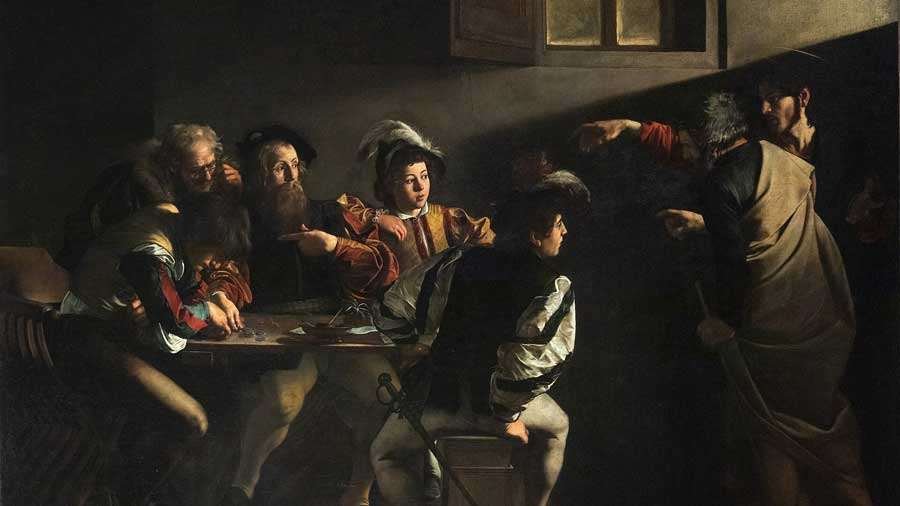
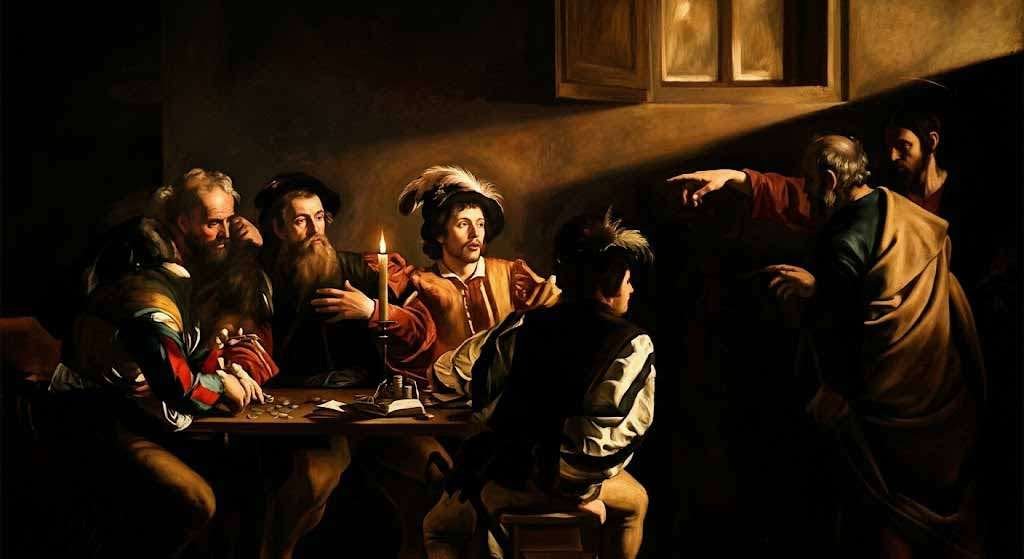
The Calling of Saint Matthew, painted around 1599–1600 for the Contarelli Chapel in Rome’s Church of San Luigi dei Francesi, broke the contract Western sacred art had honored for two centuries. It didn’t do it politely. The painting walks into a working-class Roman tavern — counting house, really, but the atmosphere is the same — and drops divine light on a man who looks like he’d rather be anywhere else. The shaft of light that enters from the upper right doesn’t warm the room. It interrogates it. Caravaggio painted the moment Heaven stopped asking politely.
What’s Actually Happening in the Room
The scene comes from Matthew 9:9 — Christ passes a tax collector named Levi sitting at a customs table, says “Follow me,” and that’s it. Matthew rises and follows. The whole gospel account is three sentences. Caravaggio gave it a room, a group of working men, a table covered in coins, and a question that ricochets off every figure in the frame.
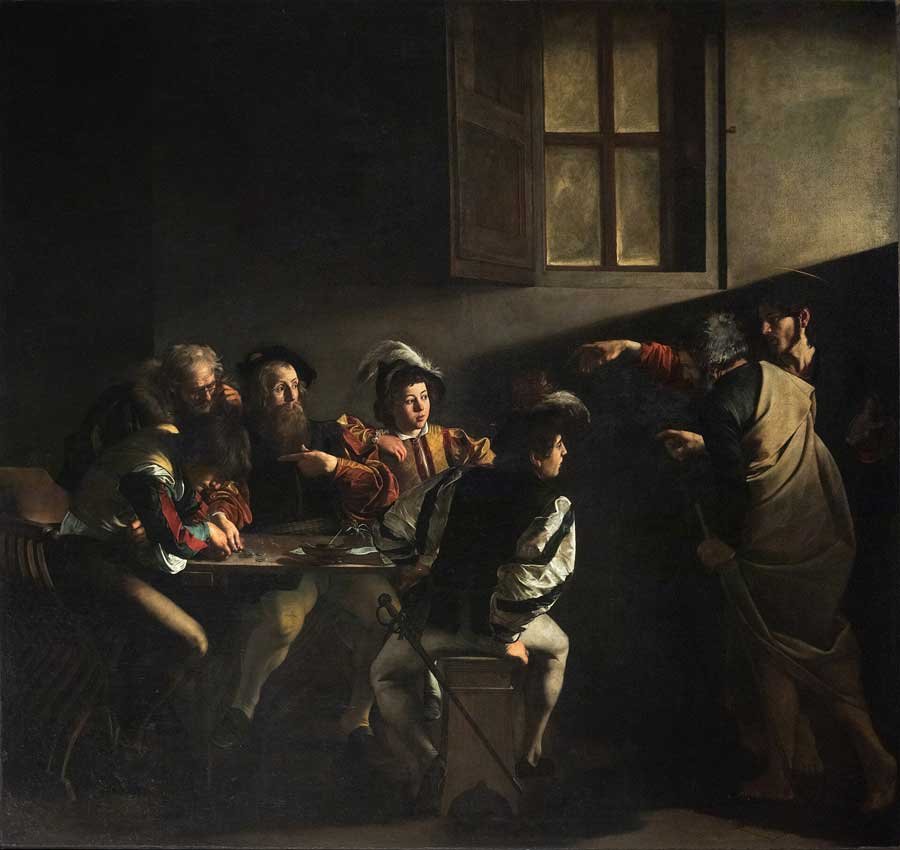
Five men sit at the table. Christ and Peter stand at the right, Christ’s arm extended, finger pointing. Most of it is in shadow. And here is the genius the first viewers would have recognized immediately: that pointing hand is lifted almost verbatim from Michelangelo’s Creation of Adam on the Sistine Chapel ceiling — the hand of God extended toward Adam — but Caravaggio has inverted the direction of grace. It isn’t flowing down from heaven. It’s moving horizontally, from one man’s hand to another, across a room that smells like bodies and tallow.
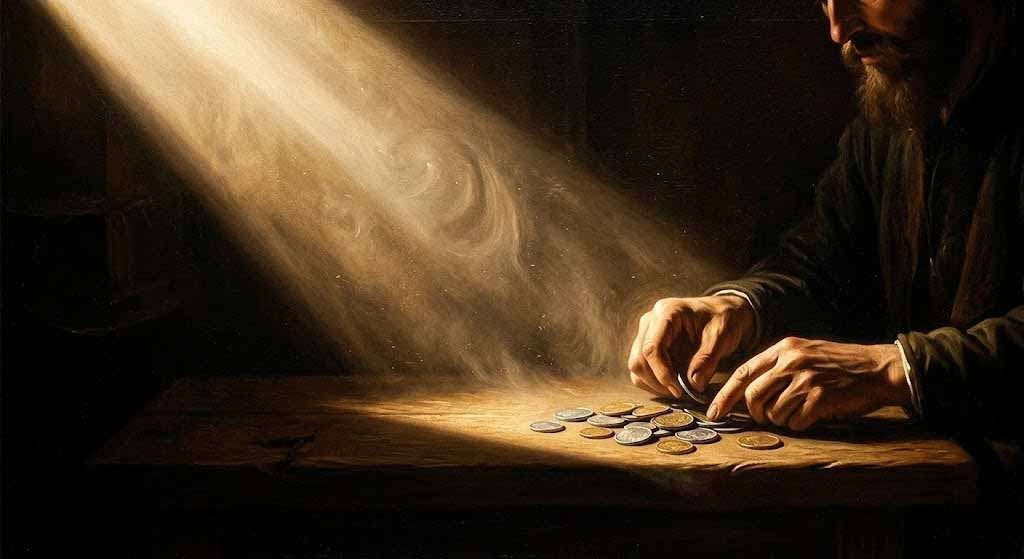
The light enters through a single high window, implied but never shown. It follows the angle of Christ’s arm. The two directions — the pointed finger and the diagonal beam — converge on the same target. This is tenebrism: not just dramatic shadow, but shadow weaponized as theology. Light doesn’t fill the room in Caravaggio’s world. It selects.
The Problem of Matthew’s Hand
Look at Matthew. He’s seated at the center-left, dressed in a plumed hat and merchant clothes, surrounded by younger men. One hand rests on the coins. The other — and this is the question art historians have argued about for four hundred years — points back at himself, or possibly at the young man seated at the far left.
Is he saying: me? Or is he redirecting Christ’s attention to someone beside him?
Both readings are defensible. That ambiguity was almost certainly intentional. Caravaggio, who read his subjects off Roman streets and painted models with dirty feet and calloused hands, understood something about how real people respond to being called. They don’t stand up straight and nod. They look around to make sure you’re talking to them. They think there must be a mistake. The hand that gestures at the chest is the universal human gesture of disbelief — you can’t mean me — and it is exactly the right psychological note to strike in a painting about a man being summoned from a life he probably thought was permanent.
That uncertainty in Matthew’s posture — the body not yet fully responding, the hand not yet decided — captures something sacred art almost never attempts: the actual moment of transformation, not before it and not after, but the split second when a life cracks open and isn’t sure yet which way it’ll fall.
Tenebrism as More Than Theater
The technique Caravaggio developed, and which his followers spread across Europe under the name chiaroscuro in its most extreme form, is often described as theatrical. That’s not wrong, but it undersells the theological argument embedded in the method.
Medieval sacred painting illuminated everything. The gold backgrounds, the flat figures, the absence of naturalistic shadow — these were deliberate. The divine was understood as the source of all light, and representing sacred scenes in light meant representing them in God’s presence. Shadow had no place in heaven. Caravaggio disagreed with every choice in that tradition and made his disagreement into paint.
In The Calling of Saint Matthew, the darkness isn’t the absence of God. The darkness is the world as it actually is — taxmen, coins, ordinary Roman afternoon — and the light is God’s intrusion into it. The light doesn’t fill the room because grace doesn’t fill the world. It picks. It singles out. The shadow surrounding Matthew makes the beam of light that crosses him feel like something that has never touched him before and might never touch him again. That’s not theater. That’s doctrine painted in oil.
The Franciscan Cardinal Francesco Maria Del Monte, who commissioned the Contarelli Chapel paintings, would have understood this immediately. The Counter-Reformation Church was fighting for relevance, battling Protestant arguments that Catholicism had become too ornate, too distant from Scripture, too fond of its own grandeur. What Caravaggio gave them was something radical: a sacred scene that looked like now. Like here. Like the people in the pews.
The Working-Class Body as Sacred Text
This is where Caravaggio’s revolution becomes most legible, and most controversial. The figures in The Calling of Saint Matthew are not idealized. They are not the smooth-limbed Florentine bodies of Renaissance painting, elevated to a kind of classical abstraction. They have weight. They have the particular slouch of men who sit at tables for a living. The young men grouped at the left wear the fashionable dress of contemporary Rome, not biblical costume — Caravaggio made no attempt to set the scene in ancient Judea.
His critics hated this. They called it degrading. One contemporary churchman rejected an early version of another Contarelli Chapel painting because the figures of saints looked like common people. To Caravaggio, that was the point.
If grace is real, it has to be able to enter a room full of real people. If Christ’s call was meaningful, it had to be audible above the sounds of coin on wood and the low conversation of working men. The dirty fingernails, the contemporary clothes, the cramped and shadowed room — these aren’t failures of reverence. They are Caravaggio’s argument that reverence without reality is just decoration.
This was a position with stakes. Understanding media and the conditions under which messages travel is always a political act. Caravaggio was rewriting the medium of sacred art, and the message encoded in that rewriting was legible to anyone with eyes: the sacred is not above you. It came to find you where you are.
Why It Still Works
The Calling of Saint Matthew hangs in the Contarelli Chapel today, where it has hung for more than four centuries, flanked by two other Caravaggio paintings of Matthew’s life. The light in the chapel is controlled and dim, which means the painting’s internal light — that diagonal shaft from the implied window — functions almost as it was designed to: as the brightest thing in a dark room.
You stand in front of it and the question Caravaggio built into Matthew’s hand lands on you. Me? The disbelief is not a weakness in the painting’s argument. It is the argument. The whole history of Western sacred art had been devoted to depicting the divine as remote, luminous, categorically different from the world of men. Caravaggio, a man of documented violence and genuine recklessness, looked at that tradition and painted his answer: a room full of people who weren’t expecting anything, and a beam of light that didn’t ask their permission.
That beam still hasn’t stopped.
You Might Also Like:
- Explorations by W.B. Yeats: The Poet Who Built His Own World
- Understanding Media: The Extensions of Man — Marshall McLuhan
Sources:
- Hibbard, Howard. Caravaggio. Harper & Row, 1983. https://www.harpercollins.com/
- Langdon, Helen. Caravaggio: A Life. Farrar, Straus and Giroux, 1999. https://us.macmillan.com/
- Spike, John T. Caravaggio. Abbeville Press, 2010. https://www.abbeville.com/
- Christiansen, Keith. “Caravaggio and ‘L’esempio davanti del naturale.'” The Art Bulletin, Vol. 68, No. 3, 1986. https://www.jstor.org/stable/3051060
- The Contarelli Chapel, Church of San Luigi dei Francesi, Rome. https://www.saintlouisfrenchrome.org/
- Web Gallery of Art — The Calling of Saint Matthew (1599–1600). https://www.wga.hu/frames-e.html?/html/c/caravagg/