Look at old photographs of 315 Bowery long enough and a joke starts to form — the kind of joke that takes twenty years to understand.
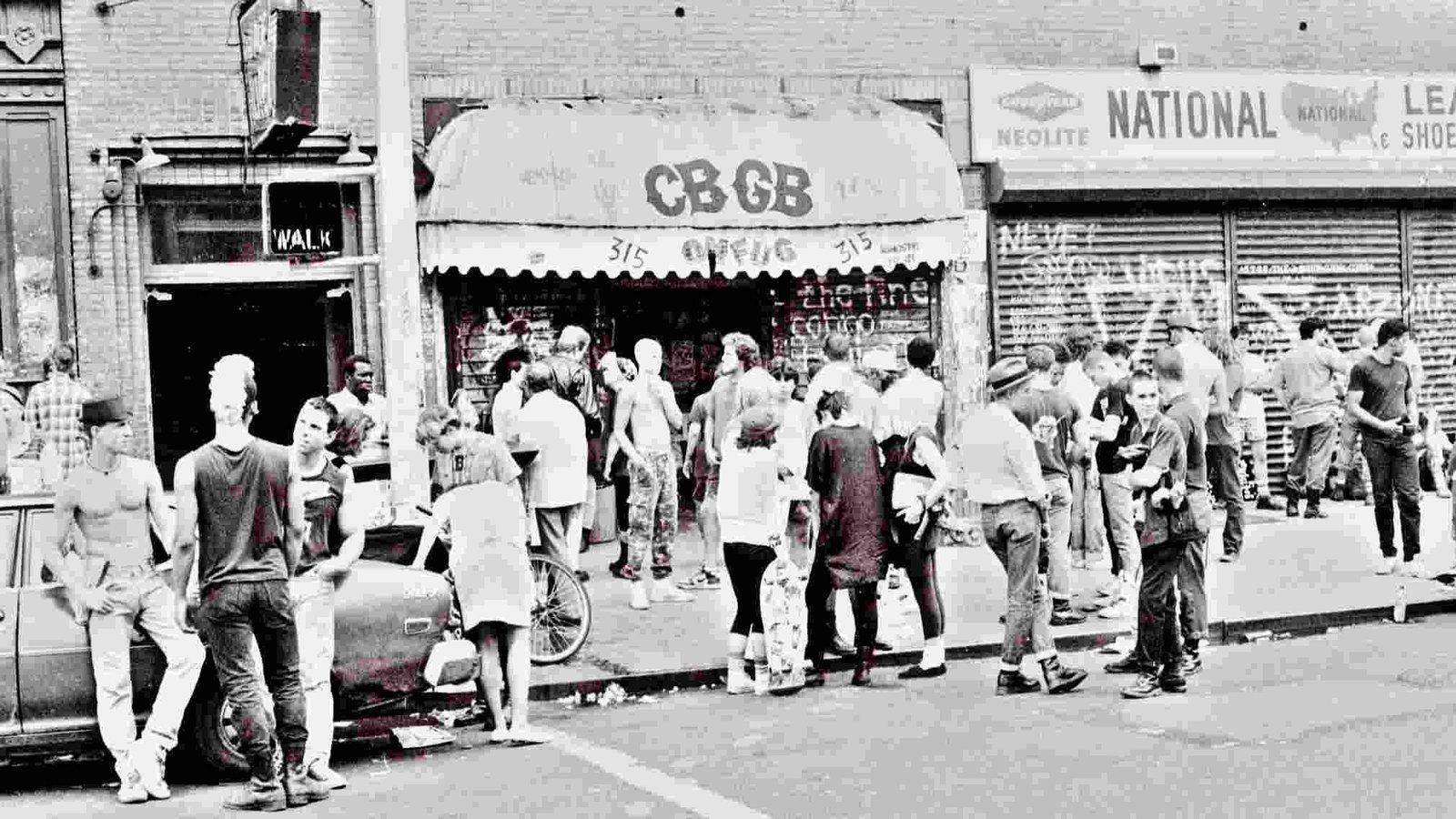
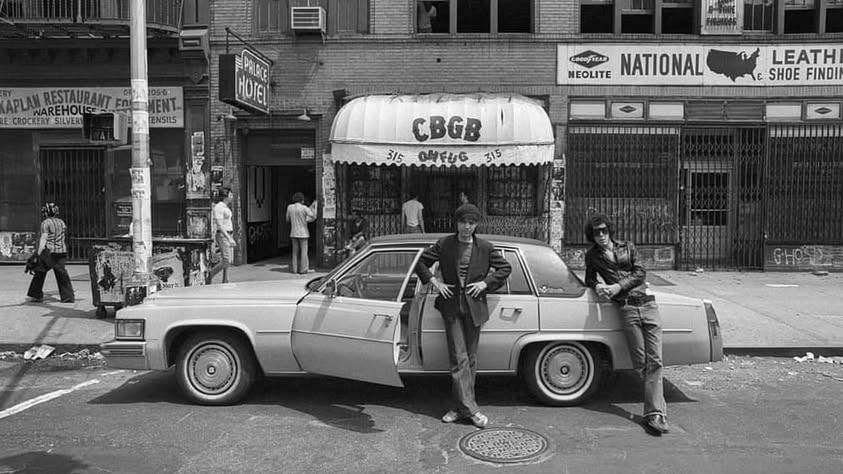
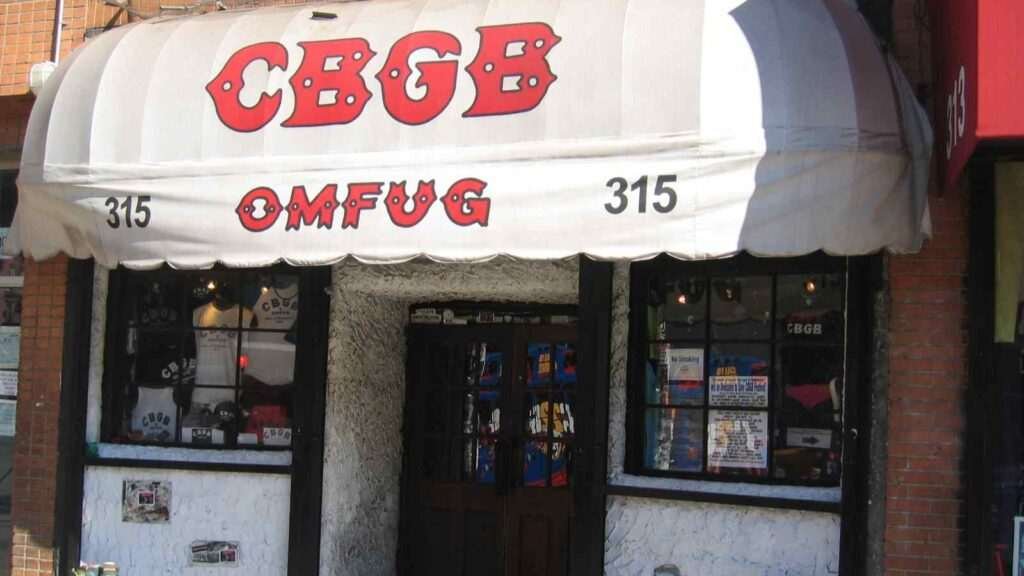
There it is, in black and white. The awning that said CBGB & OMFUG. The Palace Hotel flophouse crumbling above it. And flanking the whole scene like two witnesses at a crime: a leather and shoe-finding supply house to the right, and Kaplan Restaurant Equipment to the left. A leather shop. A commercial kitchen supplier. Pressed against the single most important music venue in New York punk history.
I was a Brooklyn kid who took the subway to the Bowery almost every Sunday through the late 1980s. I walked past those storefronts hundreds of times. I never looked at them once.
The Bowery Before It Was Romantic
By the time I started going to CBGB in the late ’80s, the Bowery had been dying its slow public death for over a century. The street had once been the theater district of Manhattan — vaudeville houses, saloons, concert halls going back to the 1800s. By the 1970s it was something else: soup kitchens, flophouses, men sleeping on cardboard in doorways, the kind of block your parents told you to avoid. The rents were cheap for a reason. Nobody wanted to be there.
That cheapness is what made it fertile. When Hilly Kristal opened CBGB on December 10, 1973 — at 315 Bowery, on the ground floor of the Palace Lodging House, which had 105 cubicles and 224 beds above it — he wasn’t looking to start a revolution. He wanted to book country, bluegrass, and blues. That’s what the name stood for: Country, Bluegrass, Blues & Other Music for Uplifting Gourmandizers. What he got instead was Television, the Ramones, the Patti Smith Group, Blondie, Talking Heads, and the wholesale invention of American punk rock and new wave.
Kristal had two rules. Bands had to carry their own equipment. And bands had to play mostly original music. That second rule was the one that changed everything. Every other club in the city wanted cover bands. CBGB wanted something nobody had heard before. Into that gap walked an entire generation of New York musicians who had nowhere else to go — and the rest is the kind of history that ends up behind glass at the Rock and Roll Hall of Fame. Which is literally where CBGB’s awning is now.
What It Was By the Time I Got There
The 1970s version of CBGB — Patti Smith howling poetry, the Ramones hammering two-minute songs at jackhammer tempo, Tom Verlaine coaxing Television into something that had no name yet — that was already history by the time I was showing up. My CBGB was the ’80s version. Harder. Faster. More crowded and more violent, in the way that a city under pressure is always more violent.
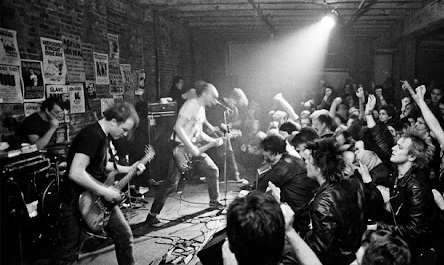
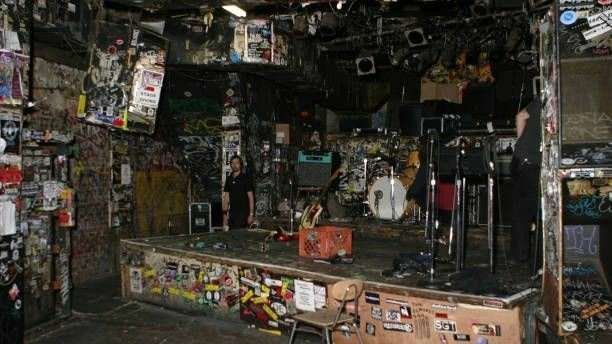
The scene that owned CBGB in the 1980s was New York hardcore. Bands like Agnostic Front, Cro-Mags, Murphy’s Law, Gorilla Biscuits, Sick of It All, Youth of Today, Bad Brains, and Warzone turned the place into a congregation. Not a concert. A congregation. The Sunday matinee — which the hardcore scene eventually called “thrash day” — started in the early 1980s and became an institution. Hilly originally moved the matinees to Sundays so Saturday night shows wouldn’t be affected by afternoon sets running long. It was a logistical decision that accidentally created a community. Every Sunday, starting in the afternoon and running until evening, a handful of hardcore bands took the stage for cheap or free, and the city’s young, angry, broke, and frequently shaved-head punk population showed up. Kids from Brooklyn. Kids from Queens. Kids from the Lower East Side squats, still smelling like the warehouse they’d slept in.
I was one of those kids. Son of Greek immigrants, born in Brooklyn, not particularly interested in the plan my circumstances had laid out for me. School was failing me or I was failing school, depending on who you asked. Music was the thing I wanted. I played guitar. I wanted it to go somewhere. And CBGB on a Sunday afternoon was where all of that energy — mine and everyone else’s — went to compress itself into something that felt, for three or four hours, like it meant something beyond the week you’d had.
The music itself was a physical argument. Agnostic Front’s Victim in Pain — their 1984 record release party happened right there on that stage — was not something you listened to so much as something that happened to your body. Sick of It All, Youth of Today, Cro-Mags: these weren’t songs in the radio sense. They were short, violent bursts of conviction. A Cro-Mags song lasted ninety seconds and felt like being grabbed by the collar and shaken. There was a reason kids were crowd-surfing and moshing and landing on concrete. The music demanded a physical response. Sitting still would have been a contradiction.
The Room Itself
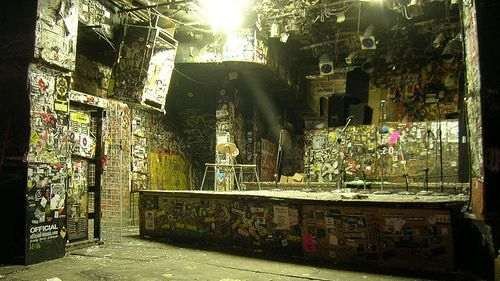
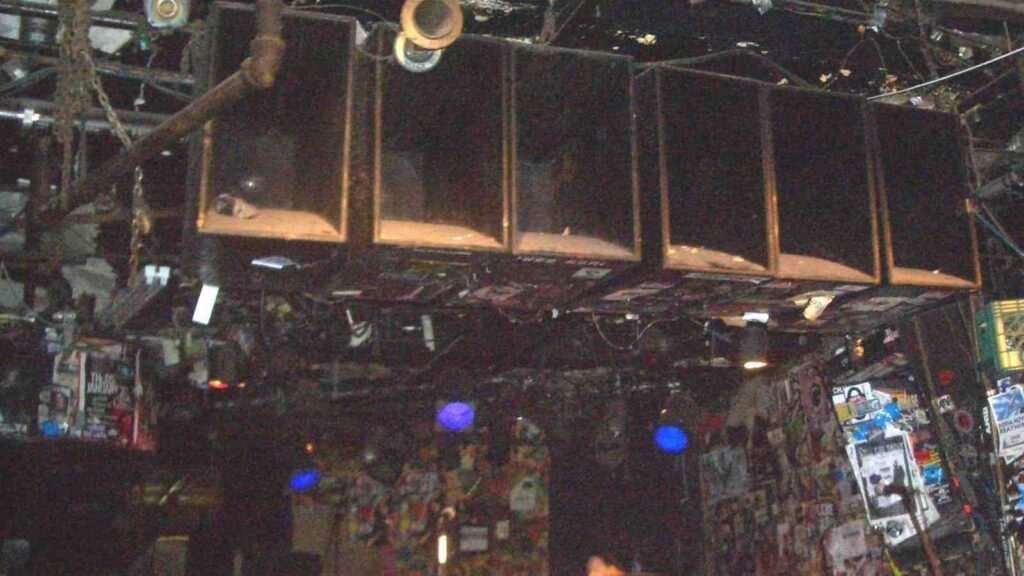
No description of CBGB is complete without the room. It was small. Smaller than you imagined from the mythology. The stage was at the back, elevated maybe a foot off the floor. The ceiling was low and the pipes running across it would drip something — condensation, probably, though nobody was entirely sure — back down onto the crowd below. The walls were layered in stickers, posters, and decades of graffiti. The bathroom was legendary in the way that natural disasters are legendary. You went in knowing you’d come out changed.
The sound was actually good. Tommy Victor, who later became the guitarist and vocalist for Prong, worked as the sound engineer for the hardcore matinees from 1986 to 1990. That’s who was behind the board when I was there. Agnostic Front recorded three live albums in that room. The sound system at CBGB was reportedly the best in its class — which is ironic, given how little the rest of the place had been maintained. But Hilly Kristal kept the place the same way for decades. He wasn’t running a venue. He was running a home.
What I wrote in my piece on Metallica and why heavy music matters comes back to me here: music that carries anger doesn’t have to be ugly to be honest. The bands at CBGB were working with the same raw material — injustice, economic pressure, the particular rage of being young and disposable in a city that was barely functional. They just played it at a different tempo.
The Three Storefronts
Here is what I didn’t know then, and can only see now by looking at the photographs.
Right there, to the right of CBGB’s awning, was National Leather & Shoe Finding — a supply shop for the leather and shoe trade. Raw materials. Hardware. The kind of place a craftsman would know by name.
To the left: Kaplan Restaurant Equipment. Commercial kitchen gear. The world of professional cooking, outfitted and supplied.
I walked past both of them every Sunday. Head down, mind on the music, carrying whatever gear I thought made me look like a musician — which, at sixteen or seventeen, was more attitude than anything else. I wanted to play. I wanted it badly enough to lie to myself about how close I was to making it happen. The music never became a business. It became something I loved that loved me back in a different way — as a listener, as someone shaped by it, not as someone who made a living from it.
The leather work and the kitchen — those came later, through a different kind of education. The diner first. Then the craft, where the material is English bridle leather and the lead time runs six months or more, because you don’t rush something built to last a hundred years. The craft found me, in the end, the way things find you when you finally stop running toward something else.
I’ve thought about this since I looked at those old photographs. What would have happened if I’d walked into one of those storefronts instead of CBGB? Probably nothing. I was seventeen. I wasn’t looking for a trade. I was looking for a feeling, and the music was where the feeling lived.
But there’s something almost absurd about the geometry. The thing I eventually made my hands do for a living — work leather, run a commercial kitchen — was standing right there on either side of the door I kept walking through to chase the thing I never caught. The Bowery had a sense of humor I wasn’t old enough to appreciate.
After the Music Stopped
CBGB ran out of options in 2006. A rent dispute with the Bowery Residents’ Committee — a homeless services nonprofit that had taken over the Palace Hotel above the club — ended in eviction. Hilly Kristal died of lung cancer in 2007, the year after the doors closed. The club’s famous awning is now in the lobby of the Rock and Roll Hall of Fame in Cleveland. The building at 315 Bowery was added to the National Register of Historic Places in 2013.
John Varvatos opened a luxury fashion boutique in CBGB’s former space in 2008. He preserved the stickers on the walls and some of the graffiti in the bathrooms, which is a choice that reasonable people can disagree about. The Dead Boys’ guitarist Cheetah Chrome had a more direct take: “All of Manhattan has lost its soul to money lords.”
The neighborhood transformed entirely. The Bowery that was soup kitchens and flophouses is now luxury hotels, designer stores, and Michelin-reviewed restaurants. The same process that killed CBGB — rising rents, gentrification, the city pricing out its own underground — has a long history in New York, and it didn’t stop at Bleecker Street. The economics of what happens to independent venues when a neighborhood “improves” is worth a separate conversation — one I started in my piece on the Live Nation antitrust trial and what it means for independent music.
What happened on those Sundays is harder to gentrify. It’s already inside people. Agnostic Front, now well into their fourth decade, released a song in 2025 called “Sunday Matinee,” from the album Echoes in Eternity, explicitly honoring those CBGB Sunday afternoons. Frontman Roger Miret described it as celebrating “the gathering of friends, families and the joyous times when we all looked forward to our Sunday Matinee” — calling the matinees “true social media at its finest.” Which is funny, and accurate, and a little heartbreaking, all at once.
Lou Morales wrote about this same world from a different angle. I covered his memoir in Brooklyn Skinhead — the community, the violence, and the strange brotherhood that surrounded this scene — and it reads like a parallel account of the same streets, the same block mentality, the same search for something to belong to.
What Stays
What I know now that I didn’t know then: the things that shape you most aren’t always the things you were trying to do. I went to CBGB to be a musician. I absorbed something else — a refusal to fake it, a suspicion of anything that wasn’t built to last, a preference for the made thing over the marketed thing. Those Sundays gave me that. Whether it came from the music or the room or the people in it, I can’t separate it out now.
The leather shop is gone. Kaplan moved. CBGB is a fashion boutique. The Bowery looks nothing like it did in the photographs.
What looks exactly the same, in the photographs: the two kids leaning on the car in front of the awning, the crowd pushing toward the door, the awning that says 315 and OMFUG and nothing else. They’re not looking at the storefronts either.
Nobody ever is, when the music is playing.
You Might Also Like
- Ride the Lightning: Metallica, Fade Away
- Brooklyn Skinhead by Lou Morales — Boots, Brotherhood, and the God He Found After
- The Economics of Live Entertainment: What the Live Nation Antitrust Trial Means for Independent Venues
Sources
- CBGB — Wikipedia
- CBGB History — cbgb.com
- Hilly Kristal’s Long Road to the Bowery — Village Preservation
- NYC’s Legendary CBGB Still Leaves a Powerful Legacy 50 Years Later — Time Out New York
- 50 Years Ago, New York City’s Punk Scene Was Born — SPIN
- CBGB: A Hardcore Fanatic’s Guide — Do You Know Hardcore
- Agnostic Front Premiere “Sunday Matinee” — Lambgoat
- A Brief History of 315 Bowery — Notes on New York
- A Rebel Life by Peter Kalafatis (2007)