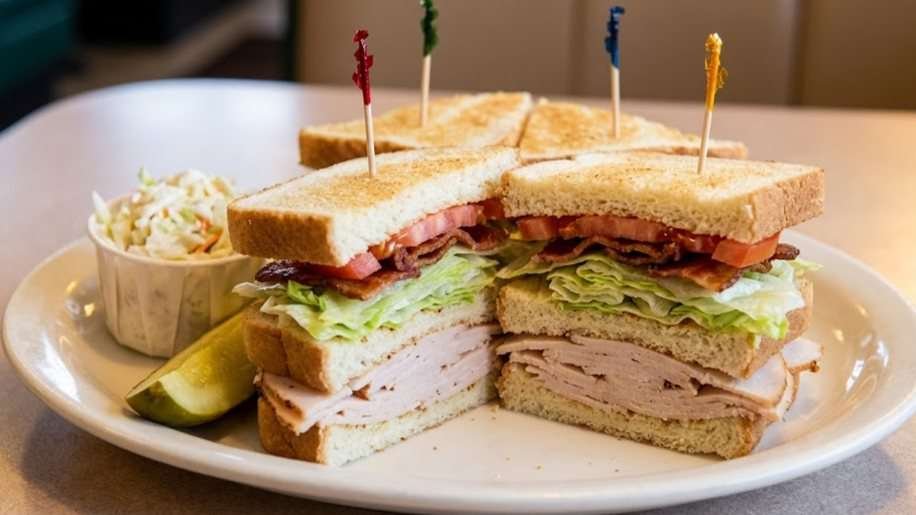
Every Long Island diner has a club sandwich. You already know what it looks like before the plate lands — three slices of white toast, iceberg lettuce with the structural integrity of wet paper, a tomato slice that has seen better days, a few strips of bacon that are at least honest about what they are, and whatever industrial turkey the kitchen is running this week. Four cellophane-fringed toothpicks holding the whole enterprise together. Quartered diagonally, plated with coleslaw from a bucket that is refilled more often than it is replaced, and a pickle spear that has been in brine long enough to have thoughts.
It is, in some essential way, perfect. And nobody knows where it came from.
This is not a case of mild historical ambiguity. The club sandwich’s origin is genuinely, stubbornly contested — a fact that should embarrass a country that has otherwise cataloged its food history in exhausting detail. We know when the Reuben was invented, more or less. We know who claims the cheesesteak. The club sandwich? Five cities and at least three institutions have staked a claim, and the best food historians alive have looked at the evidence and concluded that the answer is probably no single place at all.
The Saratoga Club House Claim: A Casino, a Gamble, and Possibly a Sandwich
The most documented and widely repeated origin points to the Saratoga Club House in Saratoga Springs, New York — not far, as it happens, from where we are. Richard Canfield purchased the club in 1894 and transformed it into one of the most exclusive gambling establishments in the country. The Canfield Casino, as it became known, was the kind of place where a man could lose a fortune at cards, win it back at roulette, and eat something extraordinary at two in the morning without anyone raising an eyebrow.
The Encyclopedia of American Food and Drink states that the club sandwich originated in the Saratoga Club House’s kitchen in 1894. The same kitchen, incidentally, that is also credited with the invention of the potato chip — a detail that should immediately make any serious food historian suspicious, since one kitchen cannot plausibly have invented both the chip and the club without the whole thing reading like mythology.
James Beard, writing in 1972, called the club sandwich one of the great sandwiches of all time and noted that it had swept around the world after an American beginning — though he had strong opinions about what that beginning looked like. He was categorical that the three-decker construction was not authentic, calling it a “horror,” and argued that the original was a two-layer sandwich, not the triple-decker that became standard. Beard was not a man who hedged his opinions.

The Union Club Counter-Claim: Fifth Avenue and 1889
The earliest known written reference to the club sandwich appears not in Saratoga but in The Evening World on November 18, 1889 — five years before the Saratoga claim — asking readers if they had tried a Union Club sandwich yet, describing two pieces of toasted Graham bread with turkey or chicken and ham between them, served warm. Several early references also credit the chef of the Union Club with creating the sandwich.
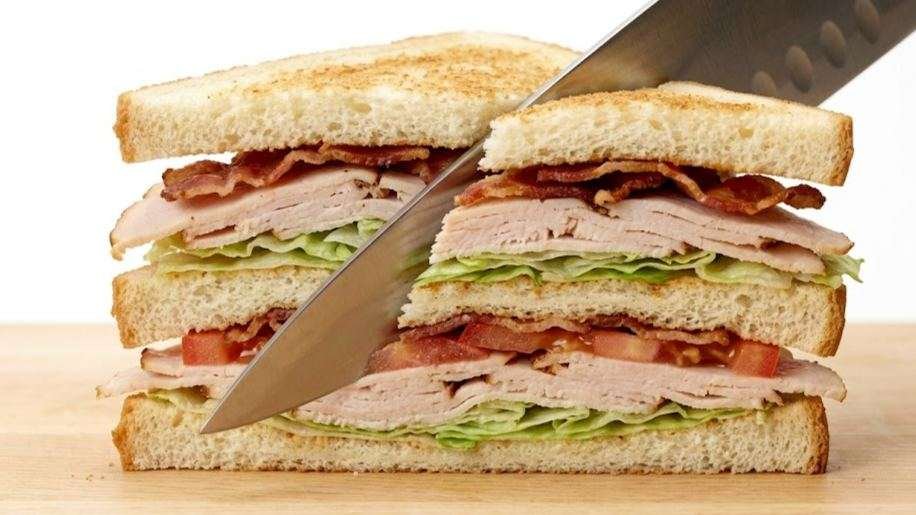
That reference predates Canfield’s Casino by half a decade. If written evidence is the standard, the Union Club on Fifth Avenue in Manhattan has the stronger case. But the Union Club’s version was a two-layer affair, served warm, closer to an open-faced club than the architectural achievement that Long Island diners eventually standardized. The three-layer construction — the middle piece of toast that is either the sandwich’s genius or its ruin, depending on your philosophy — came later, and its provenance is even murkier.
The first club sandwich recipe was published in a book of “salads, sandwiches, and chafing-dish dainties” in 1899, a decade after the Union Club reference. By then, the sandwich had already developed a following at country clubs and men’s clubs across the Northeast, which is how Wallis Simpson — the American woman for whom Edward VIII abdicated the British throne — eventually claimed to have introduced the club sandwich to England.
The Duchess of Windsor’s endorsement is the kind of detail that gets a sandwich canonized.
The Construction Problem: Who Added the Third Slice
The leap from a two-layer gentlemen’s sandwich to the triple-decker served at every diner from Babylon to Bellmore represents a significant engineering decision — and nobody has convincingly identified who made it, or when.
Florence A. Cowles, writing in Seven Hundred Sandwiches in 1929, offered one account: that a man came home late and hungry from his club one night, raided the icebox, and made himself a super sandwich which he dubbed the Club — and then took the recipe to his club, where it spread. This is either a charming origin story or entirely apocryphal, and food historians treat it accordingly.
What the record does show is that by the early 20th century, the three-layer construction had become standard on American hotel menus. The middle slice of toast serves an important structural purpose: it creates two separate flavor chambers, keeps wet ingredients from migrating through the entire sandwich, and gives the toothpick something substantial to anchor against. It is not, in other words, an arbitrary addition. Someone thought it through. We simply cannot prove who.
Henry Petroski, author of The Toothpick: Technology and Culture, notes that the frilled toothpick was probably invented to alert the eater that there was a toothpick holding the sandwich together — plain wooden picks went unnoticed, to the detriment of the unwary diner. So that cellophane frill — red, green, or yellow, spinning gently above your plate at the Heritage Diner on any given Tuesday — has a safety function. It is structural disclosure.
What Long Island Did to the Club Sandwich
Long Island diners did not ruin the club sandwich. They did something arguably more interesting: they preserved it, with perfect fidelity, in a state of mid-20th-century stasis. The club sandwich at a Long Island diner in 2025 is largely indistinguishable from a club sandwich at a Long Island diner in 1975. The iceberg lettuce has not been replaced by arugula. The industrial turkey has not given way to roasted chicken breast. The mayonnaise has not become aioli. The white bread has not become multigrain.
This is either a failure of imagination or an act of cultural conservation, and I genuinely cannot decide which.
The argument for conservation goes like this: the club sandwich is not an artisanal experience. It is a category. What you want from it is legibility — you want to know what you’re getting, in what order, at what temperature. You want the structural security of the fourth toothpick going into the last corner. You want the quarter-diagonal cut. You want the coleslaw in the little paper cup. Any deviation from this template is not an improvement; it is a misreading of the genre.
The argument against goes like this: we know, from basic culinary science, that the turkey in your Long Island diner club sandwich was processed, pressed, and sliced months ago. The tomato was picked underripe and gassed into redness. The iceberg lettuce contributes nothing except water and opacity. The bread, toasted from commercial sliced white, has no real flavor of its own. The mayonnaise is from a five-gallon institutional tub. None of these things are secrets. The question is whether the sum, assembled correctly and with decent speed on a busy Saturday morning, transcends its components.
I would argue that it does, under specific conditions — specifically when you are sitting at a booth, it is after 10 AM, you ordered coffee first, and there is nothing pressing waiting for you outside. Context matters enormously with the club sandwich. It is not a sandwich you eat standing up.
The One That’s Trying
Here on the North Shore, we’ve made our own version of the triple-decker that takes the form seriously — proper turkey layering, the third slice earning its place. If you want to understand what the club sandwich can be when someone actually thinks about it, that’s where to start. The BLT club variation is worth knowing too, because it strips the concept back to what it was always about: the three-slice structure, the acid of tomato against fat, the architecture that one kitchen — whether in Saratoga Springs or on Fifth Avenue — figured out sometime in the 1890s.
The Saratoga Club House is now the Canfield Casino Museum, still standing in Congress Park at 1 East Congress Street, Saratoga Springs. You can visit it. The gambling rooms are gone. The potato chip is everywhere. The club sandwich is on every diner menu on Long Island, assembled the same way in every county, and its origin remains as contested as ever.
James Beard thought the three-decker was a horror. Wallis Simpson carried the original to England. A man may have raided an icebox and started everything. Nobody knows for certain.
What we know is that the cellophane toothpick was invented so you wouldn’t bite into wood. Everything else, you’ll have to order and decide for yourself.
You Might Also Like
- The Forgotten Montauk Surfman’s Chowder: Cooking with Seawater at the 1800s Life-Saving Stations
- How to Build the Perfect Diner Breakfast Platter — Step-by-Step Assembly Guide
- The Classic New York Egg Cream: Chocolate, Seltzer, and Milk Done Right
Sources
- Andrew F. Smith, The Oxford Encyclopedia of Food and Drink in America (Oxford University Press, 2004)
- The Evening World, November 18, 1889 — earliest known written reference to the Union Club sandwich
- Florence A. Cowles, Seven Hundred Sandwiches (1929)
- Isabel Gordon Curtis, Good Housekeeping Everyday Cook Book (1903)
- Henry Petroski, The Toothpick: Technology and Culture (Alfred A. Knopf, 2007)
- James Beard, American Cookery (1972)
- Canfield Casino Museum, Congress Park, Saratoga Springs, NY: saratoga.com
- Wikipedia, “Club Sandwich”: en.wikipedia.org/wiki/Club_sandwich
- Saveur, “Top Picks” — frilled toothpick history: saveur.com