
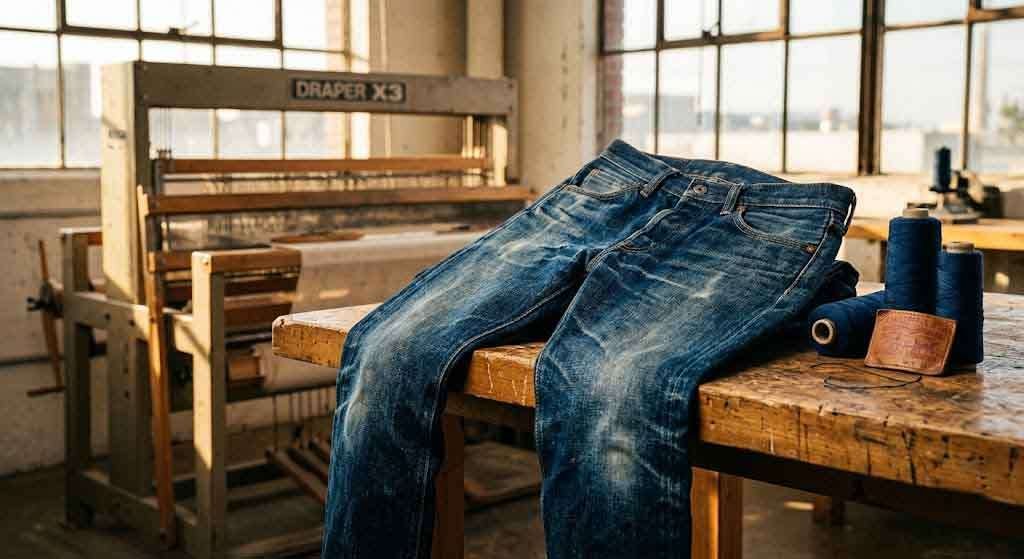
Spend $250 on a pair of jeans and most people look at you like you’ve lost it. Spend $60 at the mall and nobody says a word. That gap isn’t about vanity or brand loyalty. It’s a direct invoice for what American manufacturing actually costs — and what we collectively decided we weren’t willing to pay for.
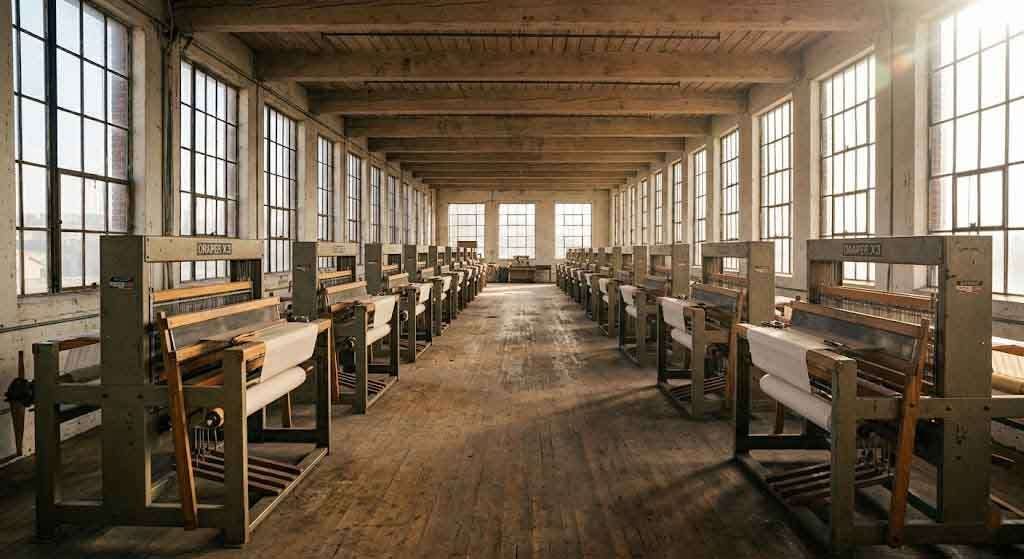
The story behind that number starts in Greensboro, North Carolina. On December 31, 2017, Cone Denim’s White Oak Plant shut its doors after 112 years of continuous operation. It was the last selvedge denim mill in the United States. About 200 workers went home for good. The looms — antique Draper X3 shuttle looms, some dating to the 1940s — went silent. And with them went the last domestic source of the fabric that had clothed American workers, soldiers, and musicians for over a century.
If you want to understand why American-made jeans cost what they do, and why the brands still making them are worth your attention, you need to understand what died that day.
What Selvedge Denim Is and Why It’s Different
Before any of this makes sense, you need to know what you’re actually buying.
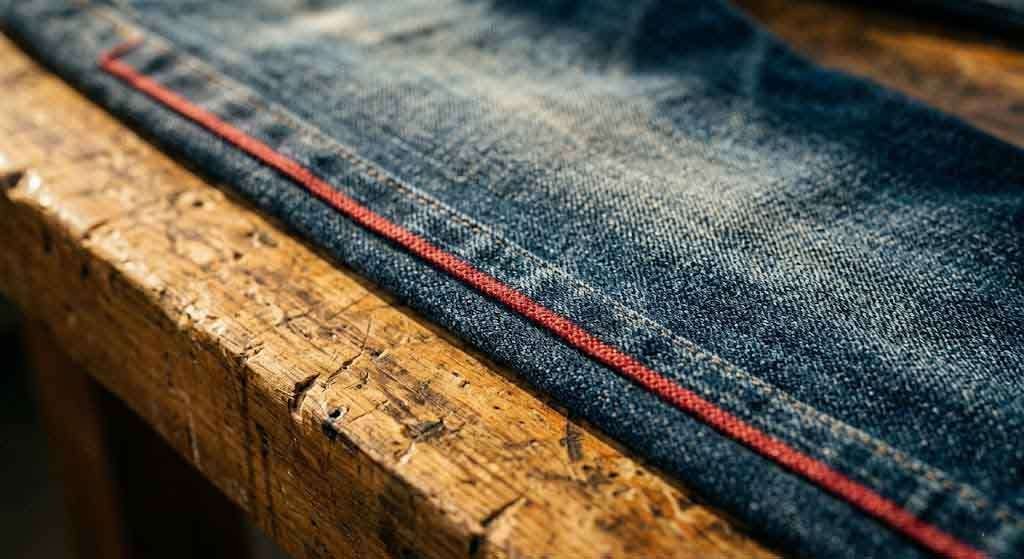
Selvedge denim is woven on a narrow shuttle loom — back and forth across a 28 to 32 inch width. The loom creates a self-finishing edge that doesn’t fray or unravel, which is where the name comes from: self-edge, contracted to selvedge. The fabric is denser and more tightly constructed than what comes off a modern wide projectile loom. It develops a subtle, irregular texture you can feel. More importantly, it ages differently — raw selvedge fades to your specific body, your specific movements, your specific life. The creases, wear points, and honeycombs that develop over a year of wearing a raw pair are yours and nobody else’s.
Mass-market denim is cut from wide-loom fabric produced at scale in Bangladesh, Vietnam, and Cambodia. It’s consistent, it’s interchangeable, and it doesn’t do what selvedge does. It wears out. It fades uniformly or not at all. It has no story.
This isn’t nostalgia talking. The Japanese understood it in the 1970s when American mills started retiring their shuttle looms for faster equipment. Japanese manufacturers quietly bought the old Draper machines, learned to run them, and built a thriving premium denim industry on American heritage. Brands like Oni and Momotaro turned the American working-class uniform into an export luxury. We sold the machinery that made us the best in the world, and Japan sold it back to us as a premium product. The irony writes itself.
White Oak was the last American exception. It ran on Draper looms since 1905, supplied Levi’s with fabric for the Lot 501 jean for 70 years under a deal the industry called “The Golden Handshake,” and kept running long after every comparable facility had closed. When private equity acquired the parent company in 2016, looked at the order volume, and concluded the fixed costs couldn’t be justified, that was it. The mill closed. The selvedge died on American soil.
The Economics That Killed It
The official cause of death was a statement from International Textile Group in October 2017: “Changes in market demand have significantly reduced order volume at the facility as customers have transitioned more of their fabric sourcing outside the U.S.” Which is accurate as far as it goes. What it doesn’t say is that those transitions happened over 30 years, driven by trade deals that made offshore labor structurally cheaper by an order of magnitude.
A skilled garment worker in North Carolina earns between $15 and $20 per hour. In Bangladesh, the equivalent monthly wage runs around $95. Vietnam roughly doubles that. Those aren’t sweatshop wages by local standards — they’re competitive wages in those economies. But when you’re a brand trying to sell jeans for $60, the math only works one way, and it doesn’t work domestically.
Add American-grown cotton, domestic yarn spinning, domestic weaving on vintage looms that require constant mechanical attention, domestic cut-and-sew, and you’re past $100 in production cost before a single dollar of marketing or margin is applied. The $250 price tag on a pair of American-made selvedge jeans isn’t a luxury premium. It’s the actual number. This same structural reality drives the price on domestic leather goods — I’ve covered the full breakdown in why American-made leather goods cost more and why it’s worth it. The math is identical. The only variable is which category you’re shopping.
The Brands Still Making It Work
White Oak’s closure didn’t end American denim. It forced the brands that cared to adapt, to find new supply chains, and in some cases to rebuild sourcing from scratch. Here’s who’s still producing work worth owning.
Raleigh Denim Workshop — Raleigh, North Carolina. Founded in 2007 by Victor and Sarah Lytvinenko in their apartment with three industrial machines and a first order from Barneys New York for 114 pairs. Every pair is hand-cut, sewn, and signed by the craftsperson who made it. The production process takes 20 to 30 times longer than mass-market output. Prices run from $250 to upward of $400. With White Oak gone, Raleigh now sources from Nihon Menpu in Japan — honest about the supply reality in a way most domestic brands aren’t. If you want American-made construction at the highest level of craft, this is the standard everything else gets measured against.
Taylor Stitch — San Francisco, California. Taylor Stitch operates on a crowdfunded production model: you commit to a run before it’s made, which reduces waste and keeps prices lower than most domestic producers. Their American-made selvedge is cut and sewn domestically, and the brand is straightforward about what’s made here and what isn’t. Good entry point for the first serious denim purchase.
Shockoe Atelier — Richmond, Virginia. The most underrated name in American denim. Everything cut and sewn in Virginia, mix of American and Japanese selvedge fabrics, lifetime repair guarantee. That last part changes the math considerably — one repair on a $240 pair of jeans is already cheaper than buying another pair of $60 imports. Prices land between $210 and $275. Refined fits without being fussy about it.
Tellason — San Francisco, California. Tellason was one of White Oak’s most loyal customers and wrote one of the more clear-eyed tributes to the mill when it closed. They still produce domestically, now sourcing fabric from Vidalia Mills in Louisiana — which carries the direct lineage from Cone’s original Draper looms. Prices in the $215–$265 range. Straightforward construction, no performance art about it.
Left Field NYC — Queens, New York. The most locally relevant name on this list. Left Field produces selvedge jeans cut and sewn in the US using Vidalia Mills denim woven in Louisiana on the same Draper X3 looms that ran at White Oak. If you want to trace the physical line from Greensboro to the present, Left Field is where that thread runs. Worth knowing about if you care about where what you wear comes from — the same attention to origin that applies to American-made leather wallets, bags, and belts applies here.
What Happened to the Looms
After White Oak closed, the Draper looms sat under plastic sheets in the empty mill building while the facility waited for a demolition buyer. A developer eventually purchased it. The looms — all 46 of them, along with their tooling, spare parts, and the iconic wooden floor they’d been bolted to for decades — were purchased by Vidalia Mills, a new operation in Vidalia, Louisiana, set up in a former Fruit of the Loom distribution center near the Mississippi River.
Vidalia invested roughly $50 million retrofitting the facility, used 100% certified American cotton traceable to specific farms, and began producing selvedge denim on the original White Oak looms. For a few years it looked like a real continuation.
Then Vidalia shuttered too.
The deadstock from those final production runs is still circulating — brands like Brave Star Selvage are selling finished jeans from what remains. When that inventory clears, there will be no more American-woven selvedge from those looms. The legacy is real but finite.
There are smaller operations working to fill the gap. Tuscarora Mills in North Carolina still produces selvedge on heritage Draper looms with USDA organic cotton, though with long lead times and high minimum orders. Huston Textile Co. in California, started by a veteran in a converted military hangar near Sacramento, is running Draper looms at small scale. The infrastructure exists. The scale doesn’t.
What to Spend and Where to Start
If you’re buying American-made denim for the first time, here’s the honest breakdown by price.
Under $200: Railcar Fine Goods in California produces small-batch American selvedge mostly under $250 through a made-to-order model that keeps costs in check. Good construction, no unnecessary ceremony about it.
$200–$275: Shockoe Atelier and Tellason are the strongest options in this range. Shockoe’s lifetime repair guarantee is a genuine differentiator — factor that in before you compare price tags.
$275 and up: Raleigh Denim if you want the full American atelier experience. Left Field if the Draper loom provenance matters. Either way, you’re buying jeans you’ll wear for a decade, not a season.
One rule applies at every price point: buy raw when you can. Raw denim — stiff, unwashed, straight off the loom — fades to your body over months of wear. The break-in is real but the result is a pair of jeans that looks like it was built specifically for you, because functionally it was. Pre-washed, pre-distressed, factory-faded denim can’t replicate that. The same logic that applies to American work boots — buy once, buy right, let time do the work — applies here completely.
The Cone Mills White Oak Plant is gone. That loss is real and it isn’t recoverable. But the case for American-made denim is intact, and the brands still building it are making something worth owning. The question was never whether you could afford $250 jeans. It was whether you understood what $60 jeans actually cost.
You Might Also Like
- The Best American-Made Leather Wallets, Bags, and Belts at Every Price Point
- 15 American Leather Goods Makers You Should Know About in 2026
- Redwing vs. Timberland vs. Thorogood: The American Work Boot Showdown Nobody’s Done Right
Sources
- Cone Mills White Oak Closure Announcement — Heddels, October 2017
- Who Killed The Cone Mills White Oak Plant? — Heddels, February 2018
- The Legend of Cone Denim’s White Oak Plant — Denimhunters
- How Raleigh Denim Set the Standard for American-Made Jeans — InsideHook
- Raleigh Denim Workshop Interview — The Manual
- American Denim Mounting a Comeback at Vidalia Mills — Sourcing Journal
- Introducing Vidalia Mills: The Return of American Selvedge — Heddels
- ITG Closing Cone’s White Oak Denim Mill — California Apparel News
- A Farewell to Cone Mills White Oak — Levi’s Off the Cuff
- Raleigh Denim Review — Stridewise