Dostoevsky stood in front of a firing squad.
Not metaphorically. Not in a nightmare. In December of 1849, in the Semyonovsky Square in St. Petersburg, Fyodor Mikhailovich Dostoevsky was lined up with a group of other political prisoners, blindfolded, and prepared to be shot. The tsar’s guards had already read the death sentence. The drums had rolled. Three of the men at the front of the line were tied to posts. Then, at the last possible moment, a courier arrived on horseback with a reprieve from Tsar Nicholas I. The execution had been staged. A mock death. A lesson.
They commuted his sentence to four years of hard labor in Siberia, followed by military service in exile.
He was twenty-eight years old.
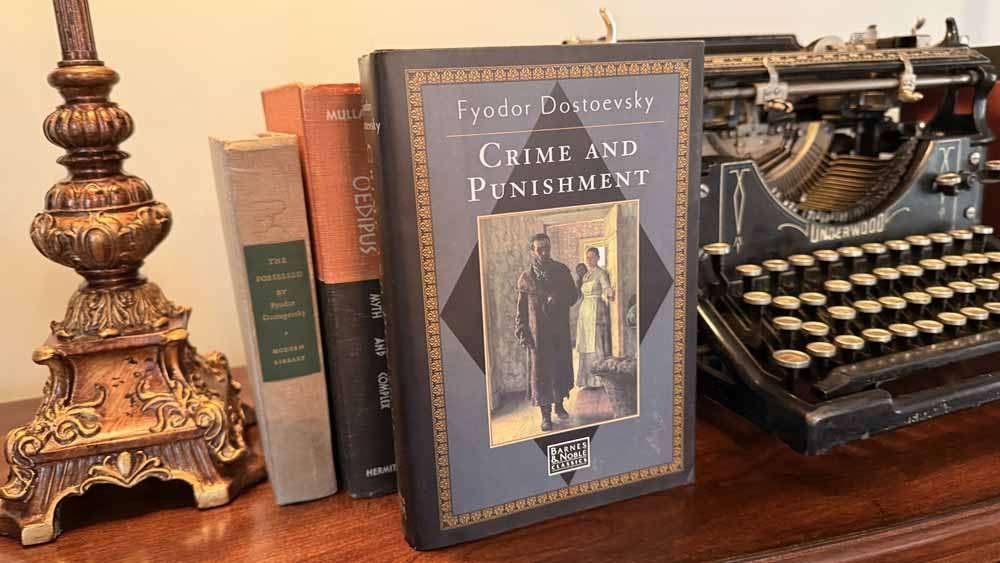
This is the man who wrote Crime and Punishment.
I’ve read a lot of fiction in my life, and I keep coming back to Dostoevsky the way you keep going back to a particular street corner from your past — not because it’s comfortable, but because something real happened there. The novel itself, published in 1866, tells the story of Rodion Raskolnikov, a destitute student in St. Petersburg who murders a pawnbroker and her sister, and then spends the rest of the book being slowly dismantled by his own mind. But the plot is almost secondary. What Dostoevsky is doing beneath the plot is the thing. He is writing about guilt, consciousness, and the gap between what a man believes himself to be and what he actually is.
He knew. That’s the point. He knew things about extremity — about what happens to a man in the dark — that most writers only imagine.
Four Years on a Prison Bunk
The Siberian labor camp at Omsk was called the House of the Dead. Dostoevsky would later write a fictionalized account of it under that title, but Crime and Punishment carries the residue of that place in ways that are harder to name. He slept in a shared barrack with hundreds of convicted murderers, thieves, and political prisoners. There were no separate cells, no privacy, no silence. He wore ankle shackles. He worked in freezing temperatures. He described his time there as being buried alive.
What he observed in that place — the internal moral lives of men who had committed the worst acts imaginable, the strange dignity some of them maintained, the way guilt operated differently in different men — became the engine of his greatest fiction. Raskolnikov is not abstract. He is assembled from observed reality. The shaking hands, the fever, the irrational returns to the scene, the compulsive near-confessions — Dostoevsky had watched real men come apart after real crimes. He knew the symptoms.
He also knew something else. He knew what it felt like to be told you were about to die, and then not to die. That knowledge — of the specific weight of survival when survival was not guaranteed — gives Crime and Punishment its particular texture. Raskolnikov doesn’t just want to get away with murder. He wants to know whether he is the kind of man who can get away with it. Whether he belongs to the category of extraordinary men — Napoleon, Caesar — who operate above ordinary moral law. The question is philosophical, but the obsession behind it is existential. Dostoevsky knew the difference between a man who thinks about death and a man who has looked at it straight.
The Epilepsy, the Gambling, the God
There’s more biography. There’s always more with Dostoevsky.
He suffered from epilepsy his entire adult life. Seizures that could come without warning, often in the night, often violent. He described the aura that preceded them as a moment of transcendent clarity — a feeling of total harmony and understanding — followed by darkness and pain. He threaded this exact experience into The Idiot with the character of Prince Myshkin, and you can feel it operating in Crime and Punishment too, in the way Raskolnikov’s consciousness pulses and distorts, in the fever-logic that makes his thinking feel both crystalline and completely unhinged at the same time.
Then there was the gambling. After his first wife died and after his time in Siberia, Dostoevsky became addicted to roulette. He lost fortunes. He borrowed money from friends and lost that too. He wrote letters begging for advances from publishers, then gambled the advances away before he could use them to pay his debts. He was, for years, in a financial hole he dug wider every time he sat down at a table. He would later write The Gambler in twenty-six days to fulfill a contract and pay off one of the debts — reportedly dictating it to a stenographer he then married.
I think about this sometimes when I read Raskolnikov’s reasoning. The gambler’s logic and the murderer’s logic are not so different in Dostoevsky’s world. Both require the man to believe he has a special relationship with risk. Both require a theory of the self that places him outside normal consequence. Raskolnikov believes he belongs to the category of men who can transgress and remain whole. Dostoevsky — who sat at the roulette wheel and believed, every time, that this spin was different — understood that logic from the inside.
What the Novel Actually Does
Crime and Punishment is about 550 pages in most English translations. It moves fast for a Russian novel. Dostoevsky was writing it in installments for a literary journal — The Russian Messenger — and the installment format kept him from the kind of sprawling digressions that make The Brothers Karamazov a mountain to climb. The structure is tight. The pressure on Raskolnikov barely releases from chapter two onward.
The detective Porfiry Petrovich is one of the great characters in literary history. He never accuses Raskolnikov directly. He circles him, retreats, flatters, provokes. He is not building a legal case — he is watching a man build a confession in his own mind, and he knows if he waits long enough, the man will bring it to him. There is something almost therapeutic about Porfiry. He is interested in Raskolnikov. Not in arresting him — in understanding him. The interrogation scenes are among the most psychologically precise things I have ever read.
Then there is Sonya, the young woman who sells her body to keep her family alive, who reads to Raskolnikov from the Gospel of John — the story of Lazarus, raised from the dead. Dostoevsky was not subtle about his symbolism, but he was sincere about it. The faith he wove into his later novels was not decoration. It was hard-won. A man who stood in front of a firing squad and then spent four years in a Siberian prison did not come to God through a theology seminar. He came through the particular terror of having nothing else left.
I have never been able to read Sonya as sentimental. She is the toughest character in the book. She has given up more than Raskolnikov ever imagined giving up, and she is not broken by it. That is the counter-argument the novel makes against Raskolnikov’s theory — not philosophical refutation, but the simple evidence of a woman still standing.
Why the Biography Matters
There are books you respect and books you believe. Crime and Punishment falls into the second category for me because I cannot separate it from what I know about the man who wrote it.
When I read Thus Spoke Zarathustra by Nietzsche — a book I’ve spent years with — I am reading a man who constructed a philosophy from his own intellect and suffering. Nietzsche was brilliant and he suffered and he went mad, and all of that is in his work. But Dostoevsky did something different. He built his fiction from observed evidence collected in places where almost no one who wrote for literary journals had ever been. The Siberian prison. The gambling dens. The epileptic aura. The mock execution. These aren’t metaphors. They are field research conducted under duress.
This is what I think about when someone tells me that biography doesn’t matter to literature — that the text stands alone and the author’s life is irrelevant. Sometimes that’s true. With Dostoevsky it is absolutely not true. Crime and Punishment does not exist without the man’s life behind it. The pressure in that novel is real pressure. The darkness is real darkness. Raskolnikov’s theory of himself as an extraordinary man who operates above conventional morality — the exact theory Dostoevsky appears to have held about himself when he was young, before Siberia taught him otherwise — is not invented. It is transcribed.
I’ve read No Exit by Sartre and I think Sartre was a smarter philosopher than Dostoevsky in the formal sense. But Dostoevsky understood the human interior in a way Sartre — comfortable, Parisian, celebrated — never could. There is suffering in Dostoevsky that no amount of intelligence can counterfeit.
On Translation
The translation matters. I’d steer anyone toward either the Pevear and Volokhonsky translation (Vintage Classics, 2011) or the Constance Garnett, which has its critics among purists but is readable in a way that serves the novel’s pace. The Pevear-Volokhonsky is denser and more faithful to Dostoevsky’s syntax, which is itself choppy and urgent in the Russian — not the smooth periodic sentences of Turgenev or Tolstoy, but something more pressured, more interrupted. It suits Raskolnikov’s fractured mental state. It suits the man who wrote it in debt, in grief, in installments.
Sixty Years of Writing About What He Knew
Dostoevsky died in 1881 at fifty-nine. He had written The Brothers Karamazov — widely considered one of the greatest novels ever written — in the final years of his life. He had come through the execution, the prison, the exile, the epilepsy, the gambling, the deaths of his first wife and his brother, the deaths of two children. He had written through all of it.
My father was a Greek immigrant who worked in restaurants his whole life. He never talked much about what he had survived to get here, but you could feel the weight of it in ordinary things — in how seriously he took work, in what he would and would not tolerate. There is a kind of knowledge that doesn’t come from reading. Dostoevsky had that kind, and it’s all over Crime and Punishment. You cannot fake it. You cannot learn it in a classroom. You earn it in the places where most people break.
Raskolnikov eventually confesses. He surrenders. Whether that represents Dostoevsky’s genuine belief in redemption through suffering or his strategic nod to the censors who reviewed serialized fiction in imperial Russia has been debated for a hundred and fifty years. I think it was both. I think Dostoevsky was a man complicated enough to believe something and also to know how to package it for a difficult market. He had, after all, survived a great deal by knowing exactly what kind of room he was in.
That is the intelligence behind this novel. Not just the philosophy, not just the psychology — but the hard-won knowledge of a man who had been in every kind of room, and came back to write it down.
Sources
- Dostoevsky, Fyodor. Crime and Punishment. Translated by Richard Pevear and Larissa Volokhonsky. Vintage Classics, 2011. penguinrandomhouse.com
- Frank, Joseph. Dostoevsky: A Writer in His Time. Princeton University Press, 2009. press.princeton.edu
- Kjetsaa, Geir. Fyodor Dostoevsky: A Writer’s Life. Translated by Siri Hustvedt and David McDuff. Fawcett Columbine, 1989.
- Dostoevsky, Fyodor. The House of the Dead. Translated by Constance Garnett. Dover Publications, 2004. doverpublications.com
- Scanlan, James P. Dostoevsky the Thinker. Cornell University Press, 2002. cornellpress.cornell.edu