Samuel Butler published a letter in a New Zealand newspaper on June 13, 1863, under the pseudonym Cellarius. He was twenty-seven, tending sheep on the Canterbury Plain, and already restless enough to turn Darwinian logic against its own century. The letter was titled “Darwin Among the Machines,” and its provocation was direct: machines were evolving, faster than animals, faster than plants, and humanity was building its own successors without realizing it. Butler went on to fold these ideas into his satirical novel Erewhon, where an entire civilization destroys its technology rather than be overtaken by it. Over a hundred years later, George Dyson — a high school dropout who spent three years living in a ninety-five-foot treehouse on Vancouver’s Burrard Inlet — picked up Butler’s thread and wove it into one of the most unusual intellectual histories of the twentieth century.
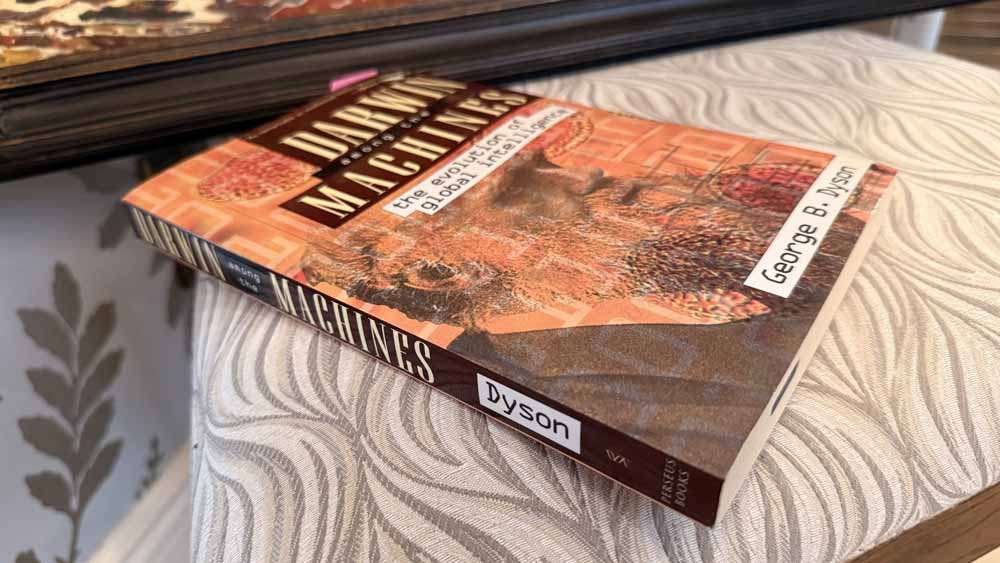
Darwin Among the Machines: The Evolution of Global Intelligence, first published in 1997, is not a straightforward history of computing. It is an argument dressed in the clothing of an intellectual lineage, and the argument is this: all intelligence is collective, technology and biology are not opposites but collaborators, and the global network humanity has built is not merely a tool — it is an evolving organism in the earliest stages of something we do not yet have the language to describe.
The Thread from Hobbes to the Internet
Dyson begins with Thomas Hobbes, whose Leviathan imagined the state itself as an artificial organism — a body composed of citizens the way a body is composed of cells. From there, the book moves through Leibniz, Robert Hooke, Erasmus Darwin, Charles Babbage, George Boole, Alan Turing, John von Neumann, and a host of lesser-known figures whose ideas fed the river of computation before anyone called it that. The history is rich and often surprising. Dyson has a gift for resurrecting forgotten thinkers and showing how their work connected to developments they never lived to see. Alfred Smee, a nineteenth-century surgeon who theorized about electrical models of the nervous system, sits alongside Olaf Stapledon, whose science fiction imagined collective intelligences spanning galaxies. William Ross Ashby’s work on self-organizing systems shares pages with Paul Baran’s distributed network architecture for the RAND Corporation, which became the conceptual blueprint for what we now call the internet.
Philosopher Peter Suber, reviewing the book, described it well: Dyson’s thesis is that all intelligence is collective, emerging from components that are themselves unintelligent, and that a global collective intelligence is now rising from the growing interconnections among human beings and their machines. The history is detailed and engaging. The thesis is provocative but underdeveloped — Dyson marshals enough evidence to make you take it seriously without ever quite giving it the full philosophical treatment it deserves.
The Dropout Who Grew Up at the Institute for Advanced Study
George Dyson’s biography matters here because it mirrors the book’s own method. He is the son of Freeman Dyson, one of the architects of quantum electrodynamics, and mathematician Verena Huber-Dyson. He grew up at the Institute for Advanced Study in Princeton, where the first electronic computers were being built and where Nils Barricelli was conducting the earliest experiments in artificial evolution on von Neumann’s machine. George left high school at sixteen, moved to British Columbia, and spent the next two decades designing Aleut-style kayaks and exploring the Inside Passage by water. He built his treehouse from salvaged materials and lived in it while constructing increasingly sophisticated baidarkas in the workshop below.
This is not the biography of someone who approaches the history of computing from the usual angle. Dyson writes like a craftsman who has spent decades working with physical materials and then turned that same patient attention to intellectual ones. The book moves the way a hand moves across a hide — slowly, with pressure, following the grain of the material rather than imposing a predetermined pattern. Some readers find this maddening. The structure is associative rather than linear, and Dyson’s chapters sometimes feel like tributaries wandering away from the main channel before looping back in unexpected places.
Barricelli and the Birth of Digital Life
The most compelling section of the book centers on Nils Barricelli, a Norwegian-Italian mathematician who arrived at Princeton in 1953 with a Fulbright grant and an idea that was several decades ahead of its time. Barricelli wanted to test whether evolution could occur in a purely digital environment. Using von Neumann’s computer — a machine with roughly five kilobytes of memory — he created populations of numerical organisms that could reproduce, mutate, and compete for survival. He observed speciation, parasitism, and what we now call punctuated equilibrium, all emerging spontaneously from simple rules applied to strings of numbers.
Von Neumann largely ignored Barricelli’s work, which proved almost fatal to its legacy. As Dyson chronicles, Barricelli labored in near-total obscurity for decades. His experiments anticipated the entire field of artificial life by roughly forty years. When the field finally emerged in the late 1980s, almost nobody remembered the man who had gotten there first. Dyson’s recovery of Barricelli’s story is one of the book’s genuine contributions to the history of science — a reminder that ideas, like organisms, sometimes arrive in environments not yet ready to sustain them.
Nature on the Side of the Machines
The book’s central provocation is captured in a line Dyson returns to throughout: nature is on the side of the machines. This is not the dystopian warning it might sound like. Dyson’s argument is subtler and, in some ways, more unsettling. He proposes that the distinction between biological and technological evolution is artificial — that both are expressions of the same underlying process, the tendency of complex systems to generate increasingly sophisticated forms of information processing. Machines do not evolve in opposition to nature. They evolve as nature, through mechanisms that rhyme with biological selection even when they do not replicate it exactly.
This idea draws heavily on the concept of symbiogenesis — the theory, championed by Lynn Margulis, that major evolutionary innovations arise not through gradual mutation but through the merging of previously independent organisms. Mitochondria were once free-living bacteria. Chloroplasts were once cyanobacteria. The eukaryotic cell itself is a collaborative assemblage. Dyson extends this logic to the digital realm: software programs merge, share code, and produce offspring that contain elements of multiple parents. Networks grow not by central design but by the same kind of opportunistic, wasteful, profligate branching that characterizes biological ecosystems. Most connections fail. The ones that survive create structures that could not have been planned.
For anyone who has spent time with Richard Dawkins’ concept of the meme — the idea that cultural information replicates, mutates, and undergoes selection just as genes do — Dyson’s argument will feel like a natural extension. If ideas can evolve, and if machines are the physical substrate through which ideas increasingly propagate, then the evolution of machines is not a metaphor for biological evolution. It is a continuation of it by other means.
What the Book Gets Right and Where It Stumbles
The strengths of Darwin Among the Machines are considerable. Dyson’s recovery of forgotten figures like Barricelli, Alfred Smee, and Julian Bigelow — von Neumann’s chief engineer on the IAS computer project — fills gaps in the standard history of computing that other accounts simply skip. His refusal to separate the history of biology from the history of technology produces insights that a more conventional historian would miss. And his writing, at its best, achieves a layered density that rewards rereading.
The weaknesses are equally real. The book’s associative structure can feel disorienting, and Dyson sometimes relies too heavily on extended quotation from his subjects rather than building his own sustained argument. As Suber noted, philosophers will find the central thesis suggestive but undercooked — Dyson presents enough evidence to make the idea of emergent machine intelligence plausible without ever submitting it to the kind of rigorous examination that would make it fully convincing. Several readers on Goodreads have echoed this frustration, describing the book as brilliant in parts but lacking a coherent through-line.
There is also the question of prediction. Dyson wrote this book in 1997, before Google, before social media, before large language models. Some of his intuitions have aged remarkably well — his sense that the web would evolve into something more like an ecosystem than an encyclopedia, his recognition that distributed networks resist centralized control, his insistence that the most important developments would emerge from the bottom up rather than the top down. Other claims feel more like poetic gestures than testable propositions. The idea that the internet is a sentient being, or is becoming one, remains exactly as unprovable as it was three decades ago.
Why It Still Matters
What makes Darwin Among the Machines worth reading now — especially now — is not its predictions but its framework. Dyson offers a way of thinking about technology that refuses the two dominant narratives of the present moment: the utopian promise of machines that will solve all human problems, and the apocalyptic fear of machines that will destroy us. In Dyson’s view, both narratives make the same mistake. They assume that human beings and machines are separate categories, locked in a zero-sum competition for dominance. The deeper truth, Dyson argues, is that we are already entangled — that the boundary between the biological and the digital was always more porous than we imagined, and that what is emerging from this entanglement is not a rival to human intelligence but a different kind of intelligence, one that includes us as components the way neurons are components of a brain.
This is a book for anyone who has wondered whether Darwin’s tree of life might have branches we haven’t learned to see yet, or whether the extended phenotype — the idea that genes build structures beyond the body — might extend further than even Dawkins imagined. It is imperfect, occasionally frustrating, and genuinely original. George Dyson, the treehouse dweller who taught himself the history of technology the way he taught himself to build kayaks — by studying old designs, working with his hands, and refusing to follow anyone else’s curriculum — produced something that belongs on the same shelf as the thinkers it chronicles.
Darwin Among the Machines: The Evolution of Global Intelligence by George B. Dyson. Perseus Books, 1997. 286 pages.
Sources
- Dyson, George B. Darwin Among the Machines: The Evolution of Global Intelligence. Perseus Books, 1997.
- Suber, Peter. “Review of George Dyson, Darwin Among the Machines.” Earlham College. https://legacy.earlham.edu/~peters/writing/dyson.htm
- Butler, Samuel. “Darwin among the Machines.” The Press, Christchurch, New Zealand, June 13, 1863. Full text via Wikipedia.
- Institute for Advanced Study. “Nils A. Barricelli.” https://www.ias.edu/scholars/nils-barricelli
- Dyson, George. “Darwin Among the Machines; or, the Origins of [Artificial] Life.” Edge.org. https://www.edge.org/conversation/george_dyson-darwin-among-the-machines-or-the-origins-of-artificial-life
- Hackett, Robert. “Meet the Father of Digital Life.” Nautilus, June 12, 2014. https://nautil.us/meet-the-father-of-digital-life-234937
- Cascadia Daily News. “Science History, Kayaks, and the Birth of the Internet: The Many Minds of George Dyson.” February 8, 2025. https://www.cascadiadaily.com/2025/feb/08/science-history-kayaks-and-the-birth-of-the-internet-the-many-minds-of-george-dyson/