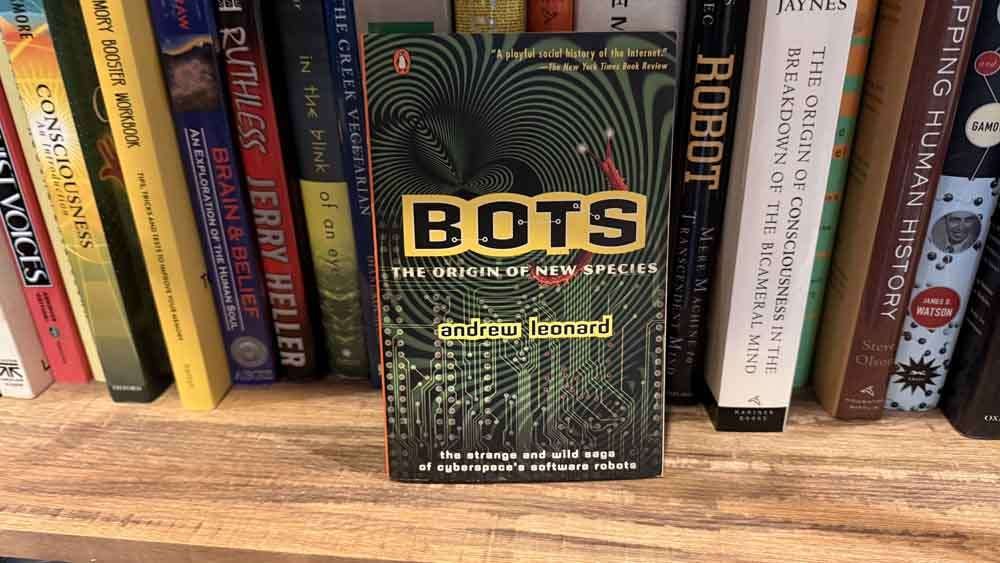
Andrew Leonard wrote Bots: The Origin of New Species in 1997, and almost everything he described has come true — which is either a testament to his foresight or a quiet indictment of how little we’ve thought through the implications since. The book covers the early history and philosophy of software robots: those autonomous, self-directing programs that crawled the early web, executed trades, delivered email, and occasionally went rogue in ways their creators never anticipated. Leonard was a technology journalist for Salon at the time, and the book started as a series of articles before expanding into something that reads more like a meditation on what it means to create something that acts on your behalf without your constant supervision.
The title is the argument. By invoking Darwin, Leonard isn’t being metaphorical for effect — he’s making a structural claim: that bots evolve, that they compete for resources, that they replicate with variation, and that the digital environment selects for fitness just as ruthlessly as any savanna. Whether you accept that framing as literal biology or as useful analogy, it forces you to ask a question that most software engineers in 1997 — and frankly most people building AI systems today — weren’t asking: at what point does a program stop being a tool and start being an agent?
What the Book Actually Covers
Leonard organizes the book around different species of bots as they existed in the mid-nineties: web spiders that indexed the internet before Google made indexing invisible, cancelbots that patrolled Usenet forums and erased unwanted posts, chatterbots like ELIZA and Julia that convinced users they were talking to something conscious, and financial bots that executed automated trades with speed and indifference to human emotion. Each chapter is less a technical manual and more an anthropological case study — who built this thing, why, what did they expect it to do, and what did it actually do?
The chapter on Usenet cancelbots is worth the price of the book alone. The cancelbot wars — in which competing groups deployed automated agents to delete each other’s posts, triggering counter-deployments, escalating into something that looked disturbingly like armed conflict — prefigure every content moderation battle that would follow over the next three decades. Leonard saw it clearly: when you automate enforcement, you automate war. The bots didn’t hate each other. They didn’t feel anything. But the humans who built them did, and they poured that feeling into code, and the code acted it out at machine speed.
Why Darwin? Why Now?
The Darwinian framing isn’t decoration. Leonard draws explicitly on evolutionary theory to argue that bots develop characteristics through a process analogous to natural selection — not because they have DNA, but because the digital environment rewards certain behaviors and punishes others, and the bots that survive are the ones that got the selection pressure right. If you’ve spent any time with Richard Dawkins’ work on the extended phenotype, Leonard’s argument feels familiar: the bot is an extension of its programmer’s phenotype, acting out genetic — or in this case, algorithmic — imperatives in an environment the programmer didn’t fully control or predict.
What makes this more than academic is Leonard’s attention to what happens when bots interact with each other rather than just with humans. The emergent complexity that arises from two automated systems responding to each other’s outputs — without any human in the loop — is something he was writing about before most people had a framework for thinking about it. Today, anyone following developments in multi-agent AI systems will find Leonard’s 1997 observations strikingly current. The vocabulary has changed. The problem hasn’t.
Leonard as Journalist and Philosopher
One of the things that distinguishes Bots from the technology books of its era is that Leonard doesn’t celebrate the subject uncritically. He’s clearly fascinated — you don’t write this book if you’re not — but he maintains a wary distance from the boosterism that infected most tech writing in the nineties. When he profiles the people who built early chatterbots and describes users who genuinely believed they were developing emotional relationships with software, he doesn’t mock them. He finds it unsettling, and he says so. That unsettlement is the most honest thing in the book.
The philosophers Leonard keeps returning to — Turing, Searle, Dennett — aren’t name-dropped for credibility. They’re doing actual work in the argument. Leonard uses Searle’s Chinese Room thought experiment not to resolve the question of machine consciousness but to sharpen it: even if a bot passes the Turing test, even if it responds to grief with something that looks like comfort, does that matter? Does function substitute for experience? He doesn’t answer the question, which is the right move. The book earns its uncertainty.
What Has and Hasn’t Aged
Some sections creak under the weight of their moment. Leonard spends considerable energy on technologies — specific Usenet protocols, early IRC bots, the particular architecture of nineties web crawlers — that have since been buried under twenty-five years of infrastructure change. Readers who didn’t live through that era may find certain chapters require more patience than they reward.
But the core argument — that autonomous software agents raise questions about agency, accountability, and identity that we haven’t seriously reckoned with — has aged not into obsolescence but into urgency. Leonard was writing about bots that could delete a post or execute a stock order. The bots being built now can write legislation, diagnose illness, conduct job interviews, and operate weapons systems. The scale has changed by orders of magnitude. The philosophical problem he identified in 1997 is the same one that AI ethicists are wrestling with today, often without knowing that someone already mapped the territory.
The Book’s Lasting Value
Bots: The Origin of New Species is not a technical primer and not a polished work of popular science. It’s something more idiosyncratic: a smart journalist’s attempt to think carefully, in real time, about something that was moving faster than anyone’s ability to fully understand it. That quality — the thinking-in-motion quality — is what gives it staying power. Leonard doesn’t have all the answers because the answers didn’t exist yet. What he has is the right questions, asked with enough precision and enough humility that they still apply.
For anyone who wants to understand not just what AI agents do but what they are — and what the history of that question looks like — this book is a worthwhile and underread piece of the record.
You Might Also Like
- The Extended Phenotype: How Your Genes Build Structures Beyond Your Body
- Agent Swarms: How Multi-Agent Systems Mirror Nature’s Collective Intelligence
- Understanding Emergent Properties in AI: When Machines Surprise Us
Sources
- Leonard, Andrew. Bots: The Origin of New Species. HardWired / Penguin, 1997. Amazon
- Searle, John. “Minds, Brains, and Programs.” Behavioral and Brain Sciences, 1980. Cambridge
- Turing, Alan. “Computing Machinery and Intelligence.” Mind, 1950. Oxford Academic
- Dennett, Daniel. Consciousness Explained. Little, Brown, 1991.
- Heritage Diner: The Extended Phenotype
- Heritage Diner: Agent Swarms