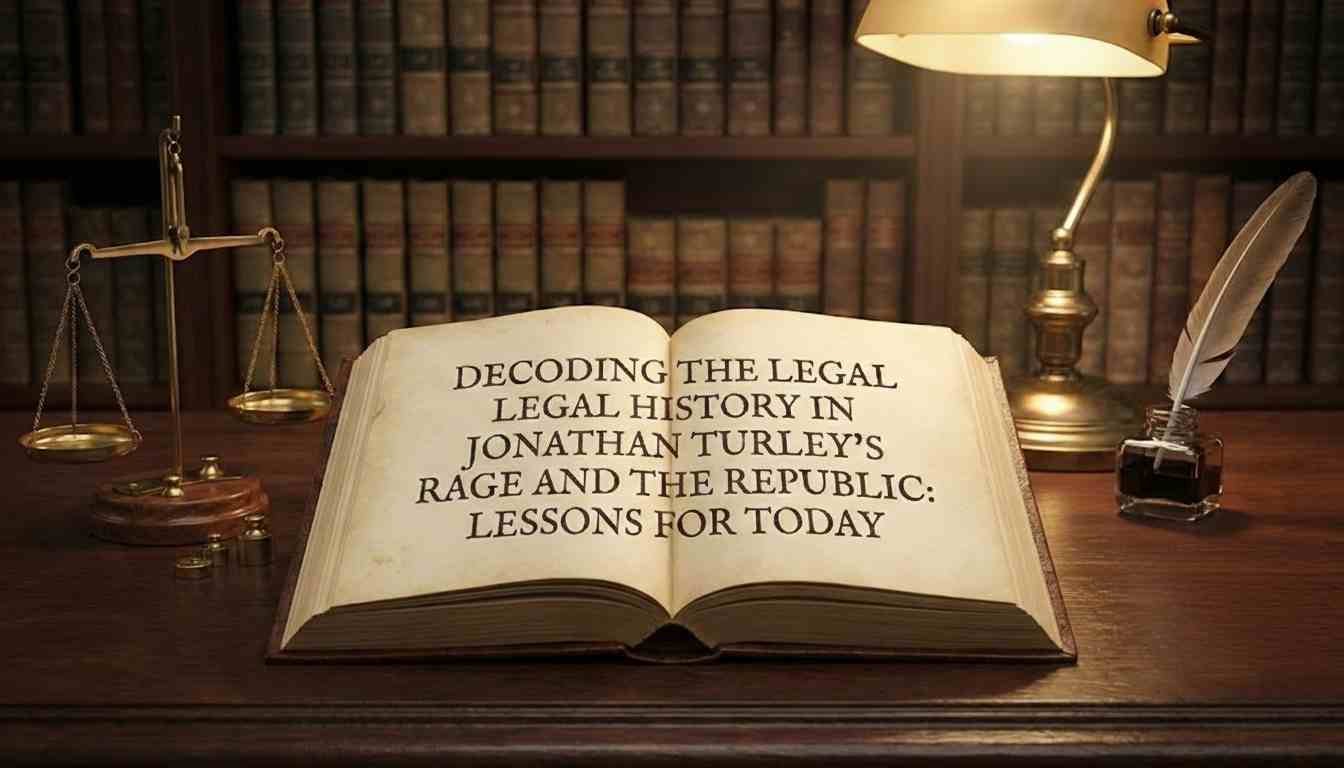
Revolutions, Turley reminds us, are not singular events. They are living organisms — feeding, mutating, and consuming the very ideals that animated them. Published February 3, 2026, timed to coincide with the 250th anniversary of the Declaration of Independence, Rage and the Republic: The Unfinished Story of the American Revolution arrives as an Instant New York Times bestseller and an urgent cultural document — one written not merely as historical retrospective but as a warning etched in constitutional law.
Jonathan Turley, who holds the Shapiro Chair for Public Interest Law at George Washington University and has testified before Congress over one hundred times — including during both the Clinton and Trump impeachments — brings to this work the rarest of combinations: litigator’s precision and historian’s sweep. The result is a book that forces its reader to hold two Americas simultaneously in mind: the one forged in 1776 and the one straining, grinding, and fracturing before our eyes today.
The Saturn Principle: Why Revolutions Devour Their Children
At the heart of Rage and the Republic lies a myth Turley uses as structural metaphor throughout the book: the legend of Kronos — Saturn in the Roman tradition — the Titan who, driven by prophecy and ambition, devoured each of his children to prevent being overthrown. The journalist Jacques Mallet du Pan watched the French Revolution consume its architects and summarized it in a phrase that echoes through Turley’s chapters: “Like Saturn, the Revolution devours its children.”
This is not rhetorical flourish. It is constitutional law as anthropology. Turley traces how the ambition that fuels revolution — its capacity to weaponize righteous anger and collective grievance — follows a predictable and devastating sequence: activism becomes extremism, extremism becomes authoritarianism, and authoritarianism consumes the very freedoms that ignited the movement in the first place.
What Turley calls “the Saturn gene” is not a pathology unique to foreign regimes or distant centuries. He witnessed it personally. While working on this book in his George Washington University law school office in May 2024, a mob formed outside chanting “Guillotine! Guillotine! Guillotine!” — not on the Place de la Concorde in Paris but on the university quad. Students had organized a mock trial of the university president and administration. Turley was literally reading about the French Reign of Terror when the French Reign of Terror, in spirit, found him.
This is the book’s opening moral: the constitutional system the Framers designed was built not for easy seasons but for the hard ones. Its architecture anticipates rage.
Thomas Paine vs. James Madison: Two Visions of Liberty That Still Compete
Turley structures much of his historical argument around the philosophical rivalry between Thomas Paine and James Madison — two men who shared a revolution but not a vision of what should follow it.
Paine was the magnificent disruptor. Born English, working class, practically self-educated, he arrived in the colonies in 1774 and wrote Common Sense, transforming colonial grievance into popular revolution almost overnight. His prose was fire. His politics were pure democratic passion: the people should rule, government should bend to the popular will, and any institution standing in the way of direct democracy was suspect.
Madison was his constitutional counterweight. The Kirkus Reviews assessment of Rage and the Republic captures the distinction sharply — where the Declaration of Independence authored by Jefferson was concerned with tyrants and autocrats, the Constitution as engineered by Madison was more fundamentally about the tyranny of the majority. Madison understood that democracies didn’t only collapse under kings; they could collapse under crowds.
The tension between these two men is not historical trivia. It is the foundational argument still being litigated in American politics and courts today. Every debate over judicial deference, majority rule, free speech limits, and constitutional interpretation echoes back to the unresolved tension between Paine’s democratic populism and Madison’s republican restraint.
Turley’s legal instincts lead him to Madison’s side — not because democracy is dangerous but because unstructured democracy historically has been. The American exception, he argues, was precisely that the Revolution produced not just a declaration of rights but a mechanism to protect those rights from the passions of any given political moment.
The French Revolution as Legal Cautionary Tale
Turley draws the American-French comparison with the care of a constitutional scholar rather than the broad strokes of a political pundit. Both revolutions erupted within years of each other, animated by similar Enlightenment principles — liberty, equality, self-determination. One produced the world’s oldest and most stable democracy. The other produced the Reign of Terror, the guillotine, and eventually Napoleon.
Why?
The answer Turley constructs over multiple chapters is architectural. The American Framers, scarred by the experience of mob rule in early state legislatures, designed systems of deliberate friction into governance: an independent judiciary, a bicameral legislature, separation of powers, a bill of rights protecting individual liberties against majoritarian impulse. They distrusted consolidated power regardless of who held it — king or crowd.
The French Revolution, brilliant in its rhetoric and catastrophic in its implementation, lacked those friction mechanisms. When the passions of the people became the supreme law, those who once led the revolution became its defendants. Robespierre, who engineered the Terror, went to the guillotine himself. George Will, reviewing the book, captured the essential paradox Turley isolates: “democratic despotism” is not an oxymoron. Majorities can tyrannize minorities. Popular revolutions can produce authoritarian nightmares.
For Turley the litigator, this history is not abstract. Every time a court is pressured to defer to popular opinion rather than constitutional principle, the French shadow lengthens.
The Constitution as Living Restraint, Not Living Permission Slip
One of Rage and the Republic‘s most pointed legal arguments addresses the current academic and political movement to reinterpret — or abandon — constitutional constraints in the name of modern necessity.
Turley notes that some law professors have begun openly calling for scrapping the Constitution as an outdated artifact of an 18th-century landed aristocracy. Progressive constitutional scholars argue for a “living” interpretation so elastic it dissolves the document’s structural restraints entirely. And from the other direction, there are those who invoke constitutional authority selectively — honoring its protections when convenient and dismissing them when inconvenient.
What both approaches share, in Turley’s analysis, is the Saturn gene: the belief that righteous ends justify constitutional shortcuts. History, he argues, provides no support for that belief. The Constitution’s genius was never ideological purity — it was procedural durability. It was built to outlast the specific passions of any generation, including the generations of the Founders themselves.
Adam Smith, whom Turley brings into the conversation as a third intellectual presence alongside Paine and Madison, saw government controls and subsidies not merely as economic inefficiency but as potential suppression of human will. Economic liberty and political liberty, in this framework, are inseparable. When governments use economic dependency as a mechanism of political control — and Turley suggests we are seeing new variants of this pattern in our own era — the constitutional guardrails matter more, not less.
From Redcoats to Robots: The AI Disruption and Democratic Stability
Rage and the Republic earns its contemporary relevance in its final section, where Turley turns from the 18th century to the near future. The nation now confronts transformative forces that dwarf the industrial revolution in speed and scope: artificial intelligence, robotics, and the automation of vast swaths of human labor.
Turley does not soften the analysis. He observes directly that there is little economic reason for a restaurant to employ workers for routine tasks when robotics can perform them without healthcare costs, wage disputes, or scheduling conflicts. This is not a comfortable observation — it is an honest one from a legal scholar who understands that economic displacement historically precedes political instability.
The historical pattern is documented: when large populations lose economic relevance faster than political systems can adapt, the conditions for revolutionary rage multiply. The dispossessed do not file amicus briefs. They fuel movements. And when those movements are channeled by demagogues who promise constitutional shortcuts in exchange for popular support, the Madisonian architecture faces its most severe stress tests.
Turley’s counter-argument is not technological pessimism or Luddite nostalgia. It is constitutional faith — a reasoned bet that the system James Madison engineered is robust enough to survive the robot revolution the same way it survived industrialization, the Civil War, the Great Depression, and the upheavals of the 1960s. But survival is not automatic. It requires civic literacy, institutional respect, and a population willing to invest in the friction mechanisms that slow majorities down long enough for rights to breathe.
As someone who has spent years watching artificial intelligence transform creative fields and operational workflows — and who has incorporated these tools deliberately into business practice while insisting that the human hand, the human judgment, and the human touch remain irreplaceable at the core of any craft worth doing — Turley’s argument resonates beyond the courtroom. The challenge of AI is not technological. It is philosophical. It is the question of what we refuse to automate and why.
The Legal Legacy: What Practicing Lawyers and Citizens Should Take Away
For readers who are practicing attorneys, law students, or engaged citizens trying to navigate the current constitutional climate, Rage and the Republic offers several durable legal and civic lessons.
First: constitutional restraint is most valuable when it is most inconvenient. Turley has built his career on arguing this point — defending speech he finds repugnant, procedural protections for people he does not admire, institutional integrity for courts and processes he believes transcend individual verdicts. The lesson of the French Revolution is that abandoning those restraints “just this once” in service of righteous ends is precisely how republics unravel.
Second: the judiciary’s independence is not a political luxury. Turley, who has testified at both Clinton and Trump impeachments and was lead counsel in the last judicial impeachment in American history, understands that judicial independence is the keystone of the entire constitutional arch. When courts become instruments of whatever political majority happens to control the appointment process, they cease to function as courts and begin to function as enforcement mechanisms. History does not grade this trajectory kindly.
Third: civic literacy is a constitutional duty, not a civic nicety. Turley’s note — “our greatest danger is not forgetting the history detailed in this book, but forgetting who we were in that history” — is a charge to every citizen. Democracies do not fail only through coups. They fail through forgetting: forgetting why the friction mechanisms exist, forgetting what they were built to prevent, and forgetting that the people who built them had just watched alternatives fail catastrophically in real time.
Rage and the Republic is an Instant New York Times bestseller published by Simon & Schuster (ISBN: 9781668205020). It is available at Amazon, Barnes & Noble, and wherever books are sold. Jonathan Turley continues to write and publish at jonathanturley.org.