
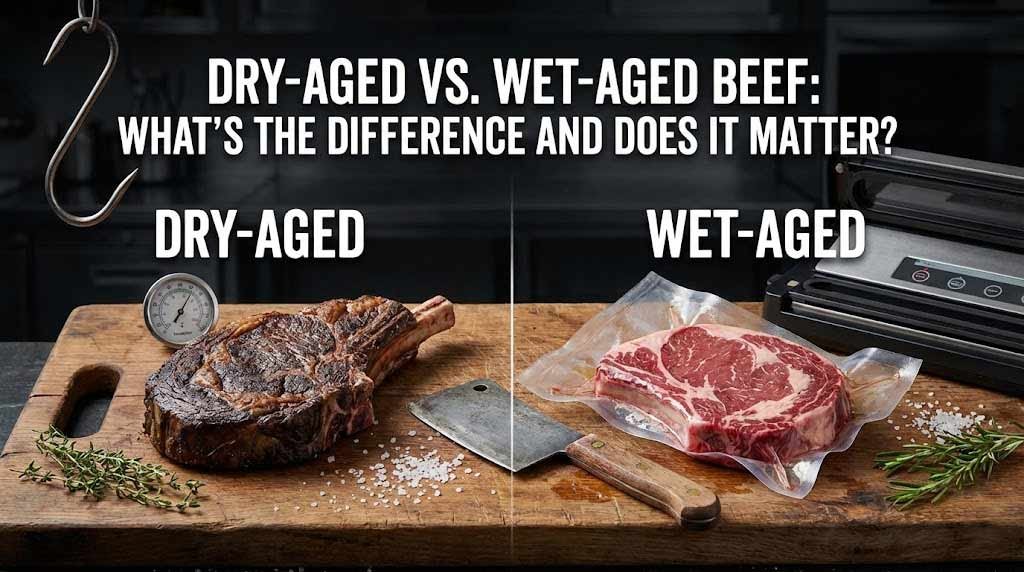
Walk into any high-end steakhouse in Manhattan, and you’ll likely spot the words “dry-aged” on the menu—often accompanied by a price tag that makes you do a double take. Drive a few blocks to your neighborhood supermarket, and virtually every steak in the case has been “wet-aged,” though the packaging rarely advertises it. Both methods promise tenderness and flavor, but they achieve those goals through fundamentally different science. Understanding the difference isn’t just a matter of foodie trivia—it can save you money, sharpen your palate, and help you make smarter decisions at the butcher counter or at a restaurant.
The debate between dry-aged and wet-aged beef is one of the most enduring conversations in the culinary world, touching on biochemistry, economics, food safety, and pure sensory pleasure. Dry aging dates back centuries—long before refrigeration, hanging meat in cool, ventilated spaces was simply how people preserved and tenderized beef. Wet aging, by contrast, is a product of modern industrial innovation, made possible by the invention of vacuum-sealed packaging in the mid-twentieth century. Today, the USDA estimates that over 90 percent of commercial beef sold in the United States is wet-aged, while dry-aged beef remains the province of specialty butchers, upscale steakhouses, and a growing community of home enthusiasts. But which method actually produces the better steak? The answer, as we’ll discover, is far more nuanced than a simple ranking. If you’re exploring homes on Long Island and imagining hosting your first backyard cookout, knowing your aged beef is a practical skill worth developing.
From Cave Walls to Cryovac Bags: A Brief History of Aging Beef
The practice of aging meat predates written history. Before the invention of refrigeration, cultures across the globe discovered that hanging freshly slaughtered animals in cool, dry environments—caves, cellars, root cellars—not only preserved the meat but made it remarkably more tender and flavorful. Medieval European butchers routinely hung whole carcasses of beef for weeks in cool stone buildings, a tradition that persisted for centuries. In the American meatpacking era of the late 1800s, whole sides of beef traveled in ice-cooled railcars from Chicago stockyards to East Coast cities, inadvertently dry aging during the multi-day journey. By the early twentieth century, dedicated aging rooms were standard fixtures in upscale butcher shops across the country.
Everything changed in the 1960s. The Cryovac Division of W.R. Grace and Company had been experimenting with vacuum-sealed packaging technology since the 1940s, and by the 1960s they introduced barrier bags capable of keeping oxygen away from meat for weeks at a time. This innovation coincided with the rise of Iowa Beef Processors (IBP), founded in Denison, Iowa in 1960, which pioneered the “boxed beef” revolution. Instead of shipping whole hanging carcasses, packers now broke carcasses into sub-primal cuts, vacuum-sealed them, and shipped them in boxes. Robert Peterson, IBP’s former chairman, later told Livestock Weekly that “the company that really made boxed beef possible was Cryovac.” By the 1980s, well over 90 percent of commercial beef in America was vacuum-packaged, and the industry term “wet aging” was born.
According to the European Food Safety Authority (EFSA), vacuum packaging was developed in the 1960s, and since then most meats—including beef, pork, and lamb—are wet-aged in vacuum packs because the method requires less time, incurs less weight loss, has lower investment costs, and the resultant product requires less trimming. Dry aging didn’t disappear entirely; it retreated to high-end steakhouses and a handful of old-school butcher shops that refused to abandon the craft. In recent decades, however, dry aging has experienced a renaissance, driven by consumer demand for artisanal food experiences and a deeper appreciation for the complex flavors that only time and open air can produce.
The Science Behind the Steak: How Aging Actually Works
Whether you’re aging beef in open air or inside a vacuum bag, the underlying biological process is essentially the same: endogenous enzymatic proteolysis—the breakdown of proteins by the meat’s own enzymes. Once an animal is slaughtered and oxygen stops flowing to the muscles, a cascade of biochemical changes begins. The most important actors are a family of calcium-dependent enzymes called calpains, particularly ““‘-calpain” (also known as calpain-1), which researchers at the USDA Meat Animal Research Center identified as the primary driver of post-mortem tenderization. These enzymes attack the structural proteins that hold muscle fibers in place—titin, nebulin, desmin, and others—weakening the architecture of the muscle and making the meat progressively more tender.
A comprehensive review published in Food Science of Animal Resources by researchers including Ertbjerg (2022) confirmed that tenderization occurs through the synergistic action of multiple endogenous proteolytic systems. ‘-Calpain dominates the initial 48 hours after slaughter, degrading the costameres and cytoskeletal structures that anchor muscle fibers. Over the following days and weeks, other enzyme systems—including cathepsins B and L (released as cell pH drops below 6) and the proteasome complex—continue the work of breaking down structural proteins. Additionally, these enzymes produce taste-related peptides, free amino acids like glutamate (responsible for umami flavor), and nucleotides that collectively deepen and enrich the beef’s flavor profile.
Here’s where the two methods diverge. In wet aging, the enzymatic processes happen inside an anaerobic (oxygen-free) environment. The vacuum seal prevents moisture loss, so the meat retains its original weight. The enzymes tenderize the beef effectively, but the flavor development is more limited—the meat tends to taste clean, fresh, and mildly metallic, without the dramatic concentration that comes from moisture loss. In dry aging, the same enzymatic tenderization occurs, but two additional transformations are happening simultaneously. First, moisture evaporates from the exposed surfaces of the meat, concentrating the remaining flavors into a smaller mass. Second, the aerobic environment allows beneficial molds and bacteria to colonize the surface of the beef, producing unique volatile compounds—nutty, buttery, blue-cheese-like aromas—that penetrate into the meat and create the signature dry-aged flavor profile.
A fascinating 2020 review published in Meat Science introduced what researchers call the “dry-aged beef paradox”—the observation that dry aging sometimes produces no measurable improvement over wet aging. The authors concluded that a specific microflora is needed to achieve the distinct flavor differences between the two methods. In other words, it’s not just the absence of packaging that makes dry aging special—it’s the unique microbial ecosystem that develops on the meat’s surface in each individual aging environment. Two different dry-aging rooms can produce meaningfully different results, even using the same cut of beef, the same temperature, and the same duration.
Dry Aging Unpacked: Process, Conditions, and What Happens Inside the Aging Room
Traditional dry aging involves hanging whole carcasses or large primal cuts—bone-in ribeye sections, strip loins, or short loins—in a climate-controlled room maintained between 32‘F and 39‘F (0‘C to 4‘C), with relative humidity typically between 75 and 85 percent, and gentle airflow circulating continuously around the meat. The bone and fat cap serve as natural protective barriers, insulating the lean interior from excessive drying. According to a comprehensive review in the Journal of Animal Science and Technology, most purveyors age beef for at least 21 days, with many programs extending to 28, 35, 45, or even 60 days and beyond depending on the desired flavor intensity.
The timeline of dry aging is a progressive transformation. During the first 7 days, the meat remains fairly bright in color but begins losing surface moisture. By day 21, the steak has lost roughly 10 percent of its original weight through evaporation, with water seeping primarily from the front and back surfaces while the fat and bone sides act as waterproof barriers. At day 30—the most popular duration for commercial dry aging—the steak has developed the characteristic flavor and texture: deeply tender, with notes often described as buttered popcorn, rare roast beef, and nuttiness. Weight loss reaches approximately 15 percent. By day 50, the loss climbs to around 23 percent, and by day 120, a steak may have shed 35 percent of its original weight, developing an intensely funky flavor that appeals to adventurous palates.
The exterior of the meat develops a hard, dark crust—called a pellicle—that must be trimmed away before cooking, further reducing the usable yield. Research from South Dakota State University found that during a 21-day dry-aging trial, beef carcass sides lost between 16 and 23 pounds each, with the greatest weight change occurring in the first three days. The study noted that from day 4 onward, carcasses lost approximately 0.1 percent of their initial weight per day. Oklahoma State University Extension reports that a typical carcass can lose 5—7 percent of total weight from aging alone—translating to 30—40 pounds on a 600-pound carcass. Combined with trim losses of 3—24 percent (depending on duration and conditions), the economics of dry aging become clear: you’re paying a premium for less physical product but dramatically more flavor per ounce.
Wet Aging Explained: The Quiet Revolution in Your Grocery Store
If you’ve ever purchased a steak from a supermarket, you’ve almost certainly eaten wet-aged beef—even if the label never mentioned it. The moment a sub-primal cut is vacuum-sealed at the packing plant, the clock starts on wet aging. The beef then travels from the processor to the distribution center to the retail store, often spending 14 to 21 days in transit and storage. During this time, the same calpain and cathepsin enzymes that drive dry aging are at work inside the sealed bag, breaking down muscle fibers and improving tenderness. The meat essentially marinates in its own purge—the protein-rich liquid that accumulates inside the bag.
The conditions for wet aging are straightforward: the vacuum-sealed meat is kept at refrigeration temperatures, typically between 32‘F and 39‘F (0‘C to 4‘C). Because the bag creates an anaerobic environment, the dominant microbial population shifts from aerobic spoilage bacteria (like Pseudomonas, which dominate during dry aging) to lactic acid bacteria and other facultative anaerobes. This microbial environment contributes to the characteristic flavor of wet-aged beef, which most consumers describe as fresh, clean, mildly metallic, and straightforwardly beefy. Some tasters note a slight sweetness or a faint sour tang, particularly in beef that has been wet-aged for longer periods.
The major advantage of wet aging is economic efficiency. Because no moisture evaporates and no exterior crust needs to be trimmed, wet-aged beef retains virtually all of its original weight. This means less product loss for the packer, lower costs for the retailer, and a lower price for the consumer. The process also requires no specialized facilities beyond standard refrigeration—no humidity-controlled aging rooms, no dedicated airflow systems, no daily monitoring. A PAC Machinery analysis notes that wet aging allows beef to be easily handled, stacked, and boxed while aging, and provides processors with increased flexibility to store and age meat for a more consistent product. For restaurants and food service operations, wet aging also offers practical advantages: consistent portion sizes, predictable costs, and minimal waste.
The typical wet-aging period ranges from 14 to 28 days for standard retail beef, though some specialty programs extend to 42 days or longer. Chicago Steak Company notes that beef cattle raised on natural grains without antibiotics may require six weeks or more to properly tenderize, as the animals tend to be older at processing. The Nebraska Beef Council, working with the University of Nebraska, conducted blind taste tests in which consumers evaluated both wet-aged and dry-aged steaks and found that participants prioritized tenderness over marbling or fat content—a finding that suggests wet aging’s consistent tenderizing ability is one of its greatest strengths.
The Taste Test: Flavor, Texture, and What the Research Actually Shows
The flavor difference between dry-aged and wet-aged beef is real, measurable, and—depending on the study you read—either dramatic or surprisingly subtle. A landmark study published in the Journal of Animal Science by Sitz, Calkins, and colleagues at the University of Nebraska evaluated consumer preferences across 273 panelists in Denver and Chicago. Their findings were nuanced: for USDA Choice steaks, no statistically significant differences in flavor, juiciness, tenderness, or overall acceptability were detected between wet-aged and dry-aged samples. However, roughly 29 percent of consumers who preferred the dry-aged Choice steaks were willing to pay nearly $2 more per pound for that preference. For USDA Prime steaks, wet-aged samples actually scored higher for flavor, tenderness, and overall acceptability, with consumers valuing them at $4.02 per pound compared to $3.58 for dry-aged Prime.
These results might seem to favor wet aging, but context matters. The study used a 30-day commercial dry-aging program followed by 7 days of vacuum aging during shipping, and the authors noted that many American consumers are simply more familiar with the taste of wet-aged beef. A separate Danish consumer study with 171 participants reached a different conclusion: consumers preferred both traditionally dry-aged beef and bag-dry-aged beef over vacuum-aged (wet-aged) samples. When participants were told which aging method had been used, the preference for dry aging grew stronger—suggesting that both intrinsic flavor differences and the cachet of the “dry-aged” label influence consumer perception.
Research from Korea published in the Journal of Animal Science and Technology found that trained sensory panels scored dry-aged beef significantly higher for tenderness, flavor, and overall acceptability across multiple cuts (sirloin, butt, and rump) when compared to both wet-aged and non-aged controls. Interestingly, the study found that dry aging produced similar overall acceptability scores across different beef cuts, while wet aging produced more variable results depending on the cut. This suggests that dry aging may be particularly effective at elevating less popular, less expensive cuts of beef—a finding with significant implications for both home cooks on a budget and restaurants looking to maximize the value of every carcass.
A 2022 study published in Q Open (Oxford Academic) surveyed 1,275 U.S. residents on their perceptions of aged beef and found that most Americans are not knowledgeable about beef aging, yet hold generally positive views of the practice. When given additional information about aging methods, consumers’ willingness to pay for dry-aged beef increased—highlighting the role that education plays in shaping demand. The study also confirmed that USDA Prime continues to command the highest premium regardless of aging method, followed by Choice and Select.
The Price of Patience: Economics, Yield, and Why Dry-Aged Steaks Cost More
The price premium on dry-aged beef is not arbitrary—it’s a direct reflection of the process’s inherent costs. Consider the math: a butcher purchases a whole bone-in strip loin at, say, $13 per pound. After 30 days of dry aging, that loin has lost approximately 15 percent of its weight to evaporation. The dried exterior pellicle must be trimmed away, accounting for additional loss. Research cited in the Journal of Animal Science and Technology puts total shrinkage at 6—15 percent and trim loss at 3—24 percent, depending on conditions and duration. A ThermoWorks analysis notes that weight loss can reach up to 39 percent of the original loin weight for longer aging periods. Meanwhile, that same butcher has been paying for refrigerated storage space, electricity for climate control, and the opportunity cost of inventory sitting unsold for a month or more.
The retail impact is substantial. Where fresh, wet-aged Prime steaks might sell for $18—25 per pound, comparable dry-aged steaks commonly fetch $40—60 or more per pound at specialty butchers, and can exceed $100 per pound at elite steakhouses for extended aging programs. According to a Pro Smoker ROI analysis, fresh steaks at $13 per pound can command $46 per pound after dry aging—more than tripling in price—even after accounting for the roughly 12 percent weight loss. This margin makes dry aging an attractive proposition for butcher shops willing to invest in the equipment and absorb the initial risk, but it also explains why the vast majority of beef at your local grocery store has been wet-aged.
Wet aging, by comparison, is almost frictionless. The beef ages inside the same vacuum packaging used for shipping and storage, requiring no additional equipment, no specialized facilities, and virtually no weight loss. The process is faster—most wet-aged beef reaches acceptable tenderness within 14—21 days—and produces consistent, predictable results. For large-scale operations processing millions of pounds of beef annually, these advantages are decisive. As the Sterling Pacific Meat Company puts it, dry-aged beef is generally 20—50 percent more expensive than wet-aged beef, reflecting the combination of lower yield, higher storage costs, and the premium that scarcity creates.
Choosing Your Side: A Practical Guide for Home Cooks and Steak Lovers
So which method should you choose? The answer depends on your palate, your occasion, and your budget. Here are some practical guidelines drawn from the research and expert consensus:
Choose dry-aged beef when you want a bold, complex flavor experience—particularly those nutty, earthy, blue-cheese-adjacent notes that can’t be replicated any other way. Dry-aged steaks are best served simply: salt, pepper, high heat, and minimal adornment. Rich, well-marbled cuts like ribeye and bone-in strip perform best because the intramuscular fat protects the interior during the long aging process. Think of dry-aged steak as you would a fine wine or artisan cheese—the pleasure is in the depth and complexity, and adding heavy sauces or marinades defeats the purpose.
Choose wet-aged beef when you prefer a fresher, more traditional beefy flavor, or when the steak is destined for bolder preparations—marinades, compound butters, chimichurri, or rubs that will complement rather than compete with the meat’s taste. Wet-aged steaks also tend to be juicier out of the package (though dry-aged proponents argue their steaks stimulate more salivation and palate-coating as you chew). Leaner cuts like filet mignon, flat iron, and boneless strip perform beautifully with wet aging. And if budget is a primary concern, wet-aged beef delivers excellent tenderness at a fraction of the cost.
For home aging enthusiasts: Dry aging at home is entirely feasible with a dedicated mini-fridge, a small fan for air circulation, and a thermometer/hygrometer to monitor conditions. Keep temperatures between 34‘F and 38‘F (1‘C—3‘C) and humidity around 80 percent. Start with a large, bone-in, well-marbled primal cut—a whole bone-in ribeye roast is ideal—and plan for at least 28 days. The UMAI Dry Bag system offers a middle path: a breathable membrane that allows moisture to escape while protecting against contamination, producing results similar to traditional dry aging with less trim loss.
One important note about food safety: both dry-aged and wet-aged beef are safe when properly handled. The controlled environment of a dry-aging room—low temperature, managed humidity, consistent airflow—prevents the growth of harmful pathogens. The crust that forms on the exterior creates a natural protective barrier, similar to the rind on aged cheese. The EFSA concluded that dry-aged and wet-aged beef, when produced according to established practices, present a similar or lower load of relevant microbiological hazards compared to standard fresh meat preparation.
The dry-aged versus wet-aged debate ultimately isn’t about declaring a winner—it’s about understanding two fundamentally different approaches to the same ancient goal of making beef more delicious. Dry aging is the slow, costly, artisanal path that produces concentrated, complex flavors through a marriage of enzymes, evaporation, and microbiology. Wet aging is the efficient, democratic method that delivers reliable tenderness and fresh beefy flavor to millions of tables every day. Both methods rely on the same foundational science—the calpain system, cathepsin activity, and the gradual unraveling of muscle architecture—but diverge in the environmental conditions that shape the final eating experience.
What the research consistently shows is that preferences are personal. Some consumers are willing to pay a significant premium for the distinctive depth of dry-aged beef; others genuinely prefer the brighter, cleaner taste of wet-aged. The 2006 University of Nebraska study found that markets exist for both, and that passionate advocates on each side are willing to put their money where their taste buds are. As the American beef industry continues to produce historically high percentages of Prime and upper-Choice cattle, the quality of both aged products improves in tandem. Whether you’re ordering a 45-day dry-aged tomahawk at your favorite steakhouse or grilling a wet-aged Choice strip at your new Long Island home, you’re benefiting from decades of meat science, centuries of culinary tradition, and an aging process that transforms raw muscle into something genuinely extraordinary.
For more on beef quality and what to look for when shopping, explore our other blog posts on meat grading and local dining. And if you’re searching for the perfect home to build your own dry-aging setup (or just a backyard big enough for a serious grill), browse available Long Island properties here.
Sources & Further Reading
• Journal of Animal Science and Technology: Dry Aging of Beef; Review (Khan et al., 2016)
• Meat Science: The Dry Aged Beef Paradox (Terjung et al., 2020)
• Food Science of Animal Resources: Endogenous Proteolytic Systems and Meat Tenderness (2021)
• European Food Safety Authority: Microbiological Safety of Aged Meat (2023)
• Q Open / Oxford Academic: Valuation of Dry and Wet Aged Beef by U.S. Consumers (2022)
• J. Anim Sci Technol: Aging Mechanism for Improving Tenderness and Taste (2023)
• USDA ARS: Meat Tenderness and the Calpain Proteolytic System (Morgan et al., 1993)
• South Dakota State Extension: How Much Weight Do Beef Carcasses Lose While Aging? (2024)
• Oklahoma State University Extension: Custom Beef Processing Expected Yields (2024)
• Sealed Air / Cryovac: History Timeline
• Supermarket Perimeter / MEAT+POULTRY: Meat and Poultry Technology Breakthroughs (2021)
• PAC Machinery: Vacuum Packaging Beef
Video Resources
Guga Foods: Dry-Aged vs. Regular Steak Experiments — Brazilian-born YouTube creator Gustavo “Guga” Tosta (3.4+ million subscribers) has become one of the internet’s most prolific dry-aging experimenters, testing everything from 35-day standard dry ages to year-long experiments and creative aging media like peanut butter, honey, and Nutella. His accessible, entertaining approach has introduced millions of viewers to the science and art of aging beef. Watch: https://www.youtube.com/watch?v=1o7GTADAo1g — A helpful introduction to the home dry-aging process, showing step-by-step how beef transforms over weeks of controlled aging.