By Peter from The Heritage Diner | heritagediner.com/blog
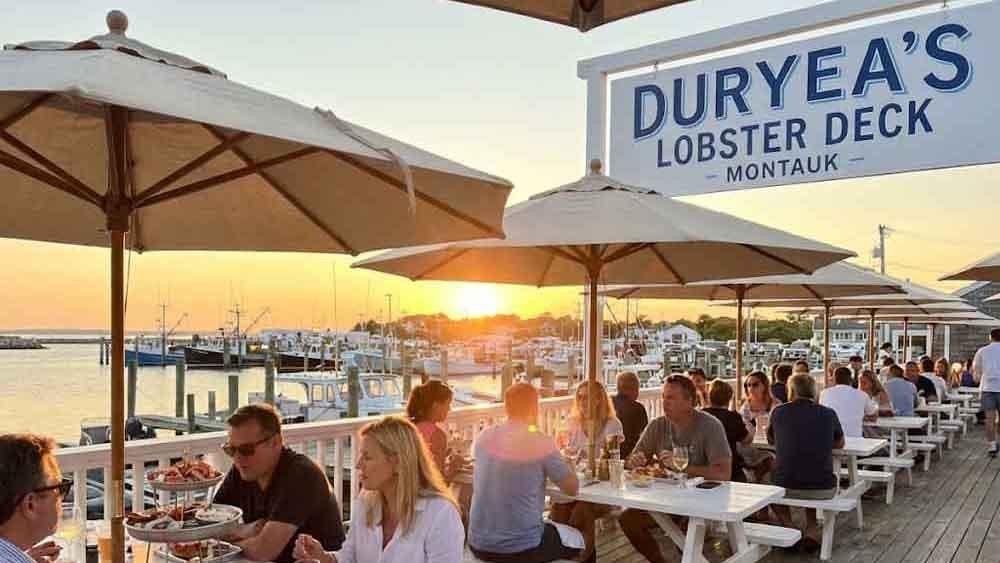
Rounding the bend on Tuthill Road, your windshield fills with Fort Pond Bay before you even see the restaurant. The brine hits first — carried on a wind that has blown uninterrupted across that water since Captain Edwin Baker Tuthill built an ice house and fishing shack on this very shore in 1888. Then comes the glint of anchored yachts, the low hum of laughter across a wooden deck, and the unmistakable signal that you have arrived at one of the last remaining coordinates of the original Montauk fishing village — a place where, for nearly a century, three generations of one family turned a modest fish business into a seafood empire, a political dynasty, and one of the most coveted dining experiences on the Eastern Seaboard. Duryea’s is not merely a restaurant. It is a living artifact of Long Island’s coastal identity, a place where the ghost of the BYOB lobster shack still haunts the bones of what has become a Mediterranean-inflected destination for billionaires and surfers alike.
The Duryea Dynasty: From Fish Shack to Seafood Empire
The origin story of Duryea’s predates the name itself. In the 1880s, Fort Pond Bay was the beating heart of Montauk’s fishing village — a scrappy enclave of Nova Scotian and Scandinavian fishermen who had followed the menhaden boats south and settled along the bay’s eastern shore (New York Heritage Digital Collections, 2024). Captain E.B. Tuthill ran a general store that sold everything from rope and gasoline to ice and seafood, shipping his catches to Manhattan via the Long Island Rail Road.
In the late 1920s, Perry Belmont Duryea Sr. bought into Tuthill’s operation and began reshaping it into something far more ambitious. By the early 1930s, the business had rebranded as Perry B. Duryea & Son, pivoting toward seafood distribution and ice manufacturing. Duryea Sr. was no ordinary fish merchant — he served as East Hampton Town Supervisor and later as a New York State Senator, embedding the family into the political bedrock of eastern Long Island (Social Life Magazine, 2025).
Then came the catastrophe that, paradoxically, cemented the Duryea legacy forever. The Great Hurricane of 1938 struck without warning on a September afternoon, sending Fort Pond Bay surging into the fishing village with winds exceeding 100 miles per hour. Twenty-six houses, fourteen boats, the post office, the school — all destroyed. The fishing village was obliterated. But one structure survived virtually intact: the Duryea ice house. A photograph from the era shows Perry Duryea Sr. standing amid the wreckage with Robert Moses himself, surveying the devastation (Montauk Library Archives, 2024). The Duryea buildings became the sole surviving remnants of the original village — a distinction they hold to this day.
When Perry Duryea Jr. returned from World War II naval aviation service around 1948, he seized on a brilliant supply-chain innovation: establishing connections with lobster dealers in Maine and Nova Scotia, importing lobsters to Montauk, warehousing them at the family facility, and distributing them to supermarkets, restaurants, and fish markets across the metropolitan area (New York Heritage Digital Collections, 2024). A regional fish business became a wholesale powerhouse.
But Duryea Jr.’s ambitions extended beyond commerce. Elected to the New York State Assembly in 1960, he rose to become Speaker from 1969 to 1973 — the last Republican to hold that position in New York history. He ran for Governor in 1978 against Hugh Carey, losing the race but cementing the family’s legendary status across Long Island. A former Navy pilot who co-founded the Montauk Airport in the 1950s, he flew his private plane to Albany when the legislature was in session. Today, both a state office building in Hauppauge and the Montauk post office bear his name (East Hampton Star, 2024).
The Last Lobster Shack: Paper Plates, BYOB, and Priceless Sunsets
For generations of Long Islanders, Duryea’s was something elemental — not a dining experience so much as a ritual. Perry “Chip” Duryea III grew up on Fort Pond Bay, learned to surf the outer bars of Ditch Plains alone in the 1960s as one of Montauk’s original wave riders, and eventually took over the family business. Under his stewardship, the restaurant operated with the beautiful simplicity of a place that didn’t need to try. You packed a cooler of beer after a day at Hither Hills, drove down Tuthill Road, ordered at the window, and waited for someone to call your name. The food arrived on paper plates with plastic utensils. You carried your own trays back to a picnic table overlooking the bay.
And there, cracking lobster shells with your hands as the sun dropped behind the dock and Fort Pond Bay turned amber and pink, you understood something about Montauk that no luxury renovation could ever fully replicate. Chip Duryea also served as a director of the Montauk Chamber of Commerce and Fighting Chance, a cancer research center in Sag Harbor — the kind of civic involvement that defined the Duryea name across three generations (Whalebone Magazine, 2016).
By 2014, Chip was ready to step away. He sold the property to Marc Rowan, co-founder of Apollo Global Management, for a reported $6.3 million (Social Life Magazine, 2025). The transaction represented more than real estate — it marked the conclusion of an 85-year family tradition and the beginning of an entirely different chapter for one of Montauk’s most storied addresses.
The Rowan Reinvention: French Riviera Meets Fort Pond Bay
Marc Rowan did not set out to become a restaurateur. As he told Fortune, the move into hospitality started because he likes to build things. Nevertheless, the Apollo CEO — whose net worth exceeds $3 billion — has transformed Duryea’s into something its founders could never have imagined. The renovation, which began around 2016, sparked years of legal battles with East Hampton Town over zoning, restaurant use, and dock expansion before a settlement was reached (East Hampton Star, 2019). But the aesthetic results are undeniable.
The weathered picnic tables gave way to elegant wooden seating beneath overhead shade sails. The BYOB policy disappeared, replaced by an extensive wine list that includes bottles of Dom Pérignon. The dock now accommodates yachts up to 150 feet, and during peak summer, roughly half the clientele arrives by boat (Social Life Magazine, 2025). Managed by Rowan’s Alchemy Hospitality group — which also operates Duryea’s Orient Point and Lulu Kitchen & Bar in Sag Harbor — the restaurant evokes the French Riviera more than the working waterfront.
Yet in a stroke of deliberate nostalgia, the ordering system has not changed. You still fill out a clipboard menu at your table, walk it to the cashier window, and pay — tip included — before eating. This holdover from the paper-plate era strikes some visitors as incongruous with entrees that push well past the $50 mark, but regulars understand: the tradition is the architecture. It is the one thread that connects the billionaire rosé crowd of 2026 to the BYOB lobster families of 1985. Anyone who has run a restaurant for a quarter century, as I have at The Heritage Diner in Mount Sinai, knows that the rituals customers perform inside your four walls matter as much as the food you put on their plates. The clipboard at Duryea’s is not an anachronism — it is a load-bearing wall.
The celebrity magnetism followed naturally. Beyoncé and Jay-Z, Jennifer Lopez, Gwyneth Paltrow, and a rotating cast of hedge fund managers have made the Lobster Deck their summer canteen (Social Life Magazine, 2025). On a Wednesday evening in late August, every table on the deck is spoken for — families, couples, groups of friends, all backlit by one of the most dramatic sunset views on Long Island.
The Menu: Cult Status, One Cobb Salad at a Time
Duryea’s menu under the current kitchen leadership reads like a love letter to the Mediterranean filtered through Montauk’s salt air. Michelin-award-winning chef Melissa O’Donnell has overseen the culinary direction, with corporate executive chef Philippe Corbet shaping the menu across all three Alchemy properties (Southforker, 2024).
The crown jewel — the dish that has achieved genuine cult following — is the Lobster Cobb Salad. Priced at approximately $95 and designed to share among three or four people, it arrives in a rustic wooden bowl: baby gem lettuces tossed in a creamy tarragon buttermilk dressing, topped with a generous mound of chilled lobster salad made from freshly steamed claw, knuckle, and tail meat. Surrounding the lobster are diced avocado, crispy bacon, halved cherry tomatoes, chopped hard-boiled eggs, and — in a deliberate departure from Cobb convention — shards of sharp cheddar rather than blue cheese crumbles. The substitution is inspired: the cheddar provides salt and cream without competing with the lobster’s natural sweetness (Dan’s Papers, 2024). Copycat recipes have proliferated across food blogs, which is perhaps the highest compliment any single dish can receive.
Beyond the Cobb, the menu anchors itself in raw bar excellence: Montauk Pearl oysters, Peeko oysters from New Suffolk on the North Fork, Peconic Gold, Canadian Beausoleil, Little Neck clams, jumbo shrimp, snow crab claws, and king crab — all available individually or assembled into dramatic seafood tower platters that serve up to four. The whole grilled octopus over crushed potatoes with kalamata olives and Romesco sauce is a signature. The Clam Bake — piled with mussels, clams, shrimp, calamari, red potatoes, corn on the cob, and a split lobster in a light buttery broth — is enormous and earned (Montauk Sun, 2024). For the landlocked contingent, a cheeseburger, skirt steak, and chicken fingers hold their ground without apology.
The wine list leans heavily into rosé — as any self-respecting Montauk waterfront restaurant should in summer — with selections from Provence and beyond, available in both standard and large format bottles. Beer options include local selections from Montauk Brewing Company. The 2025 season introduced new additions including a tomato, cucumber, and stracciatella salad, along with Duryea’s steam pot featuring lobster, king crab, snow crab claws, head-on shrimp, and top neck clams (Northforker, 2025).
Sunset Cottages: The $2,000-a-Night Extension of the Empire
In 2025, Duryea’s expanded beyond dining with the debut of the Sunset Cottages — four minimalist bungalows perched on a bluff above Fort Pond Bay, designed by Viola Rouhani of Stelle Lomont Rouhani Architects alongside co-owner Carolyn Rowan. Each cottage spans roughly 650 square feet with cedar shingle cladding that weathers to the region’s signature silvery patina, teak decks, sliding glass walls that dissolve the boundary between interior and landscape, private hot tubs, fire pits, and outdoor showers (Wallpaper*, 2025).
Rates hover around $2,000 per night, positioning the cottages as a discreet alternative to the increasingly regulated private rental market in the Hamptons. Amenities include Frette Italian sheets, a KLUFT Collection mattress with your choice of firmness, 55-inch smart TV, Sonos audio system, Natura Bissé bath products, Nespresso machine, complimentary electric bikes, paddleboards, yoga mats, and Moke shuttle service (New York Post, 2025). Breakfast hampers arrive at your door each morning courtesy of the Duryea’s Market. Lobster rolls can be delivered mid-afternoon. And cottage guests receive priority seating at the Lobster Deck — a significant advantage when the restaurant operates walk-in only throughout high season.
For anyone thinking about how hospitality and real estate increasingly converge — and as someone preparing to launch a boutique real estate venture with my wife Paola in 2026 — the Sunset Cottages represent a compelling case study. They demonstrate that in a saturated luxury market, the most powerful amenity is not a thread count or a hot tub. It is proximity to an experience that cannot be replicated elsewhere. The cottages sell access to Duryea’s itself — to the sunset, the lobster, the dock, the particular quality of light on Fort Pond Bay at 7:30 p.m. in August.
A Legacy Measured in Tides
Chip Duryea, now 75 and working as a seasonal ranger at the Montauk Downs State Park Golf Course, has not returned to the property since the sale. He recalls winter nights with 40-mile-per-hour northwest winds, scraping ice off the dock — the kind of labor that no amount of rosé-soaked nostalgia can romanticize away. As he observed to the New York Post, an influx of capital arrived about a decade ago with the intention of transforming long-standing Montauk enterprises, and he acknowledges that change was inevitable.
What Duryea’s represents today — and what it has always represented, through hurricanes and recessions and the slow transformation of Montauk from fishing hamlet to summer colony — is the tension between preservation and reinvention that defines every legacy business on Long Island. The BYOB lobster shack and the $795 bottle of Dom Pérignon coexist in the same building, on the same shore, haunted by the same salt wind. Sixty-five percent of Montauk is protected open space, and as Chip Duryea himself has noted, the beaches, the fishing, and the land will always be there. The question has never been whether the place endures. The question is what form it takes — and who gets to sit at the table.
That question, asked with enough sincerity and enough understanding of what it costs to keep the lights on for a quarter century, is the question that keeps every restaurateur in the game.
Restaurant Details:
Address: 65 Tuthill Road, Montauk, NY 11954
Phone: (631) 668-2410
Email: montauk@duryeas.com
Website: duryeas.com
Instagram: @duryeasmontauk (48K+ followers)
Season: Opens annually in late May, closes end of September
2025 Season Hours: Monday–Friday 12:00 PM – 10:00 PM | Saturday & Sunday 11:00 AM – 10:00 PM
Duryea’s Market: Open daily 8:00 AM – 8:00 PM (coffee, breakfast, grab-and-go lunch, artisanal products)
Duryea’s Boutique: Open during restaurant hours (summer essentials, home décor, custom Duryea’s merchandise)
Reservations: Walk-in only for the Lobster Deck; expect significant waits during peak weekends
Ordering System: Clipboard menu filled out at your table, brought to the cashier window; pay (including tip) before your food is served
Takeout: Available via the Duryea’s App (download for seamless pickup ordering)
Parking: Street parking and lot available
Accessibility: Wheelchair accessible
Price Range: $$$ (expect $100+ per person for a full dining experience)
Google Rating: 4.0 / 5.0 (500+ reviews)
Sunset Cottages: Four luxury cottages at approximately $2,000/night (seasonal, May–October). Book at duryeas.com or email sunsetcottagesmtk@duryeas.com | Phone: (631) 668-2500
Sister Locations: Duryea’s Orient Point (40200 Main Road, Orient, NY) | Lulu Kitchen & Bar (Sag Harbor)
Peter from The Heritage Diner writes about food, craftsmanship, and the culture of Long Island from Mount Sinai, New York. The Heritage Diner has served the community at 275 Route 25A since 2000. Peter holds graduate degrees in Philosophy from Long Island University and The New School in New York City. For bespoke English bridle leather goods, visit marcellinony.com. For apps and projects, visit x9m8.com.