
What a cow eats determines what you consume — down to the molecular level. That equation, elegant in its simplicity, sits at the heart of one of the most compelling nutritional arguments of the last two decades: that the fatty acid profile of dairy products is not fixed, not universal, and not incidental. It is a direct consequence of how, and on what, a dairy cow spends her life.
The question of grass-fed versus conventional dairy has moved well beyond the realm of boutique preference. A growing body of peer-reviewed research, spanning institutions from Johns Hopkins to the University of Minnesota to Newcastle University in England, has confirmed what regenerative farmers have long suspected: the balance between omega-6 and omega-3 fatty acids in dairy is transformed dramatically when cows graze on living pasture rather than grain-based feed. Understanding why that ratio matters — and what it means for your body — requires going back to the biochemistry.
The Fatty Acid Imbalance at the Core of the Western Diet
The human body evolved on a diet in which omega-6 and omega-3 fatty acids were consumed in roughly equal measure — a ratio approaching 1:1. Both are polyunsaturated fatty acids (PUFAs), both are classified as essential because the body cannot synthesize them independently, and both compete for the same enzymatic pathways in the body’s metabolic machinery. The difference is what each produces downstream: omega-6 fatty acids, particularly arachidonic acid, drive pro-inflammatory responses, while omega-3 fatty acids — especially EPA (eicosapentaenoic acid) and DHA (docosahexaenoic acid) — are anti-inflammatory.
The divergence from that ancestral ratio has been dramatic. Anthropological and epidemiological studies published in journals including Biomedicine & Pharmacotherapy (Simopoulos, 2008) and PMC (Innes & Calder, 2021) establish that the contemporary Western diet now delivers an omega-6 to omega-3 ratio of approximately 15:1 to 20:1. Some American dietary profiles run even higher. The primary culprit is the wholesale industrialization of the food supply — the displacement of traditional fats and whole foods by refined seed oils (soybean, corn, sunflower, canola) and grain-heavy animal feed, both of which flood the diet with linoleic acid, the primary dietary omega-6.
This lopsided ratio matters profoundly. Research published in PubMed (Simopoulos, 2002) found that a ratio of 4:1 was associated with a 70% reduction in total cardiovascular mortality in secondary prevention settings. A 2:1 to 3:1 ratio suppressed inflammatory markers in patients with rheumatoid arthritis. A ratio of 5:1 benefited asthma patients; a ratio of 10:1 produced adverse consequences in the same population. The science is nuanced — optimal ratios appear to vary by condition — but the directional conclusion is consistent: lower is better, and the historical equilibrium of approximately 1:1 is the biological baseline our bodies were built to maintain.
What Happens in the Rumen: Why Grass Changes Everything
The connection between pasture and fatty acid content is not abstract. It is biochemical, traceable, and measurable.
When a dairy cow grazes on living grass and legumes, she ingests alpha-linolenic acid (ALA), the plant-based omega-3 precursor. The rumen — the cow’s first stomach compartment, where microorganisms digest forage — converts dietary polyunsaturated fatty acids through a process called biohydrogenation. During this process, intermediaries including conjugated linoleic acid (CLA) and various omega-3 fatty acids are produced. These fatty acids are then absorbed into the bloodstream and deposited in the cow’s milk fat.
Grain disrupts this process. When a cow is fed primarily corn or soy silage, the rumen pH drops, altering the microbial environment and suppressing the bacteria responsible for producing CLA and omega-3 intermediaries. Linoleic acid — the omega-6 precursor abundant in grain — dominates instead. The result is milk with a skewed fatty acid profile that mirrors the grain-heavy diet: elevated omega-6, diminished omega-3, and reduced CLA.
The distinction is stark, and it has been quantified extensively.
The Research: Grassmilk, Organic, and Conventional — A Three-Way Comparison
The most comprehensive study to date on this subject was published in the Journal of Food Science and Nutrition by an international research team including scientists from the University of Minnesota, Johns Hopkins, Newcastle University, Southern Cross University in Australia, and Aarhus University Hospital in Denmark. Analyzing over 1,100 raw milk samples collected over three years from U.S. farms, the researchers established a clear hierarchy:
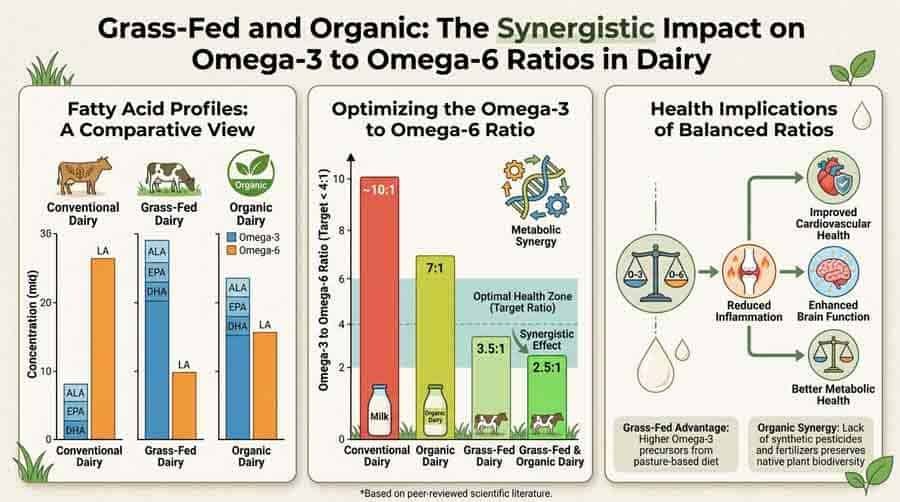
The omega-6 to omega-3 ratio in 100% grass-fed (“grassmilk”) dairy was 0.95:1 — essentially a perfect 1:1 balance. Certified organic milk delivered a ratio of 2.28:1. Conventional milk came in at 5.77:1. (Benbrook et al., Food Science and Nutrition, 2018; source)
The total omega-3 concentration followed the same gradient: grassmilk at 0.049 g/100g of milk; organic at 0.032 g/100g; conventional at 0.020 g/100g — representing a 147% increase in omega-3 content in grassmilk over conventional. Grassmilk also contained 52% less omega-6 than conventional milk and 36% less than organic.
On CLA: grassmilk averaged 0.043 g/100g versus 0.023 g/100g in organic and 0.019 g/100g in conventional — more than double the CLA concentration of standard dairy. (University of Minnesota Extension; source)
According to dietary modeling conducted as part of the same research, three daily servings of grassmilk would supply up to 58% of total daily omega-3 intake, making it the single most significant source of omega-3 fatty acids across all food categories in a typical American diet. Three servings would also provide approximately 300 mg of CLA — 75% of the daily target for adult men and 100% for adult women.
The researchers also noted that the improved fatty acid profile of grassmilk could reduce an individual’s overall dietary omega-6 to omega-3 ratio from a baseline of approximately 11:1 down to approximately 5.9:1 — a clinically meaningful shift.
The Synergistic Role of CLA: Beyond the Omega Ratio
Conjugated linoleic acid deserves its own discussion, because its profile in grass-fed dairy adds a dimension to the nutritional argument that extends well beyond the omega-3/omega-6 ratio.
CLA is a naturally occurring trans fatty acid — a classification that creates confusion, because it shares a chemical category with the industrially produced trans fats in processed foods that are widely recognized as harmful. CLA is categorically different in its biological behavior. It is produced endogenously in the rumen of grazing animals by the bacteria Butyrivibrio fibrisolvens and related species, and it accumulates in the milk fat and muscle tissue of ruminants. The industrially produced trans fats banned or restricted in processed food are created by partial hydrogenation of vegetable oils — a chemical process that produces entirely different isomers with distinct metabolic effects.
The two primary bioactive isomers of CLA — cis-9,trans-11 (c9,t11) and trans-10,cis-12 (t10,c12) — have been the subject of substantial pre-clinical and human research. According to studies reviewed in PMC (Den Hartigh, 2019; Vlaicu et al., Nutrients, 2020), CLA has demonstrated anti-carcinogenic, anti-atherogenic, and anti-obesogenic properties in animal models. In human studies, the evidence is more nuanced. A clinical trial examining CLA in breast cancer patients found reduced tumor proliferation markers. Research on colorectal cancer showed that 3g CLA daily reduced matrix metalloproteinase levels associated with tumor invasiveness. Population studies in countries where cows predominantly graze show inverse correlations between dietary CLA intake and cardiovascular disease risk.
It bears emphasis, as Memorial Sloan Kettering Cancer Center notes in its integrative medicine database, that many of CLA’s benefits documented in animal studies have not been conclusively replicated in large-scale human trials, and supplemental CLA — which uses chemically altered forms — appears to behave differently than CLA naturally derived from food. The clinical picture for supplemental CLA includes mixed results and some caution flags for individuals with cardiovascular risk or diabetes. Food-sourced CLA, however, embedded within the full fatty acid matrix of whole dairy, appears to operate synergistically with other bioactive compounds in a way that supplements cannot replicate. (Virginia Tech Extension, source)
Organic Certification vs. Grass-Fed: An Important Distinction
The three-tier model — grassmilk, organic, conventional — reveals something that surprises many consumers: organic certification is not synonymous with grass-fed.
USDA organic standards require that dairy cows have access to pasture and that at least 30% of their dry matter intake comes from grazing during a minimum of 120 days per year. Technically, a certified organic dairy herd could receive the majority of its annual nutrition from grain-based organic feeds. In practice, many organic dairies graze more extensively than the minimum requirement, and organic milk shows meaningfully better fatty acid ratios than conventional. But the gap between certified organic and 100% grass-fed is substantial — the 2.28 ratio of organic versus the 0.95 ratio of grassmilk represents nearly a 140% difference in omega balance. (Beyond Pesticides, 2018; source)
The American Grassfed Association (AGA) maintains separate certification standards requiring that at least 60% of a cow’s dry matter intake come from pasture feeding, with non-grazing periods limited to forage-based feeds — no grain, no grain-silage. Organic Valley’s Grassmilk line, produced under CROPP Cooperative’s stricter standards, prohibits grain entirely during the grazing season and requires 100% forage during non-grazing months. This is the model that produced the near-1:1 ratio documented in the Benbrook study.
For consumers, the practical takeaway is that label literacy matters. “Organic” is a meaningful improvement over conventional. “100% grass-fed” or “grassmilk” is a different category entirely.
Seasonal and Regional Variability
The research also documents an important variable: fatty acid profiles in grass-fed dairy are not static. They fluctuate with season, geography, and pasture management.
Data from the Benbrook study showed that omega-3 concentrations in grassmilk were highest from farms in the Midwest and Northeast (1.60% and 1.58% of total fatty acids, respectively), with California registering the lowest (1.40%). The omega-6 to omega-3 ratio peaked in July, when cows were on summer pasture, and reached its lowest point in December. This apparent paradox — lower omega-3 in peak grazing months — is likely explained by climate variability, drought stress on pasture quality, and the dilution effect of higher milk volumes during peak lactation.
The implication is that the quality of the grass, not simply its presence, determines the fatty acid outcome. Well-managed diverse pastures with a balance of grasses and legumes — clover, alfalfa, ryegrass — produce more nutritionally dense forage than monoculture fields. Legumes in particular contribute ALA directly, elevating the omega-3 precursor available for rumen conversion.
This positions pasture management as a nutritional intervention in its own right — a point that regenerative agriculture advocates have made for years and that the fatty acid data now supports empirically.
Market Context: Consumer Demand Is Confirming the Science
The nutritional research has arrived at a moment when the market is already moving in the same direction. The global grass-fed dairy market was valued at approximately $12.34 billion in 2024 and is projected to reach $25.67 billion by 2033, growing at a compound annual rate of 8.5%. The organic dairy market, broader in scope, was valued at approximately $27 billion in 2024 and is expected to approach $60 billion by 2034. (Expert Market Research, source; Verified Market Reports, source)
In the United States specifically, organic whole milk sales increased 15.5% in September 2024 compared to the prior year, reaching 131 million pounds — the fastest-growing segment within organic dairy. Demand for grass-fed organic milk specifically has expanded by 32%, according to market analysis from Global Growth Insights. Premium organic dairy products — which disproportionately include grass-fed options — accounted for 32% of total U.S. organic dairy sales in 2024.
This growth is not driven by marketing alone. Surveys consistently show that over 60% of consumers are willing to pay a premium for organic and grass-fed dairy products, and a growing segment specifically cites awareness of omega-3 content and fatty acid balance as purchase motivators. What was once a niche conversation within integrative medicine and functional nutrition has entered the mainstream consumer consciousness.
A Return to the Ancestral Ratio
The final argument for grass-fed dairy is evolutionary as much as it is clinical. Human physiology was shaped over hundreds of thousands of years on diets in which the omega-6 to omega-3 ratio was close to 1:1. The dramatic divergence from that baseline — driven by industrial agriculture, seed oil proliferation, and grain-fed livestock — is less than a century old. The chronic disease burden associated with persistent systemic inflammation — cardiovascular disease, type 2 diabetes, autoimmune disorders, certain cancers — has followed that divergence closely enough to suggest causation, or at minimum profound correlation.
Grass-fed dairy does not solve the Western diet in isolation. But for Americans who consume dairy regularly — and dairy is among the most widely consumed food categories in the country — switching from conventional to 100% grass-fed sources represents one of the most direct and practical levers for correcting an omega imbalance that current research links to some of the most prevalent chronic diseases of the modern era.
The cow, in the end, is a biological processor. What goes in shapes what comes out. When the input is living pasture — dense with alpha-linolenic acid, chlorophyll, and the full biochemical complexity of a diverse grass ecosystem — the output carries a fatty acid signature closer to what human metabolism was designed to use.
That is not a marketing claim. It is what the data says.
Sources:
- Benbrook, C.M. et al. (2018). Enhancing the fatty acid profile of milk through forage-based rations. Journal of Food Science and Nutrition / PMC. https://pmc.ncbi.nlm.nih.gov/articles/PMC5980250/
- University of Minnesota Extension. Grass-fed cows produce healthier milk. https://extension.umn.edu/pasture-based-dairy/grass-fed-cows-produce-healthier-milk
- Simopoulos, A.P. (2002). The importance of the ratio of omega-6/omega-3 essential fatty acids. PubMed. https://pubmed.ncbi.nlm.nih.gov/12442909/
- Simopoulos, A.P. (2008). The importance of the omega-6/omega-3 fatty acid ratio in cardiovascular disease and other chronic diseases. PubMed. https://pubmed.ncbi.nlm.nih.gov/18408140/
- Innes, J.K. & Calder, P.C. (2021). The importance of maintaining a low omega-6/omega-3 ratio for reducing the risk of autoimmune diseases. PMC. https://pmc.ncbi.nlm.nih.gov/articles/PMC8504498/
- Virginia Tech Extension. (2025). Conjugated Linoleic Acid: A Fatty Acid with Health Benefits. https://www.pubs.ext.vt.edu/HNFE/hnfe-1123/hnfe-1123.html
- Memorial Sloan Kettering Cancer Center. Conjugated Linoleic Acid (Integrative Medicine). https://www.mskcc.org/cancer-care/integrative-medicine/herbs/conjugated-linoleic-acid
- Beyond Pesticides. (2018). Study Finds Grass-Fed and Organic Milk to Be Healthier than Conventional. https://beyondpesticides.org/dailynewsblog/2018/03/study-finds-grass-fed-organic-milk-healthier-conventional/
- Organic Valley / CROPP. Organic Grass-Fed Milk Nutrition. https://www.organicvalley.coop/resources/organic-grass-fed-milk-nutrition/
- Vlaicu, P.A. et al. (2020). Conjugated Linoleic Acid and Its Beneficial Effects in Obesity, Cardiovascular Disease, and Cancer. Nutrients / PMC. https://pmc.ncbi.nlm.nih.gov/articles/PMC7401241/
- Expert Market Research. Organic Dairy Market Report and Forecast 2025-2034. https://www.expertmarketresearch.com/reports/organic-dairy-market
- Verified Market Reports. Grass Fed Dairy Market. https://www.verifiedmarketreports.com/product/grass-fed-dairy-market/