Candlelight in a chrome diner is the first warning sign. Everything else follows from that one design decision — the tablecloths, the pricelist, the clientele, the obituary.
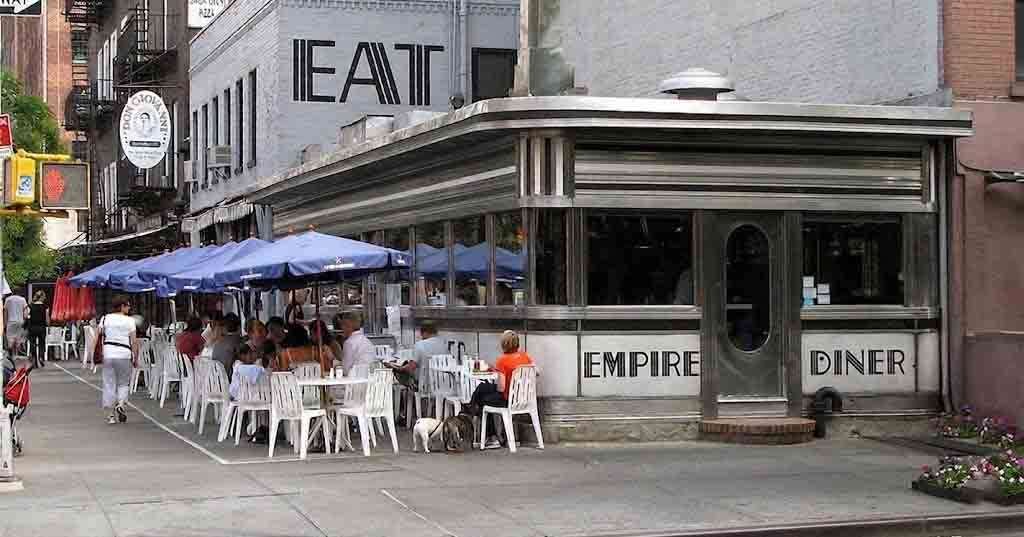
The Empire Diner at 210 Tenth Avenue has been many things since it opened on a grungy stretch of Chelsea in the mid-1970s. It started as a greasy spoon in a depressed neighborhood. It became a cultural landmark. Then it became a case study in how American real estate and taste-making conspire to push working people out of the places that were built specifically for them. The sequence is predictable. The velocity of it still catches you off guard.
I’ve been running a diner since 2000. My father ran one before that. I know what a booth looks like when a neighborhood hasn’t decided what it wants to be yet — when the guy nursing coffee at the counter is a plumber, and the guy next to him might be a poet who’s also broke, and neither of them is performing anything. They’re just eating. That’s the diner in its natural state. Once the performing starts, something has already been lost.
The Renovation That Changed the Rules
When Jack Doenias, Carl Laanes, and Richard Ruskay took over the Empire in 1976, they weren’t rescuing a diner so much as they were inventing a new category. The neighborhood was rough. Tenth Avenue was machine shops, gas stations, and auto parts stores. The diner had been sitting nearly abandoned, its windows changed over the years, its monitor roof hidden under whatever the previous owners had thought was an improvement.
The three new partners stripped it back toward its bones, put black glass where Formica had been, painted “EAT” on the wall behind the building in letters big enough to read from the highway, and mounted a miniature stainless-steel silhouette of the Empire State Building on a corner of the roof. They also did something that had almost no precedent in American diner culture: they brought in a piano. Live music. Candlelight. A menu with prices that pushed against what anyone expected to pay in a place with a counter and a spinning pie case.
Author Richard J. S. Gutman, who has spent decades cataloguing American diner history, wrote that the Empire “pioneered the concept of the diner being something other than just a diner. With candlelight, live piano music, and an untraditional menu somewhat on the pricey side, this was a new tangent for diners.” Randy Garbin, founder of Roadside Magazine, called it a case of taking “a run-down diner in a depressed neighborhood and introduced haute cuisine. The irony struck chords in both the New York art and restaurant scenes.”
The irony struck chords. That’s exactly right. The irony was the product. The working-class shell with the elevated interior — that gap between the aesthetic of scarcity and the reality of disposable income — was the whole concept. It worked because it was genuinely new. The question nobody asked at the time was what happens when the irony wears off and only the prices remain.
The Exact Year the Menu Stopped Speaking Blue-Collar
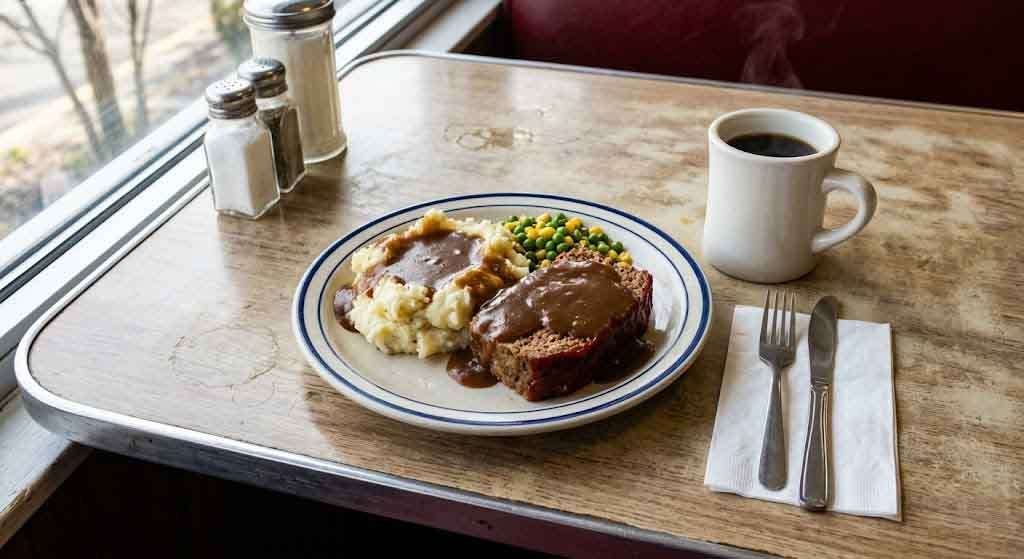
The Empire’s original menu — meatloaf, mashed potatoes, linguini with meatballs, chicken with gravy — spoke the language of every diner in the tristate area. Filling, honest, cheap enough to order twice if you were hungry and your week had gone badly. The place ran 24 hours. Cabbies came in after the midnight shift. Cops from the precinct down the block. People off the Meat Packing District floor, which at that point still smelled like what it was named for.
What Doenias, Laanes, and Ruskay understood — and what made them money — was that Chelsea was about to change. The art galleries were coming. The hotels would follow. By the 1990s, the neighborhood had completed its transition from industrial to aspirational, and the Empire was positioned right at the center of that transformation. The New Yorker noted in 1998 that the diner had become the apex hangout of the decade’s art world: “Every art scene gets the hangout it deserves. In the ’50s, there was the Cedar Tavern… And in the ’90s? The new spot is the Empire Diner, a glitz-free, gemutlich place tucked among the warehouses of West Chelsea.”
Glitz-free. That’s what they called it. But the clientele by then included Meryl Streep, Madonna, Ethan Hawke, and Minnie Driver. The meatloaf was still on the menu. But it was sitting next to dishes nobody’s grandfather ordered after a twelve-hour shift. The transition was gradual enough to feel organic. It wasn’t. It was architectural.
The moment the piano went in, the cabbie became a curiosity. Once you’re a curiosity in a place you used to belong to without thinking about it, you’re already gone. You just haven’t accepted it yet.
What the Kitchen Line Reveals
Strip away the branding and the celebrity sightings and you’re looking at a kitchen that was always too small to be what it was trying to become. The Empire’s physical structure — a genuine diner car, railcar proportions, a galley line barely wide enough for two people to pass without apology — was built for volume cooking. Eggs. Toast. Short-order. The kind of muscle memory that runs faster than thought.
Candlelight slows that down. Wine service slows that down. A menu that includes charred octopus Greek salad and matzo-ball-and-marrow soup — as the 2014 Amanda Freitag revival would feature — doesn’t come off a line built for that kind of production. It requires a different kind of labor, a different speed, a different cost structure. Every time the Empire’s kitchen tried to speak fine dining through diner infrastructure, the gap between what the building could do and what the concept demanded got wider.
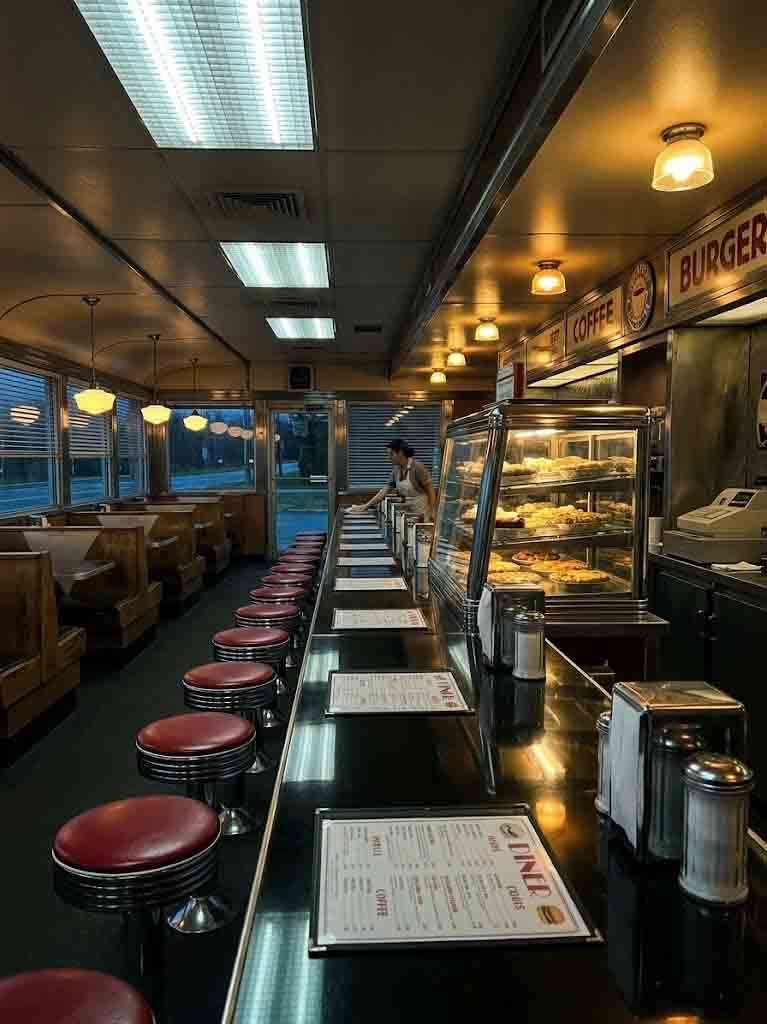
Freitag, who took over in January 2014 after a short-lived interim called The Highliner failed in the same space, understood this tension. She said her goal was paying dues to “both the original and the hash houses of her native New Jersey.” She brought back the diner aesthetic in the décor — tiled floors, a soda fountain, a healthy dose of chrome — but the menu moved: pork chops with pancetta and cranberry beans. A kale Caesar as a signature dish.
A kale Caesar. In a chrome diner on Tenth Avenue.
The line between homage and erasure is drawn right there.
The Business of Belonging
The Empire closed for the first time in May 2010. The landlords wouldn’t renew the lease. By then it had become, in the words of its own outgoing management, “the latest hangout for artists, starving and otherwise.” The general manager posted a farewell statement listing the clientele that had passed through its doors over three decades — Chelsea residents, actors, police commissioners, athletes, gangsters, Barbra Streisand, Steven Spielberg. The list itself tells the story. Police commissioners and gangsters eating at the same counter is a diner. Steven Spielberg and Barbra Streisand is something else.
The Highliner lasted less than a year. Then Freitag’s version ran from 2014 to December 2015, when the ownership fell four months behind on rent and got evicted. Freitag herself had already left by then. “The rents are unmanageable,” she said of the neighborhood. A Chelsea restaurant veteran saying Chelsea rents are unmanageable should settle every argument about what happened to the Empire and what happened to the neighborhood that hosted it.
The current iteration opened in 2017 and is still operating. “Classic American fare with refined quality ingredients take on traditional diner favorites” — that’s the actual language from their current website. Every word of that sentence is doing work. Classic signals nostalgia. Refined signals expense. Take on signals that what you remember is being reinterpreted rather than repeated. You’re not getting the meatloaf your father ate. You’re getting the idea of it, plated more carefully, costing more than he made in an hour.
A Village Voice critic, writing near the end of the diner’s original run, captured it without ceremony: “The building itself is deservedly beloved, but the restaurant’s surly service and way overpriced, completely unremarkable grub mean that the only thing we’ll miss is the upright piano.” The piano that started the whole transformation. What a thing to miss.
What Gets Swapped Out and What Remains
The physical structure of the Empire Diner is a New York City landmark. The exterior can’t be changed. The stainless steel is frozen. The proportions of the car, the dimensions of the counter, the neon above the door — all protected. What isn’t protected is everything that gave the place its original reason to exist: the working-class neighborhood, the price point, the people who ate there without thinking about eating there.
Chelsea in 2026 is gallery openings and the High Line and hotel bars and a Whole Foods. The machine shops are gone. The gas stations are gone. The auto parts stores are gone. The Meat Packing District now hosts fashion houses and nightclubs that cost more to get into than the Empire’s original meatloaf dinners cost to eat. The neighborhood that made the diner necessary doesn’t exist anymore. The building does.
That’s the trap gentrification sets for the institutions that survive it. You preserve the shell and hollow out the function. You keep the chrome and replace the cabbie with the art dealer. The diner persists as an image of itself — a photo opportunity, a clever backdrop, a piece of “authenticity” that the neighborhood now sells as a premium feature to people who arrived after everything authentic had already left.
I think about this every time someone tells me that the Formica aesthetic is back in style, that diner culture is having a moment, that the retro look is trending in restaurant design. It’s always the look. Never the price. Never the guy at the counter at 2 AM who has nowhere else to be and four dollars in his pocket and doesn’t need to perform any version of himself to sit there. That guy doesn’t get to trend. He just gets displaced.
The Empire Diner still operates at 210 Tenth Avenue. The exterior is landmarked and beautiful. The burgers are good, reportedly. The kale Caesar is probably excellent. The booth where Bruce Springsteen used to sit — he proposed to Patti Scialfa on a bench across the street — is still there, roughly where it was. The piano is gone. That detail is not nothing. The thing that changed the diner’s class position in 1976 didn’t survive the thing it created. Even the upward tarnish eventually tarnishes.
You Might Also Like:
The Flour Beneath the Bread: What Goes Into a Proper Sourdough Loaf | Rum Row and the Freeport Bootleggers: Long Island’s Clandestine War on the Water | Deserve’s Got Nothing to Do with It: Why Unforgiven Is the Greatest American Western Ever Made
Sources
- Empire Diner — Wikipedia: https://en.wikipedia.org/wiki/Empire_Diner
- Empire Diner official site: https://empire-diner.com/about/
- DNAinfo, “Chelsea’s ‘Empire Diner’ Forced To Close Again Amid Rent Struggles,” December 2015: dnainfo.com
- Time Out New York, “Empire Diner Resurrects in Chelsea,” January 2014: timeout.com
- Untapped New York: untappedcities.com
- Forgotten New York: forgotten-ny.com